This blockchain creates a ‘green intersection’ between Web2 and a sustainable Web3

cointelegraphPublicado a 2025-12-09Actualizado a 2025-12-09

Resumen

Electroneum is an eco-friendly blockchain that addresses the high energy consumption and operational costs associated with traditional proof-of-work (PoW) systems like Bitcoin. Using a unique Proof of Responsibility (PoR) consensus mechanism with 32 trusted validators, it drastically reduces energy use. Fully compatible with the Ethereum Virtual Machine (EVM), Electroneum processes transactions in under 5 seconds at a cost as low as $0.0001 per transaction. It supports Web2-to-Web3 migration, as seen with platforms like AnyTask.com, which has over a million users. Partnerships with organizations like the One Ocean Foundation and Zypto demonstrate its real-world utility in green initiatives and financial inclusion. With nearly 1 million active addresses and over 300,000 daily transactions, Electroneum positions itself as a scalable, sustainable blockchain solution.

Sponsored Content

Eco-friendly project Electroneum provides a blockchain with ultra-low energy use and costs.

High electricity bills and a hefty carbon footprint have become defining challenges for many blockchains.

Bitcoin alone is estimated to consume between 150 TWh and 210 TWh of electricity annually. Its energy consumption is on par with that of many nations, such as South Africa, Thailand and the UAE, while doubling the consumption of Finland, Belgium and Austria. Moreover, Bitcoin’s electricity consumption increases by around 25% each year, stressing that its energy needs are an ever-growing concern.
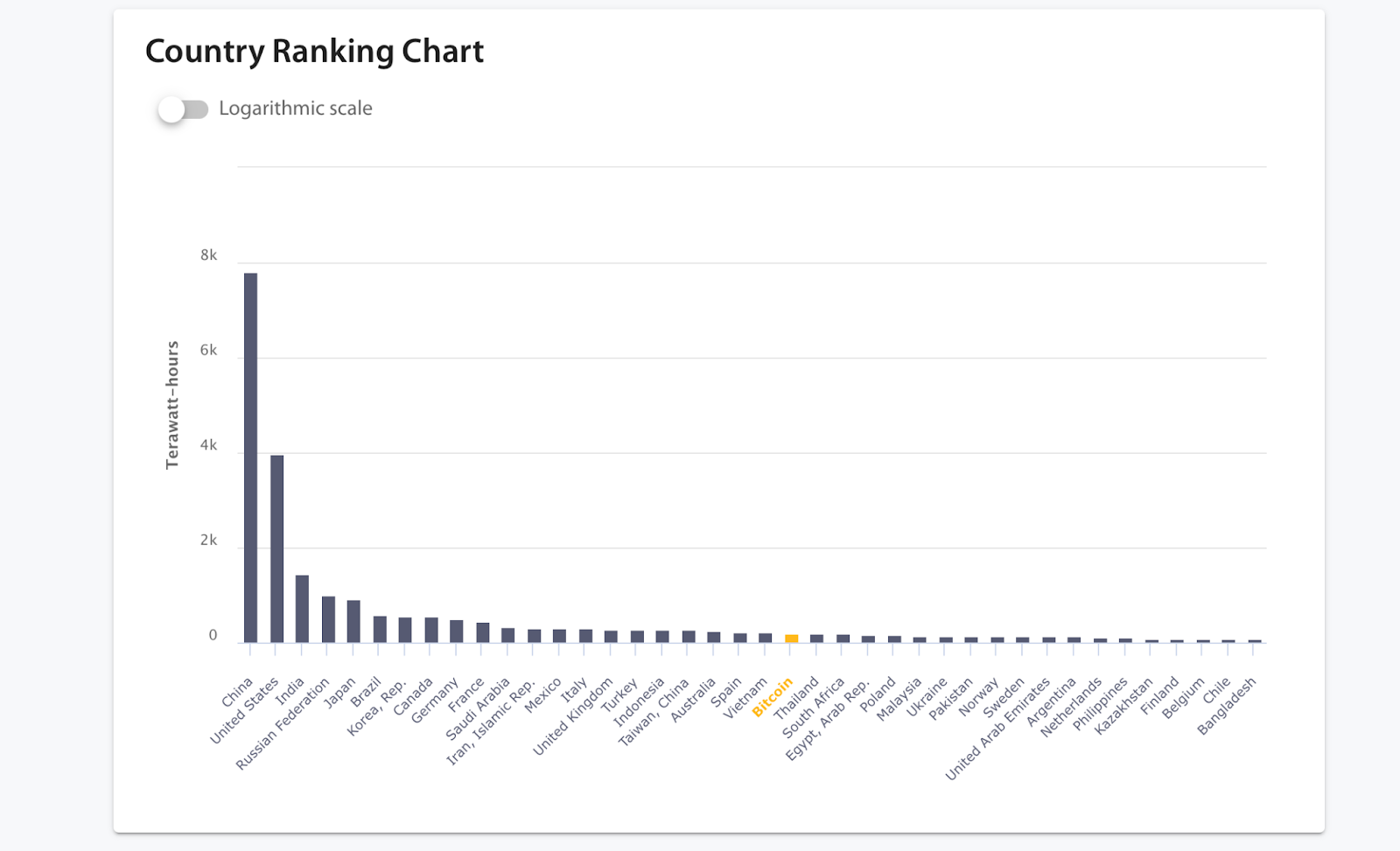
Bitcoin’s annual energy consumption compared to that of nations. Source: Cambridge Centre for Alternative Finance

The power-hungry design of proof-of-work (PoW) — Bitcoin’s consensus mechanism — also has serious financial side effects. High energy usage drives up operational costs and creates a barrier for smaller participants while also raising concerns among investors and corporate users striving to meet sustainability targets.

Proof-of-stake (PoS) chains like Ethereum have eased some of these concerns by replacing energy-intensive mining with staking, slashing power requirements and operational costs. Yet, scalability remains a major challenge that hinders global adoption of PoS networks. As transaction demand grows, PoS networks face congestion from time to time, leading to slower confirmations and higher fees.

Electroneum 2.0, a layer-1 blockchain with ultra-low energy consumption, provides a solution to ease these worries. It employs a unique consensus mechanism, called Proof of Responsibility (PoR), to cut energy consumption drastically. Designed to improve the shortcomings of traditional consensus systems, PoR introduces a set of trusted validators — currently standing at 32 — instead of miners and stakers to run the network.

Electroneum is also fully compatible with Ethereum Virtual Machine (EVM). Transactions finalize within 5 seconds, with a cost as low as $0.0001 worth of ETN per transaction. This results in a blockchain environment where developer accessibility meets sustainability, empowering Web2 companies and developers to migrate to Web3 without sacrificing performance for environmental responsibility.

A Web2 project adopting this blockchain solution is AnyTask.com. The project brings together freelancers and service seekers on a digital platform. With the integration with Electroneum, sellers receive payments in ETN on AnyTask.com. The platform has already crossed the 1 million user mark.

Green and Web3 — Win for the world

Electroneum’s partnership with One Ocean Foundation demonstrates the blockchain’s capability to contribute to green causes. Dedicated to marine conservation, the Foundation integrated Electroneum to bring verifiability to donations and tokenize green practices. The partnership was nominated for Areté Award, an excellence award for responsible tech innovation.

Beyond being a green solution, Electroneum appeals to projects with its high scalability as well. Zypto, an all-in-one crypto platform, recently joined forces with Electroneum. The collaboration will allow ETN holders to spend their crypto using a Visa or Mastercard payment card issued by Zypto. The move will also expand ETN’s utility and support its mission of financial inclusion.

Intersection between Web2 world to Web3 vision

The blockchain’s accelerated adoption is evident in statistics. Electroneum is en route to hit 1 million active onchain addresses, with daily transaction count already exceeding 300,000. Since its launch in 2024, nearly 2,000 smart contracts have been deployed on the network.

Electroneum also launched a joint NFT initiative with One Ocean Foundation, Blue Forest. This Electroneum-based NFT collection is dedicated to seagrass reforestation in the Mediterranean, with all proceeds going to the cause.

As Electroneum continues to grow its ecosystem and user base, its focus remains on maintaining a balance between innovation and responsibility. The combination of ultra low-cost transactions, energy efficiency and compatibility with existing Web3 infrastructure positions it as a viable choice for organizations seeking both performance and sustainability.

With ongoing collaborations that bring blockchain technology into practical, socially conscious use cases, Electroneum demonstrates how environmental awareness and digital progress can coexist. Its trajectory suggests a future where scalable and eco-conscious blockchain solutions become standard rather than an exception.

Criptos en tendencia

Lecturas Relacionadas

CPU Makes a Comeback to the Table, A $170 Billion "Power Seizure" Drama Begins

A new era is dawning for the server CPU (Central Processing Unit), driven by the shift from AI model training to large-scale reasoning and the rise of Agentic AI. This article explores how the CPU is reclaiming a central role in the AI data center. For years, the focus has been on the GPU (Graphics Processing Unit) for AI training. However, as AI moves to the inference and Agent phase—where tasks involve complex, multi-step reasoning, tool calls, and data management—the workload balance is flipping. Studies show CPUs now handle over 70% of the workload in Agentic AI, up from 10-30% in training. This is because Agent tasks generate massive intermediate data (KV Cache) that exceeds GPU memory, forcing it to be offloaded to the CPU's larger, more scalable memory pools. This increased importance is translating into market changes. Major players are taking note: NVIDIA launched its first standalone CPU line, Vera, based on ARM architecture and optimized for Agent performance. AMD doubled its server CPU market forecast to over $1200 billion by 2030. Analyst reports project the total server CPU market could reach $1700 billion by 2030, with AI-driven demand being a primary driver. Furthermore, the classic ratio of CPUs to GPUs in AI servers is rapidly changing, converging from 1:8 toward 1:1 for Agent deployments. This surge in demand has led to a rare industry-wide price increase of 10-15% for server CPUs from Intel and AMD, breaking a decade-long trend of "more performance for the same price." Demand is bifurcating into high-core-count CPUs for in-rack GPU support and moderate-core CPUs for standalone Agent task orchestration. In China, this global trend presents an opportunity for domestic CPU manufacturers like Hygon (海光信息) and Huawei Kunpeng, who are bolstered by both growing AI infrastructure needs and national policies promoting technological self-reliance ("xin chuang"). The maturity of their software ecosystems is also accelerating, evidenced by faster adaptation to new AI models. In conclusion, the narrative is shifting from a GPU-centric view to one where CPU-GPU synergy is critical. The CPU is no longer a peripheral component but a performance-defining bottleneck and a key growth driver in the AI hardware stack, opening a massive new market estimated in the hundreds of billions of dollars.

marsbitHace 2 hora(s)

CPU Makes a Comeback to the Table, A $170 Billion "Power Seizure" Drama Begins

marsbitHace 2 hora(s)

TechFlow Intelligence: AMD AI Director Publicly Criticizes Claude Code for "Becoming Dumber and Lazier", Trump Claims Full Ceasefire in Hormuz But Strait Still Has 80 Unexploded Mines

TechFlow Intelligence Report: This daily digest covers key developments in AI, crypto, hardware, and geopolitics. In AI, SK Telecom faces US export control scrutiny over its partnership with Anthropic, while a Gemini user reports being misled in a scam scenario, sparking safety debates. China's Z.AI launches the GLM-5.2 model, rivaling Claude Opus without NVIDIA chips. In crypto, Bithumb lists ReProtocol, and Upbit delists KernelDAO. On the hardware front, MIT researchers build a custom OS to study chips, ASML denies US claims its advanced lithography machines are in China, and Amazon considers selling its in-house AI chips. Apple's future A21 Pro chip may use TSMC's latest N2P process. Major tech issues include 10,000 GitHub repositories distributing malware and Apple patching a critical eavesdropping flaw in Beats earbuds. US stocks rise, led by semiconductors, with Intel surging 10.6%, while SpaceX falls 3.5%. Geopolitically, despite a US-Iran deal, the Strait of Hormuz remains risky with ~80 uncleared mines, stalling 80M barrels of oil on standby tankers. Iran postpones Switzerland talks, and Trump calls the agreement an "unconditional surrender." The report highlights a contrast: temporary geopolitical calm versus the ongoing, fundamental restructuring of tech supply chains and chip independence.

marsbitHace 2 hora(s)

TechFlow Intelligence: AMD AI Director Publicly Criticizes Claude Code for "Becoming Dumber and Lazier", Trump Claims Full Ceasefire in Hormuz But Strait Still Has 80 Unexploded Mines

marsbitHace 2 hora(s)

Trading

Spot
Futuros

Artículos destacados

Qué es XAG

El contrato perpetuo XAGUSDT es el símbolo de negociación para la plata cotizada en dólares estadounidenses, representando 1 onza troy de plata.

8 Vistas totalesPublicado en 2026.06.18Actualizado en 2026.06.18

Qué es XAG

Cómo comprar XAG

¡Bienvenido a HTX.com! Hemos hecho que comprar Silver (XAG) sea simple y conveniente. Sigue nuestra guía paso a paso para iniciar tu viaje de criptos.Paso 1: crea tu cuenta HTXUtiliza tu correo electrónico o número de teléfono para registrarte y obtener una cuenta gratuita en HTX. Experimenta un proceso de registro sin complicaciones y desbloquea todas las funciones.Obtener mi cuentaPaso 2: ve a Comprar cripto y elige tu método de pagoTarjeta de crédito/débito: usa tu Visa o Mastercard para comprar Silver (XAG) al instante.Saldo: utiliza fondos del saldo de tu cuenta HTX para tradear sin problemas.Terceros: hemos agregado métodos de pago populares como Google Pay y Apple Pay para mejorar la comodidad.P2P: tradear directamente con otros usuarios en HTX.Over-the-Counter (OTC): ofrecemos servicios personalizados y tipos de cambio competitivos para los traders.Paso 3: guarda tu Silver (XAG)Después de comprar tu Silver (XAG), guárdalo en tu cuenta HTX. Alternativamente, puedes enviarlo a otro lugar mediante transferencia blockchain o utilizarlo para tradear otras criptomonedas.Paso 4: tradear Silver (XAG)Tradear fácilmente con Silver (XAG) en HTX's mercado spot. Simplemente accede a tu cuenta, selecciona tu par de trading, ejecuta tus trades y monitorea en tiempo real. Ofrecemos una experiencia fácil de usar tanto para principiantes como para traders experimentados.

5 Vistas totalesPublicado en 2026.06.18Actualizado en 2026.06.18

Cómo comprar XAG

Cómo comprar XAU

¡Bienvenido a HTX.com! Hemos hecho que comprar Gold (XAU) sea simple y conveniente. Sigue nuestra guía paso a paso para iniciar tu viaje de criptos.Paso 1: crea tu cuenta HTXUtiliza tu correo electrónico o número de teléfono para registrarte y obtener una cuenta gratuita en HTX. Experimenta un proceso de registro sin complicaciones y desbloquea todas las funciones.Obtener mi cuentaPaso 2: ve a Comprar cripto y elige tu método de pagoTarjeta de crédito/débito: usa tu Visa o Mastercard para comprar Gold (XAU) al instante.Saldo: utiliza fondos del saldo de tu cuenta HTX para tradear sin problemas.Terceros: hemos agregado métodos de pago populares como Google Pay y Apple Pay para mejorar la comodidad.P2P: tradear directamente con otros usuarios en HTX.Over-the-Counter (OTC): ofrecemos servicios personalizados y tipos de cambio competitivos para los traders.Paso 3: guarda tu Gold (XAU)Después de comprar tu Gold (XAU), guárdalo en tu cuenta HTX. Alternativamente, puedes enviarlo a otro lugar mediante transferencia blockchain o utilizarlo para tradear otras criptomonedas.Paso 4: tradear Gold (XAU)Tradear fácilmente con Gold (XAU) en HTX's mercado spot. Simplemente accede a tu cuenta, selecciona tu par de trading, ejecuta tus trades y monitorea en tiempo real. Ofrecemos una experiencia fácil de usar tanto para principiantes como para traders experimentados.

3 Vistas totalesPublicado en 2026.06.18Actualizado en 2026.06.18

Cómo comprar XAU

Discusiones

Bienvenido a la comunidad de HTX. Aquí puedes mantenerte informado sobre los últimos desarrollos de la plataforma y acceder a análisis profesionales del mercado. A continuación se presentan las opiniones de los usuarios sobre el precio de A (A).

活动图片