From Monday to Friday mornings, focusing on macro trends, US stocks, AI, precious metals, and crude oil, reviewing the market with data and seizing opportunities with trends. Produced by PANews.
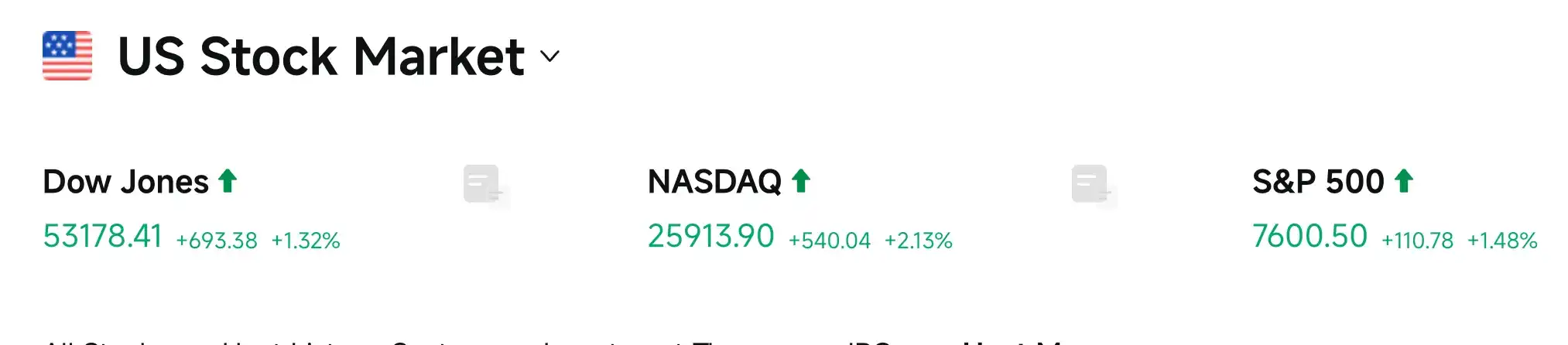
On the first trading day of August, Wall Street got off to a strong start. As US President Trump signaled progress in US-Iran negotiations, the market renewed bets that the Strait of Hormuz might reopen, causing crude oil risk premiums to fall rapidly, while US stocks and bonds rallied in tandem.
All three major US stock indexes closed higher, with the Dow Jones Industrial Average rising 1.32% to close at a record high; the Nasdaq Composite surged 2.13%; and the S&P 500 gained 1.48%, approaching its all-time high.
Iran Denies Talks with US, Trump Blasts Oil Giants Demanding Lower Prices
Trump claimed on Monday that US-Iran negotiations had begun, with the first phase being the opening of the Strait of Hormuz and the second phase focusing on denuclearization, and hinting that the strait "may reopen as soon as tomorrow."
Senior Iranian officials immediately refuted this, denying any direct talks with the US, stating Iran was only discussing safe passage arrangements for the Strait of Hormuz with Oman, and warning they would not allow the US to establish non-Iranian routes. Despite the conflicting statements, influenced by negotiation expectations, WTI crude plummeted 7.42% yesterday, with Brent crude also plunging about 6%.
Simultaneously, Trump pressured US oil companies, naming ExxonMobil and Chevron, demanding they "lower consumer gas prices now." Data shows ExxonMobil and Chevron's combined second-quarter profits reached a staggering $29 billion, equivalent to daily profits of about $318 million, a more than threefold increase year-over-year. Trump expressed strong dissatisfaction, accusing oil companies of profiteering from supply shortages.
The energy sector was the only one among the S&P 500's 11 sectors to close lower, as investors began reducing the energy risk premium previously built up due to Middle East conflicts.
Precious Metals Consolidate with Strength, US Bond Yields Fall, Yen Intervention Becomes Market Focus
Gold held above the key $4,000 level, closing slightly higher. The Bank of Korea plans to purchase domestically refined gold bars for the first time in 13 years and already bought a small amount of gold ETFs in the second quarter. Official buying provides support for the medium-term allocation thesis for gold. The Bank of Korea stated that geopolitical risks have heightened the necessity to diversify foreign exchange reserves. As of July, its gold holdings remained at 104.4 tons, with foreign exchange reserves at $427.36 billion at the end of June.
In the interest rate market, influenced by falling oil prices, the 10-year US Treasury yield fell about 5 basis points to around 4.68%, while the 2-year yield settled around 4.246%, with long-end performance outpacing the short-end. ING rates strategist Michiel Tukker bluntly stated that oil prices remain the biggest uncertainty, which will largely determine whether rates rise or fall this week. B. Riley Wealth chief market strategist Art Hogan summarized the core desk trading logic: "Wake up every day and look at two indicators—international oil prices and the 10-year US Treasury yield. If both are down, the market usually stays stable."
The US Dollar Index fell initially then stabilized, briefly breaking below 100. The dollar did not weaken significantly, partly due to strong US manufacturing data dampening bets on rapid easing. Although the US July ISM Manufacturing Index jumped to 55.6, the highest since May 2022, market expectations for a September Fed rate hike remained at 66.5%.
Additionally, yen exchange rate volatility drew attention, with estimates suggesting the Bank of Japan used about $87 billion (approximately ¥11 trillion) in intervention between July 30 and 31. Market concerns that Japan selling US Treasuries to fund interventions would push yields higher were soothed by US Treasury Secretary Bessent, who stated that liquidity mechanisms provided by the Fed allow countries to exchange US Treasuries as collateral for dollars, eliminating the need for direct bond sales, which eased short-term pressure on the US Treasury market.
The 'Magnificent Seven' Launch Counteroffensive, Amazon Joins the $3 Trillion Club
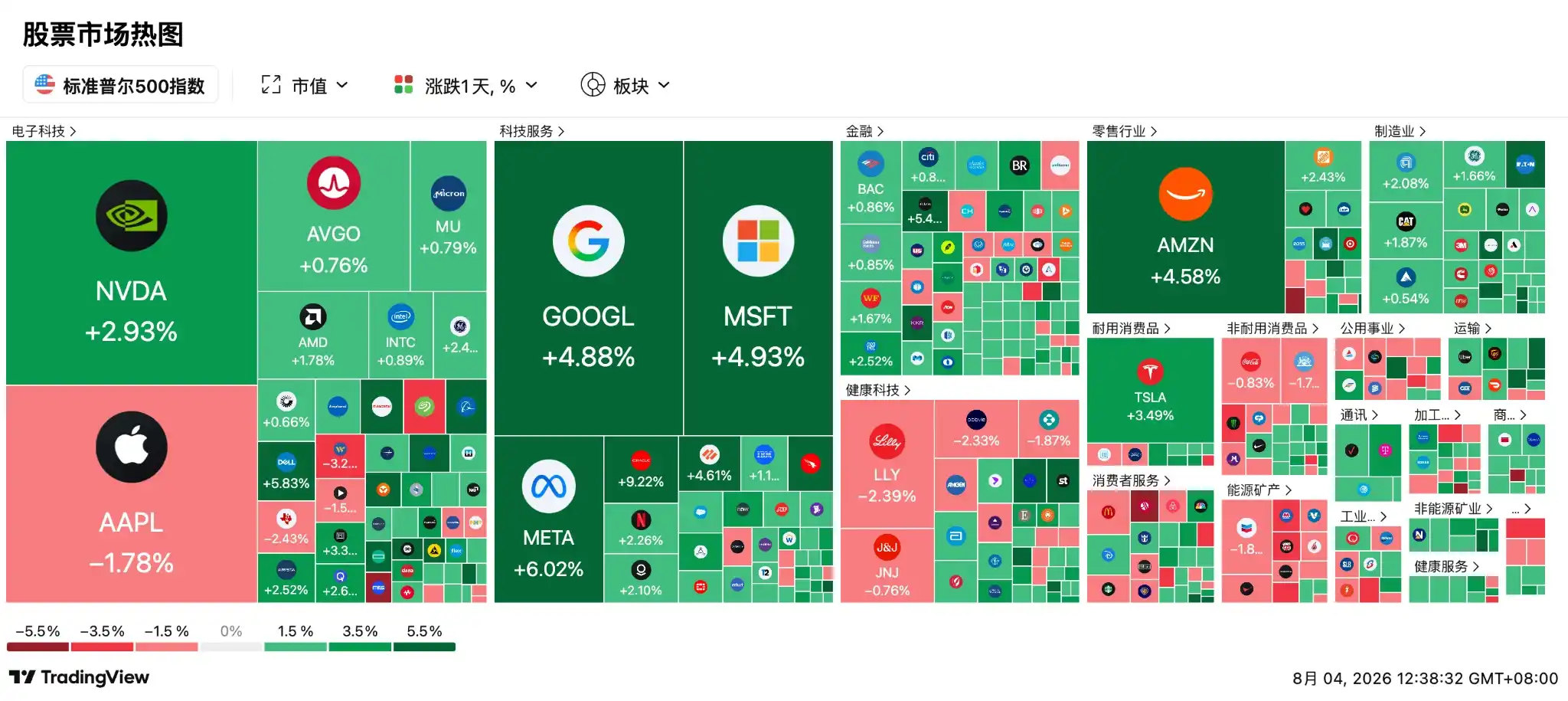
US stocks staged a strong rebound last night, with the AI and cloud computing narrative fully returning. The Magnificent Seven index surged 3.6%, marking its best single-day performance since March 31. Among them, Amazon's stock rose over 4%, its market cap surpassing $3 trillion for the first time; Nvidia gained nearly 3%, its total market value returning above $5 trillion; Meta jumped over 6%; Microsoft and Google each rose nearly 5%.
Fund flows indicated a shift from defense to offense, with cloud service providers like CoreWeave, Oracle, and AI software stocks like Palantir and Snowflake rallying collectively. A latest Morgan Stanley report noted that the AI sector pullback was primarily technically driven, with the high ROI of enterprise AI deployment and sustained growth in computing demand underpinning the long-term logic of the AI infrastructure cycle. Additionally, optical communications, quantum computing, and space-related stocks were also active.
Specific Company Actions and Stock Price Movements:
-
Amazon closed up 4.58%: Driven by better-than-expected Q2 AWS cloud performance, Amazon's total market cap historically broke through the $3 trillion mark. Wall Street is extremely optimistic about its raised full-year 2026 capital expenditure guidance, believing the trend of AI computing power supply shortage will persist. Chairman Bezos also seized the moment to announce a $4.1 billion stock sale plan. Related cloud computing stocks soared across the board: CoreWeave skyrocketed 19%, NEBIUS surged over 11%, and Oracle followed with a gain of over 9%.
-
Meta rose over 6%, leading the Magnificent Seven: Although high AI infrastructure investment pressures short-term profits, the market is more bullish on its long-term strategic positioning. Zuckerberg reiterated the 2026 capital expenditure upper limit could reach as high as $145 billion, indicating Meta will continue to ramp up AI infrastructure investment.
-
Google rose nearly 5%, its total market cap surpassing Apple to become the world's second-largest: Its off-balance-sheet guarantee scale surged sixfold in nine months to $43.8 billion, using "financial backing" to secure TPU orders and accelerate data center expansion.
-
Microsoft closed up 4.93%, gaining about 25% over the past three trading sessions: Following its earnings report, institutions continued to raise Microsoft's target price. UBS raised its target from $480 to $525, and CMBI raised from $616 to $634, both maintaining "Buy" ratings. The consensus average target price is around $565.
-
Nvidia followed the AI infrastructure trade recovery, rising nearly 3%, with its market value returning to $5 trillion: Goldman Sachs chief strategist Ben Snider stated investors need not over-worry about recent AI and momentum asset volatility, viewing the current pullback more as concentration squeeze and consolidation. Strong corporate earnings remain the core engine supporting the bull market. Goldman named Alphabet, Amazon, Microsoft, Nvidia, and Broadcom as key profit contributors.
-
SpaceX closed up 5.68%, rallying late in the session ahead of earnings: SpaceX will report its first quarterly earnings since going public after the market closes on August 4th. The stock had traded below its $135 IPO price for multiple weeks since its mid-June debut, falling over 50% from intraday highs and erasing more than $500 billion in market cap. Musk responded to an X platform user, agreeing the current period would later be seen as a "fantastic buying opportunity." This remark clearly ignited retail sentiment, with funds betting on a reversal ahead of earnings. Related space stocks rose in unison: Rocket Lab and Boeing (with 737 Max 7 receiving FAA airworthiness certification) rose over 8%, AST SpaceMobile gained nearly 8%, and Viasat rose nearly 6%.
-
Palantir surged over 14% after hours, with Q2 results and full-year guidance exceeding expectations. Full-year revenue guidance was raised to $8.15 - $8.16 billion, far exceeding original expectations. US commercial revenue soared 149% year-over-year, further validating the AI adoption narrative. AI application software stocks continued strong: Reddit rose nearly 10%, Snowflake gained nearly 5%, ServiceNow, Applovin, and Datadog all rose over 2%.
-
Snap rose over 7% after hours: Although boosted by World Cup ad revenue leading to better-than-expected Q2 revenue, the CEO emphasized AR glasses represent the biggest long-term opportunity, a narrative that received enthusiastic market response.
-
The optical communications sector was also ignited by AI data center demand: Applied Optoelectronics rose nearly 17%, AXT Inc gained nearly 14%, Lumentum and Coherent rose over 9%, Corning gained over 6%, and Credo rose over 5%.
-
Quantum computing concept stocks broadly rose: D-Wave Quantum surged over 10%, Rigetti Computing rose over 7%, IonQ gained nearly 7%, IBM and Honeywell rose over 1%.
-
Memory/storage sector rebounded: Micron Technology, which initially fell nearly 6% intraday, rebounded to close higher. SanDisk rose 6.03%, driven by NAND market recovery and data center demand expectations. Seagate fell 2.93%, but BNP Paribas raised its target price from $1050 to $1275, maintaining "Outperform," citing that massive data generated by AI applications is driving nearline HDD demand, and the company's increased long-term agreement commitments for 2028-2029 help stabilize future revenue and prices.
-
Crypto-related stocks mostly rose, with SoFi Technologies up over 10%, IREN up over 8%, Hut 8 and Robinhood up over 4%, Strategy up nearly 2%. Morgan Stanley believes valuations for related names like TeraWulf, Cipher Mining, HUT 8, Riot Platforms, Applied Digital, and Galaxy Digital are currently at low levels, leaving room for re-rating. Additionally, GameStop fell over 12% (the company announced a $1.4 billion private exchange of convertible notes), Circle fell nearly 4%.
What to Watch Next:
August 4th (Tuesday)
-
August 4-6: Ai4 2026 and FMS Flash Memory Summit Open: North American AI industry summit and global flash memory summit open concurrently. Industry giants like Nvidia, Google, Microsoft, Meta, Samsung will attend. AI pioneers Hinton, Fei-Fei Li, and Andrew Ng appear together for the first time. Samsung is expected to announce its HBM4E roadmap.
-
Key Earnings: Hut 8, Cipher Mining, Caterpillar, Pfizer, Merck, Spotify, HSBC Holdings, Techtronic Industries, etc.
August 5th (Wednesday)
-
04:30 (ET?) SpaceX's First Earnings Report Since IPO: The market focuses on Starlink revenue, Starship commercialization progress, free cash flow, and capital expenditure pace. With a large lock-up expiration for SpaceX two days later, if the earnings report fails to deliver a strong growth narrative, the stock could face both liquidity and valuation pressure. Strong Starlink revenue and commercial launch guidance could help alleviate pre-expiration selling pressure.
-
05:00 (ET?) AMD, Astera Labs, Arista Networks Earnings: AMD's report is a key test for the AI chip second tier. The market watches MI series AI chip shipments, data center revenue, gross margins, and H2 guidance. Astera Labs is a key player in AI server interconnect and data center connectivity chips. Arista is a bellwether for AI network switches and cloud data center capital expenditure.
-
White House Plans Meeting with AI Companies to Review AI Regulatory Framework: OpenAI, Google, Anthropic, Meta, etc., will participate. If the framework leans towards voluntary safety testing and moderate regulation, valuation discounts for leading AI companies may shrink. If review mechanisms tighten, smaller model and application-layer companies may face higher compliance costs.