The V5 That Never Came: Uniswap Stuck in an Innovation Dilemma

marsbitPublicado a 2026-04-11Actualizado a 2026-04-11

Resumen

ChainCatcher author Gu Yu analyzes Uniswap's perceived slowdown in innovation. Despite its history of rapid iteration—from V1 in 2018 to V4 in 2023—the protocol has not announced a new version since. V4 introduced Hooks, a programmable plugin system allowing custom functions like dynamic fees and MEV protection, but its mainnet launch was delayed to January 2025 due to security audits. V4’s TVL peaked at $1.2 billion but has since fallen to $650 million, only 40% of V3’s TVL. Uniswap expanded to new blockchains and API partnerships but faced challenges with newer initiatives: its appchain, Unichain, saw TVL drop from $900 million to $36 million, and its token auction product (CCA) entered a crowded market. High-profile departures and a 74% drop in UNI token price over the past year reflect operational and growth struggles. A proposal to enable fee mechanisms and burn tokens briefly boosted UNI’s price, but Uniswap’s annualized revenue remains behind competitors like PancakeSwap and Aave. The article concludes that Uniswap’s situation mirrors broader DeFi stagnation but notes its strong security record and leading position in decentralized trading. The future of V5 and its role in driving the next DeFi wave remain uncertain.

Author: Gu Yu, ChainCatcher

In the crypto industry, the pace of innovation is often a key measure of a protocol's vitality. However, Uniswap, which once single-handedly kicked off the DeFi Summer, seems to be slowing down.

Looking back at Uniswap's evolution, its iteration rhythm has always been known for its fast pace: V1, featuring the AMM mechanism, was born in 2018; V2 introduced ERC-20/ERC-20 pairs in 2020; V3 launched concentrated liquidity in 2021; and V4 proposed programmable Hooks in 2023. On average, every 1.5 years, Uniswap would introduce a highly innovative mechanism, reshaping the flow paths of tens of billions of dollars.

However, as of April 2026, nearly three years have passed since the announcement of the V4 proposal, and the market has yet to see any updates on Uniswap's next version.

Currently, Uniswap's product developments still revolve around Uniswap V4, which aims to transform Uniswap from a fixed-function AMM into a highly programmable liquidity platform. The core innovation of this version is Hooks, which are modular, programmable plugins that allow developers to insert custom logic throughout a pool's lifecycle, enabling almost limitless functions such as dynamic fees, limit orders, TWAMM (Time-Weighted Automated Market Maker), MEV protection, loss hedging, custom oracles, continuous clearing auctions (CCA), and more.

In other words, whereas developers previously had to fork Uniswap to implement certain specific functions, leading to the fragmentation of Uniswap's liquidity across many forked DEXs, now developers only need to write a Hook contract to significantly enhance the customizability of Uniswap's liquidity pools.

Although Uniswap announced the specific concept of the V4 version in June 2023, due to security concerns, the version underwent 9 independent audits and a large-scale security competition, delaying its mainnet launch from the initial Q3 2024 to the end of January 2025.

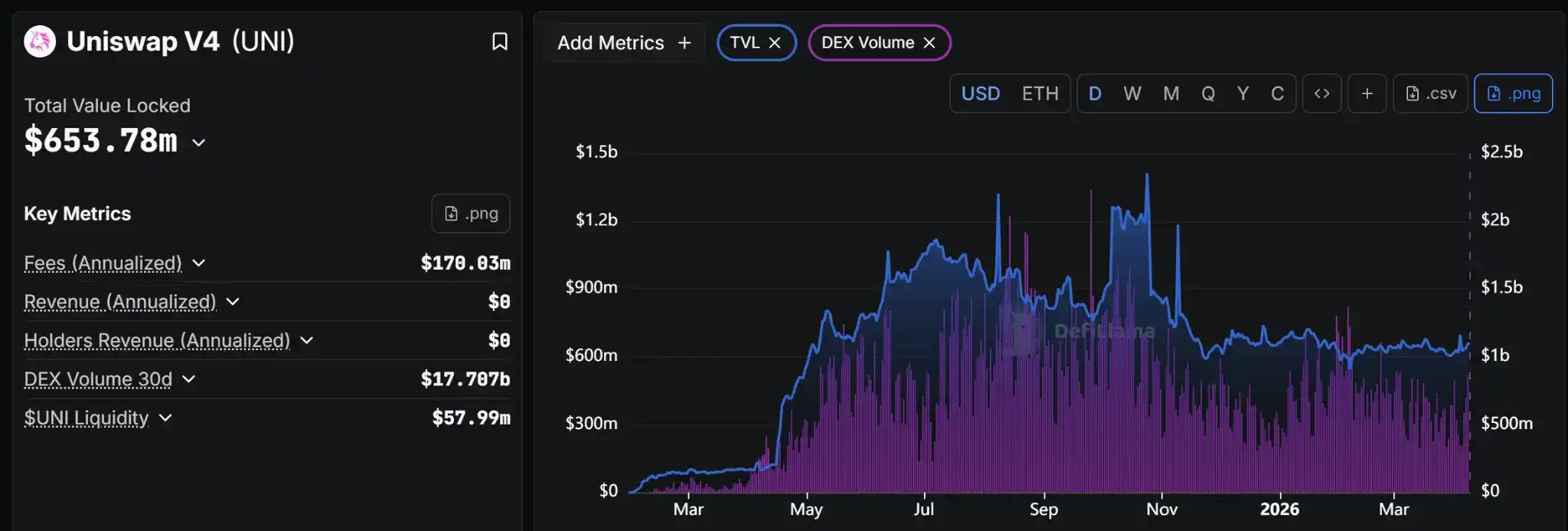
After its launch, the total value locked (TVL) in Uniswap V4 peaked at over $1.2 billion but has since fallen to $650 million, which is still only 40% of the V3 version and also lags behind the V2 version.
Meanwhile, Uniswap has also been "following the rules" in accelerating its expansion in use cases and markets. Over the past six months, Uniswap has launched on blockchains such as Linea, Tempo, X Layer, and Monad to seize market opportunities on emerging chains. On the other hand, Uniswap has been全力 expanding its API partnerships, with recent announcements including adopters like Anchorage Digital, Ledger, Privy, and MetaMask.

Of course, Uniswap has not been without new moves at the product level in recent years. For example, the appchain Unichain and the CCA token auction product have both generated significant market反响.

In February 2025, Uniswap's appchain, Unichain, officially launched on the mainnet, attracting over 90 DeFi protocol integrations. Its TVL peaked at $900 million but has since fallen to $36 million.

At the end of 2025, Uniswap announced the launch of its Continuous Clearing Auction (CCA) function, specifically designed for price discovery and liquidity bootstrapping of new assets, and subsequently partnered with Aztec and Rainbow to complete token sales.

However, it must be pointed out that by 2025, both appchains and token auctions were very "stale" business models in the crypto space. Many projects with stagnant core businesses were exploring "chain issuance" and Launchpad services. Uniswap also "followed suit" and joined this trend, but the practical impact has been very limited.

In earlier years, Uniswap also explored areas like NFT marketplaces and on-chain games through heavy acquisitions of products like Genie and Crypto: The Game. Subsequent data reflected that these were two failed acquisitions.

In the past year, the departures of key personnel such as Growth Lead Sarina Siddhanti, COO Mary Catherine Lader, Head of Strategy & Operations Zach Wong, Chief Legal Officer Katherine Minarik, and Venture Lead Julia Rosenberg also reflect Uniswap's efforts to control operational costs and its struggles with growth.

Uniswap's overall decline is also reflected in the price of its governance token, UNI. Over the past year, the price of UNI fell by over 74% at its worst, dropping below $2 at its lowest point, significantly exceeding the overall decline of mainstream cryptocurrencies. This has sparked criticism from market analysts who call the UNI token "completely worthless."

In September 2025, Arca Chief Investment Officer Jeff Dorman responded to a tweet by Uniswap founder Hayden Adams about the protocol's performance data on X, saying: "We are not bearish on Uniswap, but we are bearish on UNI. In today's market and evolving regulatory environment, it is just a completely meaningless token. Your stance and that of your venture capitalists don't matter. Either switch to a model that distributes revenue or conducts buybacks, or just don't have a token."

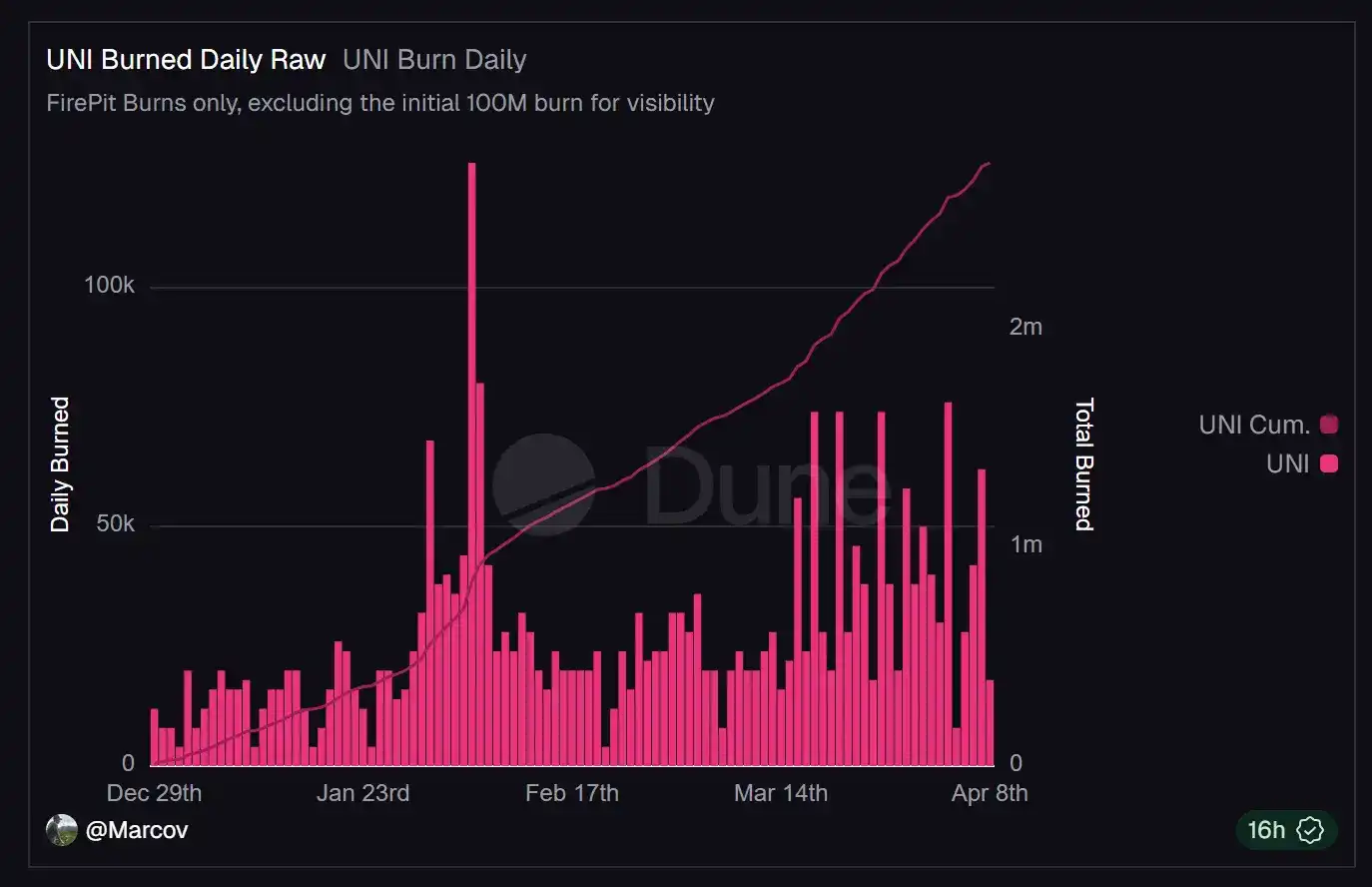
In response to market doubts and to赋予 UNI more value, the Uniswap Foundation proposed in November last year to activate the protocol fee switch for Uniswap V2 and V3 and use the fees to buy back and burn UNI, while also burning 100 million UNI from the treasury. Subsequently, UNI's price surged nearly 38% in a short time, reaching over $9 at its peak.

According to DeFillama data, Uniswap's recent daily fee income ranges between $100,000 and $200,000, with nearly $3.93 million in revenue over the past 30 days. The annualized revenue is approximately $46 million, still lagging behind other DeFi protocols like PancakeSwap, Jupiter, Lido, and Aave.
Uniswap's awkward situation is actually a projection and reflection of the bleak现状 of the DeFi industry: a lack of underlying innovation, exhausted industry narratives, and liquidity being consumed in fragmentation and存量博弈.

However, Uniswap remains one of the very few top DeFi protocols that has not suffered a hack, with no protocol-level fund theft incidents ever occurring. It is also the decentralized exchange protocol with the highest total value locked, and its industry status and user trust remain intact.

But, will there be a Uniswap V5? If so, when will it arrive? Can Uniswap continue to be the engine of the next DeFi Summer?




Preguntas relacionadas

QWhat is the core innovation of Uniswap V4 and how does it aim to transform the protocol?

AThe core innovation of Uniswap V4 is Hooks, which are modular, programmable plugins that allow developers to insert custom logic throughout a pool's lifecycle. This transforms Uniswap from a fixed-function AMM into a highly programmable liquidity platform, enabling features like dynamic fees, limit orders, TWAMM, MEV protection, and more without requiring a protocol fork.

QAccording to the article, what are the main factors contributing to Uniswap's perceived slowdown in innovation?

AThe main factors include the nearly three-year gap since the V4 announcement with no news of a V5, the delayed mainnet launch of V4 due to extensive security audits, the relatively low TVL adoption of V4 compared to older versions, and the pursuit of 'older' business models like appchains and token auctions instead of groundbreaking new mechanisms.

QHow has the performance of Uniswap's governance token, UNI, reflected the protocol's recent challenges?

AThe UNI token price fell by over 74% in a year, dropping below $2, which was a steeper decline than the overall market for major cryptocurrencies. This performance sparked criticism that the token lacked real value, leading to a proposal to activate fee switches for revenue generation and a token burn to try and increase its value.

QWhat two major initiatives did Uniswap launch in 2025, and how successful were they?

AIn 2025, Uniswap launched the Unichain appchain, which initially attracted over 90 DeFi integrations but saw its TVL plummet from a high of $900 million to $36 million. It also launched a Continuous Clearing Auction (CCA) feature for token launches, partnering with projects like Aztec and Rainbow.

QDespite its current challenges, what key strengths does the article acknowledge that Uniswap still possesses?

AThe article acknowledges that Uniswap remains one of the few major DeFi protocols to have never suffered a hack, has the highest Total Value Locked (TVL) among decentralized exchanges, and maintains its industry status and user trust.

Lecturas Relacionadas

This Week's Key Events Preview | U.S. to Release April CPI Data; U.S. Senate Banking Committee to Review "Digital Asset Market Structure Act of 2025"

Weekly News Preview: Key events for May 12-16 include major economic and crypto industry developments. On Tuesday, May 12, the U.S. will release its April CPI data. Additionally, the gaming blockchain Ronin will begin a 10-hour migration to an Ethereum Layer 2, built on OP Stack with EigenDA for data availability. This aims to leverage Ethereum's security and settle RON's annual inflation below 1%. Base's first independent network upgrade, "Base Azul," is scheduled for mainnet activation on Wednesday, May 13, focusing on security, performance, and developer experience enhancements. Thursday, May 14, sees the U.S. Senate Banking Committee voting on the "Digital Asset Market Structure Act of 2025." In other news, Solana DeFi protocol Carrot will shut down, setting a final withdrawal deadline due to impacts from the Drift exploit. The Moscow Exchange will launch futures trading for Solana, Ripple, and Tron indices (RUB-settled) for qualified investors. Multiple service closures are scheduled for Friday, May 15. Dmail Network will begin winding down due to unsustainable infrastructure costs and failed commercialization. Users must export data before this date. Separately, the Cosmos-based lending blockchain UX Chain will fully shut down. Finally, on Saturday, May 16, gaming infrastructure provider Lattice will wind down operations, with its Redstone Layer 2 network ceasing. Users are urged to withdraw assets, especially from contracts like Uniswap pools, before the shutdown.

链捕手Hace 56 min(s)

This Week's Key Events Preview | U.S. to Release April CPI Data; U.S. Senate Banking Committee to Review "Digital Asset Market Structure Act of 2025"

链捕手Hace 56 min(s)

Morning Post | Trump Media Group Releases Q1 Financial Report; Top Three DeFi Applications Return Nearly $100 Million in Revenue to Token Holders in 30 Days; Michael Saylor Shares Bitcoin Tracker Info Again

**Title: Daily Briefing | Trump Media Group Releases Q1 Report; Top 3 DeFi Apps Return Nearly $100M to Token Holders; Michael Saylor Signals Potential Bitcoin Buy** **Summary:** Key developments in the past 24 hours include: * **Economic Outlook:** Goldman Sachs has pushed back its forecast for the next two Federal Reserve interest rate cuts to December 2026 and March 2027, citing persistent inflationary pressures from energy costs. This delayed timeline is expected to tighten liquidity flow into risk assets, including cryptocurrencies. * **DeFi & Revenue:** Data from DefiLlama shows that three leading DeFi applications—Hyperliquid, Pump.fun, and EdgeX—collectively distributed $96.3 million in revenue to their token holders over the last 30 days. This trend highlights a shift in the crypto community's focus towards real protocol earnings and sustainable economic models. * **Corporate Bitcoin Moves:** Michael Saylor, founder of MicroStrategy (note: referred to as 'Strategy' in the text, likely a typographical error), has signaled potential upcoming Bitcoin purchases by posting a "Bitcoin Tracker" update, following a pattern that typically precedes the company's official disclosure of new acquisitions. * **Market Integrity:** Prediction market platform Polymarket announced updates to address platform issues, including identifying and banning clusters of accounts involved in "ghost-fill" activities and implementing measures to prevent bulk account creation. * **Regulation:** The Bank of England Governor warned that stablecoin regulation could lead to tensions between US and international regulators. In South Korea, the National Tax Service has launched a pilot program to entrust seized virtual assets to private custody firms for management. * **Meme Token Trends:** GMGN data lists the top trending meme tokens on Ethereum (e.g., HEX, SHIB), Solana (e.g., FWOG, TROLL), and Base (e.g., SKITTEN, PEPE) over the past day. **Financial Note:** Trump Media & Technology Group reported a Q1 loss of approximately $4 billion, primarily attributed to unrealized losses on its Bitcoin and other digital asset holdings.

链捕手Hace 1 hora(s)

Morning Post | Trump Media Group Releases Q1 Financial Report; Top Three DeFi Applications Return Nearly $100 Million in Revenue to Token Holders in 30 Days; Michael Saylor Shares Bitcoin Tracker Info Again

链捕手Hace 1 hora(s)

Telegram Takes Direct Control of TON, Social Traffic Rewrites the Public Chain Narrative

Telegram founder Pavel Durov announced that Telegram will replace the TON Foundation as the core driver and largest validator of The Open Network (TON). Key initiatives include a sixfold reduction in transaction fees, performance upgrades, and improved developer tools within the next few weeks. This marks a strategic shift from Telegram merely providing user access to deeply integrating TON into its platform's core infrastructure. The goal is to transform Telegram's massive social traffic into sustainable on-chain activity. While viral mini-apps like Notcoin have demonstrated Telegram's ability to drive user adoption, TON aims to support frequent, low-value transactions inherent to social platforms—such as tipping, in-app payments, and game rewards. Ultra-low fees and sub-second finality (0.6 seconds) are crucial to making blockchain interactions seamless and nearly invisible within the Telegram user experience. However, Telegram's increased central role raises questions about network decentralization. Durov argues that Telegram's participation will attract more large validators, thereby enhancing decentralization. TON also offers high annual staking rewards (18.8%), aiming to retain capital within its ecosystem. The fundamental challenge for TON is no longer leveraging Telegram's user base, but becoming an indispensable, seamless infrastructure layer for Telegram's everyday applications—moving from an adjacent chain to an embedded utility.

marsbitHace 1 hora(s)

Telegram Takes Direct Control of TON, Social Traffic Rewrites the Public Chain Narrative

marsbitHace 1 hora(s)

Trading

Spot
Futuros
活动图片


