Telegram Takes Direct Control of TON, Social Traffic Rewrites the Public Chain Narrative

marsbitPublicado a 2026-05-11Actualizado a 2026-05-11

Resumen

Telegram founder Pavel Durov announced that Telegram will replace the TON Foundation as the core driver and largest validator of The Open Network (TON). Key initiatives include a sixfold reduction in transaction fees, performance upgrades, and improved developer tools within the next few weeks. This marks a strategic shift from Telegram merely providing user access to deeply integrating TON into its platform's core infrastructure. The goal is to transform Telegram's massive social traffic into sustainable on-chain activity. While viral mini-apps like Notcoin have demonstrated Telegram's ability to drive user adoption, TON aims to support frequent, low-value transactions inherent to social platforms—such as tipping, in-app payments, and game rewards. Ultra-low fees and sub-second finality (0.6 seconds) are crucial to making blockchain interactions seamless and nearly invisible within the Telegram user experience. However, Telegram's increased central role raises questions about network decentralization. Durov argues that Telegram's participation will attract more large validators, thereby enhancing decentralization. TON also offers high annual staking rewards (18.8%), aiming to retain capital within its ecosystem. The fundamental challenge for TON is no longer leveraging Telegram's user base, but becoming an indispensable, seamless infrastructure layer for Telegram's everyday applications—moving from an adjacent chain to an embedded utility.

Author | Asher(@Asher_ 0210)
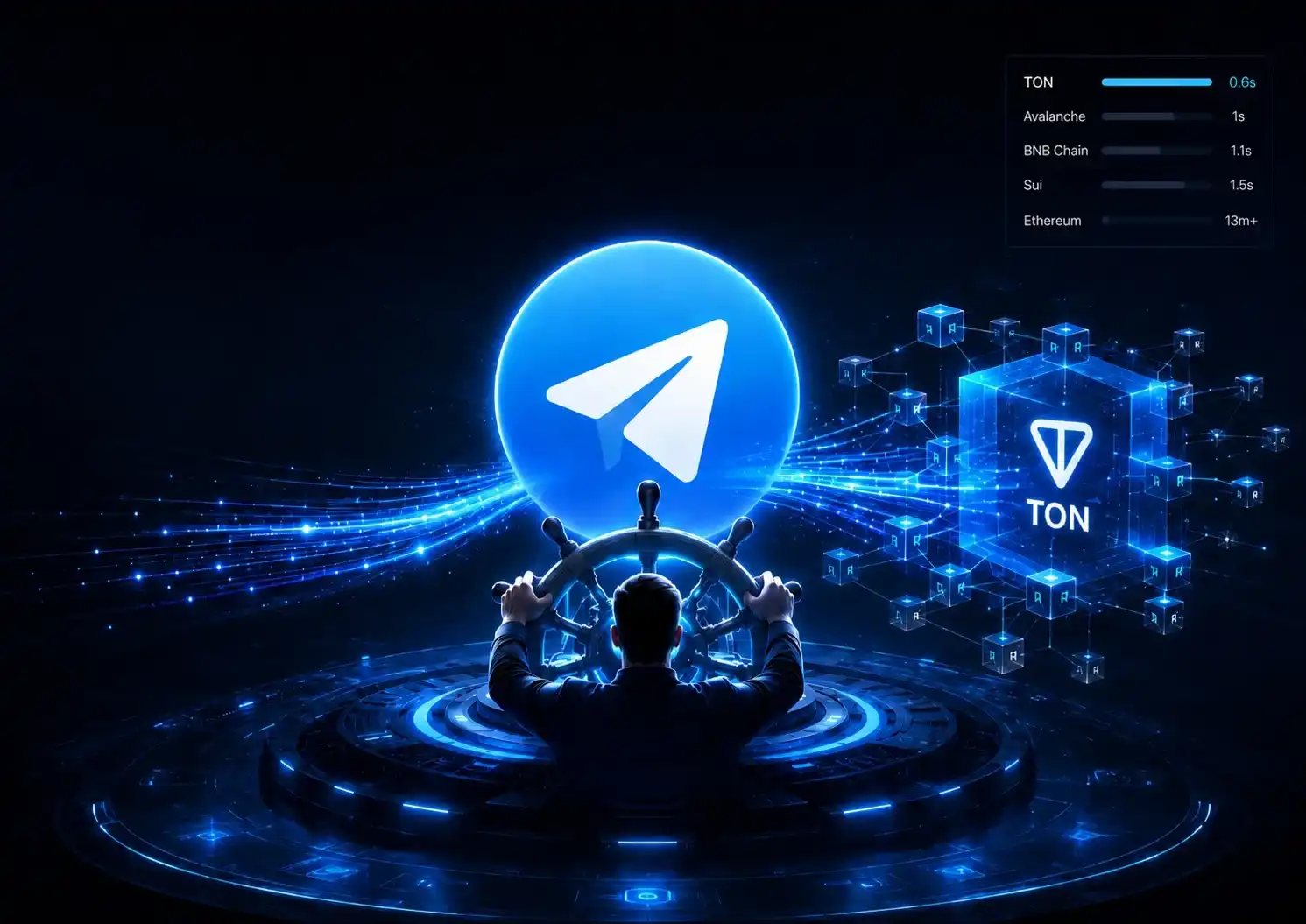
On May 4th, Telegram founder Pavel Durov announced on platform X that TON network transaction fees have been reduced by 6 times, nearing zero. More crucially, he stated that Telegram will replace the TON Foundation, becoming the new core driving force of the TON network and its largest validator. TON's focus will now shift to technological advantages, including a new ton.org, new developer tools, and performance upgrades, with a timeframe of the next 2 to 3 weeks.
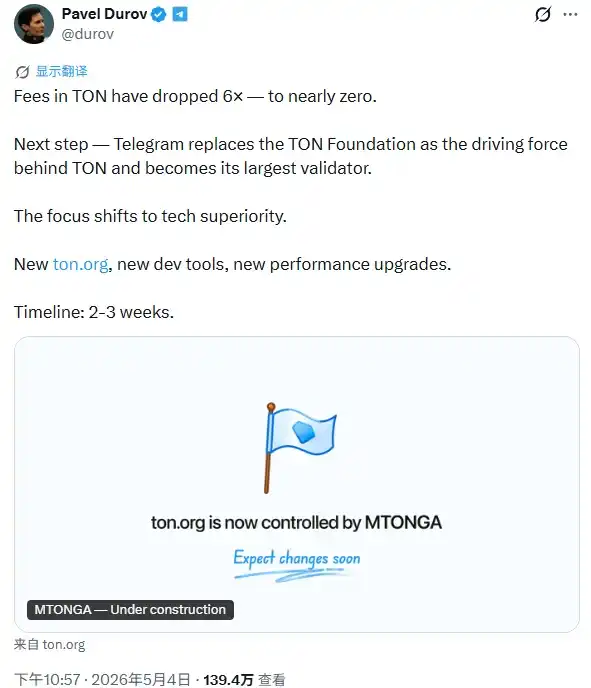
Telegram Founder: TON Fees Reduced by 6x, Telegram to Become Largest Validator

In the past, the relationship between TON and Telegram was more like a strong binding with weak leadership. Telegram provided the gateway, while the Foundation and community were responsible for advancement, with a layer of distance always between them. But this time, Telegram isn't just continuing to bring users to TON; it's beginning to enter more foundational positions such as validator, technical roadmap, and development tools. TON is no longer just a chain adjacent to the Telegram ecosystem but is being reintegrated into Telegram's product system.

TON Doesn't Lack a Gateway; It Lacks Turning the Gateway into Use Cases

Past market discussions about TON often revolved around Telegram's user scale. But for a public chain, having a gateway doesn't equal having an ecosystem, and having user reach doesn't equal having long-term usage. TON's unique aspect is its inherent attachment to a high-frequency social platform, where Mini Apps, wallets, channels, bots, games, and payments already exist within Telegram. This allows TON to avoid having to find users from scratch like most Layer1s. However, if these scenarios cannot solidify into sustained on-chain interactions, Telegram's traffic can only bring waves of short-term hype.

Projects like Notcoin and Dogs have proven that Telegram can quickly generate viral spreads. Simple gameplay combined with social relationship chains can indeed attract a large number of users into crypto applications in a short time. But such explosions come and go quickly. TG mini-games and airdrops can bring attention but can hardly alone sustain a long-term ecosystem.

Therefore, the fee reduction, speed increase, developer tools, and validator role emphasized by Pavel Durov this time point not to a single technological upgrade, but to TON addressing its most critical missing link—transforming Telegram's gateway into sustainable use cases. Only when fees are low enough, confirmation speeds are fast enough, and developer integration is simple enough can scenarios like channel tipping, Mini Apps tasks, game rewards, creator revenue, ad revenue sharing, bot calls, and group micropayments potentially evolve from product features into on-chain activities.

TON no longer needs to repeat the story of "backed by Telegram." What it truly needs to prove is whether the high-frequency behaviors within Telegram can be effectively borne by TON.

Fee Reduction and Speed Increase Aim to Enable Smaller, Higher-Frequency Transactions

The fee reduction by TON this time shouldn't be understood merely as cost optimization typical of public chains. Viewed within the context of Telegram, it actually solves the problem of whether small-amount, high-frequency interactions can become viable.

Most potential on-chain behaviors within Telegram are not large transfers but more fragmented daily operations. Individual transaction amounts are low, but occurrence frequency is high. If users have to perceive fees, wait for confirmations, and repeatedly handle wallet interactions with every button click, these scenarios can hardly truly take off.

Therefore, fee reduction and speed increase must be considered together. Fees approaching zero lower the usage barrier; reducing finality time to 0.6 seconds lowers the perception of waiting. For Telegram, the chain shouldn't become an extra layer perceived by users but should be hidden as much as possible behind product actions like sending messages, clicking buttons, and viewing balance changes.
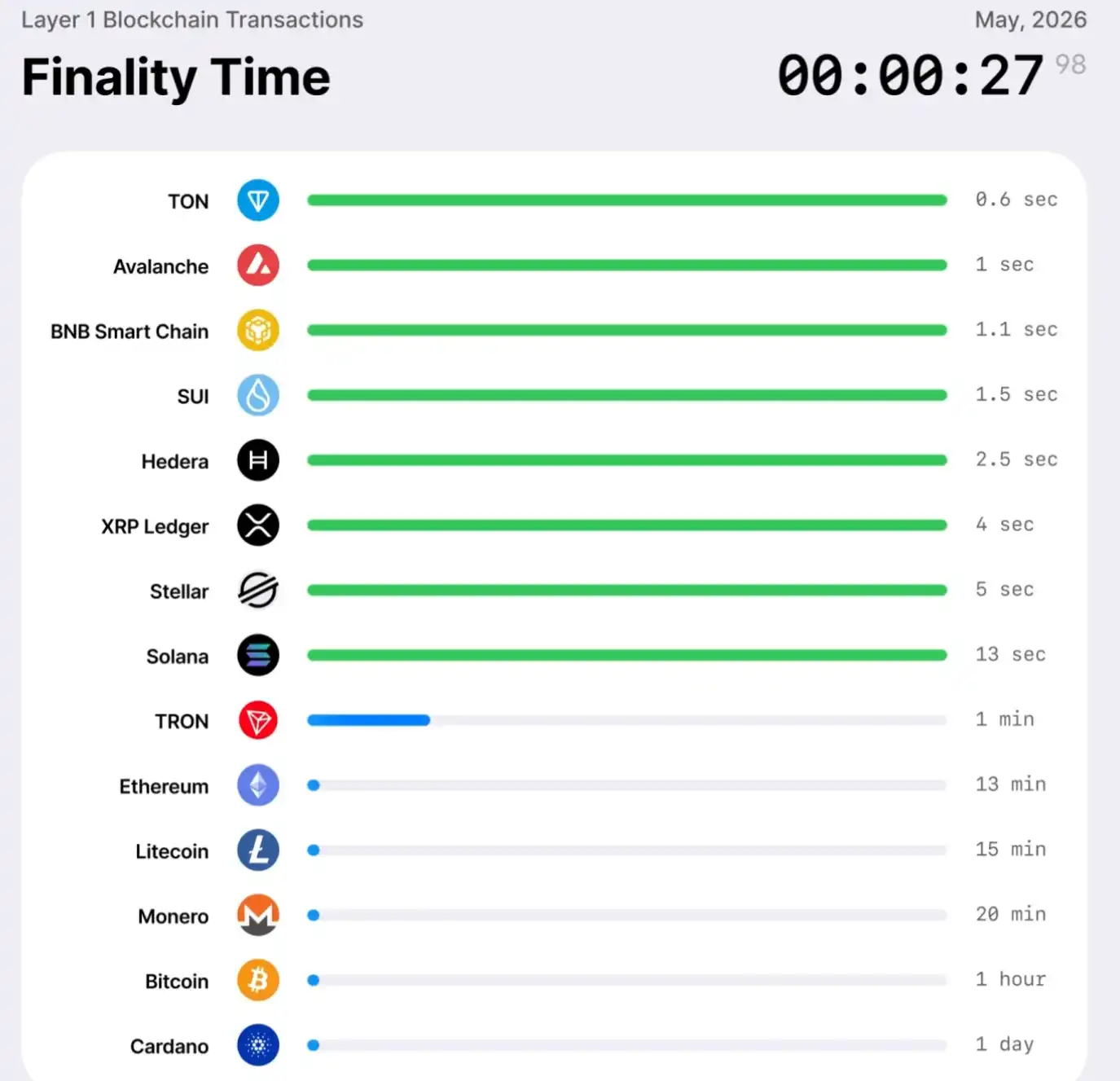
Comparison of "Finality Time" Among Mainstream Public Chains

This also distinguishes TON from many other Layer1s. Its goal isn't solely to make DeFi trades faster or transfers cheaper; it aims to embed the chain into Telegram's daily use. Only when cost, waiting time, and wallet operations are minimized enough can TON potentially evolve from a Telegram-related public chain into the underlying network directly invoked by Telegram's application layer.

From Gateway to Validator, Telegram Begins Penetrating TON's Core

Telegram becoming TON's largest validator is the most significant step in this change. It means Telegram is no longer just providing TON with a gateway and brand endorsement but is entering the network's security and operational mechanisms. Previously, TON was driven by the Foundation and community, which offered greater openness but a relatively decentralized pace. Now, with Telegram directly involved, its products, wallet, Mini Apps, payments, and developer tools have the opportunity to be realigned.

Efficiency may increase, but controversy will also grow. Telegram replacing the TON Foundation as the main driving force and becoming the largest validator will inevitably lead to renewed external discussions about TON's centralization risks. In response, Pavel Durov stated that Telegram's participation would attract more large-scale participants into the validator pool, thereby enhancing decentralization. This logic is not without merit, but the final judgment will depend on results, not statements.

The truly important aspects going forward are whether the validator structure can become more diverse, whether governance information is sufficiently transparent, whether the Foundation and community retain independent space, and whether ecosystem projects can continue developing without relying on Telegram's will.

Therefore, Telegram's return is not a simple positive but a trade-off. For TON to enter the mainstream application layer, it needs Telegram's strong execution capabilities; but the more prominent Telegram's role, the more TON needs to prove it is not merely an internal settlement chain serving Telegram.

High Staking Rewards Retain More Tokens for TON

Pavel Durov subsequently emphasized that TON ranks first in annual staking rewards among the top 50 cryptocurrencies by market cap, with a high rate of 18.8%. Compared to fee reduction and speed increase, high staking rewards are more likely to mobilize capital sentiment and provide TON with another layer of holding rationale in the market's eyes.
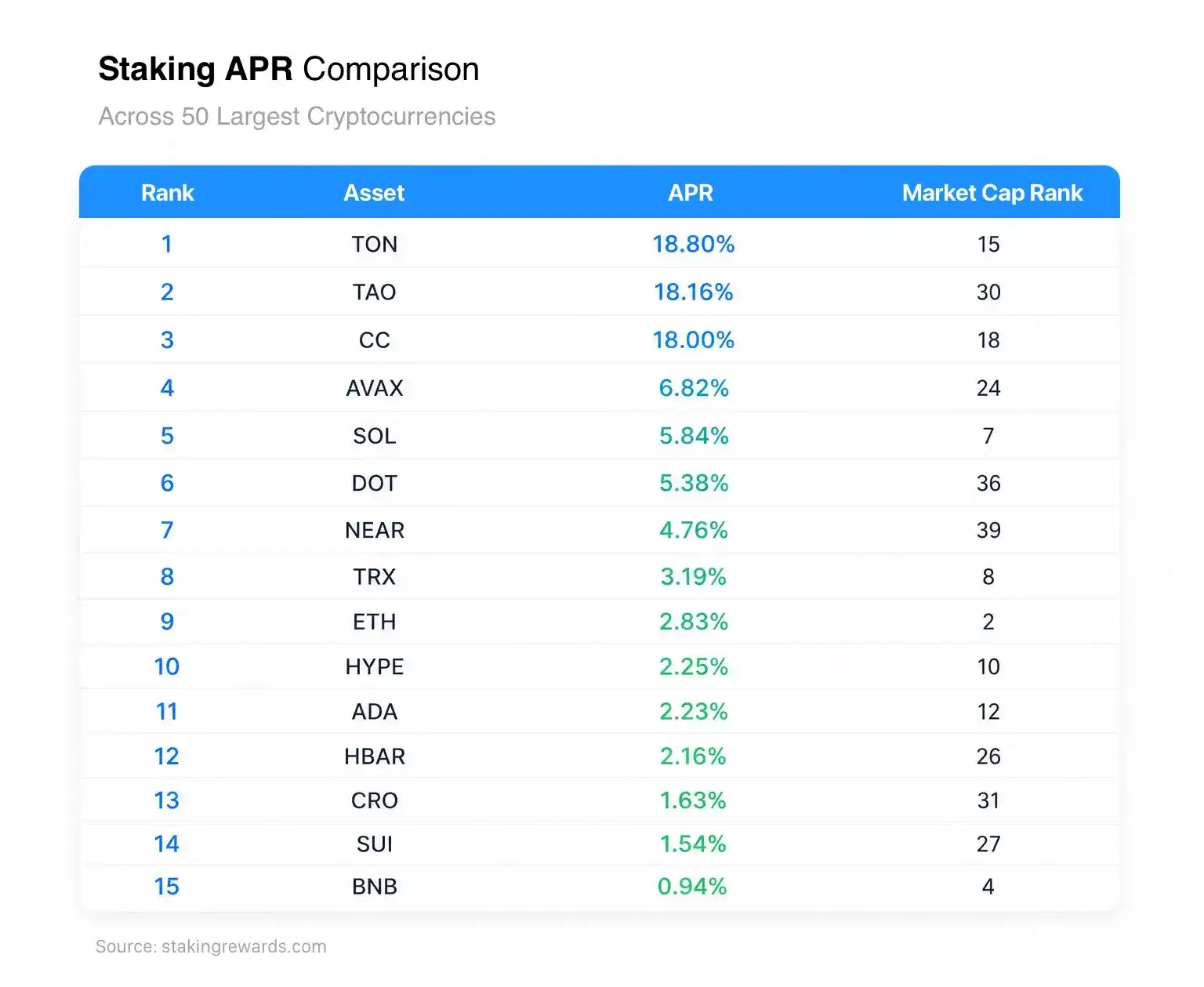
TON Annual Staking Rewards Rank First Among Top 50 Cryptocurrencies

This also makes TON's narrative somewhat more complete. It's not just relying on Telegram's user gateway to attract attention or improving experience through technical upgrades; it's also using staking rewards to keep capital within its ecosystem. The simultaneous presence of gateway, performance, validators, and rewards makes this change more substantial than a single positive factor.

Of course, high yield itself is not the end goal; it's more like buying TON a longer observation period. As long as subsequent developer tools and performance upgrades are delivered, and more capital is locked into the network, a positive feedback loop with real usage may form. For TON, the value of staking rewards isn't just about increasing holding returns but making the market willing to continue waiting for it to truly convert Telegram's gateway advantage.

TON's Return to Telegram Is Not the Finish Line, But a Tougher Challenge

The key for TON going forward is not to continue leveraging Telegram for traffic, but to truly become part of Telegram's application ecosystem. If Telegram's chat, payments, applications, creator economy, and automated interactions are gradually undertaken by TON, then TON's competitors will not just be other Layer1s, but all networks attempting to become the next-generation application infrastructure.

TON isn't just repeating the social traffic story; it's beginning to attempt to turn social traffic into on-chain order. The gateway is just the beginning; usage is the answer. Telegram can push TON to the forefront, but whether it stays there ultimately depends on whether TON can become the layer of infrastructure that operates behind user perception, within the functioning of applications.

If the past TON was still proving how close it is to Telegram, now it must prove how deeply integrated it can be within Telegram's daily use. True mainstream adoption isn't about making users aware they are using a chain, but about making the chain part of the application experience.

TON's opportunity lies here, and so does its pressure.

Preguntas relacionadas

QAccording to the article, what is the new role that Telegram will assume in the TON network, as announced by Pavel Durov?

ATelegram will become the new core driver of the TON network, replacing the TON Foundation. It will also become the network's largest validator.

QWhat is identified as the key challenge TON needs to overcome, beyond just having access to Telegram's large user base?

ATON needs to transform its access and user reach into sustainable, long-term usage scenarios. It must convert Telegram's high-frequency social interactions into persistent on-chain activities.

QWhy are the reductions in transaction fees and improvements in speed particularly important for TON within the Telegram context?

ALow fees (approaching zero) and fast finality (0.6 seconds) are crucial to enable the small, frequent, and fragmented transactions typical of Telegram's daily use cases. They lower the barrier and reduce user friction, allowing the blockchain to operate seamlessly in the background of the app experience.

QWhat potential downside or concern is raised regarding Telegram becoming the core driver and largest validator of TON?

AThe move raises concerns about increased centralization risk and questions regarding the future independence of the TON Foundation and community projects. It represents a trade-off between stronger execution from Telegram and the need for TON to maintain network decentralization.

QHow does the article frame the high annual staking reward offered by TON, and what purpose does it serve?

AThe high staking reward (18.8% annually, ranked first among top 50 cryptocurrencies) is seen as a mechanism to attract and lock in capital within the TON ecosystem. It provides an additional incentive for holding TON and buys time for the network to realize its potential in converting Telegram's user base into active usage.

Lecturas Relacionadas

In the Era of MiCA, Why is the EU CASP License Becoming Increasingly Important?

In the MiCA era, the EU's Crypto-Asset Service Provider (CASP) license is becoming increasingly crucial, especially after the transitional period ends on July 1, 2026. Post-deadline, crypto service providers operating under old national frameworks must either secure MiCA authorization or exit the EU market, rendering the previous model of using a single member state's VASP registration for pan-European operations obsolete. The CASP license fundamentally changes the regulatory landscape by shifting from a fragmented, nation-by-nation registration system to a unified "passporting" regime. Authorized in one member state, a CASP can provide its licensed services across the EU, offering greater legal clarity and operational efficiency compared to the past. MiCA defines CASP authorization based on specific service types, such as custody, trading platform operation, exchange, and transfer of crypto-assets. The scope of authorization is determined by actual business functions, not self-selection, with corresponding prudential requirements like capital adequacy. Banks and institutional clients increasingly value CASP status as it provides a verifiable, standardized framework for due diligence, accessible through ESMA's public registers. The regulation significantly limits the "reverse solicitation" exception for non-EU firms. Active marketing or outreach to EU clients generally necessitates a CASP license, moving away from reliance on offshore entities. It's important to note that a CASP license is not a universal permit; it covers crypto-asset services but does not automatically authorize traditional financial activities like payment services (governed by PSD2) or dealing in financial instruments (governed by MiFID II). A complete crypto-fiat payment solution often requires both a CASP and a licensed payment institution. Priority candidates for pursuing a CASP license include: 1) Platforms with the EU as a primary long-term market; 2) Projects seeking partnerships with EU banks or large institutions; and 3) Groups aiming to consolidate cross-border operations under one regulated entity. In contrast, early-stage projects without concrete EU plans may find the process premature. Ultimately, the growing importance of the CASP stems from the end of regulatory ambiguity in Europe. It has evolved from a consideration to a fundamental requirement for market access, client trust, and sustainable operations within the EU's now-harmonized crypto regulatory framework.

marsbitHace 3 min(s)

In the Era of MiCA, Why is the EU CASP License Becoming Increasingly Important?

marsbitHace 3 min(s)

Bernstein Research Report Analysis: Global Semiconductor Equipment WFE Grows 75% in Two Years, DRAM and Logic Chips Are the Biggest Drivers

Bernstein significantly raises its global Wafer Front-End (WFE) equipment spending forecast: $148B in 2026 (from $141B), $204B in 2027 (from $175B), and $259B in 2028 (from $198B). This represents a cumulative 75% growth over two years, confirming a strong equipment upcycle. Memory, especially DRAM, is the primary driver, with DRAM WFE expected to surge 53% in 2027 and 37% in 2028. Logic/Foundry follows, driven by advanced node investments. The forecast upgrades are broad-based, but the largest incremental contribution comes from memory spending outside China and logic/foundry expansion within China. Bernstein expects China's WFE demand to be resilient, jumping to $101B in 2028 from $573B in 2027 due to comprehensive expansion across memory, advanced logic, and mature nodes. A key factor is the DUV lithography shortage, which is expected to ease in H2 2026, allowing imports to recover. Top equipment picks include ASML (preferred in Europe) for its exposure to DRAM and advanced logic, and Applied Materials (top US pick) for its broad exposure and attractive valuation. In China, NAURA is favored due to its comprehensive product portfolio and significant advanced logic exposure. Bernstein views the recent sector pullback as an attractive entry point, arguing that market expectations for 2027/2028 demand strength remain too low and that supplier guidance is conservative.

marsbitHace 4 min(s)

Bernstein Research Report Analysis: Global Semiconductor Equipment WFE Grows 75% in Two Years, DRAM and Logic Chips Are the Biggest Drivers

marsbitHace 4 min(s)

The True Cost of Strategy Being Forced to 'Hoard' U.S. Dollars

The article analyzes MicroStrategy's (now Strategy) shift towards holding substantial US dollar reserves (currently $4.65 billion) while selling Bitcoin, contrasting this with its core identity as a Bitcoin-focused company. It argues this move is a strategic necessity specific to Strategy, driven by its unique business model of issuing "digital credit" (preferred securities) with fixed USD dividend obligations. To secure favorable credit ratings (e.g., S&P's B- rating, which penalizes Bitcoin-heavy balance sheets) and sustain this credit issuance, Strategy must demonstrate significant dollar liquidity. However, this cash hoarding imposes a heavy "invisible tax" or opportunity cost: capital allocated to low-yielding cash reserves cannot be deployed into Bitcoin, artificially raising the required return threshold on its actual Bitcoin investments to cover fixed dividend costs. The author concludes that Strategy is an extreme case, and most other Bitcoin-related companies should not blindly emulate this strategy. For them, dollar reserves should be dictated strictly by operational needs and prudent buffers, not arbitrary targets. Holding excess cash typically means forfeiting potential Bitcoin returns for uncertain benefits, making it economically unsound unless a company shares Strategy's specific credit-dependent capital structure. The decision ultimately hinges on a firm's unique business model and genuine cash flow requirements.

marsbitHace 7 min(s)

The True Cost of Strategy Being Forced to 'Hoard' U.S. Dollars

marsbitHace 7 min(s)

New Fed Correspondent: Inflation Data 'Neither Hot Nor Cold' Offers Fed Temporary Respite but Future Path Remains Uncertain

Inflation data for July came in as expected, providing the Federal Reserve with some breathing room ahead of its September meeting, though the longer-term policy path remains uncertain. The core CPI rose 0.2% month-over-month and 2.5% year-over-year, in line with forecasts, easing immediate pressure for a rate hike. Following the report, market expectations for a September rate increase fell below 50%. Despite the temporary respite, deep divisions persist within the Fed. At least six of the twelve voting members have recently signaled openness to further tightening, with three having voted for a hike in July. The debate centers on whether current rates are sufficiently restrictive to bring inflation back to the 2% target or if persistent factors like tariffs, energy prices, and surging demand from AI infrastructure necessitate more action. San Francisco Fed President Mary Daly highlighted the growing complexity, outlining two potential scenarios: a baseline where inflationary pressures fade, allowing for rates to hold steady, and an alternative where shocks persist and inflation gains self-reinforcing momentum. She suggested that if the latter materializes, the policy response might need to be more aggressive than the typical 25-basis-point increments. With Fed Chair Wash adopting a less forward-leaning public stance, markets are closely monitoring data and other officials' comments for clues. The upcoming August CPI report, due just days before the September FOMC meeting, is now seen as a critical determinant for the final decision.

marsbitHace 7 min(s)

New Fed Correspondent: Inflation Data 'Neither Hot Nor Cold' Offers Fed Temporary Respite but Future Path Remains Uncertain

marsbitHace 7 min(s)

Market Trend (Aug 13): Nasdaq Leads Gain as CPI Meets Expectations; Coherent Beats Estimates Then Falls in After-Hours

U.S. stock markets were mixed on August 13th. While the S&P 500 and Nasdaq Composite rose, the Dow Jones Industrial Average was essentially flat. The catalyst was the July CPI report, which came in line with expectations across the board, keeping market pricing for a September Federal Reserve rate hike steady near 45%. The trading day's standout was a surge in AI-related sectors following the CPI release. AI cloud service providers Nebius and CoreWeave soared, while companies in the optical communications and memory chip spaces, including Coherent and SK Hynix, also posted significant gains. However, a stark reality check emerged after the closing bell. Despite reporting quarterly results that exceeded expectations, shares of optical communications leader Coherent and AI chipmaker Cerebras plunged in after-hours trading. Cerebras was hit by an unexpected drop in hardware revenue. Similarly, Cisco Systems shares initially rose on strong earnings and news of $4 billion in AI-related orders, only to reverse sharply lower later, highlighting increased investor scrutiny on valuations and growth sustainability in the crowded AI space. In other markets, gold extended its rally, oil prices rose, and Bitcoin rebounded from pre-CPI declines. Market focus now shifts to digesting the latest corporate earnings and upcoming U.S. retail sales data.

marsbitHace 27 min(s)

Market Trend (Aug 13): Nasdaq Leads Gain as CPI Meets Expectations; Coherent Beats Estimates Then Falls in After-Hours

marsbitHace 27 min(s)

Trading

Spot
活动图片