Original author: Geo Chen (Fidenza Macro)
Original compilation: Shenchao TechFlow
Guide: Geo Chen of Fidenza Macro liquidated all his holdings in AI semiconductors and infrastructure in June this year, and now he presents his complete bearish rationale. His analytical framework spans the blow-up of Korean leveraged ETFs, the impact of Chinese models on standard closed-source AI, the inflection point where compute supply shifts from shortage to surplus, and the risk of the Federal Reserve losing credibility under stagflationary pressure—for any investor holding AI-related assets, this article is worth a thorough read.
March 2000. March 2008. January 2020. December 2022. Certain months are etched clearly in my memory; they were all turning points preceding severe market turmoil. I believe that looking back at this month in the future, we will feel the same way.
In June this year, I sold all my AI semiconductor and infrastructure holdings and moved into cash. I then took a vacation, enjoying a summer away from the markets, initially expecting a flat, sideways summer with few opportunities.
The outcome was completely unexpected.
Everything that has happened over the past month has increasingly convinced me that the equity bull market has peaked. I am typically an optimist, so I did not reach this conclusion lightly. Unfortunately, developments in the AI field, the Iran war, and Federal Reserve policy are combining to create stagflationary conditions, with more turbulence ahead. In this article, I will break down my bearish logic point by point.
Why the AI Bull Market is Over
AI was the leader of this bull market and the primary driver of GDP growth. Without AI, the bull market lacks support. Strong earnings from hyperscaler cloud providers and semiconductor companies fueled this rally, so one might argue: as long as earnings grow and fundamentals are solid, the bull market can continue. But the reality is that stock prices reflect capital flows and market narratives; earnings are just one of many drivers. Most bull markets peak before earnings decline, and often even before analysts begin to downgrade expectations.
Many bull markets have an overshooting phase: low-quality capital pushes the market to new highs, often in a parabolic shape. So-called low-quality capital refers to groups with information asymmetry, price insensitivity, and unsustainable buying power. The overshooting phase is usually only clear in hindsight, but if you can identify that low-quality buyers are driving the final leg of the advance, there is an opportunity to spot the overshoot in real-time. This is precisely the framework I used when exiting the crypto market in August 2025—at that time, I judged that MicroStrategy and crypto treasury firms were providing exit liquidity for the cycle top.
In this AI rally, the low-quality capital was primarily Korean retail investors, who massively bought 2x or 3x leveraged ETFs on SK Hynix, the KOSPI index, and other memory plays. This capital spread outward, inflating valuations for companies across the entire AI supply chain that benefited from supply bottlenecks. These leveraged ETFs created hundreds of billions of dollars in additional buying power, but this power is fundamentally unsustainable. The hedging needs of the products forced market makers to accumulate substantial negative gamma exposure, compelling them to buy on up days and sell heavily on down days, with the resulting severe volatility triggering liquidations and margin calls.
Citibank estimates that the follow-on effects from the sell-off in leveraged products have erased $38.7 billion so far, and data circulating online shows 1.2 million accounts were liquidated—equivalent to 1 in every 30 Korean adults being wiped out. The extreme speculation by Korean retail surpasses anything I have seen in any other bull market. A kind of financial nihilism led many Korean retail investors to go all-in, using leverage to amplify their positions, simply reasoning that they felt they were too late and had to catch up:
Recently, a post appeared on the workplace community Blind, telling the story of someone who suffered heavy losses in a margin call. The poster wrote: "SK Hynix and Samsung Electronics kept rising, but I felt I entered too late and was panicking." He added: "After hours, I went all in with my entire assets of 170 million won plus 200 million won of unsettled margin, a total of 370 million won, but the next day the Korean stock market crashed, and I suffered heavy losses."
— from Korea Business
And after all this pain, the crowding in momentum stocks remains at elevated levels.
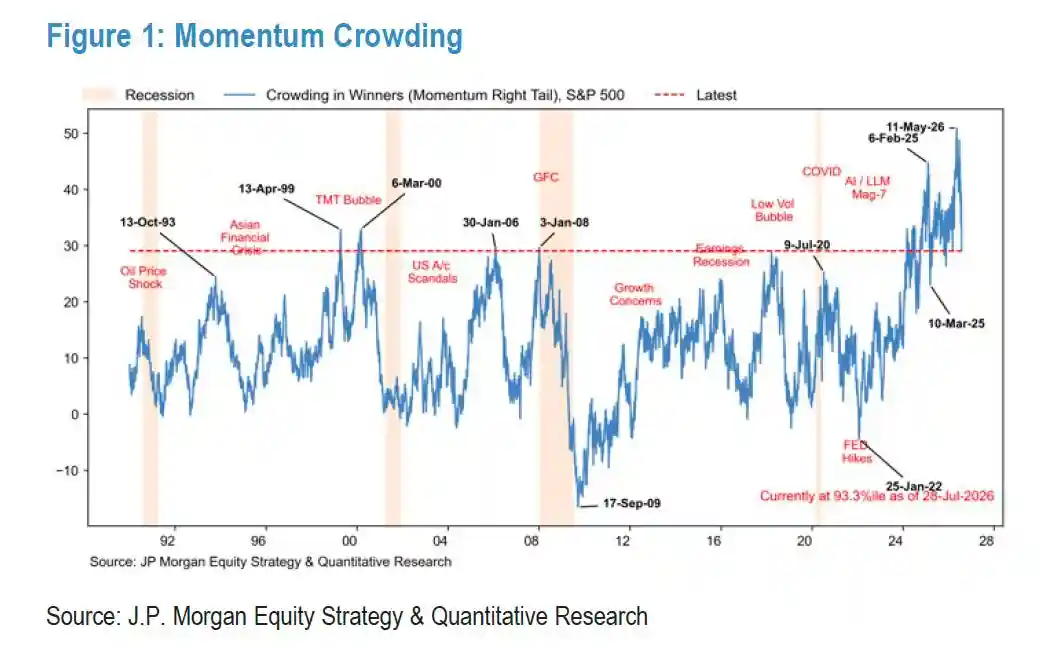
Chart: S&P 500 Momentum Leaders Crowding (J.P. Morgan, currently at 93.3% high, near peak from before July 2026). Source: J.P. Morgan
Parabolic bull markets almost always end with a protracted bear market. The more extreme the sentiment, price, and leverage during the rise, the worse the hangover afterwards. Once margin is called, that capital is damaged and rarely returns. For a bull market to reach new highs again, this damaged capital must somehow be replaced by new capital and entirely new narratives—this healing process takes a long time and may not even happen.
Those waiting for a new narrative to reignite the AI bull market will likely be sorely disappointed. If anything has changed, the narrative over the past few weeks has only worsened. Chinese AI lab Moonshot AI released Kimi K3, a model that outperformed Claude Fable on Code Arena.
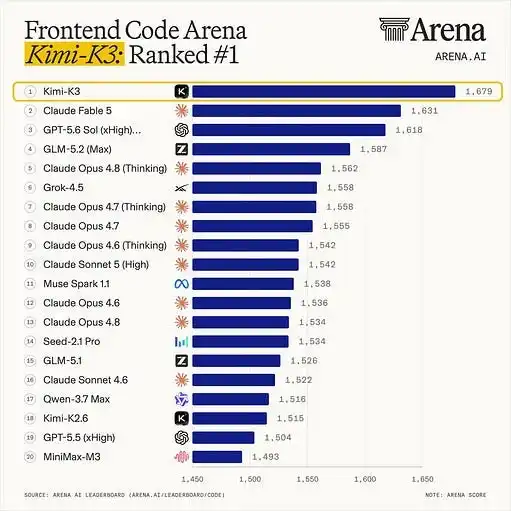
Chart: Frontend Code Arena ranking, Moonshot AI's Kimi-K3 ranks first (1,679 points), surpassing Claude Fable 5 (1,631 points). Source: Arena
Alibaba followed Moonshot AI's footsteps, launching Qwen 3.8, a large open-source weight model with a parameter count as high as 2.4 trillion. Market sentiment is also tilting towards open-source models, with Nvidia's Jensen Huang being the latest heavyweight in the AI field to publicly endorse open source.
Global macro master Louis-Vincent Gave once said: "When China comes in, profits go out." This has played out in electric vehicles and solar panels, and now the market fears competition from China will commoditize intelligence. All signs point in the same direction: the cost of intelligence is converging towards the cost of the compute required to serve it. Users can get comparable performance from open-source models at a far lower price than closed-source models, with better data privacy and no lock-in, making it hard to justify paying a premium for OpenAI and Anthropic.
Cheaper intelligence is good for end-users, but a nightmare for closed-source AI labs (OpenAI, Anthropic, Google) that have promised massive compute leasing or procurement expenditures. As profit margins and market share erode, their ability to raise capital at high valuations weakens, which in turn undermines their capacity to fulfill compute commitments. OpenAI's decision to postpone its IPO to next year is likely due to a lack of confidence in achieving a $1 trillion valuation. SpaceX falling to $112, 27% below its IPO price, might be further dampening their IPO prospects. Because OpenAI and Anthropic have circular transactions with other participants across the ecosystem, they have become single points of failure for the entire AI industry.
The Coming Compute Overcapacity
AI bulls point out that AI compute, along with components like memory and optical networking, is still in shortage, but this logic is flawed. Every commodities trader knows that supply shocks and bottlenecks feel most acute precisely at market tops. By the time supply and demand rebalance, the bull market has usually fully reversed. Often, shortages even flip into surpluses, leading to protracted bear markets.
Considering the scale of compute already committed to or under construction by emerging cloud providers and hyperscalers, I wouldn't be at all surprised to see compute overcapacity in a year or two.
The shift from compute shortage to overcapacity can very well occur alongside continued rapid growth in token consumption and AI model revenue. The rate of efficiency improvements in hardware and AI algorithms is already outpacing the rate at which users are increasing token consumption, leading total token spend to decline from its level in June this year. Silicon Data's token spend index shows overall token spend peaked in June and has been trending lower since.
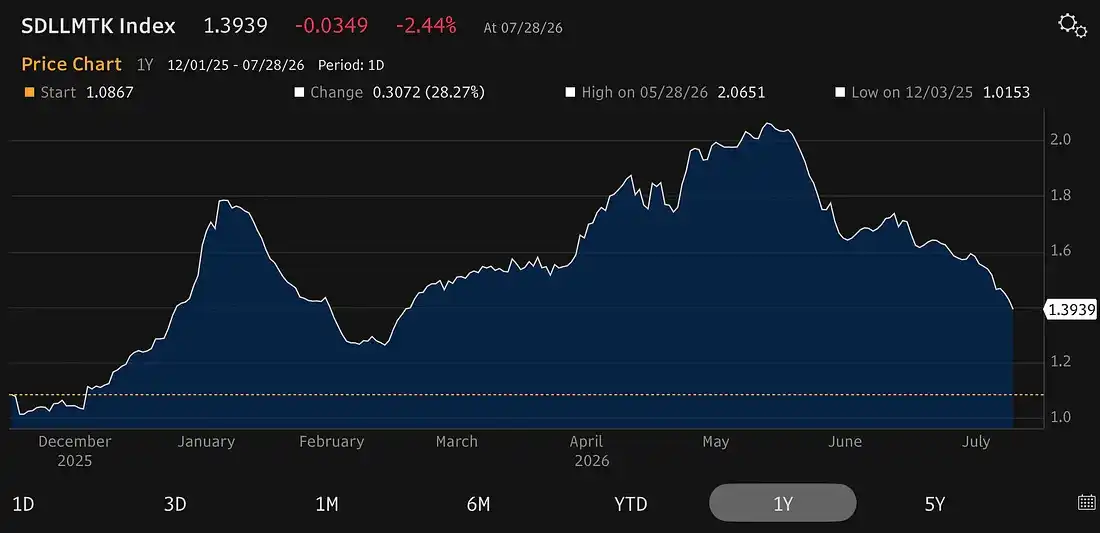
Chart: SDLLMTK Index (Token Spend Index), peaked in June and has been declining. Source: Silicon Data
What will compute overcapacity look like? Half-finished data centers, defaulted commitments, and in some cases, debt defaults. It could get ugly. Corporate bond spreads for data centers and hyperscalers are sending signals: the exorbitant investment in compute is becoming an increasingly dangerous business decision.
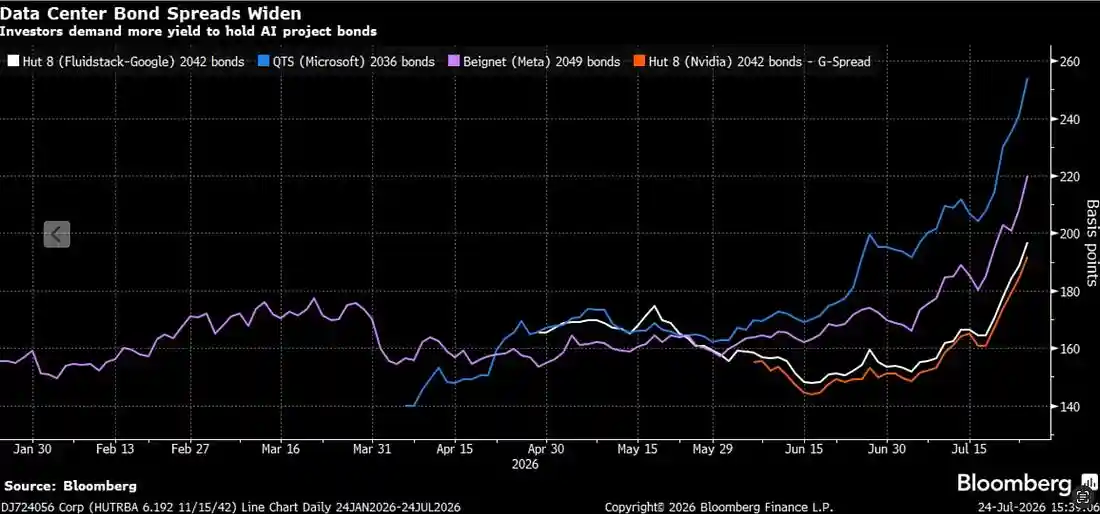
Chart: Widening AI Data Center Bond Spreads (Hut 8, QTS, Meta, etc.). Source: Bloomberg
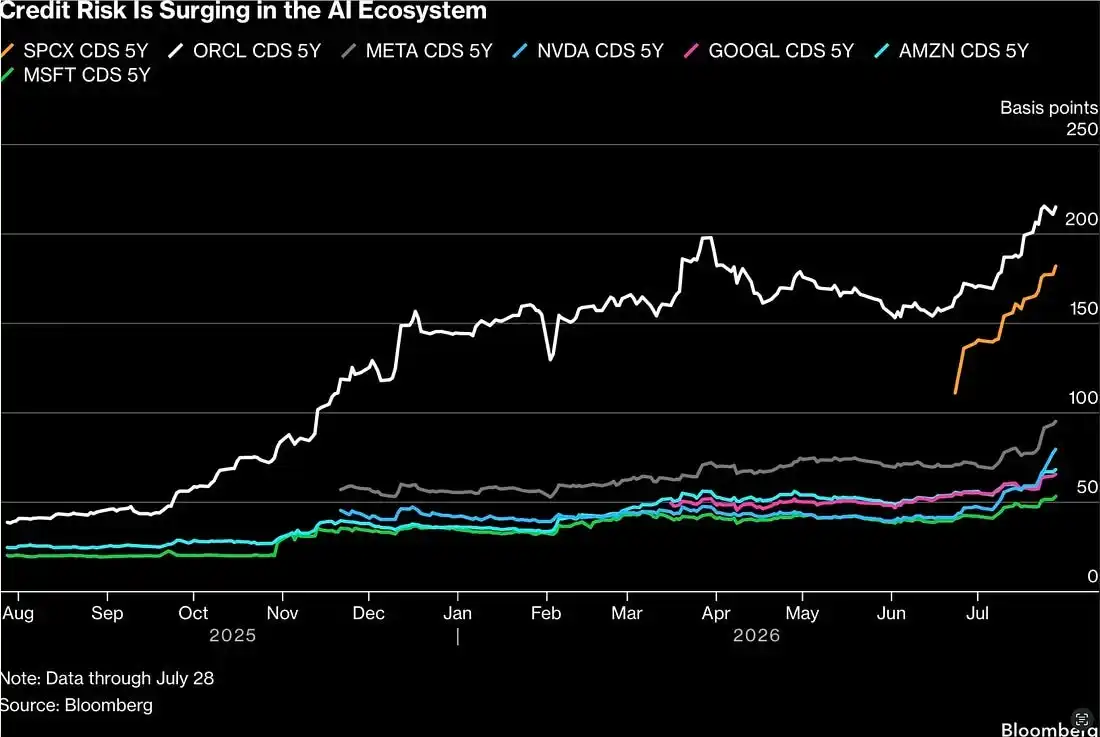
Chart: Surging AI Ecosystem Credit Risk (5-year CDS basis points, SPCX spikes). Source: Bloomberg
The stock market is no longer rewarding hyperscalers announcing increased AI capital expenditures, yet they are ignoring this signal and continuing to ramp up investment.
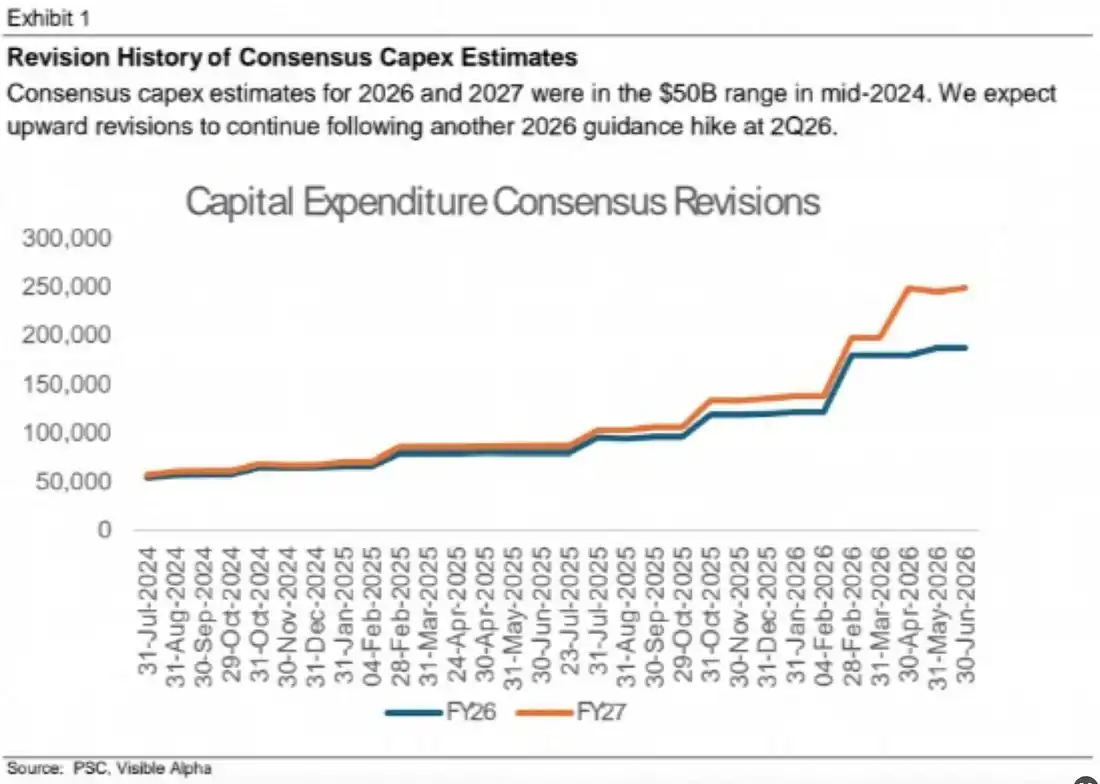
Chart: 2024–2026 Fiscal Year Capex Consensus Estimate Revisions. Source: Bloomberg
Google announced raising its 2026 AI capital expenditure from $195 billion to $205 billion, and its stock fell 7% that day.
I know this pessimistic scenario is hard to imagine, but recent history offers plenty of reminders. When the Strait of Hormuz was blocked in April, few predicted oil would drop back to $70 so quickly. When silver was trading at $120 in January this year, very few thought it would fall to $55 within a year. In 2021, almost no one believed the high-flying growth stocks of that bull market would fall 80-90% the following year. Shortages can flip to surplus rapidly, and positioning can shift just as quickly.
Iran—The Next Endless War
I previously thought the impact of the Iran war on stocks would be limited long-term, but my view has changed. This conflict is evolving into an intermittent quagmire. Iranian hardliners have no intention of giving up their two trump cards: their stockpile of weapons-grade enriched uranium and their control over the Strait of Hormuz. Seizing these would require a protracted ground war, and even then, the probability of success is questionable. This war also has the potential to evolve into a proxy conflict between the U.S. and China.
The U.S. Department of Defense estimates the war has cost American taxpayers $37.5 billion so far, but this is likely an underestimate, not accounting for economic costs and future spending needed to replenish equipment and ammunition to pre-war levels. Trump dragging the country into a costly, open-ended war without congressional approval will go down in history as one of the most emblematic cases of the broken state of American democracy.
Over the past six years, the world has experienced four inflationary shocks (COVID-19 pandemic, Russia-Ukraine war, Trump tariffs, Strait of Hormuz blockade). Each led to tighter monetary policy and significant market pullbacks. The Iran war could be the most persistent stagflationary force among them, as it impacts global energy and commodity supplies while pushing up government funding costs.
The Fed Under Warsh
Kevin Warsh is attempting to comprehensively reform how the Federal Reserve measures inflation, responds to it, and communicates with the public, all while under pressure from supply shocks and the bursting of the AI bull market bubble. It's like replacing all the parts of a plane while flying through a storm.
Against a backdrop of above-target inflation and widening fiscal deficits, Warsh faces two bad choices. He could tighten early, flattening the yield curve, but this risks causing a recession. Or he could delay tightening, letting the bond market's long end do the job. For now, he seems to have chosen delay.
At yesterday's FOMC meeting, the Fed had the chance to back Warsh's hawkish rhetoric with a rate hike, but they did not. The bond market's reaction was a violent bear steepening, a signal that the Fed's credibility in controlling inflation is eroding. Joseph Wang points out that Warsh is promising price stability and a 2% inflation target while simultaneously modifying how inflation is measured in ways he cannot publicly acknowledge. Without a clear framework, bond investors have no anchor for expectations, and volatility rises in a way the stock market struggles to digest.
The long-end yield broke through 5.2%, hitting a two-year high. This technical breakout signals a new phase in the U.S. Treasury bear market, creating a new headwind for stocks.
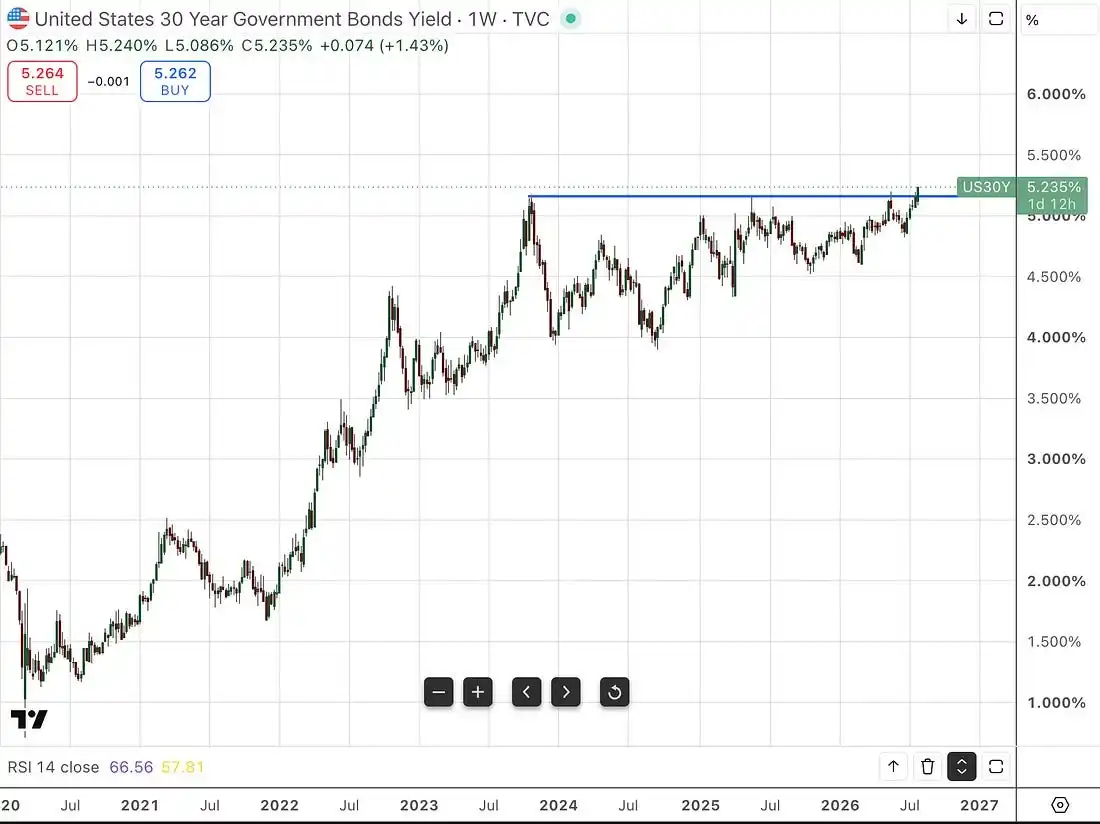
Chart: U.S. 30-Year Treasury Yield Weekly Chart, breaks through 5.2% to a two-year high. Source: Bloomberg
Disclaimer: The content of this communication is for informational and educational purposes only and does not constitute professional financial advice, an investment recommendation, or a solicitation to buy or sell any securities or instruments. This communication is not a trading signal service, and the author strongly advises readers not to follow his trading operations without relevant market experience and research. The author of this communication is not a registered investment advisor or financial planner. The information presented is based on the author's own research and experience and should not be considered personalized investment advice. Any investment or trading decisions you make based on this communication are at your own risk. Past performance is not indicative of future results. All investments carry the risk of loss, and no trade or strategy discussed in this communication guarantees profit or is suitable for your specific situation. The author assumes no responsibility for any liability arising from any action taken or not taken based on this communication. The author bears no responsibility for any loss, damage, or liability arising from the use or misuse of the information provided.






