The True Test for the Crypto Industry: How the 2026 Midterm Elections Will Determine the Fate of Legislation

marsbitPublicado a 2026-03-19Actualizado a 2026-03-19

Resumen

The 2026 US midterm elections could be a critical turning point for crypto legislation. Prediction markets indicate a high probability of Democrats retaking the House and possibly the Senate. This would shift control of key committees—House Financial Services and Senate Banking—to vocal crypto critics Maxine Waters and Elizabeth Warren, respectively. While nearly half of Democratic lawmakers have supported specific crypto bills like the GENIUS Act, this cross-party support lacks power where it matters most: in committee. Committees control the agenda—deciding which bills receive hearings, markups, or are stalled without a vote. Under Waters and Warren, crypto legislation faces high risk of being blocked entirely. The Senate offers a marginal bright spot, with some pro-crypto Democrats like Ruben Gallego potentially leading subcommittees. However, the overall outlook is concerning. Even with bipartisan support, the path to regulatory clarity may be interrupted if anti-crypto chairs control the legislative process. The core risk is structural: pro-crypto voices exist in Congress but lack agenda-setting power in decisive committees.

Original Title: Mapping Out Crypto's Midterms Fate

Original Author: David Christopher, Bankless

Original Compilation: Peggy, BlockBeats

Editor's Note: The 2026 U.S. midterm elections may become a critical variable for the direction of the crypto industry.

From an outcome perspective, prediction markets generally believe that the Democratic Party has a high probability of retaking the House of Representatives, and it is not impossible for them to control both the House and the Senate. If this scenario occurs, control of key congressional committees will shift accordingly, with Maxine Waters and Elizabeth Warren leading the House Financial Services Committee and the Senate Banking Committee, respectively.

But what really needs attention is not "who supports crypto," but "who controls the agenda."

Based on a cross-analysis of prediction markets, candidate positions, and congressional structure, this article points out an underestimated risk: even if cross-party support is forming, it holds almost no practical significance if it cannot enter the committee process. Control over hearings, deliberations, and scheduling allows committees to directly determine the life or death of a bill without even holding a vote.

Structurally, this is the core contradiction at present: although a significant proportion of Democratic lawmakers have shifted to support crypto on specific bills, this support has not translated into dominance at the committee level. In the stage that truly determines the fate of legislation, the overall landscape still presents a cautious or even opposing stance.

With the potential power reshuffle brought by the midterm elections, the crypto industry is no longer short-term policy volatility but a deeper institutional uncertainty: the path to regulatory clarity may be interrupted before it even truly begins.

Therefore, a relatively clear scenario judgment can be formed: under the baseline scenario, regulatory progress will enter a period of stagnation; in a more pessimistic scenario, core legislation such as stablecoins and market structure may be completely blocked, with short-term policy benefits nearly zero.

Below is the original text:

How bad will these midterm elections really be for the crypto industry? As the possibility of a Democratic sweep of the House and Senate in the midterm elections continues to rise, I want to take a closer look at what the existing polls are actually telling us and what this means for the future of the crypto industry.

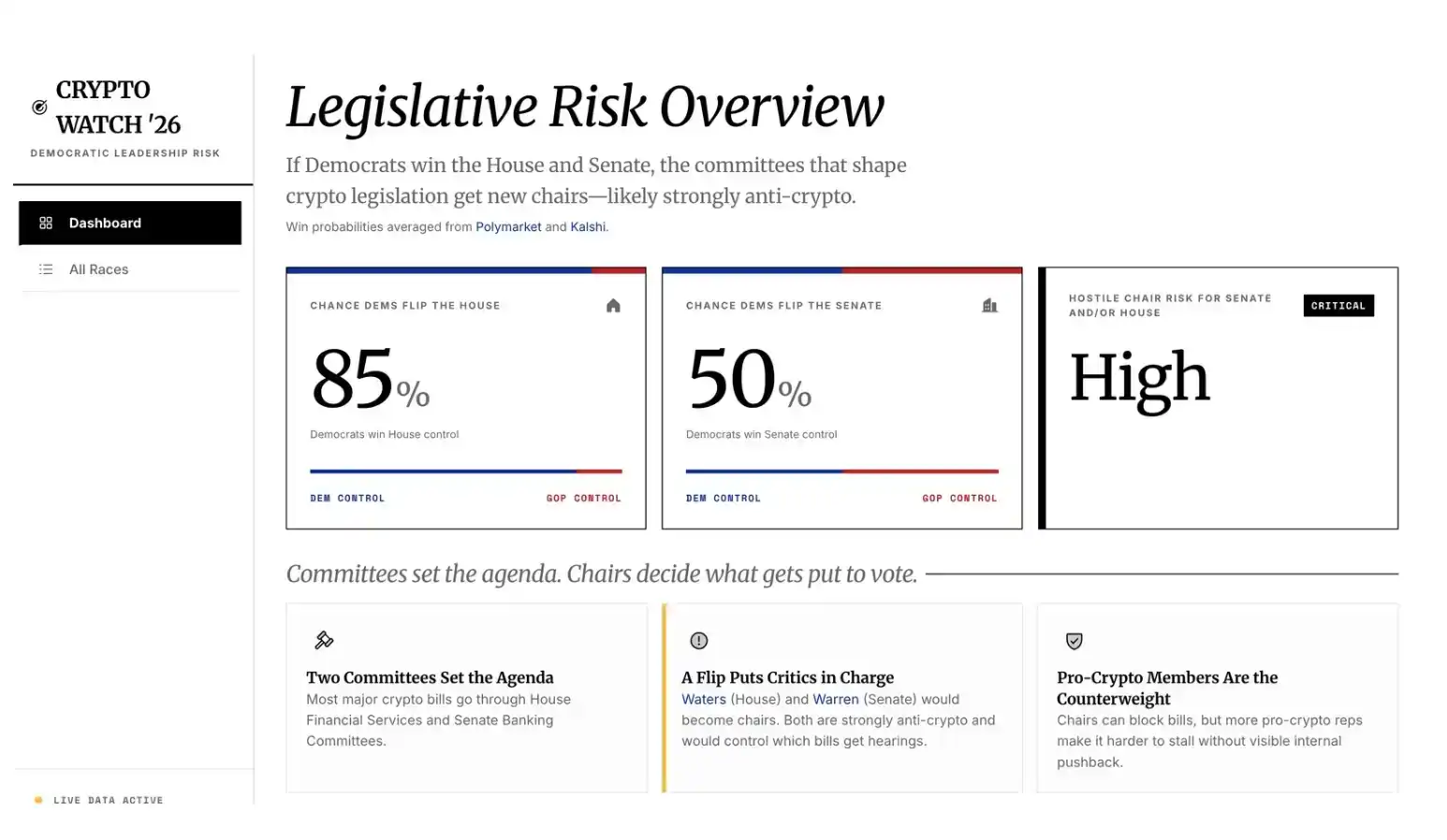
To do this, I referenced data from prediction markets, as well as databases like Stand with Crypto (SWC) that record candidates' positions on the crypto industry. While integrating this information, I also built a visualization panel: after obtaining the data, I used Cursor to build the front end, Claude Code to string together the logic, and Vercel for final deployment.

Although the data is still being supplemented, I have already built a database tracking districts where Democratic candidates are leading, mapping them to their positions on crypto issues and the congressional committees they might join. This has allowed me to sketch an initial outline of the policy environment in the coming months: seemingly still operable on the surface, but upon closer inspection, there are some deeper structural issues lurking within.
One Surprising Point

First, support for the crypto industry within the Democratic Party is actually greater than outsiders imagine—at least on certain specific bills.

In the House, 101 Democratic lawmakers (about 48% of the caucus) voted in favor of the GENIUS Act; in the Senate, 18 Democratic senators (about 40%) voted to advance the bill for passage. This does constitute a cross-party support alliance. But this support is bill-specific. Once it enters the committee stage, where legislation truly begins to move, this alliance quickly falls apart.

And that is precisely the problem.

Where Power Comes From

Crypto-related legislation never goes directly to a full floor vote.

Whether it's stablecoins, market structure, or SEC regulatory authority, all content must first go through committee review. The House Financial Services Committee (HFSC) and the Senate Banking Committee are the two critical arenas where crypto bills live or die (bills involving market structure also require the Agriculture Committee to correspond to the CFTC regulatory portion). The committee chairs decide which topics get hearings, which proceed to markup, and which are quietly dragged into procedural stagnation. If the chair opposes a bill, he doesn't even need to call a vote; he can simply cold-shoulder it by not setting the agenda.

Recent Republican chairs have demonstrated how this power can be used to advance legislation. For example, Senate Banking Committee Chair Tim Scott pushed the GENIUS Act through the committee and guided its passage in the Senate; former House Financial Services Committee Chair Patrick McHenry led the FIT21 Act, the first major crypto market structure bill to pass the House. Current Chair French Hill has continued this momentum, pushing related legislation including the CLARITY Act (though it remains stalled in the Senate) and holding ongoing hearings on digital assets and capital markets modernization.

What Happens if Democrats Win Across the Board?

In the U.S. Congress, the majority party controls all committee chairmanships, without exception.

If Democrats take the House, they will lead all House committees; if they also take the Senate, they will control all Senate committees. Within the majority party, chairs are typically assigned by seniority.

In the House Financial Services Committee, the most senior Democrat is Maxine Waters; in the Senate Banking Committee, it is Elizabeth Warren. Both are well known for having opposed almost all major crypto bills. Warren opposed the GENIUS Act during its consideration, citing threats to national security, while Waters called it a comprehensive crypto scam.

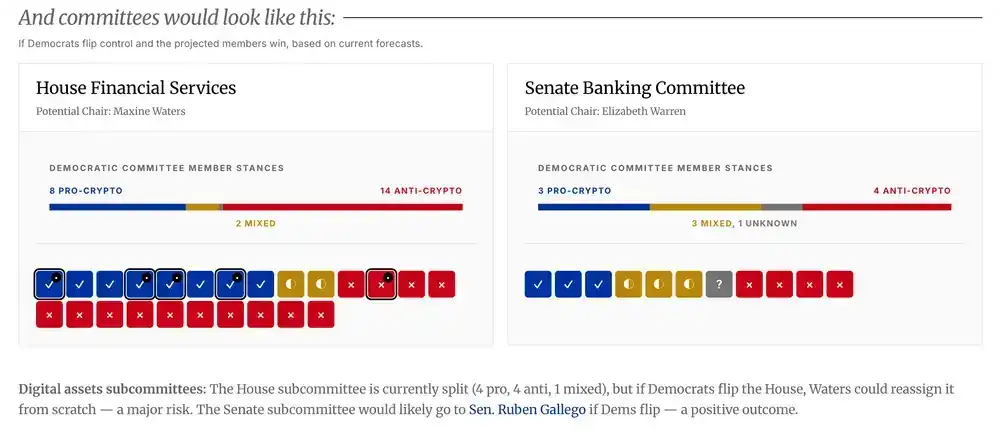
More critical is the mechanism in the House: once party control changes, all subcommittees are reshuffled. The majority party not only determines the seat ratio but also influences the assignment of new members. At that point, Waters would have significant influence over the composition of the Financial Services Committee (HFSC) and its subcommittees, including the leadership of the Digital Assets Subcommittee. Although she cannot unilaterally decide all appointments (party leadership and the caucus are also involved), she can certainly steer the overall structure towards a more anti-crypto stance that aligns with her position.

In fact, the current composition of Democrats on the HFSC itself leans towards being critical of the crypto industry, such as Brad Sherman, Stephen Lynch, Emanuel Cleaver, Sylvia Garcia, and others. Although there are also crypto-supportive Democratic lawmakers, such as Jim Himes, Bill Foster, Ritchie Torres, Josh Gottheimer, and Vicente Gonzalez, who can provide some counterbalance, they do not control the agenda-setting power under Waters' chairmanship.
The Situation in the Senate: Slightly Better, But Still Constrained

The landscape in the Senate Banking Committee is relatively less bleak. If Elizabeth Warren becomes chair, the committee would present a mixed structure: there are relatively crypto-supportive members like Mark Warner, Ruben Gallego, Angela Alsobrooks, as well as explicitly opposing voices like Tina Smith, and some lawmakers with more摇摆 (swaying) positions.

There is a marginal positive here: if Democrats win the Senate, Gallego, who scores relatively well in the Stand with Crypto (SWC) rating system, would likely chair the Digital Assets Subcommittee. Although Warren would still control the overall committee agenda, Gallego could at least carve out some space for pro-crypto voices at the subcommittee level.

What's Really Key Are These Election Seats

A more realistic problem is: currently, most of those crypto-supportive Democratic lawmakers are not on the House Financial Services Committee (HFSC) or the Senate Banking Committee.

They can certainly vote in favor when a bill reaches the full floor vote, and they can exert some pressure on party leadership (though in the current climate of increasing crypto issue partisanship, most may be unwilling to stick their necks out for it). But what they cannot do is: force a committee chair to move a piece of legislation into the process.

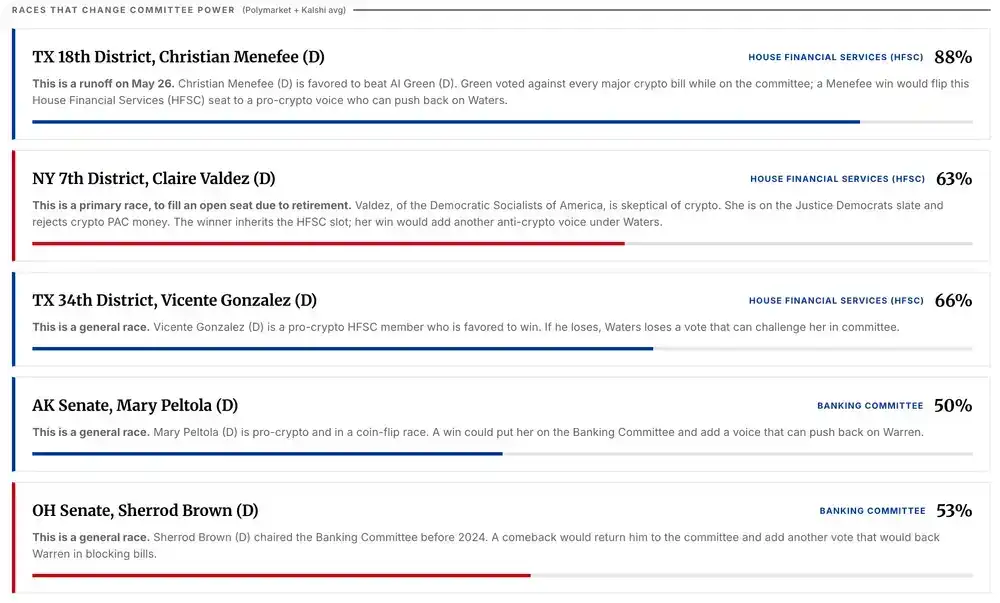
Therefore, what will truly affect the direction of crypto policy are the outcomes of a few key races in specific districts—elections that will directly change the composition of the committees, thereby determining whether a bill has a chance to be discussed, not just voted on.
Conclusion on the Midterms

The prospects in the House are quite grim.

If there's an 85% probability of Democrats flipping the House, then Maxine Waters becoming chair of the Financial Services Committee (HFSC) is almost a near certainty. She can not only rearrange subcommittee seats but also control the agenda. The so-called bright spots are very limited—for example, Menefee potentially replacing Green's seat, Gonzalez successfully getting re-elected—these only provide a degree of checks and balances but do not change the fundamental issue of who holds the gavel.

The Senate becomes the remaining key battleground, but the situation worsened further last night.

In the Illinois primary, Juliana Stratton defeated Raja Krishnamoorthi. Combining the Stand with Crypto (SWC) rating and the fact that Fairshake invested $7 million against her, it can be basically judged that Stratton belongs to the staunchly anti-crypto camp.

Even more frustrating is the overall structure: crypto-supportive Democrats do exist. In both chambers, about 47% of Democratic lawmakers supported the GENIUS Act, and in the House, 37% supported the CLARITY Act. But the problem is—the life or death of a bill is not determined by the full floor vote.

What truly determines fate is the committee stage. And in the committee votes related to market structure, it almost completely follows party lines. The support that exists has not translated into actual influence in the key decision-making arenas.

Crypto shouldn't have become such a highly partisan issue. Crypto-supportive Democrats do exist—they just aren't in the positions of power.

This data panel is still being continuously improved, and I will continue to update it in the coming weeks and months. But even with the current data still incomplete, the overall picture is quite clear: the House will most likely be the source of resistance, and the only place worth investing effort in now is the Senate.

Original link

Preguntas relacionadas

QWhat is the main concern for the crypto industry regarding the 2026 US midterm elections?

AThe main concern is that if Democrats regain control of both the House and Senate, key committee leadership (like Maxine Waters and Elizabeth Warren) could block crypto-related legislation from even reaching a floor debate, stalling regulatory progress.

QWhich two congressional committees are identified as the most critical for the fate of crypto legislation?

AThe House Financial Services Committee (HFSC) and the Senate Banking Committee are identified as the two most critical committees for crypto legislation.

QAccording to the article, what is bipartisan support for crypto bills not enough to ensure their passage?

ABipartisan support is not enough because bills must first pass through committee, where the chairs control the agenda and can prevent them from being heard or voted on, regardless of broader support.

QWho would likely chair the House Financial Services Committee if Democrats win the House, and what is her stance on crypto?

AMaxine Waters would likely chair the House Financial Services Committee, and she is described as being opposed to major crypto legislation, having called it a 'comprehensive crypto scam'.

QWhat is one marginally positive development mentioned in the Senate Banking Committee under a potential Democratic majority?

AA marginally positive development is that Ruben Gallego, who has a favorable rating from Stand with Crypto, would likely chair the digital assets subcommittee, potentially creating some space for pro-crypto voices.

Lecturas Relacionadas

Bitcoin's 'Rally Ends,' Officially Entering the Later Stage of a Bear Market?

Bitcoin prices declined 13% this week, reversing the recent rebound and signaling a likely transition into the later stages of a bear market. Key on-chain metrics deteriorated, with the short-term holder cost basis falling below the Realized Price—a pattern last seen in early 2022, characteristic of bear market maturity. The rally to ~$82k proved to be a bear market bounce, as evidenced by the 90-day realized profit/loss ratio failing to sustain above the bullish threshold of 2. Daily realized losses surged to $1.35B, including significant selling from long-term holders who accumulated near cycle tops, indicating ongoing supply redistribution. Price was rejected almost precisely at the aggregate US spot ETF cost basis of ~$83k, turning that level into resistance and leaving the average ETF investor underwater again. Spot market selling pressure intensified, with the 7-day volume delta turning significantly negative to its weakest level since February. While a major long liquidation event cleared over $400M in leverage, spot demand has not yet stepped in to absorb the resulting supply. Options markets continue pricing in higher future volatility (elevated volatility risk premium) and maintain a skew toward put options, reflecting persistent demand for downside protection, though not yet panic. Overall, market structure remains fragile. Sustained recovery likely requires a reclaim of the ETF cost basis, a shift back to positive spot demand, and a slowdown in realized loss-taking. Until then, the market risks further downside or extended consolidation within the broader bear trend.

Foresight NewsHace 18 min(s)

Bitcoin's 'Rally Ends,' Officially Entering the Later Stage of a Bear Market?

Foresight NewsHace 18 min(s)

How Risky is the "Death Spiral" of MSTR and STRC?

Summary: This article explores the perceived "death spiral" risk between MicroStrategy (MSTR), its Bitcoin holdings, and its perpetual preferred stock (STRC), drawing comparisons to the LUNA-UST collapse. While both systems feature price anchors, high yields for holders, and potential feedback loops, their core mechanisms differ fundamentally. The MSTR-STRC structure relies on continuous financing to sustain its high dividend payouts, primarily through stock ATM offerings. A negative feedback cycle could occur: falling MSTR stock price makes raising equity capital harder, increasing pressure to sell Bitcoin, which undermines STRC confidence and further depresses MSTR. However, unlike LUNA-UST's automated, direct linkage, the MSTR-STRC loop is weaker and has brakes: STRC dividends can be deferred or rates lowered, and STRC holders have a $100/share liquidation preference in bankruptcy, providing a price floor. The company's sustainability hinges on its ability to continue financing. Its current ~$900 million USD reserves cover only about 6.3 months of its ~$1.71 billion annual interest/dividend burden. The next six months are critical, aligning with both the potential bottom in Bitcoin's four-year cycle and the depletion timeline of its reserves. While a LUNA-style catastrophic collapse is deemed highly unlikely due to structural differences, the key question is whether MicroStrategy can navigate this period through healthy deleveraging to restart its capital engine.

Foresight NewsHace 36 min(s)

How Risky is the "Death Spiral" of MSTR and STRC?

Foresight NewsHace 36 min(s)

How Much Debt Does Strategy Really Have? Is There a Risk of Implosion?

MicroStrategy's Debt Risk: A Turning Point in the "Never Sell" Strategy As of June 3, 2026, MicroStrategy holds 843,706 bitcoins (valued at ~$53.1B) but faces significant financial obligations. Its capital structure includes $6.75B in convertible notes and $15.48B in perpetual preferred stock (led by the $8.5B STRC series), creating an annual payout burden of ~$1.71B. With software revenue at only ~$500M, interest and dividend obligations far exceed operating income. A critical shift occurred in late May 2026 when the company sold 32 bitcoins for ~$2.5M to cover dividends, breaking CEO Michael Saylor's long-standing "never sell" pledge. This symbolic move triggered a sharp decline in both Bitcoin's price and MSTR stock, reflecting market fears about cash flow sustainability. The core of the strain is the STRC perpetual preferred stock, designed as a "permanent loan" with no maturity date but requiring high monthly dividends (currently 11.5%). Its business model relies on a three-part cycle: issuing new STRC shares, using proceeds to buy more Bitcoin and fund a USD reserve, and using that reserve to pay dividends. This cycle depends on continuous investor demand for STRC and Bitcoin's price appreciation. Analysis shows Bitcoin needs to appreciate at least 2.3% annually to cover the $1.71B in yearly obligations at current holdings. With Bitcoin price down ~22% from March 2026 highs, this pressure has intensified. The company's $900M USD reserve can only cover about 7 months of payments if STRC issuance stalls. Key risks are not immediate bankruptcy or forced Bitcoin liquidation (as BTC is not collateral), but rather: 1) The erosion of MSTR's premium to its Bitcoin holdings (mNAV), which would cripple its ability to raise cheap capital; 2) A vicious cycle where stagnant Bitcoin prices reduce STRC demand, draining the USD reserve and forcing BTC sales, further depressing prices. The period from February 2027 to September 2028 is a crucial test, with over $5.9B in convertible notes facing put options or maturity. In essence, MicroStrategy has evolved from a simple Bitcoin holder into a complex financial entity acting like a "private Bitcoin bank," leveraging its BTC holdings to create layered financial products. Its survival depends on maintaining Bitcoin's price trend, its stock premium, and market appetite for its preferred shares. The recent token sale marks not a betrayal of its Bitcoin thesis, but an admission that the leveraged strategy must eventually be paid for.

marsbitHace 47 min(s)

How Much Debt Does Strategy Really Have? Is There a Risk of Implosion?

marsbitHace 47 min(s)

Anthropic Cries Wolf: Is the AGI Threat Real, or Just an IPO Story?

Anthropic has published an article titled "When AI builds itself," discussing the emerging concept of "recursive self-improvement," where AI begins to actively participate in designing, training, testing, and optimizing its own subsequent versions. The company presents internal data showing that by May 2026, over 80% of code merged into its codebase was written by Claude, its AI model. Claude's capabilities have expanded to handling complex, open-ended engineering tasks, achieving a 76% success rate in such areas, and even contributing to research processes, such as optimizing code performance and conducting AI safety experiments. Anthropic outlines an evolution from human-driven development to AI-assisted workflows, culminating in the current stage where AI agents can autonomously write, run, and delegate code. The company cautions that the path toward a "closed loop," where AI continuously improves itself, is becoming visible. It calls for coordinated global mechanisms to potentially slow or pause frontier AI development to allow safety research and societal structures to catch up. However, the timing of this warning coincides with Anthropic's preparations for an IPO, framing the narrative not just as a safety concern but also as a demonstration of Claude's advanced capabilities and its integral role in accelerating Anthropic's own R&D—creating a potential "flywheel" effect for competitive advantage. This contrasts with OpenAI's recent, more policy-oriented discussion of the same risks, highlighting the competitive dynamics in the AI industry as companies position themselves in both the technological and regulatory landscape.

marsbitHace 1 hora(s)

Anthropic Cries Wolf: Is the AGI Threat Real, or Just an IPO Story?

marsbitHace 1 hora(s)

Trading

Spot
Futuros

Artículos destacados

Qué es $S$

Entendiendo SPERO: Una Visión General Completa Introducción a SPERO A medida que el panorama de la innovación continúa evolucionando, la aparición de tecnologías web3 y proyectos de criptomonedas juega un papel fundamental en la configuración del futuro digital. Un proyecto que ha atraído la atención en este campo dinámico es SPERO, denotado como SPERO,$$s$. Este artículo tiene como objetivo reunir y presentar información detallada sobre SPERO, para ayudar a entusiastas e inversores a comprender sus fundamentos, objetivos e innovaciones dentro de los dominios web3 y cripto. ¿Qué es SPERO,$$s$? SPERO,$$s$ es un proyecto único dentro del espacio cripto que busca aprovechar los principios de descentralización y tecnología blockchain para crear un ecosistema que promueva la participación, la utilidad y la inclusión financiera. El proyecto está diseñado para facilitar interacciones de igual a igual de nuevas maneras, proporcionando a los usuarios soluciones y servicios financieros innovadores. En su esencia, SPERO,$$s$ tiene como objetivo empoderar a los individuos al proporcionar herramientas y plataformas que mejoren la experiencia del usuario en el espacio de las criptomonedas. Esto incluye habilitar métodos de transacción más flexibles, fomentar iniciativas impulsadas por la comunidad y crear caminos para oportunidades financieras a través de aplicaciones descentralizadas (dApps). La visión subyacente de SPERO,$$s$ gira en torno a la inclusividad, buscando cerrar brechas dentro de las finanzas tradicionales mientras aprovecha los beneficios de la tecnología blockchain. ¿Quién es el Creador de SPERO,$$s$? La identidad del creador de SPERO,$$s$ sigue siendo algo oscura, ya que hay recursos públicos limitados que proporcionan información de fondo detallada sobre su(s) fundador(es). Esta falta de transparencia puede derivarse del compromiso del proyecto con la descentralización, una ética que muchos proyectos web3 comparten, priorizando las contribuciones colectivas sobre el reconocimiento individual. Al centrar las discusiones en torno a la comunidad y sus objetivos colectivos, SPERO,$$s$ encarna la esencia del empoderamiento sin señalar a individuos específicos. Como tal, comprender la ética y la misión de SPERO sigue siendo más importante que identificar a un creador singular. ¿Quiénes son los Inversores de SPERO,$$s$? SPERO,$$s$ cuenta con el apoyo de una diversa gama de inversores que van desde capitalistas de riesgo hasta inversores ángeles dedicados a fomentar la innovación en el sector cripto. El enfoque de estos inversores generalmente se alinea con la misión de SPERO, priorizando proyectos que prometen avances tecnológicos sociales, inclusión financiera y gobernanza descentralizada. Estas fundaciones de inversores suelen estar interesadas en proyectos que no solo ofrecen productos innovadores, sino que también contribuyen positivamente a la comunidad blockchain y sus ecosistemas. El respaldo de estos inversores refuerza a SPERO,$$s$ como un contendiente notable en el dominio de proyectos cripto que evoluciona rápidamente. ¿Cómo Funciona SPERO,$$s$? SPERO,$$s$ emplea un marco multifacético que lo distingue de los proyectos de criptomonedas convencionales. Aquí hay algunas de las características clave que subrayan su singularidad e innovación: Gobernanza Descentralizada: SPERO,$$s$ integra modelos de gobernanza descentralizada, empoderando a los usuarios para participar activamente en los procesos de toma de decisiones sobre el futuro del proyecto. Este enfoque fomenta un sentido de propiedad y responsabilidad entre los miembros de la comunidad. Utilidad del Token: SPERO,$$s$ utiliza su propio token de criptomoneda, diseñado para servir diversas funciones dentro del ecosistema. Estos tokens permiten transacciones, recompensas y la facilitación de servicios ofrecidos en la plataforma, mejorando la participación y la utilidad general. Arquitectura en Capas: La arquitectura técnica de SPERO,$$s$ apoya la modularidad y escalabilidad, permitiendo la integración fluida de características y aplicaciones adicionales a medida que el proyecto evoluciona. Esta adaptabilidad es fundamental para mantener la relevancia en el cambiante paisaje cripto. Participación de la Comunidad: El proyecto enfatiza iniciativas impulsadas por la comunidad, empleando mecanismos que incentivan la colaboración y la retroalimentación. Al nutrir una comunidad sólida, SPERO,$$s$ puede abordar mejor las necesidades de los usuarios y adaptarse a las tendencias del mercado. Enfoque en la Inclusión: Al ofrecer tarifas de transacción bajas e interfaces amigables para el usuario, SPERO,$$s$ busca atraer a una base de usuarios diversa, incluyendo a individuos que anteriormente pueden no haber participado en el espacio cripto. Este compromiso con la inclusión se alinea con su misión general de empoderamiento a través de la accesibilidad. Cronología de SPERO,$$s$ Entender la historia de un proyecto proporciona información crucial sobre su trayectoria de desarrollo y hitos. A continuación se presenta una cronología sugerida que mapea eventos significativos en la evolución de SPERO,$$s$: Fase de Conceptualización e Ideación: Las ideas iniciales que forman la base de SPERO,$$s$ fueron concebidas, alineándose estrechamente con los principios de descentralización y enfoque comunitario dentro de la industria blockchain. Lanzamiento del Whitepaper del Proyecto: Tras la fase conceptual, se lanzó un whitepaper completo que detalla la visión, los objetivos y la infraestructura tecnológica de SPERO,$$s$ para generar interés y retroalimentación de la comunidad. Construcción de Comunidad y Primeras Interacciones: Se realizaron esfuerzos de divulgación activa para construir una comunidad de primeros adoptantes y posibles inversores, facilitando discusiones en torno a los objetivos del proyecto y obteniendo apoyo. Evento de Generación de Tokens: SPERO,$$s$ llevó a cabo un evento de generación de tokens (TGE) para distribuir sus tokens nativos a los primeros seguidores y establecer liquidez inicial dentro del ecosistema. Lanzamiento de la dApp Inicial: La primera aplicación descentralizada (dApp) asociada con SPERO,$$s$ se puso en marcha, permitiendo a los usuarios interactuar con las funcionalidades centrales de la plataforma. Desarrollo Continuo y Alianzas: Actualizaciones y mejoras continuas a las ofertas del proyecto, incluyendo alianzas estratégicas con otros actores en el espacio blockchain, han moldeado a SPERO,$$s$ en un jugador competitivo y en evolución en el mercado cripto. Conclusión SPERO,$$s$ se erige como un testimonio del potencial de web3 y las criptomonedas para revolucionar los sistemas financieros y empoderar a los individuos. Con un compromiso con la gobernanza descentralizada, la participación comunitaria y funcionalidades diseñadas de manera innovadora, allana el camino hacia un paisaje financiero más inclusivo. Como con cualquier inversión en el espacio cripto que evoluciona rápidamente, se anima a los posibles inversores y usuarios a investigar a fondo y participar de manera reflexiva con los desarrollos en curso dentro de SPERO,$$s$. El proyecto muestra el espíritu innovador de la industria cripto, invitando a una mayor exploración de sus innumerables posibilidades. Mientras el viaje de SPERO,$$s$ aún se desarrolla, sus principios fundamentales pueden, de hecho, influir en el futuro de cómo interactuamos con la tecnología, las finanzas y entre nosotros en ecosistemas digitales interconectados.

72 Vistas totalesPublicado en 2024.12.17Actualizado en 2024.12.17

Qué es $S$

Qué es AGENT S

Agent S: El Futuro de la Interacción Autónoma en Web3 Introducción En el paisaje en constante evolución de Web3 y las criptomonedas, las innovaciones están redefiniendo constantemente cómo los individuos interactúan con las plataformas digitales. Uno de estos proyectos pioneros, Agent S, promete revolucionar la interacción humano-computadora a través de su marco agente abierto. Al allanar el camino para interacciones autónomas, Agent S busca simplificar tareas complejas, ofreciendo aplicaciones transformadoras en inteligencia artificial (IA). Esta exploración detallada profundizará en las complejidades del proyecto, sus características únicas y las implicaciones para el dominio de las criptomonedas. ¿Qué es Agent S? Agent S se presenta como un marco agente abierto innovador, diseñado específicamente para abordar tres desafíos fundamentales en la automatización de tareas informáticas: Adquisición de Conocimiento Específico del Dominio: El marco aprende inteligentemente de diversas fuentes de conocimiento externas y experiencias internas. Este enfoque dual le permite construir un rico repositorio de conocimiento específico del dominio, mejorando su rendimiento en la ejecución de tareas. Planificación a Largo Plazo de Tareas: Agent S emplea planificación jerárquica aumentada por la experiencia, un enfoque estratégico que facilita la descomposición y ejecución eficiente de tareas complejas. Esta característica mejora significativamente su capacidad para gestionar múltiples subtareas de manera eficiente y efectiva. Manejo de Interfaces Dinámicas y No Uniformes: El proyecto introduce la Interfaz Agente-Computadora (ACI), una solución innovadora que mejora la interacción entre agentes y usuarios. Utilizando Modelos de Lenguaje Multimodal de Gran Escala (MLLMs), Agent S puede navegar y manipular diversas interfaces gráficas de usuario sin problemas. A través de estas características pioneras, Agent S proporciona un marco robusto que aborda las complejidades involucradas en la automatización de la interacción humana con las máquinas, preparando el terreno para una multitud de aplicaciones en IA y más allá. ¿Quién es el Creador de Agent S? Si bien el concepto de Agent S es fundamentalmente innovador, la información específica sobre su creador sigue siendo elusiva. El creador es actualmente desconocido, lo que resalta ya sea la etapa incipiente del proyecto o la elección estratégica de mantener a los miembros fundadores en el anonimato. Independientemente de la anonimidad, el enfoque sigue siendo en las capacidades y el potencial del marco. ¿Quiénes son los Inversores de Agent S? Dado que Agent S es relativamente nuevo en el ecosistema criptográfico, la información detallada sobre sus inversores y patrocinadores financieros no está documentada explícitamente. La falta de información disponible públicamente sobre las bases de inversión u organizaciones que apoyan el proyecto plantea preguntas sobre su estructura de financiamiento y hoja de ruta de desarrollo. Comprender el respaldo es crucial para evaluar la sostenibilidad del proyecto y su posible impacto en el mercado. ¿Cómo Funciona Agent S? En el núcleo de Agent S se encuentra una tecnología de vanguardia que le permite funcionar de manera efectiva en diversos entornos. Su modelo operativo se basa en varias características clave: Interacción Humano-Computadora Similar a la Humana: El marco ofrece planificación avanzada de IA, esforzándose por hacer que las interacciones con las computadoras sean más intuitivas. Al imitar el comportamiento humano en la ejecución de tareas, promete elevar las experiencias de los usuarios. Memoria Narrativa: Empleada para aprovechar experiencias de alto nivel, Agent S utiliza memoria narrativa para hacer un seguimiento de las historias de tareas, mejorando así sus procesos de toma de decisiones. Memoria Episódica: Esta característica proporciona a los usuarios una guía paso a paso, permitiendo que el marco ofrezca apoyo contextual a medida que se desarrollan las tareas. Soporte para OpenACI: Con la capacidad de ejecutarse localmente, Agent S permite a los usuarios mantener el control sobre sus interacciones y flujos de trabajo, alineándose con la ética descentralizada de Web3. Fácil Integración con APIs Externas: Su versatilidad y compatibilidad con varias plataformas de IA aseguran que Agent S pueda encajar sin problemas en ecosistemas tecnológicos existentes, convirtiéndolo en una opción atractiva para desarrolladores y organizaciones. Estas funcionalidades contribuyen colectivamente a la posición única de Agent S dentro del espacio cripto, ya que automatiza tareas complejas y de múltiples pasos con una intervención humana mínima. A medida que el proyecto evoluciona, sus posibles aplicaciones en Web3 podrían redefinir cómo se desarrollan las interacciones digitales. Cronología de Agent S El desarrollo y los hitos de Agent S pueden encapsularse en una cronología que resalta sus eventos significativos: 27 de septiembre de 2024: El concepto de Agent S fue lanzado en un documento de investigación integral titulado “Un Marco Agente Abierto que Usa Computadoras Como un Humano”, mostrando las bases del proyecto. 10 de octubre de 2024: El documento de investigación fue puesto a disposición del público en arXiv, ofreciendo una exploración profunda del marco y su evaluación de rendimiento basada en el benchmark OSWorld. 12 de octubre de 2024: Se lanzó una presentación en video, proporcionando una visión visual de las capacidades y características de Agent S, involucrando aún más a posibles usuarios e inversores. Estos marcadores en la cronología no solo ilustran el progreso de Agent S, sino que también indican su compromiso con la transparencia y la participación comunitaria. Puntos Clave Sobre Agent S A medida que el marco Agent S continúa evolucionando, varios atributos clave destacan, subrayando su naturaleza innovadora y potencial: Marco Innovador: Diseñado para proporcionar un uso intuitivo de las computadoras similar a la interacción humana, Agent S aporta un enfoque novedoso a la automatización de tareas. Interacción Autónoma: La capacidad de interactuar de manera autónoma con las computadoras a través de GUI significa un salto hacia soluciones informáticas más inteligentes y eficientes. Automatización de Tareas Complejas: Con su metodología robusta, puede automatizar tareas complejas y de múltiples pasos, haciendo que los procesos sean más rápidos y menos propensos a errores. Mejora Continua: Los mecanismos de aprendizaje permiten a Agent S mejorar a partir de experiencias pasadas, mejorando continuamente su rendimiento y eficacia. Versatilidad: Su adaptabilidad en diferentes entornos operativos como OSWorld y WindowsAgentArena asegura que pueda servir a una amplia gama de aplicaciones. A medida que Agent S se posiciona en el paisaje de Web3 y criptomonedas, su potencial para mejorar las capacidades de interacción y automatizar procesos significa un avance significativo en las tecnologías de IA. A través de su marco innovador, Agent S ejemplifica el futuro de las interacciones digitales, prometiendo una experiencia más fluida y eficiente para los usuarios en diversas industrias. Conclusión Agent S representa un audaz avance en la unión de la IA y Web3, con la capacidad de redefinir cómo interactuamos con la tecnología. Aunque aún se encuentra en sus primeras etapas, las posibilidades para su aplicación son vastas y atractivas. A través de su marco integral que aborda desafíos críticos, Agent S busca llevar las interacciones autónomas al primer plano de la experiencia digital. A medida que nos adentramos más en los reinos de las criptomonedas y la descentralización, proyectos como Agent S sin duda desempeñarán un papel crucial en la configuración del futuro de la tecnología y la colaboración humano-computadora.

471 Vistas totalesPublicado en 2025.01.14Actualizado en 2025.01.14

Qué es AGENT S

Cómo comprar S

¡Bienvenido a HTX.com! Hemos hecho que comprar Sonic (S) sea simple y conveniente. Sigue nuestra guía paso a paso para iniciar tu viaje de criptos.Paso 1: crea tu cuenta HTXUtiliza tu correo electrónico o número de teléfono para registrarte y obtener una cuenta gratuita en HTX. Experimenta un proceso de registro sin complicaciones y desbloquea todas las funciones.Obtener mi cuentaPaso 2: ve a Comprar cripto y elige tu método de pagoTarjeta de crédito/débito: usa tu Visa o Mastercard para comprar Sonic (S) al instante.Saldo: utiliza fondos del saldo de tu cuenta HTX para tradear sin problemas.Terceros: hemos agregado métodos de pago populares como Google Pay y Apple Pay para mejorar la comodidad.P2P: tradear directamente con otros usuarios en HTX.Over-the-Counter (OTC): ofrecemos servicios personalizados y tipos de cambio competitivos para los traders.Paso 3: guarda tu Sonic (S)Después de comprar tu Sonic (S), guárdalo en tu cuenta HTX. Alternativamente, puedes enviarlo a otro lugar mediante transferencia blockchain o utilizarlo para tradear otras criptomonedas.Paso 4: tradear Sonic (S)Tradear fácilmente con Sonic (S) en HTX's mercado spot. Simplemente accede a tu cuenta, selecciona tu par de trading, ejecuta tus trades y monitorea en tiempo real. Ofrecemos una experiencia fácil de usar tanto para principiantes como para traders experimentados.

962 Vistas totalesPublicado en 2025.01.15Actualizado en 2026.06.02

Cómo comprar S

Discusiones

Bienvenido a la comunidad de HTX. Aquí puedes mantenerte informado sobre los últimos desarrollos de la plataforma y acceder a análisis profesionales del mercado. A continuación se presentan las opiniones de los usuarios sobre el precio de S (S).

活动图片