The Success of Robinhood Chain Proves Ethereum Is Not Dead

marsbitPublicado a 2026-07-13Actualizado a 2026-07-13

Resumen

The article argues that Robinhood's decision to build its own dedicated blockchain, Robinhood Chain, as an Ethereum Layer 2 (L2) using Arbitrum technology is a powerful endorsement of Ethereum's L1+L2 model, not a rejection of it. This move reflects a broader shift in the crypto industry from projects focused on token monetization to real-world businesses building cash-generating operations. Historically, many crypto projects chose infrastructure to support token sales and speculative value. In contrast, businesses like Robinhood and Coinbase (with Base) choose infrastructure based on commercial needs: security, liquidity, customer reach, and control. Ethereum's model provides a trusted, neutral, and liquid global settlement layer (L1) coupled with customizable, high-performance execution environments (L2s). This allows companies to maintain control and specialization without the cost and risk of building an independent L1 from scratch. The author contends that as more traditional enterprises enter the space to build sustainable businesses, they will rationally select Ethereum's L1 for maximum security and liquidity and its L2s for scalability and customization. This trend strengthens Ethereum's network effects and the utility of ETH as the native gas and asset within this expanding ecosystem. Robinhood's choice is thus seen as a landmark example of pragmatic business strategy aligning with Ethereum's architectural strengths.

Original Ryan Berckmans

Compiled / Odaily Planet Daily Golem

The previous era of the crypto industry dumped tokens via infrastructure, while its next era will choose Ethereum L1+L2 to build real businesses.

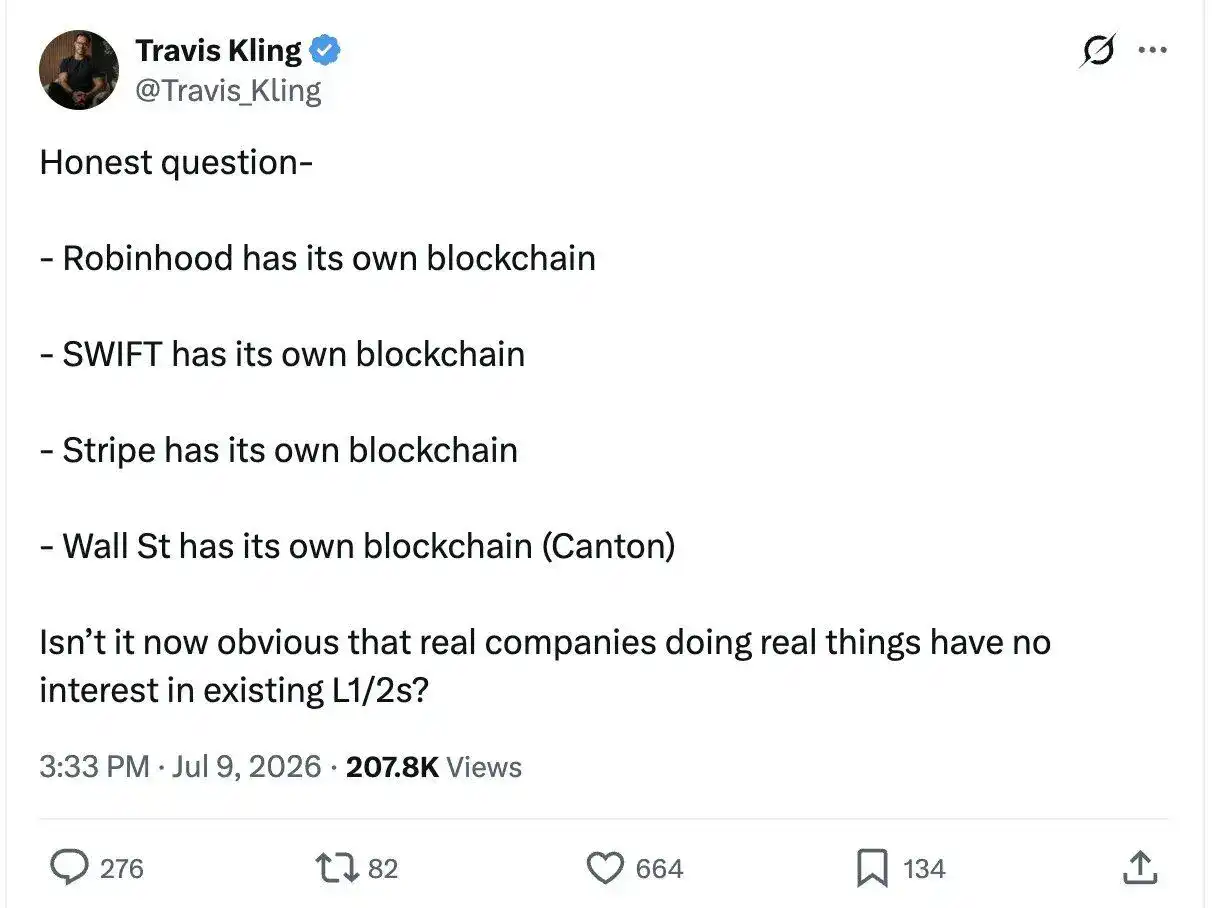
Travis Kling posed a question this week: "Is it now obvious that companies doing real business are not interested in L1/L2?" Robinhood was his first example. But on the contrary, Robinhood is almost a perfect counterexample: when entity companies make business decisions, they almost always choose the Ethereum L1+L2 model.
Robinhood chose an existing L1—Ethereum, and then built its own Ethereum L2 leveraging Arbitrum technology. Robinhood Chain uses Ethereum blobs for data availability, uses ETH as its native gas token, and its security is also provided by Ethereum.

Therefore, Robinhood has not negated Ethereum's L1+L2 model; on the contrary, the model is running on Robinhood as intended.

The "buyers" choosing Ethereum have changed. In the past, crypto projects chose public chains and technologies to sell their own tokens, while the emerging real-world on-chain economy is adopting the Ethereum L1+L2 model as the foundation for cash businesses.

As the composition of buyers changes, I believe Ethereum's advantages will become even more apparent.

The Old Crypto Economy Was Token-Centric

By "real businesses serving real users," I mean a traditional corporate model: building products customers need, earning profits by serving them, and increasing the equity value of those profits.

"Real users" here refers to consumption demand arising from ordinary economic needs, not speculative demand primarily generated by new token issuance. Crypto-native users are obviously real users. This is not a moral judgment on a protocol's usefulness or its developers' sincerity, but merely a distinction regarding the goal of operating a real economy business.

Token value can only come from three sources:

  • Cash: A reliable claim on future cash flows, similar to on-chain equity or bonds;
  • Utility: Access, control, governance, or other privileged participation rights to a valuable system. Even without cash flow, tokens that control important things clearly have value;
  • Monetary Premium: People hold the asset because they expect others to accept and recognize its value in the future. This asset is no longer merely a claim that must ultimately be exchanged for something else; it becomes a store of wealth—a terminal value asset.

The monetary premium is real but extremely difficult to sustain. It requires deep network effects in trust, liquidity, distribution, integration, and utility. Gold, the US dollar, Bitcoin, and Ethereum have all built different versions of this effect, while few other assets have achieved it.

Looking back, since programmable cryptocurrencies became popular, the vast majority of industry participants have not been ordinary cash flow businesses. Their economic goal has often been to sell a token whose value is primarily based on utility, an anticipated monetary premium, or distant promises of future cash.

Sometimes their plans were straightforward—launch a protocol and sell its token; sometimes more indirect—receive funding from a token-funded ecosystem and then cash out the tokens; sometimes a project genuinely expected future profitability, but since the token's valuation was detached from any plausible future cash, the actual business model still relied on confidence in the token itself.

This became the norm because almost every project was doing something similar, but there were exceptions.

Centralized exchanges are inherently cash transaction platforms and are naturally multi-chain, adding another chain is like adding another deposit/withdrawal channel. Some stablecoin issuers are also cash transaction businesses, initially serving crypto-native clients and now rapidly expanding into the broader economy.

But these exceptions precisely prove the point: Businesses aiming for ordinary cash transactions choose infrastructure that maximizes their business, not token value.

Different Business Goals Will Build Different Projects

A business's ultimate goal determines its technology choices.

If the goal is a cash transaction business, then blockchain is infrastructure, and the selection criteria are to reduce risk, improve the product, reach customers, and secure profits. If the goal is token monetization, then blockchain choice has more degrees of freedom. After receiving funding from a public chain, a business can choose to develop on the chain that funded it.

For example, if a protocol succeeds on Chain A, you can launch a similar protocol on Chain B so investors can price your token by comparison. Want momentum for a new token? Then a new L1, L2, appchain, gas token, governance system, or a particular tech stack can become selling points.

The problem is not technological diversity itself; the crypto industry will continue to see an explosion of applications, protocols, L2 architectures, and specialized execution environments. The problem is the tendency to turn every new idea into a sovereign, independent ecosystem (with its own L1 architecture, security validation, liquidity base, and monetary asset), regardless of whether the underlying product warrants it.

As the industry now shifts toward cash businesses, experiments continue, but they will increasingly be built on shared infrastructure. Businesses will specialize at the application layer or on L2s, while relying on the Ethereum L1 layer for settlement, security validation, liquidity maintenance, and monetary asset management. The result is not less innovation, but a balance: more diversity at the edges, more concentration at the base.

The traditional crypto economy typically chose architecture around the token it wanted to sell, while the emerging on-chain economy will choose architecture around the product it wants its customers to buy.

The Buyers Are Changing

The future of the crypto industry will be fundamentally different from the past because the "buyers" have changed.

Previous US administrations actively suppressed on-chain transaction development. Now this trend has reversed. The GENIUS Act is now in effect, providing a legal framework for payment stablecoins, and Europe's MiCA regulatory framework is fully applicable. Brokers, payment companies, banks, asset managers, and governments worldwide are formulating strategies for stablecoins, tokenization, and on-chain transactions.

This doesn't mean all regulatory issues are resolved, but at least it shows large institutions can attempt more blockchain business.

We are approaching the beginning of the S-curve for true crypto industry adoption.

When we emerge from this phase, the crypto industry and traditional finance will no longer be distinct categories. Property, money, transactions, finance, identity, and trust will all be coordinated through a network of on-chain and off-chain systems. Eventually, "Web 3" will fade away like "Web 2," and everything will simply be the internet.

As this process advances, a larger proportion of crypto market participants will be entity businesses serving ordinary consumers in the broader economy. This proportion will be reflected not just in the number of companies, but in capital volume, user numbers, asset scale, and institutional influence.

These companies are no longer crypto projects seeking a business model to support their token, but businesses using crypto technology to optimize existing or emerging cash businesses. This determines their technology choices. Infrastructure choices made for token economics do not well guide choices made for cash economics.

Entity Businesses Won't Build Infrastructure from Scratch

Typically, entity businesses have limited budgets for risky infrastructure development. They don't want consensus mechanisms, cross-chain bridges, validator economics, gas, governance tokens, and liquidity bootstrapping to become six separate side hustles. Each additional element must create customer value or it becomes a burden.

The chain should serve the business, not the business serve the chain.

Some businesses are inherently multi-chain. Exchanges, wallets, stablecoin issuers, and certain asset issuers may require broad distribution. Even then, "multi-chain" rarely means all chains are equally important. Different chains often have their own domains in terms of liquidity, issuance, settlement, product status, or deeper integration.

Most on-chain businesses need to commit to one chain or a small number of chains. Their choice typically takes three forms:

  • When on-chain businesses need maximum decentralization, credible neutrality, minimized risk, or liquidity, they use Ethereum L1 services. L1 execution is more costly because it bears the most powerful shared environment;
  • When businesses need control, customization, compliance, predictable unit economics, low latency, or high throughput, they build their own Ethereum L2. Because they can have their own dedicated chain as they wish, while maintaining a direct connection to Ethereum;
  • When businesses don't need L1 and building their own L2 isn't necessary, they typically use one or more mature shared L2s. Base, Arbitrum One, Robinhood, and other mature Ethereum L2s have become common deployment platforms.

These on-chain businesses will still bridge assets, "export products," and connect to other networks. Having a main chain doesn't mean isolation; importing, exporting, and interoperability are also core parts of on-chain business. But the main chain remains crucial. It determines the system's security, canonical state, liquidity relationships, operational model, and long-term dependencies.

Why Ethereum's L1+L2 Model Remains Useful

Ethereum separates the two major elements large enterprises need.

The L1 provides a highly decentralized, credibly neutral, and highly liquid global hub. L2s provide a market of fast, low-cost, specialized, controllable, and customizable execution environments.

The L1 remains neutral, while L2s at the edge can adapt to different operators, jurisdictions, products, and users. L2s extend Ethereum not just technically but also politically: organizations can operate their way without asking the global hub (L1) to become their private chain.

Independent L1s can offer control and performance advantages. In some cases, full sovereignty over consensus and data availability is worth it for a project, but acquiring it isn't cheap.

A new L1 must create and maintain its own security system, validator or operator set, bridges, liquidity, tooling, integrations, and reputation. It creates a new security and liquidity silo, increasing the cost and friction of interoperability with Ethereum L1 and the broader L2 economy (the dominant on-chain economic network).

For the vast majority of businesses, the value created by an independent L1 doesn't offset these costs.

A custom Ethereum L2 gets most of the business advantages a company wants from an independent L1: high TPS, control over execution, upgrades, fees, sequencing, latency, access rules, and product-specific features.

Furthermore, L2s provide advantages independent L1s don't inherently have: Ethereum for settlement and data availability, a standard L1 bridge, proximity to Ethereum's assets and capital, and a path for increasingly trust-minimized interoperability.

L2 design still matters. Admin keys, upgrade keys, proof systems, and withdrawal guarantees determine how much security users have at any moment. But even an L2 controlled by a few operators can offer users a solid settlement foundation on Ethereum L1. Companies don't need to operate and maintain their own L1 layer to run their business.

Ethereum L2s are both independent blockchains and part of the Ethereum economic system. They can own and customize their execution environment while leveraging Ethereum for settlement, data availability, and interoperability management.

L2s often deeply integrate ETH into their application economies, for example as the native Gas token. Canonical bridging models provide a trust-minimized path for capital and assets on L1 to enter the L2's "local economy." Each new L2 has a unique product interface, and Ethereum's network effects grow stronger.

Robinhood Made This Business Decision

Robinhood's development path is highly instructive.

It first launched stock tokens on the mature L2 Arbitrum One, validated the product, and understood its own needs, then launched a proprietary chain built on the Arbitrum platform.

This will likely become a standard strategy for entity businesses: build a business on a blockchain first, then upgrade to a dedicated L2 once scale, product needs, and unit economics justify it.

Robinhood Chain is customized for the financial services industry. It uses Arbitrum technology, offers 100-millisecond latency, predictable transaction pricing, high throughput, and infrastructure tailored to Robinhood's performance, security, and regulatory requirements.

At the same time, Robinhood Chain remains an Ethereum L2. It uses Ethereum blobs for data availability and uses ETH as the native gas. Its official bridge to Ethereum requires no third-party validator set. This is what it looks like when an entity business builds a real on-chain product.

Robinhood doesn't need to launch a Robinhood gas token or convince the public it's worthy of a lasting monetary premium. Robinhood itself owns stock; its economic gains come from customers, products, assets, transactions, and cash flow. Blockchain is just its infrastructure.

Using ETH as gas is a simple business decision. L2 services already use ETH to pay for L1 services. ETH is liquid, widely adopted, and the system's native token. If Robinhood used a proprietary Gas token, it would add issues of distribution, liquidity, pricing, and legality, and launching a token wouldn't improve Robinhood's core product.

Robinhood's success will depend on its application layer and the off-chain business enabled by it, not the efficiency with which it creates a new monetary asset. Therefore, when someone says Robinhood built its own blockchain and rejected existing L1 and L2 services, it's inaccurate.

Robinhood merely rejected sharing its dedicated execution environment with other projects, not Ethereum. On the contrary, it chose Ethereum as the parent chain for its proprietary blockchain.

Previously, Coinbase made a similar decision by launching Base. Coinbase is not an Ethereum maximalist, and it's well known that Brian Armstrong has publicly stated his enthusiasm for Bitcoin far exceeds that for Ethereum. Yet, when Coinbase chose infrastructure for its on-chain business, it still chose to become an Ethereum L2.

Base is precisely the strongest evidence that Ethereum's L1+L2 model is not just talk; Coinbase's decision was business-driven, not ideological.

When companies build cash businesses rather than conduct token sales, they make business decisions, and this leads them to choose infrastructure—the Ethereum L1+L2 model.

What This Means for Ethereum and ETH

This shift in participant composition is extremely bullish for Ethereum.

Historically, the blockchain competitive landscape was dominated by teams whose incentives focused on token creation, ecosystem funding, and token valuation. Looking ahead, the blockchain competitive landscape will increasingly be dominated by companies optimizing for security, customers, control, distribution, liquidity, and interoperability—all to serve cash businesses.

This shifts demand toward Ethereum's "barbell" structure: L1 for maximum risk reduction and liquidity; L2s for scaling, customization, and operator control.

Ethereum developed into a global universal platform not by forcing all companies into the same shared execution environment, but by becoming the common underlying settlement, security, liquidity, and asset layer for numerous environments.

This is also bullish for ETH. ETH's success lies in building a monetary network and global trust. ETH is an excellent staking asset and the native asset of Ethereum's global settlement layer. Across the ecosystem, it serves as collateral, a liquid asset, a treasury asset, a productive asset, and is becoming a terminal asset.

As more entity businesses build on Ethereum, they will distribute ETH to more users, integrate it into more products, and make it useful in more areas. This enhances ETH's liquidity and investor confidence, which in turn strengthens the monetary premium, which ultimately evolves into a larger network effect.

Robinhood is not an exception, but a beacon.

Real businesses use Ethereum L1 when they need the world's most neutral, lowest-risk, and most liquid shared environment. When they need control, customization, and high performance, they build their own Ethereum L2. And when their business doesn't yet justify building an independent blockchain, they deploy to mature blockchains, typically Ethereum L2s.

This is not because they are Ethereum fans, but because they are making rational business decisions.

Criptos en tendencia

Lecturas Relacionadas

Tokenized Equity Is Unbundling Venture Capital's One-Stop-Shop Financing Business

Tokenized Equity Splits VC's One-Stop Financing Business The article explores how tokenizing company shares on the blockchain fundamentally reshapes the venture capital model. Traditionally, a VC's term sheet is a bundled service providing capital, valuation, curation/signaling, network access, governance, and implied follow-on funding. Tokenized equity, where shares are natively issued and registered on-chain, enables the unbundling of these services. Securitize exemplified this by listing on the NYSE while simultaneously issuing its native stock tokens on Solana and Avalanche. This creates continuous liquidity and price discovery, allowing startups to source services separately. Market-based platforms can handle funding and valuation; specialized service providers manage cap tables, token vesting, and programmable governance; and key individuals or smaller funds can offer brand credibility and network access. While this unbundling commoditizes transactional and administrative functions, core VC value persists in areas resistant to digitization: deep value judgment, strategic guidance, and using personal reputation to attract talent, customers, and future investors. Just as record labels survived by focusing on A&R (artist discovery) after music distribution was digitized, VCs will evolve to specialize in the nuanced, human-centric aspects of startup building. Founders gain the freedom to choose which services to source from the market versus which to obtain from trusted partners, fundamentally changing early-stage decision-making.

Foresight NewsHace 55 min(s)

Tokenized Equity Is Unbundling Venture Capital's One-Stop-Shop Financing Business

Foresight NewsHace 55 min(s)

South Korean Broker's 'Below-Expectations' Forecast Triggers 12% Plunge in SK Hynix, Putting Pressure on Entire Storage Sector

South Korean brokerage KIS released a forecast for SK Hynix's Q2 2026 earnings, predicting operating profit of 60.4 trillion won, up 556% year-over-year. However, this figure was about 8% below the market consensus of 65 trillion won. The shortfall was attributed to SK Hynix's high proportion of HBM (High Bandwidth Memory) revenue. HBM is typically sold under long-term agreements (LTAs) with fixed prices, which limited the company's average selling price (ASP) growth compared to the soaring spot market prices for standard DRAM and NAND. KIS emphasized this was a methodological adjustment to include LTA pricing, not a fundamental deterioration, and maintained its buy rating and 3.8 million won target price. Nevertheless, the report triggered a sharp market sell-off. SK Hynix's stock plunged over 12%, falling below 2 million won and extending its pullback from recent highs. The sell-off spread to related assets: leveraged ETFs tracking SK Hynix and Samsung Electronics fell sharply in Hong Kong, and A-share memory stocks also declined. Analysts note the incident highlights market sensitivity to earnings misses versus high expectations. However, KIS argues the long-term investment thesis remains intact, with the industry shift toward LTAs potentially leading to more stable, sustained profitability rather than volatile quarter-to-quarter ASP gains.

链捕手Hace 1 hora(s)

South Korean Broker's 'Below-Expectations' Forecast Triggers 12% Plunge in SK Hynix, Putting Pressure on Entire Storage Sector

链捕手Hace 1 hora(s)

Trading

Spot

Artículos destacados

Qué es ETH 2.0

ETH 2.0: Una Nueva Era para Ethereum Introducción ETH 2.0, conocido ampliamente como Ethereum 2.0, marca una actualización monumental para la blockchain de Ethereum. Esta transición no es solo una mejora superficial; busca mejorar fundamentalmente la escalabilidad, seguridad y sostenibilidad de la red. Con un cambio del mecanismo de consenso intensivo en energía Prueba de Trabajo (PoW) a una Prueba de Participación (PoS) más eficiente, ETH 2.0 promete un enfoque transformador para el ecosistema blockchain. ¿Qué es ETH 2.0? ETH 2.0 es un conjunto de actualizaciones interconectadas y distintivas centradas en optimizar las capacidades y el rendimiento de Ethereum. La reestructuración está diseñada para abordar desafíos críticos que el mecanismo actual de Ethereum ha enfrentado, particularmente en lo que respecta a la velocidad de transacción y la congestión de la red. Objetivos de ETH 2.0 Los objetivos principales de ETH 2.0 giran en torno a mejorar tres aspectos clave: Escalabilidad: Con el objetivo de aumentar significativamente el número de transacciones que la red puede manejar por segundo, ETH 2.0 busca superar la limitación actual de aproximadamente 15 transacciones por segundo, potencialmente alcanzando miles. Seguridad: Las medidas de seguridad mejoradas son fundamentales para ETH 2.0, particularmente a través de una mejor resistencia contra ciberataques y la preservación del ethos descentralizado de Ethereum. Sostenibilidad: El nuevo mecanismo PoS está diseñado no solo para mejorar la eficiencia, sino también para reducir drásticamente el consumo de energía, alineando el marco operativo de Ethereum con consideraciones ambientales. ¿Quién es el Creador de ETH 2.0? La creación de ETH 2.0 se puede atribuir a la Fundación Ethereum. Esta organización sin fines de lucro, que desempeña un papel crucial en el apoyo al desarrollo de Ethereum, es liderada por el notable cofundador Vitalik Buterin. Su visión de un Ethereum más escalable y sostenible ha sido la fuerza motriz detrás de esta actualización, involucrando contribuciones de una comunidad global de desarrolladores y entusiastas dedicados a mejorar el protocolo. ¿Quiénes son los Inversores de ETH 2.0? Si bien los detalles sobre los inversores de ETH 2.0 no se han hecho públicos, se sabe que la Fundación Ethereum recibe apoyo de varias organizaciones e individuos en el ámbito de blockchain y tecnología. Estos socios incluyen firmas de capital de riesgo, compañías tecnológicas y organizaciones filantrópicas que comparten un interés mutuo en apoyar el desarrollo de tecnologías descentralizadas e infraestructura blockchain. ¿Cómo Funciona ETH 2.0? ETH 2.0 se distingue por introducir una serie de características clave que lo diferencian de su predecesor. Prueba de Participación (PoS) La transición a un mecanismo de consenso PoS es uno de los cambios más destacados de ETH 2.0. A diferencia de PoW, que se basa en la minería intensiva en energía para la verificación de transacciones, PoS permite a los usuarios validar transacciones y crear nuevos bloques de acuerdo con la cantidad de ETH que apuestan en la red. Esto conduce a una mayor eficiencia energética, reduciendo el consumo en aproximadamente un 99.95%, convirtiendo a Ethereum 2.0 en una alternativa considerablemente más verde. Cadenas Shard Las cadenas shard son otra innovación crítica de ETH 2.0. Estas cadenas más pequeñas operan en paralelo con la cadena principal de Ethereum, lo que permite que múltiples transacciones sean procesadas simultáneamente. Este enfoque mejora la capacidad general de la red, abordando las preocupaciones de escalabilidad que han afectado a Ethereum. Cadena Beacon En el núcleo de ETH 2.0 se encuentra la Cadena Beacon, que coordina la red y gestiona el protocolo PoS. Funciona como un organizador de cierta manera: supervisa a los validadores, asegura que los shards permanezcan conectados a la red y monitorea la salud general del ecosistema blockchain. Cronología de ETH 2.0 El viaje de ETH 2.0 ha estado marcado por varios hitos clave que trazan la evolución de esta importante actualización: Diciembre 2020: El lanzamiento de la Cadena Beacon marcó la introducción de PoS, preparándose para la migración hacia ETH 2.0. Septiembre 2022: La finalización de “La Fusión” representa un momento crucial en el que la red Ethereum se trasladó exitosamente de un marco PoW a uno PoS, anunciando una nueva era para Ethereum. 2023: El lanzamiento esperado de cadenas shard tiene como objetivo mejorar aún más la escalabilidad de la red Ethereum, consolidando a ETH 2.0 como una plataforma robusta para aplicaciones y servicios descentralizados. Características Clave y Beneficios Escalabilidad Mejorada Una de las ventajas más significativas de ETH 2.0 es su escalabilidad mejorada. La combinación de PoS y cadenas shard permite que la red expanda su capacidad, permitiendo acomodar un volumen mucho mayor de transacciones en comparación con el sistema heredado. Eficiencia Energética La implementación de PoS representa un gran paso hacia la eficiencia energética en la tecnología blockchain. Al reducir drásticamente el consumo de energía, ETH 2.0 no solo disminuye los costos operativos, sino que también se alinea más estrechamente con los objetivos de sostenibilidad global. Seguridad Mejorada Los mecanismos actualizados de ETH 2.0 contribuyen a mejorar la seguridad en toda la red. El despliegue de PoS, junto con las medidas de control innovadoras establecidas a través de cadenas shard y la Cadena Beacon, asegura un mayor grado de protección contra posibles amenazas. Costos Más Bajos para los Usuarios A medida que la escalabilidad mejora, los efectos sobre los costos de transacción también serán evidentes. Se espera que una mayor capacidad y una menor congestión se traduzcan en tarifas más bajas para los usuarios, haciendo que Ethereum sea más accesible para transacciones cotidianas. Conclusión ETH 2.0 marca una evolución significativa en el ecosistema blockchain de Ethereum. A medida que aborda problemas fundamentales como la escalabilidad, el consumo de energía, la eficiencia en las transacciones y la seguridad general, la importancia de esta actualización no puede ser subestimada. La transición a la Prueba de Participación, la introducción de cadenas shard y el trabajo fundamental de la Cadena Beacon son indicativos de un futuro donde Ethereum puede satisfacer las crecientes demandas del mercado descentralizado. En una industria impulsada por la innovación y el progreso, ETH 2.0 se erige como un testimonio de las capacidades de la tecnología blockchain para allanar el camino hacia una economía digital más sostenible y eficiente.

193 Vistas totalesPublicado en 2024.04.04Actualizado en 2024.12.03

Qué es ETH 2.0

Qué es ETH 3.0

ETH3.0 y $eth 3.0: Un Examen Profundo del Futuro de Ethereum Introducción En el paisaje en rápida evolución de las criptomonedas y la tecnología blockchain, ETH3.0, a menudo denotado como $eth 3.0, ha surgido como un tema de considerable interés y especulación. El término abarca dos conceptos principales que merecen aclaración: Ethereum 3.0: Esto representa una posible actualización futura destinada a aumentar las capacidades de la blockchain existente de Ethereum, enfocándose particularmente en mejorar la escalabilidad y el rendimiento. ETH3.0 Meme Token: Este proyecto de criptomoneda distinto busca aprovechar la blockchain de Ethereum para crear un ecosistema centrado en memes, promoviendo la participación dentro de la comunidad de criptomonedas. Comprender estos aspectos de ETH3.0 es esencial no solo para los entusiastas de las criptomonedas, sino también para aquellos que observan tendencias tecnológicas más amplias en el espacio digital. ¿Qué es ETH3.0? Ethereum 3.0 Ethereum 3.0 se presenta como una actualización propuesta para la red de Ethereum ya establecida, que ha sido la columna vertebral de muchas aplicaciones descentralizadas (dApps) y contratos inteligentes desde su inicio. Las mejoras previstas se concentran principalmente en la escalabilidad, integrando tecnologías avanzadas como sharding y pruebas de conocimiento cero (zk-proofs). Estas innovaciones tecnológicas tienen como objetivo facilitar un número sin precedentes de transacciones por segundo (TPS), potencialmente alcanzando millones, abordando así una de las limitaciones más significativas que enfrenta la tecnología blockchain actual. La mejora no es meramente técnica, sino también estratégica; está destinada a preparar la red de Ethereum para su adopción generalizada y utilidad en un futuro marcado por una mayor demanda de soluciones descentralizadas. ETH3.0 Meme Token En contraste con Ethereum 3.0, el ETH3.0 Meme Token se aventura en un ámbito más ligero y juguetón al combinar la cultura de memes de internet con la dinámica de las criptomonedas. Este proyecto permite a los usuarios comprar, vender e intercambiar memes en la blockchain de Ethereum, proporcionando una plataforma que fomenta la participación comunitaria a través de la creatividad y los intereses compartidos. El ETH3.0 Meme Token tiene como objetivo demostrar cómo la tecnología blockchain puede intersectarse con la cultura digital, creando casos de uso que son tanto entretenidos como financieramente viables. ¿Quién es el Creador de ETH3.0? Ethereum 3.0 La iniciativa hacia Ethereum 3.0 es impulsada principalmente por un consorcio de desarrolladores e investigadores dentro de la comunidad de Ethereum, incluyendo notablemente a Justin Drake. Conocido por sus ideas y contribuciones a la evolución de Ethereum, Drake ha sido una figura prominente en las discusiones sobre la transición de Ethereum a una nueva capa de consenso, denominada “Beam Chain.” Este enfoque colaborativo para el desarrollo significa que Ethereum 3.0 no es el producto de un creador singular, sino más bien una manifestación de ingenio colectivo centrado en avanzar la tecnología blockchain. ETH3.0 Meme Token Los detalles sobre el creador del ETH3.0 Meme Token son actualmente inidentificables. La naturaleza de los tokens de memes a menudo conduce a una estructura más descentralizada y dirigida por la comunidad, lo que podría explicar la falta de atribución específica. Esto se alinea con la ética de la comunidad cripto más amplia, donde la innovación a menudo surge de esfuerzos colaborativos en lugar de individuales. ¿Quiénes son los Inversores de ETH3.0? Ethereum 3.0 El apoyo a Ethereum 3.0 proviene principalmente de la Fundación Ethereum junto con una entusiasta comunidad de desarrolladores e inversores. Esta asociación fundamental proporciona un grado significativo de legitimidad y mejora la perspectiva de una implementación exitosa, ya que aprovecha la confianza y credibilidad construidas a lo largo de años de operaciones en la red. En el clima cambiando rápidamente de las criptomonedas, el apoyo de la comunidad juega un papel crucial en impulsar el desarrollo y la adopción, posicionando a Ethereum 3.0 como un contendiente serio para futuros avances en blockchain. ETH3.0 Meme Token Si bien las fuentes actualmente disponibles no proporcionan información explícita sobre las fundaciones o organizaciones de inversión que respaldan el ETH3.0 Meme Token, es indicativo del modelo de financiamiento típico para tokens de memes, que a menudo depende del apoyo de base y la participación comunitaria. Los inversores en tales proyectos suelen consistir en individuos motivados por el potencial de innovación impulsada por la comunidad y el espíritu de cooperación que se encuentra dentro de la comunidad cripto. ¿Cómo Funciona ETH3.0? Ethereum 3.0 Las características distintivas de Ethereum 3.0 radican en su implementación propuesta de sharding y tecnología zk-proof. Sharding es un método de particionamiento de la blockchain en piezas más pequeñas y manejables o “shards,” que pueden procesar transacciones de manera concurrente en lugar de secuencial. Esta descentralización del procesamiento ayuda a prevenir la congestión y asegura que la red permanezca receptiva incluso bajo una carga pesada. La tecnología de prueba de conocimiento cero (zk-proof) contribuye con otra capa de sofisticación al permitir la validación de transacciones sin revelar los datos subyacentes involucrados. Este aspecto no solo mejora la privacidad, sino que también aumenta la eficiencia general de la red. También se habla de incorporar una Máquina Virtual de Ethereum de conocimiento cero (zkEVM) en esta actualización, amplificando aún más las capacidades y utilidad de la red. ETH3.0 Meme Token El ETH3.0 Meme Token se distingue al capitalizar la popularidad de la cultura de memes. Establece un mercado para que los usuarios participen en el comercio de memes, no solo por entretenimiento sino también por el posible beneficio económico. Al integrar características como staking, provisión de liquidez y mecanismos de gobernanza, el proyecto fomenta un entorno que incentiva la interacción y participación de la comunidad. Al ofrecer una mezcla única de entretenimiento y oportunidad económica, el ETH3.0 Meme Token tiene como objetivo atraer a una audiencia diversa, que abarca desde entusiastas de las criptomonedas hasta conocedores casuales de memes. Línea de Tiempo de ETH3.0 Ethereum 3.0 11 de noviembre de 2024: Justin Drake insinúa la próxima actualización de ETH 3.0, centrada en mejoras de escalabilidad. Este anuncio significa el comienzo de las discusiones formales sobre la futura arquitectura de Ethereum. 12 de noviembre de 2024: Se espera que la propuesta anticipada para Ethereum 3.0 se desvele en Devcon en Bangkok, preparando el escenario para una mayor retroalimentación de la comunidad y posibles próximos pasos en el desarrollo. ETH3.0 Meme Token 21 de marzo de 2024: El ETH3.0 Meme Token se lista oficialmente en CoinMarketCap, marcando su incursión en el dominio público de las criptomonedas y mejorando la visibilidad de su ecosistema basado en memes. Puntos Clave En conclusión, Ethereum 3.0 representa una evolución significativa dentro de la red de Ethereum, enfocándose en superar las limitaciones en términos de escalabilidad y rendimiento a través de tecnologías avanzadas. Sus actualizaciones propuestas reflejan un enfoque proactivo hacia las demandas y la usabilidad futura. Por otro lado, el ETH3.0 Meme Token encapsula la esencia de la cultura impulsada por la comunidad en el espacio de las criptomonedas, aprovechando la cultura de memes para crear plataformas atractivas que fomentan la creatividad y participación del usuario. Comprender los distintos propósitos y funcionalidades de ETH3.0 y $eth 3.0 es fundamental para cualquiera interesado en los desarrollos en curso dentro del espacio cripto. Con ambas iniciativas abriendo caminos únicos, subrayan colectivamente la naturaleza dinámica y multifacética de la innovación en blockchain.

216 Vistas totalesPublicado en 2024.04.04Actualizado en 2024.12.03

Qué es ETH 3.0

Cómo comprar ETH

¡Bienvenido a HTX.com! Hemos hecho que comprar Ethereum (ETH) sea simple y conveniente. Sigue nuestra guía paso a paso para iniciar tu viaje de criptos.Paso 1: crea tu cuenta HTXUtiliza tu correo electrónico o número de teléfono para registrarte y obtener una cuenta gratuita en HTX. Experimenta un proceso de registro sin complicaciones y desbloquea todas las funciones.Obtener mi cuentaPaso 2: ve a Comprar cripto y elige tu método de pagoTarjeta de crédito/débito: usa tu Visa o Mastercard para comprar Ethereum (ETH) al instante.Saldo: utiliza fondos del saldo de tu cuenta HTX para tradear sin problemas.Terceros: hemos agregado métodos de pago populares como Google Pay y Apple Pay para mejorar la comodidad.P2P: tradear directamente con otros usuarios en HTX.Over-the-Counter (OTC): ofrecemos servicios personalizados y tipos de cambio competitivos para los traders.Paso 3: guarda tu Ethereum (ETH)Después de comprar tu Ethereum (ETH), guárdalo en tu cuenta HTX. Alternativamente, puedes enviarlo a otro lugar mediante transferencia blockchain o utilizarlo para tradear otras criptomonedas.Paso 4: tradear Ethereum (ETH)Tradear fácilmente con Ethereum (ETH) en HTX's mercado spot. Simplemente accede a tu cuenta, selecciona tu par de trading, ejecuta tus trades y monitorea en tiempo real. Ofrecemos una experiencia fácil de usar tanto para principiantes como para traders experimentados.

4.3k Vistas totalesPublicado en 2024.12.10Actualizado en 2026.06.02

Cómo comprar ETH

Discusiones

Bienvenido a la comunidad de HTX. Aquí puedes mantenerte informado sobre los últimos desarrollos de la plataforma y acceder a análisis profesionales del mercado. A continuación se presentan las opiniones de los usuarios sobre el precio de ETH (ETH).

活动图片