The Signal That Has Appeared Before Every BTC Bottom Since 2014, It Was Close This Time

marsbitPublicado a 2026-07-13Actualizado a 2026-07-13

Resumen

A valuation model tracking Bitcoin for 12 years has been updated. The new model shows a current score of 24.3, placing BTC in the historical bottom 20% range. However, analysis reveals that since 2014, every Bitcoin bear market bottom has seen this score drop *below 20* for a sustained period before turning around. The current cycle's low so far was 21.5 on July 1st. The author explains the model was rebuilt to address a flaw in its historical baseline, making it a more accurate "map" of current value. Two interpretations are offered: either the historically definitive washout has not yet occurred, or this cycle's bottom will be shallower, as each cycle has been less volatile than the last. The author's action plan involves automated buying triggered at specific score levels. A purchase was made at the cycle's cheapest reading (21.5), with more capital allocated for a potential drop below 20. The strategy emphasizes following a pre-written plan over emotion. Additional market context is provided: Bitcoin reclaimed its 200-week moving average, the BTC/Gold ratio is at a 3-year low showing capital preference for gold, and Bitcoin dominance remains high at 59%, indicating no "altcoin season." The summary concludes by noting the model's inconvenient implication—the market looks less like a bottom now—and poses a question to readers: at what score would they deploy their final capital?

Author: Jake Pahor

Compilation: Shenchao TechFlow

Shenchao Guide: A valuation model that has tracked Bitcoin's 12-year history has just been rebuilt. The new model shows a current reading of 24.3, in the bottom 20% historical range—but at the true bottom of every previous bear market, this number has fallen below 20. Either this time is different, or the real washout hasn't come yet. For those wanting to buy the dip, it's an uncomfortable but worthwhile signal to watch.

Two weeks ago I told you Bitcoin was in the bottom 3% range of its entire history. Today that score reads 24.3, bottom 20%.

The market hasn't moved 17 points. The model changed. Rather than quietly updating a number and hoping no one checks, I'd rather explain in plain English exactly what happened.

Because here's the thing: if you're using a score to make real-money decisions, you deserve to know when and why it changes. That's the difference between a system and a pitch.

Why the Score Moved But the Market Didn't

Our old model had a flaw we've known about. It compared today's price to Bitcoin's entire history, including the early years when BTC could swing thousands of percent in months. That volatility will never repeat. Because it was baked into the baseline, the score would read low and drift, and could never again reach the top of its own range. Useful, but drifting.

The rebuilt model (v4.1, now live) measures where price sits within a fair value band that projects forward with the asset, instead of being anchored to 2012. Same 0 to 100 scale. Same job. Better ruler. We validated it against 21 hand-labeled cycle tops and bottoms in Bitcoin's history, and it's about 35% more accurate at identifying those points than the old model. I'm not dumping the full methodology in a newsletter, but we've published the plain-English version on the site because a score you can't interrogate is just a feeling with numbers attached.

So what does the new ruler actually say?

This is where it gets interesting, and honestly a bit uncomfortable.

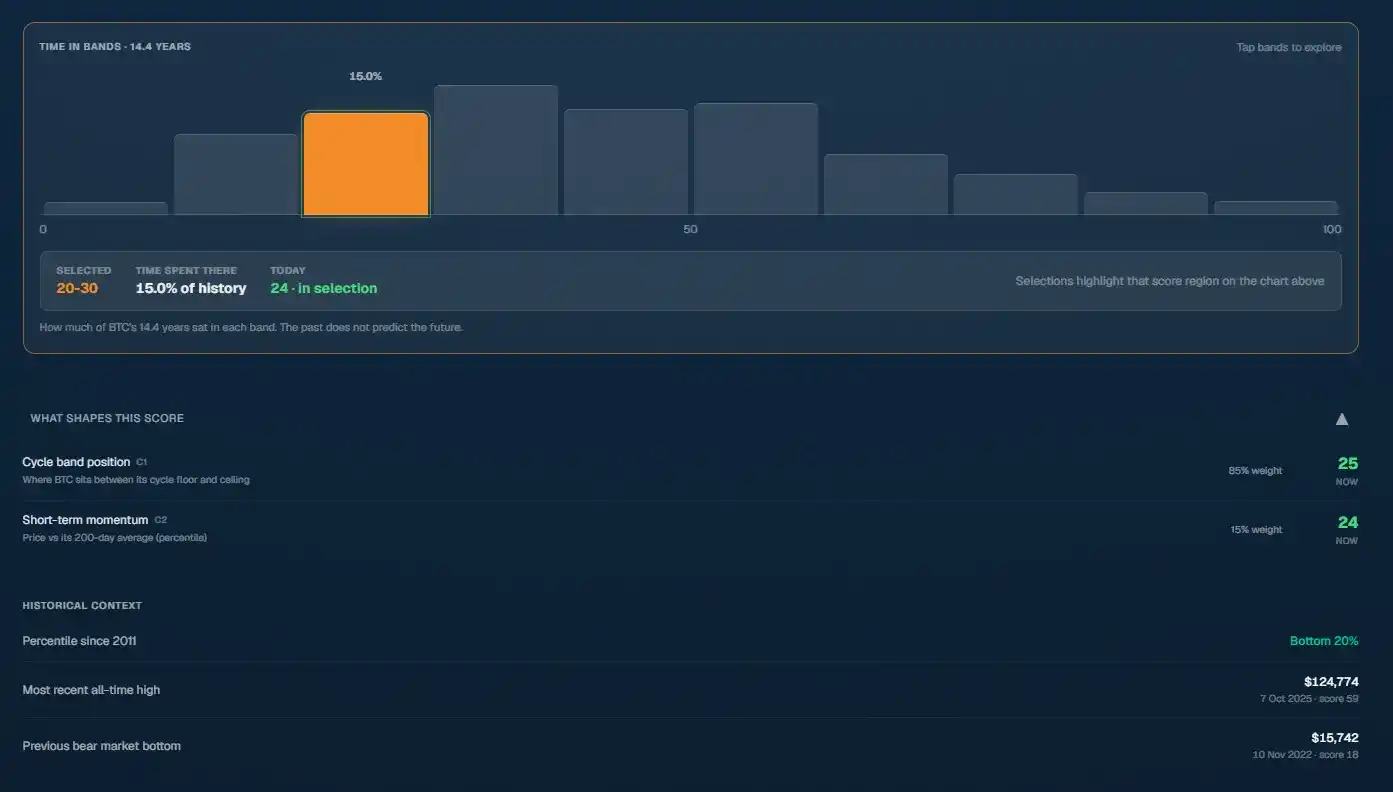
Since 2014, every Bitcoin bear market has ended the same way on this model: the score spends real time below 20 before the turn. The 2015 bottom printed around 7. December 2018 printed around 15. At the November 2022 price low of $15,742, the score read 18, and spent weeks below 20 around that time.
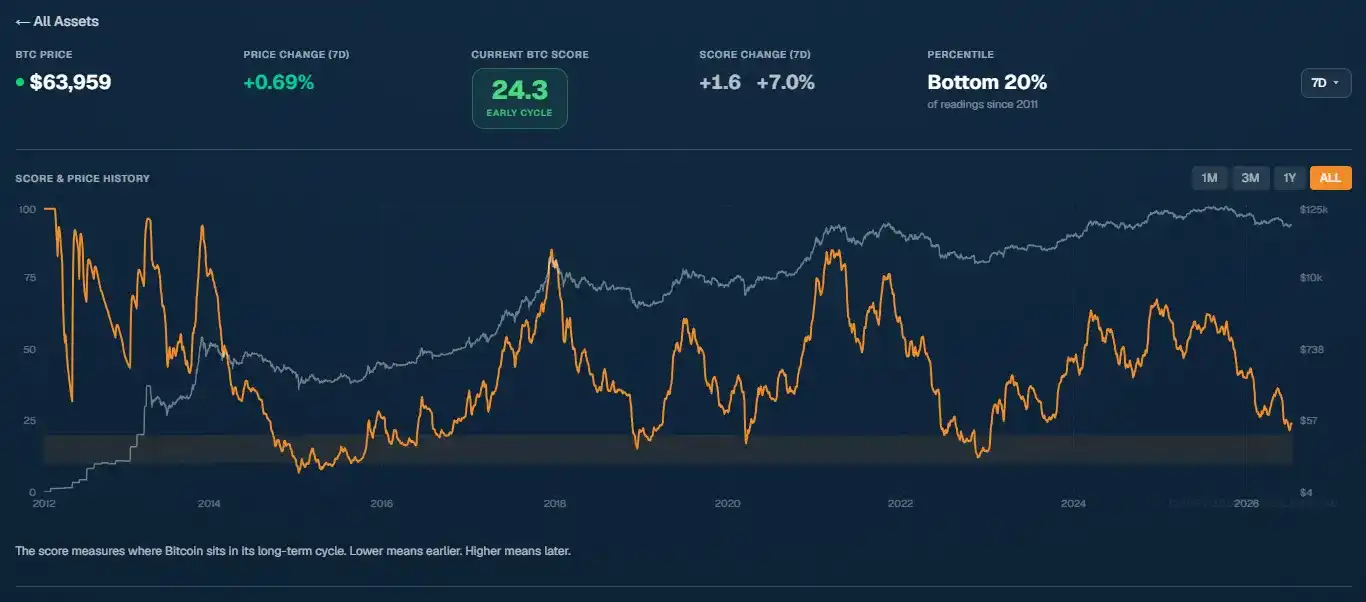
The lowest print of this cycle so far: 21.5, July 1st, with BTC at $58,550.

Close. But not there.

Take from that what you will, but here is my honest take: By the standard of every previous cycle, we have not yet seen the kind of washout that has historically marked the end. That is one possibility. The other possibility is that this cycle stays shallower, just as each prior cycle has been shallower than the last. Our October 2025 top printed a score of 59, well short of the 74+ readings of past manias. A compressed top could mean a compressed bottom. The past doesn't predict the future, and I won't pretend the model is a crystal ball. It's a map of where we are, not a prediction of where we're going.

What I actually did, because a score without a decision is just decoration:

I bought on July 1st. Not because I called a bottom (I didn't know it was a bottom, no one does). But because my plan had a trigger set at that price, and the trigger fired. It felt like a completely ordinary day. The score printed the cheapest reading of the entire cycle, and my phone didn't ring once. That's what real accumulation zones feel like: boring, quiet, slightly nauseating.

I still have a large chunk of capital left. Its deployment schedule is written in my plan, tied to score levels, not to how I feel on a given day. If the score prints below 20, my plan buys more aggressively. If it doesn't and the market turns anyway, my regular DCA already has me positioned. In either case, I don't need to be right. I just need to follow what I wrote when I was calm.

The rebuilt score is live in the app now, along with historical data, so you can check every claim I just made against the charts yourself.

CSH Risk Dashboard
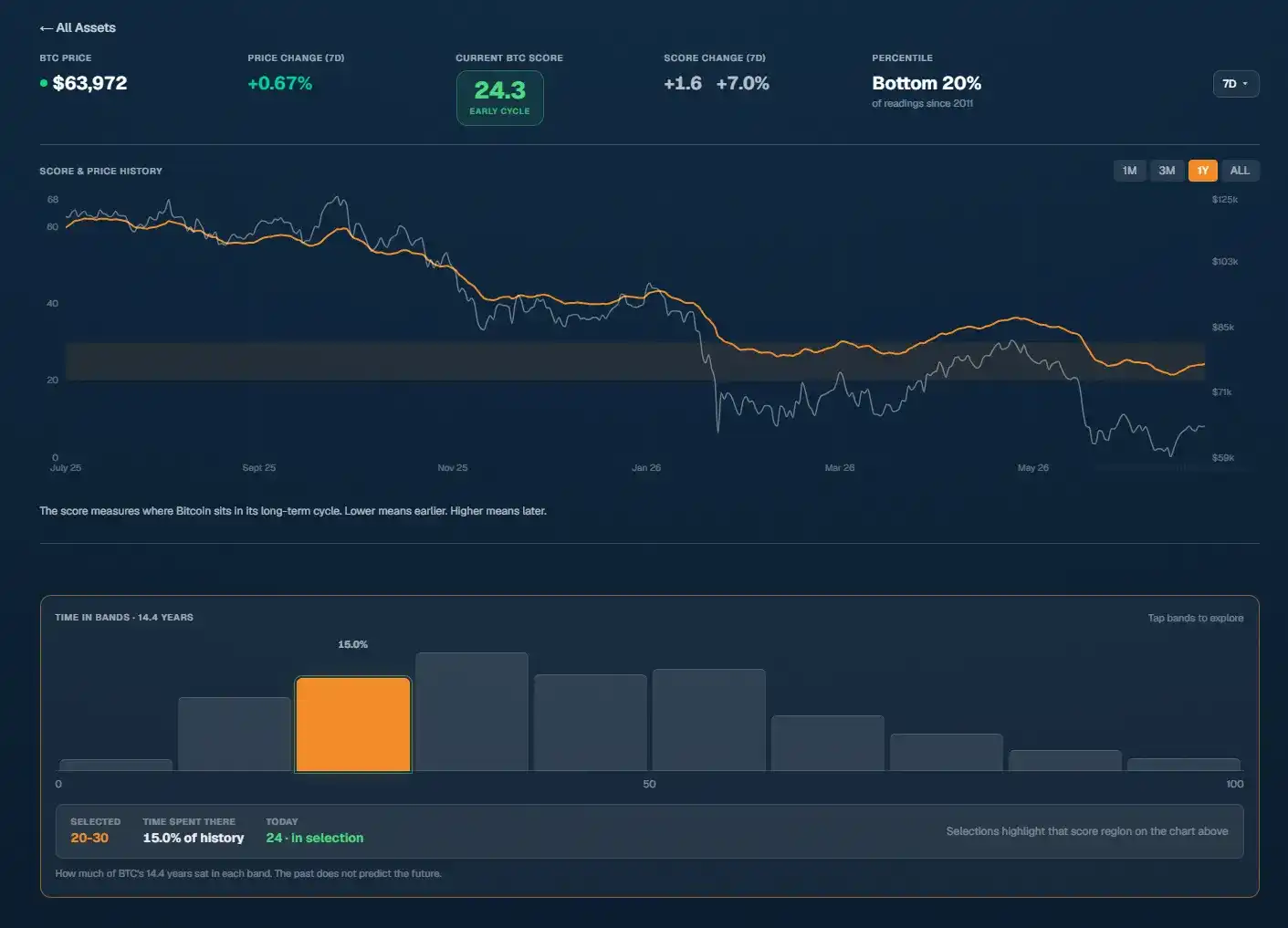
The numbers as of tonight:

BTC $64,085, up 0.96% this week. The score sits at 24.3, up 1.6 points (7%) over the same period, in the bottom 20% of all readings since 2011. We're in the 20-30 band, where BTC has spent about 15% of its 14.4-year history.

To callback, because the system keeps receipts: The July 1st low at $58,550 printed the cheapest score of this cycle, 21.5. Since then, price is up about 9.5%, and the score has risen with it. None of this changes the plan. The next tier has its trigger, and the trigger hasn't moved.

BTC reclaimed its 200-week moving average this week, around $62.9k, after losing it on July 1st. So what: That line is the life/death line for long-term holders, and the past two bear markets ground below it for months. A quick reclaim is constructive. My plan doesn't trade moving averages, but this aligns with the shift the score's momentum reading captured this week.

One bitcoin now buys about 15.5 ounces of gold, the lowest in nearly three years. Gold has corrected hard, from near-record highs of ~$5,100 in January to around $4,120, but BTC has still lost ground relative to it: This ratio has roughly halved since the October top, when one coin bought nearly 30 ounces. So what: Hard money capital went to gold first this cycle. When the crypto cycle turns, this ratio will snap back fast. My plan doesn't trade this ratio, but there's no clearer picture of how unloved BTC is right now.

Bitcoin dominance at 59%. So what: Altseason isn't even on the radar. The playbook's bear market rule: Altcoins bleed longer and harder. Plan accumulates the index leader first, asks altcoin questions much later in the cycle.

Jake's Workbench: Launch Week

The biggest build week we've ever had. Tom is a machine:

CSH Score v4.1 is live for BTC, with ETH, SOL, and XRP to follow. The website ate a full UI overhaul, charts and mobile included. And we ran a full security audit ahead of something we've been working toward all year: The paid Founding Plan.
To be direct about that last thing: There will be exactly 100 Founding seats, discount priced and permanently locked. That cap is real, not marketing theater, so when it's full, it's full. If you want first look, create a free account, and you'll hear it from me before anyone else. For the price of a coffee or two a month, you get the score, the plan builder, and a dashboard that keeps you honest on the days you don't want to be.

An apology here: If you were using a live plan with triggers on the score this week, the model change moved your readings. I know that's annoying. Short-term pain, long-term sharper tool. Full changelog on the site.

Looking Ahead to Next Week

I'm watching three things, none requiring prediction:

The 200-week MA around $62.9K. We reclaimed it this week after losing it July 1st. Holding above it is the first good sign; losing it again puts lower support back in play.

The path of the score to 20. Every prior bear market printed below it before turning, but not this one yet. If it gets there, my plan buys harder. If it doesn't, DCA already has me positioned. Watch this number with me in the app.

The gold rotation. If the BTC/gold ratio stops declining, that's the earliest signal hard money capital is starting to look our way.

We rebuilt our own model 10 to 12 weeks before asking anyone to pay for it, and the new version makes today's market look less like a bottom, not more. That was the most commercially inconvenient possible result, and we shipped it anyway. Systems over hype was never meant to be a slogan.

My question for you this week, and I'll feature the best answers next issue: What score level would get you to deploy your final third of dry powder? Reply with a number. Mine is already written in my plan.

If this issue was useful, give it a heart. Substack decides who else to show it to based on that.

Talk next Sunday,

Thanks for reading. Share this with someone who would find it valuable.

Criptos en tendencia

Preguntas relacionadas

QAccording to the article, what is the key historical signal for Bitcoin bottoming out since 2014 that has not yet been fully met in the current cycle?

ASince 2014, every Bitcoin bear market has ended with the CSH Score valuation model reading remaining below 20 for a substantial period before the turn. The current cycle's lowest reading so far is 21.5, which is close but has not yet fallen below the 20 threshold.

QWhat major change was made to the CSH Score model (v4.1), and what was its purpose?

AThe model was rebuilt to measure the price's position within a projected fair value range that moves forward with the asset, rather than comparing today's price against Bitcoin's entire volatile history. This corrects a flaw in the old model where early extreme volatility made the score read lower and drift, providing a better and more accurate measuring tool.

QWhat action did the author take on July 1st, and why?

AThe author bought Bitcoin on July 1st when the price was $58,550. This was not an attempt to call the bottom, but because a pre-set trigger in his investment plan was activated at that price level, which coincided with the cycle's cheapest CSH Score reading of 21.5 at that time.

QWhat does the current Bitcoin-to-Gold ratio indicate about market sentiment towards BTC?

AThe current ratio of approximately 15.5 ounces of gold per Bitcoin is near a three-year low, having halved since the peak in October. This indicates that hard-money capital favored gold this cycle and that Bitcoin is currently deeply out of favor relative to gold.

QWhat is the author's stated investment strategy regarding potential further downside and his remaining capital?

AThe author has a significant portion of capital remaining. His deployment schedule is tied to specific CSH Score levels outlined in his plan, not daily emotions. If the score prints below 20, his plan dictates more aggressive buying. If it doesn't fall below 20 but the market turns anyway, his regular Dollar-Cost Averaging (DCA) already gives him exposure. The strategy is to follow the pre-written plan.

Lecturas Relacionadas

Qingyan Jingzhun Raises Hundreds of Millions in Funding, with Investment from National Equipment Manufacturing Giants

Qingyan Precision, a provider of physical AI infrastructure, has secured billions of RMB in Series B financing. The investment round, led by prominent automotive industry funds and notably featuring the state-owned China National Machinery Industry Corp. (Sinomach) fund, underscores a strategic shift in the capital market towards companies with proven industrial application capabilities. The company positions itself as the "engineering foundation for physical AI," specializing in enabling embodied intelligence (like humanoid robots) to operate in complex, real-world industrial environments. Its core offering is the "TsingLoop" multi-modal data engineering pipeline, which captures and standardizes data from physical workspaces (like visual, force, and process parameters) to create reusable data assets. This system supports a "Robot-in-the-Loop" testing framework that validates robotic performance in digital twin simulations and real-world conditions before deployment. Qingyan Precision leverages over eight years of experience and a network of 2000+ industrial sensor nodes across sectors like automotive and mining. This provides a crucial "training ground" for embodied AI models. The founding team combines academic pedigree from Tsinghua University and Stanford with deep industry experience from leading robotics firms. The company's vision is to build "one foundation, one brain, and hundreds of vertical applications," using its data platform and industrial world model to deploy scalable physical intelligence across various industrial tasks.

marsbitHace 1 hora(s)

Qingyan Jingzhun Raises Hundreds of Millions in Funding, with Investment from National Equipment Manufacturing Giants

marsbitHace 1 hora(s)

Making a Fortune of $10.32 Million: The World Cup Money-Printing Tactic of a Polymarket Whale

**Earning $10.32 Million: A Polymarket Whale's World Cup Profit Strategy** While teams battle for the World Cup trophy, a hidden whale nicknamed "swisstony" has been quietly making a fortune on the prediction market Polymarket. This account, created around July 2025, boasts total profits of $18.62 million, with $10.33 million earned in the past month alone. With a 52.9% win rate, it has placed over 139,600 predictions, averaging about 380 trades per day—indicating it is likely a high-frequency quantitative bot. The account's signature "trash panda" aptly describes its strategy: sifting through vast market data and tiny price discrepancies to build wealth. Its current holdings are heavily concentrated on the France vs. Spain semi-final, including a roughly $160,000 bet against France. Analysis shows two core tactics driving its success: 1. **High-Volume "Anti-Favorite" Bets:** Placing large wagers (often $400k-$1M) against overvalued favorites like Germany or England, buying "No" shares at favorable prices when market-implied win probability is 46%-64%. It has recorded over 17 individual profits exceeding $1 million using this method. 2. **"Lottery-Ticket" Bets on Extreme Long Shots:** Allocating small amounts (thousands of dollars) to buy shares priced as low as 0.2¢-1.2¢ on outcomes deemed nearly impossible. While most of these bets lose, the occasional win—like those with payouts over 100x—generates significant profits (over $100,000 per hit) that boost overall returns without risking much capital. This dual approach combines consistent, large-scale profit from correcting major market mispricings with opportunistic, high-reward bets on extreme underdogs. The account exemplifies how systematic, high-frequency execution can amplify a small statistical edge into millions in profits on prediction markets.

Foresight NewsHace 1 hora(s)

Making a Fortune of $10.32 Million: The World Cup Money-Printing Tactic of a Polymarket Whale

Foresight NewsHace 1 hora(s)

AI Token Factory Explosion: Tsinghua University Team Raises 10 Billion in Half a Year

Qijing Tech, a company founded by a Tsinghua University team of faculty and students, has rapidly become a significant player in China's AI infrastructure sector, focusing on high-quality AI token production. Over the past six months, the startup has secured over 1 billion RMB in funding. The company specializes in AI inference—the efficient use of AI models—positioning itself as a "high-quality AI token factory." Unlike many competitors initially focused on model training, Qijing Tech believes inference is where real economic value is generated. Its core technology optimizes the entire AI token production chain through innovations like "full-system heterogeneous collaboration," aiming for stable, efficient, and low-cost output suitable for enterprise use. This strategy has attracted significant investor interest. Major funding rounds have been led by institutions such as Henan Investment Group Huirong Fund, with continued backing from existing investors. The company's "less models, deeper optimization" approach, concentrating resources on key models and high-value scenarios, is resonating in a market where a few top models dominate token usage. The results are promising. Since early 2026, Qijing Tech reports a threefold increase in token production efficiency per unit of computing power and a thirtyfold increase in total high-quality token output. Monthly revenue for June 2026 alone surpassed its entire 2025 revenue. Operating on a "Token as a Service" (TaaS) model, Qijing Tech engages in both direct token sales and collaborative operations, helping partners like state-owned enterprises transition from traditional computing power leasing to high-value token production. As AI token usage in China surges, Qijing Tech aims to be a key enabler in the emerging AI token economy, building the essential infrastructure for the AI era.

marsbitHace 1 hora(s)

AI Token Factory Explosion: Tsinghua University Team Raises 10 Billion in Half a Year

marsbitHace 1 hora(s)

Financing Weekly Report | SBI Makes Consecutive Moves, Bets $125 Million on Gauntlet; Crypto Capital Continues to Flow to Trading and Infrastructure

Weekly crypto financing highlights show capital continues to flow into trading, compliance, and digital asset infrastructure, with traditional financial institutions like Japan's SBI Holdings playing a larger role. SBI made two major investments: a $125M exclusive investment in DeFi risk management and asset allocation platform Gauntlet, and leading a $76M Series C round for crypto exchange EDX Markets. Other notable crypto deals included: QIZ Security ($17M seed) for post-quantum cryptography management; TrueDAO ($10M strategic) for AI-powered DeFi infrastructure; KOR Protocol ($7.5M Series A) for an on-chain creative asset clearing platform; Tether's $20M strategic investment in Brazil's Mercado Bitcoin; and M1X Global ($5.5M seed) for sovereign financial infrastructure. The AI sector saw larger individual rounds. Prime Intellect raised $130M Series A for its decentralized AI protocol stack. AI legal services firm Norm raised $120M, reaching a $1.2B valuation. Voice AI company Gradium's total funding surpassed $100M. The report also notes a shift towards business models focused on specific enterprise-level AI infrastructure and application scenarios. Overall, the crypto primary market remains subdued, with nine deals totaling over $261M last week, centered on centralized finance, DeFi, and infrastructure.

marsbitHace 1 hora(s)

Financing Weekly Report | SBI Makes Consecutive Moves, Bets $125 Million on Gauntlet; Crypto Capital Continues to Flow to Trading and Infrastructure

marsbitHace 1 hora(s)

Trading

Spot

Artículos destacados

Qué es BITCOIN

Entendiendo HarryPotterObamaSonic10Inu (ERC-20) y Su Posición en el Espacio Cripto En los últimos años, el mercado de criptomonedas ha sido testigo de un aumento en la popularidad de las monedas meme, capturando el interés no solo de los comerciantes, sino también de aquellos que buscan compromiso comunitario y valor de entretenimiento. Entre estos tokens únicos se encuentra HarryPotterObamaSonic10Inu (ERC-20), un proyecto intrigante que mezcla referencias culturales en el tejido de las criptomonedas. Este artículo profundiza en los aspectos clave de HarryPotterObamaSonic10Inu, explorando sus mecanismos, ethos impulsado por la comunidad y su relación con el paisaje cripto más amplio. ¿Qué es HarryPotterObamaSonic10Inu (ERC-20)? Como su nombre sugiere, HarryPotterObamaSonic10Inu es una moneda meme construida sobre la blockchain de Ethereum, clasificada bajo el estándar ERC-20. A diferencia de las criptomonedas tradicionales que pueden enfatizar la utilidad práctica o el potencial de inversión, este token prospera en el valor de entretenimiento y la fuerza de su comunidad. El proyecto tiene como objetivo fomentar un entorno donde los usuarios comprometidos puedan reunirse, compartir ideas y participar en actividades inspiradas por diversos fenómenos culturales. Una característica notable de HarryPotterObamaSonic10Inu es su cero impuestos en las transacciones. Este atractivo elemento tiene como objetivo incentivar el comercio y la participación comunitaria, sin cargos adicionales que puedan disuadir a los comerciantes de pequeña escala. El suministro total de la moneda está establecido en mil millones de tokens, una cifra que marca su intención de mantener una circulación sustancial dentro de la comunidad. Creador de HarryPotterObamaSonic10Inu (ERC-20) Los orígenes de HarryPotterObamaSonic10Inu están algo envueltos en misterio; los detalles sobre el creador siguen siendo desconocidos. El desarrollo de este token carece de un equipo identificable o de un plan explícito, lo cual no es inusual dentro del sector de monedas meme. En cambio, el proyecto ha surgido de manera orgánica, con su progreso muy dependiente del entusiasmo y la participación de su comunidad. Inversores de HarryPotterObamaSonic10Inu (ERC-20) En cuanto a inversiones externas y respaldo, HarryPotterObamaSonic10Inu también sigue siendo ambiguo. El token no lista ninguna fundación de inversión conocida o apoyo organizacional significativo. En cambio, la savia del proyecto es su comunidad de base, que informa su crecimiento y sostenibilidad a través de la acción colectiva y el compromiso en el espacio cripto. ¿Cómo Funciona HarryPotterObamaSonic10Inu (ERC-20)? Como una moneda meme, HarryPotterObamaSonic10Inu opera principalmente fuera de los marcos tradicionales que a menudo rigen el valor de los activos. Hay varios aspectos distintivos que definen cómo funciona el proyecto: Transacciones Sin Impuestos: Sin tarifas impositivas en las transacciones, los usuarios pueden comprar y vender el token libremente sin preocuparse por costos ocultos. Compromiso Comunitario: El proyecto prospera en la interacción comunitaria, aprovechando plataformas de redes sociales para crear entusiasmo y facilitar la participación. Las discusiones, el intercambio de contenido y el compromiso son elementos cruciales que ayudan a expandir su alcance y fomentar la lealtad entre los seguidores. Sin Utilidad Práctica: Cabe señalar que HarryPotterObamaSonic10Inu no ofrece utilidad concreta dentro del ecosistema financiero. Más bien, se clasifica como un token principalmente para actividades de entretenimiento y comunitarias. Referencia Cultural: El token incorpora astutamente elementos de la cultura popular para atraer interés, conectando con entusiastas de los memes y seguidores de las criptomonedas por igual. HarryPotterObamaSonic10Inu ejemplifica cómo las monedas meme operan de manera diferente a los proyectos de criptomonedas más tradicionales, ingresando al mercado como construcciones sociales innovadoras en lugar de activos utilitarios. Cronología de HarryPotterObamaSonic10Inu (ERC-20) La historia de HarryPotterObamaSonic10Inu está marcada por varios hitos notables: Creación: El token surgió de un meme viral, capturando la imaginación de muchos entusiastas de las criptomonedas. Las fechas específicas de creación no están disponibles, subrayando su ascenso orgánico. Listado en Exchanges: HarryPotterObamaSonic10Inu ha llegado a varios exchanges, permitiendo un acceso y comercio más fácil por parte de la comunidad. Iniciativas de Compromiso Comunitario: Actividades continuas destinadas a mejorar la interacción comunitaria, incluyendo concursos, campañas en redes sociales y generación de contenido por parte de fanáticos y defensores. Planes de Expansión Futuros: La hoja de ruta del proyecto incluye el lanzamiento de una colección de NFT, mercancía y un sitio de comercio electrónico relacionado con sus temas culturales, involucrando aún más a la comunidad e intentando añadir más dimensiones a su ecosistema. Puntos Clave Sobre HarryPotterObamaSonic10Inu (ERC-20) Naturaleza Impulsada por la Comunidad: El proyecto prioriza la participación colectiva y la creatividad, asegurando que la involucración de los usuarios esté a la vanguardia de su desarrollo. Clasificación como Moneda Meme: Representa la epítome de las criptomonedas basadas en el entretenimiento, diferenciándose de los vehículos de inversión tradicionales. Sin Afiliación Directa con Bitcoin: A pesar de la similitud en el nombre del ticker, HarryPotterObamaSonic10Inu es distinto y no tiene relación con Bitcoin u otras criptomonedas establecidas. Enfoque en la Colaboración: HarryPotterObamaSonic10Inu está diseñado para crear un espacio para la colaboración y el intercambio de historias entre sus poseedores, proporcionando una vía para la creatividad y el vínculo comunitario. Perspectivas Futuras: La ambición de expandirse más allá de su premisa inicial hacia NFTs y mercancías describe un camino para que el proyecto potencialmente ingrese a avenidas más tradicionales dentro de la cultura digital. A medida que las monedas meme continúan capturando la imaginación de la comunidad de criptomonedas, HarryPotterObamaSonic10Inu (ERC-20) se destaca debido a sus lazos culturales y su enfoque centrado en la comunidad. Si bien puede no encajar en el molde típico de un token impulsado por la utilidad, su esencia radica en la alegría y la camaradería fomentadas entre sus seguidores, destacando la naturaleza en evolución de las criptomonedas en una era cada vez más digital. A medida que el proyecto continúa desarrollándose, será importante observar cómo las dinámicas comunitarias influyen en su trayectoria en el cambiante paisaje de la tecnología blockchain.

1.9k Vistas totalesPublicado en 2024.04.01Actualizado en 2024.12.03

Qué es BITCOIN

Cómo comprar BTC

¡Bienvenido a HTX.com! Hemos hecho que comprar Bitcoin (BTC) sea simple y conveniente. Sigue nuestra guía paso a paso para iniciar tu viaje de criptos.Paso 1: crea tu cuenta HTXUtiliza tu correo electrónico o número de teléfono para registrarte y obtener una cuenta gratuita en HTX. Experimenta un proceso de registro sin complicaciones y desbloquea todas las funciones.Obtener mi cuentaPaso 2: ve a Comprar cripto y elige tu método de pagoTarjeta de crédito/débito: usa tu Visa o Mastercard para comprar Bitcoin (BTC) al instante.Saldo: utiliza fondos del saldo de tu cuenta HTX para tradear sin problemas.Terceros: hemos agregado métodos de pago populares como Google Pay y Apple Pay para mejorar la comodidad.P2P: tradear directamente con otros usuarios en HTX.Over-the-Counter (OTC): ofrecemos servicios personalizados y tipos de cambio competitivos para los traders.Paso 3: guarda tu Bitcoin (BTC)Después de comprar tu Bitcoin (BTC), guárdalo en tu cuenta HTX. Alternativamente, puedes enviarlo a otro lugar mediante transferencia blockchain o utilizarlo para tradear otras criptomonedas.Paso 4: tradear Bitcoin (BTC)Tradear fácilmente con Bitcoin (BTC) en HTX's mercado spot. Simplemente accede a tu cuenta, selecciona tu par de trading, ejecuta tus trades y monitorea en tiempo real. Ofrecemos una experiencia fácil de usar tanto para principiantes como para traders experimentados.

5.3k Vistas totalesPublicado en 2024.12.12Actualizado en 2026.06.02

Cómo comprar BTC

Qué es $BITCOIN

ORO DIGITAL ($BITCOIN): Un Análisis Integral Introducción al ORO DIGITAL ($BITCOIN) ORO DIGITAL ($BITCOIN) es un proyecto basado en blockchain que opera en la red Solana, cuyo objetivo es combinar las características de los metales preciosos tradicionales con la innovación de las tecnologías descentralizadas. Aunque comparte un nombre con Bitcoin, a menudo referido como “oro digital” debido a su percepción como un refugio de valor, ORO DIGITAL es un token separado diseñado para crear un ecosistema único dentro del paisaje Web3. Su meta es posicionarse como un activo digital alternativo viable, aunque los detalles sobre sus aplicaciones y funcionalidades aún están en desarrollo. ¿Qué es ORO DIGITAL ($BITCOIN)? ORO DIGITAL ($BITCOIN) es un token de criptomoneda diseñado explícitamente para su uso en la blockchain de Solana. A diferencia de Bitcoin, que proporciona un papel de almacenamiento de valor ampliamente reconocido, este token parece centrarse en aplicaciones y características más amplias. Aspectos notables incluyen: Infraestructura Blockchain: El token está construido sobre la blockchain de Solana, conocida por su capacidad para manejar transacciones de alta velocidad y bajo costo. Dinámicas de Suministro: ORO DIGITAL tiene un suministro máximo limitado a 100 cuatrillones de tokens (100P $BITCOIN), aunque los detalles sobre su suministro circulante no se han divulgado actualmente. Utilidad: Si bien las funcionalidades precisas no están delineadas explícitamente, hay indicios de que el token podría ser utilizado para diversas aplicaciones, potencialmente involucrando aplicaciones descentralizadas (dApps) o estrategias de tokenización de activos. ¿Quién es el Creador de ORO DIGITAL ($BITCOIN)? En la actualidad, la identidad de los creadores y el equipo de desarrollo detrás de ORO DIGITAL ($BITCOIN) sigue siendo desconocida. Esta situación es típica entre muchos proyectos innovadores dentro del espacio blockchain, particularmente aquellos alineados con las finanzas descentralizadas y fenómenos de monedas meme. Si bien tal anonimato puede fomentar una cultura impulsada por la comunidad, intensifica las preocupaciones sobre la gobernanza y la responsabilidad. ¿Quiénes son los Inversores de ORO DIGITAL ($BITCOIN)? La información disponible indica que ORO DIGITAL ($BITCOIN) no tiene patrocinadores institucionales conocidos ni inversiones destacadas de capital de riesgo. El proyecto parece operar en un modelo de peer-to-peer centrado en el apoyo y la adopción de la comunidad en lugar de rutas de financiamiento tradicionales. Su actividad y liquidez se sitúan principalmente en intercambios descentralizados (DEX), como PumpSwap, en lugar de plataformas de trading centralizadas establecidas, lo que resalta aún más su enfoque de base. Cómo Funciona ORO DIGITAL ($BITCOIN) Los mecanismos operativos de ORO DIGITAL ($BITCOIN) pueden elaborarse en función de su diseño blockchain y atributos de red: Mecanismo de Consenso: Al aprovechar el único proof-of-history (PoH) de Solana combinado con un modelo de proof-of-stake (PoS), el proyecto asegura una validación de transacciones eficiente que contribuye al alto rendimiento de la red. Tokenómica: Si bien los mecanismos deflacionarios específicos no se han detallado extensamente, el vasto suministro máximo de tokens implica que podría atender microtransacciones o casos de uso nicho que aún están por definirse. Interoperabilidad: Existe el potencial de integración con el ecosistema más amplio de Solana, incluyendo varias plataformas de finanzas descentralizadas (DeFi). Sin embargo, los detalles sobre integraciones específicas permanecen no especificados. Cronología de Eventos Clave Aquí hay una cronología que destaca hitos significativos relacionados con ORO DIGITAL ($BITCOIN): 2023: El despliegue inicial del token ocurre en la blockchain de Solana, marcado por su dirección de contrato. 2024: ORO DIGITAL gana visibilidad al estar disponible para trading en intercambios descentralizados como PumpSwap, permitiendo a los usuarios comerciar contra SOL. 2025: El proyecto presencia actividad de trading esporádica y potencial interés en compromisos liderados por la comunidad, aunque no se han documentado asociaciones notables o avances técnicos hasta el momento. Análisis Crítico Fortalezas Escalabilidad: La infraestructura subyacente de Solana soporta altos volúmenes de transacciones, lo que podría mejorar la utilidad de $BITCOIN en varios escenarios de transacción. Accesibilidad: El potencial bajo precio de trading por token podría atraer a inversores minoristas, facilitando una participación más amplia debido a oportunidades de propiedad fraccionada. Riesgos Falta de Transparencia: La ausencia de patrocinadores, desarrolladores o un proceso de auditoría conocidos públicamente puede generar escepticismo sobre la sostenibilidad y confiabilidad del proyecto. Volatilidad del Mercado: La actividad de trading depende en gran medida del comportamiento especulativo, lo que puede resultar en una volatilidad de precios significativa y en incertidumbre para los inversores. Conclusión ORO DIGITAL ($BITCOIN) surge como un proyecto intrigante pero ambiguo dentro del ecosistema de Solana en rápida evolución. Si bien intenta aprovechar la narrativa del “oro digital”, su alejamiento del papel establecido de Bitcoin como refugio de valor subraya la necesidad de una diferenciación más clara de su utilidad y estructura de gobernanza previstas. La aceptación y adopción futura dependerán probablemente de abordar la actual opacidad y de definir sus estrategias operativas y económicas de manera más explícita. Nota: Este informe abarca información sintetizada disponible hasta octubre de 2023, y pueden haber ocurrido desarrollos más allá del período de investigación.

119 Vistas totalesPublicado en 2025.05.13Actualizado en 2025.05.13

Qué es $BITCOIN

Discusiones

Bienvenido a la comunidad de HTX. Aquí puedes mantenerte informado sobre los últimos desarrollos de la plataforma y acceder a análisis profesionales del mercado. A continuación se presentan las opiniones de los usuarios sobre el precio de BTC (BTC).

活动图片