Author: Jae, PANews
In the hot summer of July, RWA (Real World Assets) became the hottest narrative in the crypto market. The on-chain scale reached a historical high of $32 billion, an increase of approximately 22% compared to the beginning of the month, surpassing the previous peak set in April this year.
While the industry was still celebrating the breakthrough of $30 billion in RWA tokenization scale, a set of DeFi utilization data revealed its structural dilemma beneath the prosperous surface. Currently, nearly 90% of on-chain RWA is in an unused state, not participating in any DeFi activities such as lending or collateral.
The severe imbalance between scale and activity is becoming an unavoidable practical proposition for the RWA track: assets are on-chain, and then what?
A "Scissors Gap" Between Scale and Utilization, Divergent Performance Among Leading Platforms
According to the "True State of Tokenization 2026" report jointly released by BeInCrypto Intelligence and RWA.xyz, among 1,289 tokenized assets with a value exceeding $100,000, 910 assets had no on-chain transfers within a week. This means that over 70% of tokenized assets are usually "asleep."
Additionally, according to statistics from Edgy, a partner at Bitcoin L2 protocol Stacks, the total scale of the RWA market currently exceeds $30 billion, with 87% of the assets in a state of "on-chain dormancy": they have not entered the lending market as collateral, nor formed effective circulation in trading venues. Most have only completed the first step of "accounting on-chain." The report from DWF Labs also points out that currently only about 10% of tokenized RWA are truly active in DeFi protocols, while the remaining 90% are static capital "parked" in institutional wallets.
This divergence between "scale and utilization" is even more evident among leading platforms.
Securitize: Scale Champion, Underperformer in Utilization
As the issuance partner for BlackRock's BUIDL fund, Securitize is undoubtedly the "volume king" in the RWA tokenization field. To date, its tokenized asset scale has exceeded $4.9 billion, with Q1 revenue reaching $19.5 million, and it even went public on the New York Stock Exchange with a valuation of approximately $1.25 billion. However, its DeFi utilization rate is only about 0.7%, creating a huge contrast between its massive asset scale and extremely low DeFi usage rate.
Ondo Finance: Multi-Chain Expansion, Utilization Remains Low
The protocol manages nearly $3.5 billion in tokenized assets, has deployed on over 10 chains, possesses 168 integrated projects, and its tokenized equity market share exceeds 70%. Ondo's DeFi utilization rate is about 2.7%. Although better than Securitize, it still has a significant gap from being truly "active."
Maple Finance: "Small Scale" Achieves "High Efficiency"
Maple's scale is much smaller than Securitize and Ondo, with its assets under management being only $2.3 billion. However, its active loans have exceeded $1.6 billion, with cumulative loans initiated surpassing $22 billion, achieving a DeFi utilization rate as high as 62%.
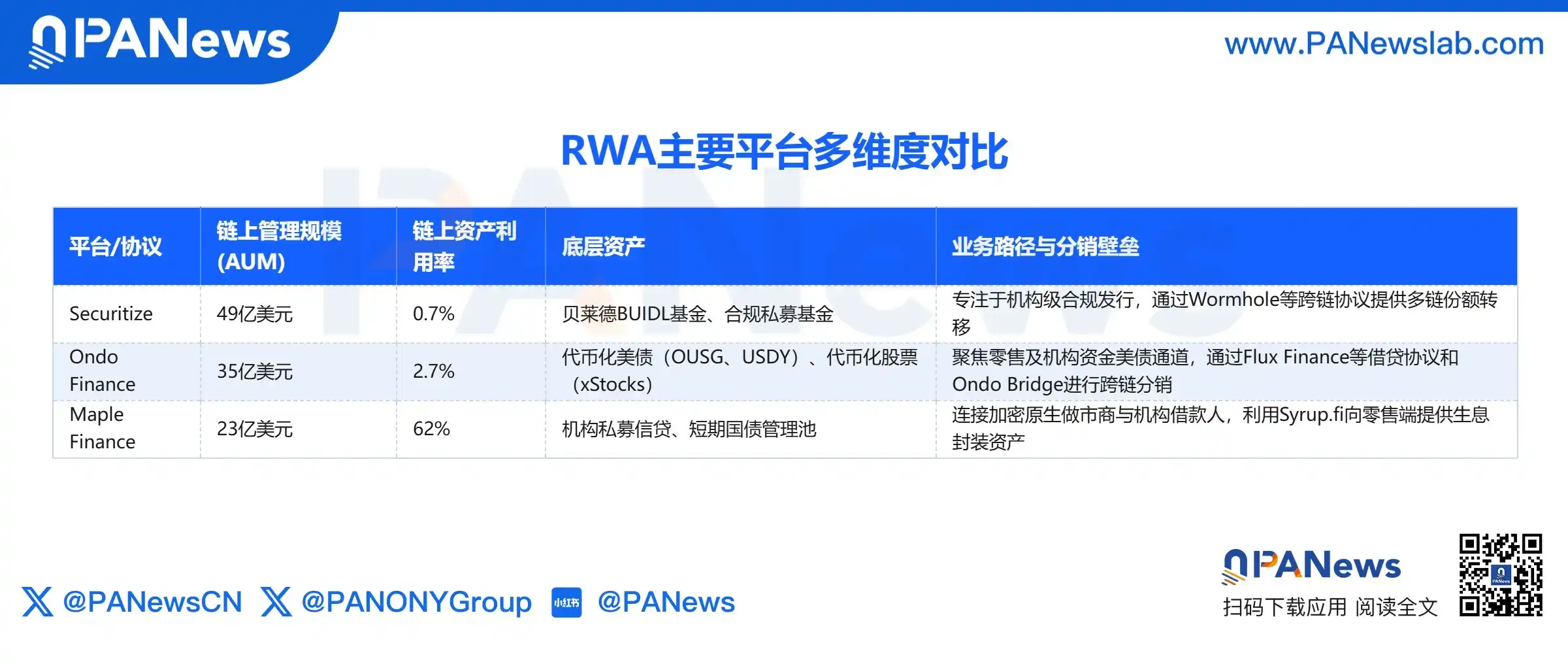
In terms of business models, the three have fundamental differences.
Securitize and Ondo primarily play the role of "asset issuers." Their strengths lie in compliance architecture and institutional relationships: obtaining licenses, signing major clients, moving assets onto the chain. Their revenue comes from issuance and management fees, representing a "selling shovels" business model. The circulation and use after tokenization are not their main business segments.
Maple, on the other hand, is an "asset application faction." It is an on-chain credit protocol, and its assets are designed from issuance to be embedded in lending activities. Therefore, Maple can leverage its smaller asset scale to achieve higher DeFi utilization, allowing assets to truly "circulate" and generate on-chain economic value such as lending interest and transaction fees.
Why Does "On-Chain" Not Equal "Circulation"?
The phenomenon of RWA "falling asleep once on-chain" is a current stage state resulting from the combined effects of asset attributes, compliance constraints, and infrastructure deficiencies.
Asset Attributes: Yield-Holding ≠ Trading Circulation
Currently, the on-chain RWA track is dominated by two main segments: "active yield pools" primarily based on private credit, and "yield havens" based on tokenized treasury bonds. They also exhibit a polarized trend in DeFi utilization.
The business essence of private credit is "fund lending." In Maple's credit pools, stablecoins deposited by investors are quickly lent out by the protocol to qualified institutional borrowers, thus pushing the DeFi utilization rate above 60%. This "deposit equals lending" model makes most of its TVL equivalent to the "outstanding loan balance."
In stark contrast, the DeFi utilization rate for tokenized treasury bonds is only about 5%. The value proposition of tokenized treasury bonds is "risk-free yield on-chain," not as a trading tool. Holders of products like BlackRock's BUIDL and Franklin Templeton's BENJI are mainly institutions and stablecoin issuers. Their purpose for buying is to hold and earn yield, not for frequent trading or leveraging.
A significant amount of tokenized treasury bonds are used as underlying assets for stablecoins: approximately 90% of Ethena's USDtb reserves hold BUIDL, and Frax's frxUSD also uses BUIDL as one of its reserve assets. It can be said that tokenized treasury bonds are fulfilling financial functions, just not reflected in the DeFi utilization metrics.
Compliance Shackles: Whitelist Mechanisms Naturally Limit Circulation
The vast majority of tokenized assets are legally classified as securities and must comply with strict investor suitability rules. Products like Securitize's BUIDL and Ondo's OUSG implement KYC whitelist mechanisms, where tokens can only be transferred between verified qualified investor wallets.
This means that from the moment traditional assets go on-chain, there is a fundamental logical contradiction with "permissionless DeFi." They can be tokenized but cannot freely enter public lending pools like Aave or Compound as collateral. Even permissioned markets like Aave Horizon can only cover a small portion of institutional users.
However, high scale and low utilization are an inevitable path for RWA to go mainstream. First moving assets onto the chain compliantly, establishing the full lifecycle of custody, auditing, and transfer agency, and then discussing composability, is the necessary sequence for institutional capital entry. From this perspective, "sleeping RWA" is not a waste but is accumulating strength for the next phase of development.
Infrastructure Deficiency: Market Making and Clearing Mechanisms Not Yet Mature
Andrei Grachev, Managing Partner at DWF Labs, pointed out that liquidity is a limiting factor for expanding RWA on-chain. What is lacking is the infrastructure that enables tokenized assets to be traded at scale: real-time pricing, instant redemption, and deep secondary markets capable of providing quotes.
As he said, the lack of liquidity infrastructure is precisely the third bottleneck RWA encounters. Market makers generally adopt a wait-and-see attitude towards tokenized assets: thin trading volumes cannot cover market-making costs, opaque valuation of underlying assets exacerbates holding risks, and compliance transfer restrictions further narrow the range of counterparties.
Due to low turnover rates, the bid-ask spreads for most RWA are much higher than in traditional financial markets. In the absence of deep secondary markets, even if investors want to participate in DeFi trading or lending, they face practical challenges in asset pricing and liquidation.
From "Issuance Race" to "Application Competition," Channels Are Eating Everything
The industry has become aware of the low DeFi utilization rate of tokenized assets, and the focus of competition in the second half of the RWA track is gradually shifting from "who issues more" to "who can use them."
On one hand, native credit protocols inherently possess the advantage of high DeFi utilization. Protocols like Maple and Centrifuge have deeply integrated assets with lending scenarios from their initial design, and their business models inherently drive asset circulation. Although such projects may not be large in scale, they represent a direction of deep integration between RWA and DeFi.
On the other hand, distribution layer integration is becoming a new growth point. Securitize integrates with UniswapX to achieve compliant on-chain trading,
Centrifuge partners with Morpho to open up lending distribution channels. The gradual improvement of the infrastructure layer is opening up the last mile from asset issuance to usage.
Even more noteworthy are gateway players like Robinhood Crypto. For the vast majority of DeFi protocols, the most difficult challenge after product launch is finding users and attracting liquidity. Robinhood Crypto possesses an existing application ecosystem (App), proprietary wallet (Wallet), and customer relationships. Assets, once issued, can be directly connected to existing users, solving the pain point of "who to find after issuance" faced by most platforms.
After the yield-bearing token SyrupUSDG, issued by Maple, was listed on Robinhood Crypto, its circulating market cap surged to $100 million within one month. In contrast, a similar product, SyrupUSDT, promoted by the protocol itself, took a full 9 months to reach the same level. This means that in the stage of RWA entering mass adoption, the dominance of channels, distribution networks, and user habits far exceeds the mere attributes of the assets.
The utilization paradox of RWA is essentially a microcosm of the collision between traditional financial frameworks and crypto-native logic. The former emphasizes compliance, risk control, and holding yield; the latter pursues composability, high turnover, and Lego-style innovation. The gap between the two is difficult to bridge in the short term by a single platform or single technology.
The $32 billion scale proves the feasibility of "moving traditional assets on-chain," but the low utilization rate also reminds the industry: this is just the first step of a long journey. The next test is not about how many assets can be recorded on the blockchain, but how many assets can circulate, be used, and create new application scenarios on-chain.
For builders and investors, the selection criteria for the next stage need to be more diverse: not only looking at issuance scale but also at liquidity depth; not only looking at the length of the asset list but also at the actual utilization rate. Tokenization is never the end goal; making assets come alive on-chain is the true starting point of the RWA narrative.






