The Real Cost of Being One Minute in Prediction Markets — A Study on the Golden Entry Windows for Different Events

marsbitPublicado a 2026-02-14Actualizado a 2026-02-14

Resumen

In prediction markets, the cost of hesitation is measured in minutes. This analysis of 2,023 on-chain trades on Polymarket reveals that the "confirmation tax"—the price paid for waiting to verify news—can be devastatingly high. The core metric is "Remaining Alpha" (1 - current price). For events that resolve to "YES" ($1), buying at $0.20 offers $0.80 in potential profit, while buying at $0.90 leaves only $0.10. The research identifies three distinct event types with their own profit decay curves: 1. **Sudden & Certain Events** (e.g., "Maduro arrested"): The golden window is the first 60 seconds, with an average entry price of $0.56 (44% Alpha). Alpha's half-life is less than 2 minutes, evaporating entirely after ~10 minutes. Strategy: Prioritize position over 100% certainty. 2. **Negotiation & Correction Events** (e.g., "SVB acquisition"): The decay is step-like. A 6-hour observation window existed with prices stable at ~$0.65, followed by a sharp price correction. Strategy: Look for confirmation signals (e.g., large smart money buys) rather than racing to be first. 3. **Priced-In Events** (e.g., "TikTok ban"): The event is highly anticipated. By the official deadline (T0), the price is already efficient (~$0.84), offering near-zero Alpha. Strategy: Avoid entering at T0; it's the finish line, not the start. The key takeaway: Time is an exponential function of money in prediction markets. A one-minute delay can mean forfeiting the vast majority of profitable alpha, t...

Author: Hubble AI

For prediction market traders, the biggest pain point is often not "not knowing," but "being too late."

When we see breaking news, our instinctive reaction is usually to first verify:"Is this news reliable?" or "Is it a rumor?" This caution is a virtue in traditional investing, but in binary options markets like Polymarket, it can be an extremely expensive hidden cost.

We call this cost the "confirmation tax."

The PolyHub team reviewed 2,023 on-chain trade-by-trade data points from Polymarket, attempting to answer a quantitative question: How much Alpha (excess return) did you actually sacrifice to obtain 100% information certainty?

The data conclusion was more brutal than we anticipated: in the most liquid突发事件 (sudden events), the first 10 minutes absorbed 96% of the information advantage. This means that when you spend 1 minute confirming the authenticity of the news, you have actually handed over the vast majority of the profits to those opponents who are willing to take risks or have faster information sources.

This article does not instill anxiety; it only uses on-chain data from three typical markets to reconstruct the "golden entry window" for different types of news events.

The conclusion is brutal and simple: In prediction markets, time is an exponential function of money. The later you enter, the smaller the remaining profit space you can capture, and this decay rate often far exceeds most people's imagination.

I. Defining the Metric: What is "Remaining Profit Space"?

To quantify the cost of "entering late," we use a simple metric:

Remaining Profit Space (Alpha) = 1 - Current Buy Price

For a contract that最终结算 (settles) at $1 (YES):

  • Entering at $0.20, your remaining space is $0.80.

  • Entering at $0.90, your remaining space is only $0.10.

This is the money still left on the table for you. Our research found that as time passes, this money doesn't decrease linearly; it evaporates exponentially.

II. On-Chain Review: Three Different "Decay Curves"

1. Sudden & Certain Type: Only "Blind Rush," No "Confirmation"

  • Case: Maduro Arrested (Maduro out by Jan 31, 2026?)

  • Characteristics: Physical event + Instant official confirmation.

  • On-Chain Data Reconstruction:

0-1 minute (Golden Window): Within 60 seconds after the information shock, the average transaction price was only $0.56, meaning the remaining profit space was as high as 0.44 (44%).

1-5 minutes: Just a few minutes later, large amounts of capital rushed in, and the remaining space quickly dropped to 0.12.

After 10 minutes: The price stabilized at $0.97, Alpha exhausted.

Trading Insight: In this type of market, the half-life of Alpha is < 2 minutes. If you try to wait for "in-depth reports" from mainstream media to confirm the information, you are essentially providing exit liquidity for those who entered in the first minute. The strategy here is only one: Sacrifice certainty for entry position, under controllable risk.

2. Game Correction Type: Compete on "Signals," Not Speed

  • Case: Silicon Valley Bank Acquisition (Will SVB be acquired?)

  • Characteristics: No single breaking news; composed of weekend negotiations, rumors, and market expectation corrections.

On-Chain Data Reconstruction:

  • First 6 hours (Observation Period): Even though it was Monday morning, the price remained at 0.61-0.64, the market was hesitating.

  • 极狐

    6-12 hours (Confirmation Period): The price showed step-like jumps, rising from 0.64 to 0.94.

Trading Insight: The decay in this type of market is "step-like." The golden window lasts 0-6 hours. You don't need to compete on speed here; what you need to look for are "confirmation signals" that can change market consensus(e.g., rumors of谈判破裂 (negotiation breakdown), large buy orders from Smart Money).

3. Already Priced-In Type: Buying Means Catching the Falling Knife

  • Case: TikTok US Ban (TikTok banned in the US)

  • Characteristics: The event itself has been highly anticipated for a long time, with huge market liquidity.

On-Chain Data Reconstruction: In the 60 minutes before and after the official生效 (enforcement) of the ban (T0), the price stabilized around 0.84, with almost no Alpha generation visible.

Trading Insight: For highly anticipated institutional events, T0 is not the starting line, but the finish line. Entering at this point offers no information advantage, only the risk of "selling the news."

III. Practical Advice: Build Your "Entry Decision Tree"

Based on the above data, we advise traders, when seeing news, not to rush to place an order immediately, but to spend 5 seconds judging the event type, and then match the corresponding strategy:
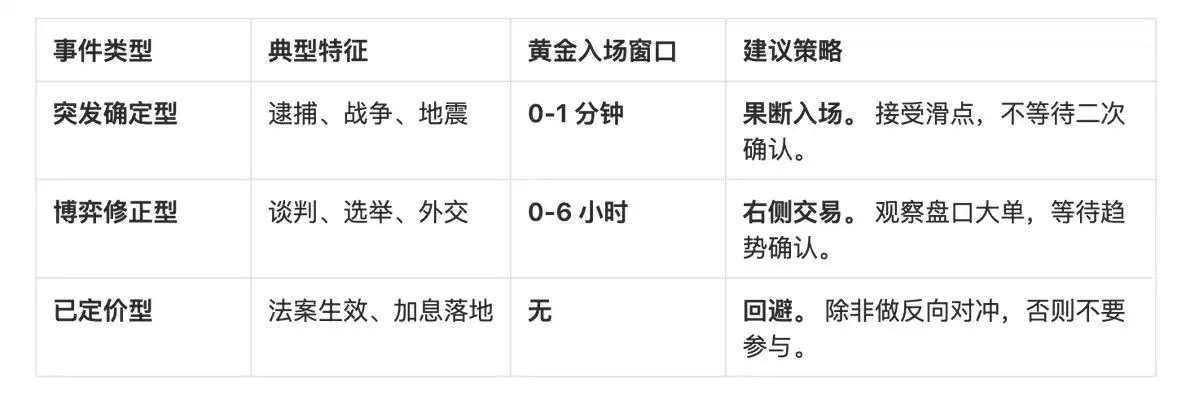
Conclusion

In prediction markets, 1 minute of hesitation corresponds not to the passage of time, but to a violent collapse of the profit-loss ratio.

Next time you face major news, ask yourself this question:

"Am I entering now as a hunter to capture Alpha, or as prey to provide liquidity?"

Preguntas relacionadas

QWhat is the 'confirmation tax' mentioned in the article, and why is it costly in prediction markets?

AThe 'confirmation tax' is the cost of sacrificing potential alpha (excess returns) by taking time to verify the authenticity of news before trading. In prediction markets like Polymarket, this is extremely expensive because the first few minutes after an event absorb the vast majority of the information advantage. Waiting even one minute to confirm news can mean forfeiting most of the profits to faster, risk-taking traders.

QAccording to the data, what percentage of the information advantage is absorbed within the first 10 minutes in high-liquidity突发事件 (sudden events)?

AAccording to the analysis of 2,023 on-chain trades, the first 10 minutes absorb 96% of the information advantage in high-liquidity sudden events.

QWhat are the three types of event decay curves identified in the research, and name one example for each.

AThe three types are: 1. Sudden Deterministic Events (e.g., 'Maduro out by Jan 31, 2026?'), 2. Game Theory Correction Events (e.g., 'Will SVB be acquired?'), and 3. Already Priced-In Events (e.g., 'TikTok banned in the US').

QFor a 'Sudden Deterministic' event, what is the approximate half-life of alpha, and what is the only viable strategy?

AFor a 'Sudden Deterministic' event, the half-life of alpha is less than 2 minutes. The only viable strategy is to sacrifice certainty in exchange for an entry position, acting on the news quickly within a risk-controllable framework.

QWhat is the key difference in strategy between a 'Sudden Deterministic' event and a 'Game Theory Correction' event?

AFor a 'Sudden Deterministic' event, the strategy requires extreme speed, acting within the first minute. For a 'Game Theory Correction' event, speed is less critical; the strategy focuses on identifying 'confirmation signals' that shift market consensus over a longer window (e.g., 0-6 hours), such as rumors of failed negotiations or large buys from smart money.

Lecturas Relacionadas

Super-Rich Hoarded Record Cash in February, Stock Market Hit New Highs Four Months Later: Who's Getting Fooled?

In February, the total assets in US money market funds reached a record high of approximately $8.25 trillion, a trend highlighted by high-net-worth individuals increasing their cash holdings. Notably, Warren Buffett's Berkshire Hathaway amassed a $381.7 billion cash pile ahead of his 2025 retirement, while other prominent figures like Peter Thiel sold tech stocks, fueling narratives of wealthy investors seeking safety. However, by June, the trend reversed. Money market fund assets fell to around $7.87 trillion, indicating a flow of capital back into equities. Concurrently, the S&P 500 and Nasdaq reached all-time highs, with the S&P 500 surpassing 7600 points. This market surge occurred despite the earlier defensive moves, highlighting a potential opportunity cost for those who retreated to cash. Analysis shows that since early 2022, the S&P 500's total return significantly outpaced that of prime money market funds. The capital shifted from equities appears to have been partly reallocated into alternative investments like real estate, art, and private credit, especially among ultra-high-net-worth individuals. Meanwhile, major investment banks like Goldman Sachs and Morgan Stanley have raised their year-end targets for the S&P 500, citing AI-driven earnings growth, while also cautioning about risks including market concentration and economic fragility beneath the surface rally.

marsbitHace 19 min(s)

Super-Rich Hoarded Record Cash in February, Stock Market Hit New Highs Four Months Later: Who's Getting Fooled?

marsbitHace 19 min(s)

Robot Vacuums Have Been Competing for 20 Years, So Why Are 90% of Chinese Households Still Hesitant?

The article explores why over 90% of Chinese households are still hesitant to adopt robotic vacuum cleaners despite two decades of industry development, identifying a core "trust gap" as the primary barrier. The central issue is not a lack of need, but user concerns about reliability in dynamic, real-world home environments. Common anxieties include the robot dragging pet waste, colliding with transparent objects, tangling in cords, scattering cat litter, getting stuck on thresholds, missing corners under furniture, and requiring high-maintenance bases that develop odors. The industry's past focus on competing on technical specs (suction power, mopping functions) has not adequately addressed these practical usability and trust problems. The piece then examines DJI's entry into the market with its ROMO 2 model as a potential new approach. Leveraging its expertise in spatial perception and obstacle avoidance from drones, DJI's solution emphasizes "less intervention" through three key principles: less manual re-cleaning, less user rescue missions, and less maintenance. Specific ROMO 2 features highlighted include advanced obstacle recognition (handling transparent objects and small items), adaptive leg mechanisms for climbing thresholds (up to 8.5cm), an extendable arm for reaching under furniture, AI for identifying and appropriately handling different mess types (e.g., avoiding scattering dry debris), and a self-cleaning base designed to minimize user upkeep. The article argues the next phase of competition should shift from a "parameter race" to a "trust race." It draws a parallel to the iPhone's simplification of the smartphone, suggesting that focusing on a reliable, low-hassle user experience—where people feel confident leaving their floors to the machine—is what's needed to finally convince the vast majority of观望ing families. The ultimate test for products like the ROMO 2 will be long-term user adoption, retention, and口碑, not just technical specifications.

marsbitHace 19 min(s)

Robot Vacuums Have Been Competing for 20 Years, So Why Are 90% of Chinese Households Still Hesitant?

marsbitHace 19 min(s)

The Unclear American Economy: Resilient or Cooling Down?

**U.S. Economic Outlook: Resilient or Cooling Down?** This analysis examines whether the U.S. economy is heading towards a recession. While still growing, the economy shows significant signs of strain. Key data points include Q1 2026 GDP growth of 1.6% and Q1 PCE inflation at 4.5% (annualized), more than double the Fed's target. The labor market remains resilient but is softening, with unemployment at 4.3%. Critical recession indicators present a mixed picture: the yield curve has normalized after a prolonged inversion (historically a late-cycle signal), and the Conference Board's Leading Economic Index has been declining. Current recession probability for 2026 is estimated at 19%, but rises to 41% for 2027, indicating heightened delayed risks. Major pressures are building: a wall of corporate debt refinancing at higher rates, depleted consumer savings, a contracting housing sector, and an energy price shock. The economy exhibits stagflationary characteristics—high inflation alongside slowing growth—which constrains the Federal Reserve's policy options. Historical patterns show recessions are often preceded by Fed tightening and yield curve inversions. If a recession occurs, it is expected to be mild, similar to 2001 rather than 2008. For investors, a defensive portfolio shift toward staples, healthcare, and short-term high-quality bonds may be prudent, while maintaining a long-term, diversified perspective. Key developments to monitor include upcoming GDP, employment, and inflation data, as well as policy signals from the new Fed Chair.

marsbitHace 27 min(s)

The Unclear American Economy: Resilient or Cooling Down?

marsbitHace 27 min(s)

Trading

Spot
Futuros

Artículos destacados

Cómo comprar ONE

¡Bienvenido a HTX.com! Hemos hecho que comprar Harmony (ONE) sea simple y conveniente. Sigue nuestra guía paso a paso para iniciar tu viaje de criptos.Paso 1: crea tu cuenta HTXUtiliza tu correo electrónico o número de teléfono para registrarte y obtener una cuenta gratuita en HTX. Experimenta un proceso de registro sin complicaciones y desbloquea todas las funciones.Obtener mi cuentaPaso 2: ve a Comprar cripto y elige tu método de pagoTarjeta de crédito/débito: usa tu Visa o Mastercard para comprar Harmony (ONE) al instante.Saldo: utiliza fondos del saldo de tu cuenta HTX para tradear sin problemas.Terceros: hemos agregado métodos de pago populares como Google Pay y Apple Pay para mejorar la comodidad.P2P: tradear directamente con otros usuarios en HTX.Over-the-Counter (OTC): ofrecemos servicios personalizados y tipos de cambio competitivos para los traders.Paso 3: guarda tu Harmony (ONE)Después de comprar tu Harmony (ONE), guárdalo en tu cuenta HTX. Alternativamente, puedes enviarlo a otro lugar mediante transferencia blockchain o utilizarlo para tradear otras criptomonedas.Paso 4: tradear Harmony (ONE)Tradear fácilmente con Harmony (ONE) en HTX's mercado spot. Simplemente accede a tu cuenta, selecciona tu par de trading, ejecuta tus trades y monitorea en tiempo real. Ofrecemos una experiencia fácil de usar tanto para principiantes como para traders experimentados.

288 Vistas totalesPublicado en 2024.12.12Actualizado en 2026.06.02

Cómo comprar ONE

Discusiones

Bienvenido a la comunidad de HTX. Aquí puedes mantenerte informado sobre los últimos desarrollos de la plataforma y acceder a análisis profesionales del mercado. A continuación se presentan las opiniones de los usuarios sobre el precio de ONE (ONE).

活动图片













