The New York Times: After Trump's Return to the White House, Major Retreat in SEC's Crypto Lawsuits

marsbitPublicado a 2025-12-16Actualizado a 2025-12-16

Resumen

In a significant policy reversal following Donald Trump's return to the White House, the U.S. Securities and Exchange Commission (SEC) has dramatically scaled back its enforcement actions against the cryptocurrency industry. An investigation by The New York Times found that over 60% of ongoing crypto-related cases were either paused, settled favorably, or dropped entirely under the new administration. Key findings include the SEC dropping seven crypto cases, five of which involved firms with known financial ties to Trump. An additional seven cases saw reduced charges or lenient settlements, with three linked to Trump associates. The remaining nine active cases involve entities with no known connection to the former president. The SEC stated its shift was based on legal and policy considerations, not political favoritism, citing long-standing internal opposition to many crypto lawsuits. However, the timing coincides with Trump’s pro-crypto stance and his family’s business ventures in the sector, including the World Liberty Financial project. Notable cases dropped or softened include those against Binance, Ripple Labs, and Gemini Trust. The latter is operated by the Winklevoss twins, who have financial and business ties to the Trump family. While no direct evidence of presidential pressure was found, the pattern suggests a stark departure from the aggressive enforcement seen under the Biden administration. The policy shift has raised concerns among former SEC officials abou...

A cryptocurrency company operated by billionaire brothers the Winklevosses once faced a severe federal lawsuit, but after Donald Trump returned to the White House, the U.S. Securities and Exchange Commission (SEC) decided to suspend the case. Previously, the SEC had also filed a lawsuit against the world's largest cryptocurrency exchange, Binance, yet after the new administration took office, the lawsuit was completely dismissed. Additionally, after years of legal disputes with Ripple Labs, the new SEC attempted to reduce the penalties imposed by the court on this cryptocurrency company.

An investigation by The New York Times found that the SEC's retreat in these cases reflects a comprehensive shift in the federal government's attitude toward the cryptocurrency industry after Trump began his second term. No regulatory agency has ever withdrawn multiple lawsuits against the same industry on such a large scale, yet The New York Times discovered that when Trump took office again, over 60% of the cryptocurrency-related cases being pursued by the SEC saw relaxed handling—either suspending proceedings, reducing penalties, or outright dismissing cases.

The investigation also pointed out that the move to dismiss cryptocurrency cases is particularly unusual. During Trump's administration, the proportion of dismissed cases related to cryptocurrency companies far exceeded the dismissal rate for cases in other industries. Although the specifics of these cryptocurrency lawsuits vary, many of the involved companies share a commonality: financial dealings with Trump, who calls himself the "crypto president."

As the top federal agency overseeing financial market violations, the SEC is no longer actively pursuing any company known to be associated with Trump. For all companies that have cooperated with the Trump family's cryptocurrency business or funded his political activities, the SEC has dismissed related lawsuits. The only remaining cryptocurrency-related cases now involve obscure entities with no apparent connection to Trump.

· The SEC dismissed 7 cryptocurrency cases, 5 of which involved companies with known ties to Trump;

· Another 7 cryptocurrency cases were suspended, with favorable settlement plans or concessions made, 3 of which involved companies with known ties to Trump;

· Only 9 cases remain without dismissal, and none of these involve parties with known connections to Trump.

The SEC stated in a declaration that there was no political favoritism in handling cryptocurrency enforcement cases, and this adjustment in enforcement direction was based on legal and policy considerations, including doubts about its own authority to regulate the cryptocurrency industry. The SEC also emphasized that long before Trump supported the cryptocurrency industry, current Republican commissioners fundamentally opposed filing most cryptocurrency-related lawsuits, while stressing that the SEC "places great importance on securities fraud issues and earnestly safeguards investor rights."

There is currently no evidence that the president pressured the SEC to show leniency toward specific cryptocurrency companies. The New York Times also found no indication that these companies influenced the cases by providing political donations or engaging in business collaborations with Trump; some financial dealings and business collaborations even occurred after the SEC adjusted its case handling approach.

But the core issue is that Trump is both a participant in the cryptocurrency industry and its top policymaker. As president, the policies he promotes, if highly aligned with his personal interests, create conflicts of interest. The fact that many cryptocurrency companies sued by the SEC are connected to him highlights this very conflict.

At the start of Trump's second term, the White House publicly declared that the president would "halt those aggressive enforcement actions and excessive regulatory measures that hinder cryptocurrency innovation." Although the SEC's dismissal of individual cryptocurrency cases had already attracted public attention, The New York Times, through analyzing thousands of court records and conducting dozens of interviews, found that the scale of the SEC's relaxation of cryptocurrency regulation this year far exceeds previous instances, and Trump's allies in the cryptocurrency industry have reaped significant benefits, details that had not been fully exposed before.

All defendants involved in this investigation denied any violations, with many claiming they were only accused of procedural violations. Additionally, some cases where the SEC relaxed its handling involved companies with no apparent connection to the president.

White House Press Secretary Karoline Leavitt dismissed claims that Trump and his family have conflicts of interest, stating that the related policies Trump is promoting "fulfill the president's promise to advance innovation, create economic opportunities for all Americans, and help the U.S. become a global cryptocurrency hub."

The Trump administration has comprehensively relaxed regulation of the cryptocurrency industry, with the U.S. Department of Justice even disbanding its cryptocurrency enforcement unit. The SEC's policy shift this year can be described as a 180-degree turn.

Analysis by The New York Times shows that during the Biden administration, the SEC filed an average of over two cryptocurrency-related cases per month, through channels including federal courts and the agency's internal legal system. Even during Trump's first term, the SEC filed about one cryptocurrency-related case per month on average, including the high-profile Ripple lawsuit.

In stark contrast, after Trump took office again, the SEC has not filed a single cryptocurrency-related case, while dozens of lawsuits against other industries are still proceeding.

Atkins stated in a declaration that these measures by the SEC were merely to rectify the overly aggressive regulatory stance of the previous administration toward the cryptocurrency industry. He said the SEC under Biden used enforcement power to forcibly implement new policies. He emphasized: "I have made it clear that we will completely abandon the model of using enforcement as a substitute for regulation."

While cryptocurrency companies cheer this new era, veteran SEC lawyers who led these cases are deeply concerned about the trend of relaxed regulation. They worry that this agency, founded during the worst of the Great Depression and nearly a century old, with its original purpose of protecting investor interests and maintaining market order, will now, by relaxing regulatory pressure, embolden the cryptocurrency industry, thereby harming consumer rights and even posing risks to the entire financial system.

Christopher E. Martin, a former senior litigation attorney at the SEC who led a lawsuit against a cryptocurrency company, chose to retire after the SEC dismissed the case this year. Speaking about the SEC's broad relaxation of regulation, he said bluntly: "This is complete capitulation, simply throwing investors to the wolves."

The End of Regulatory Crackdowns

Late last year, inside the glass-walled SEC headquarters in Washington, regulatory actions against cryptocurrency had nearly ground to a halt. Gary Gensler, the SEC chairman during the Biden administration, had wanted to advance multiple cryptocurrency investigations, but his term was counting down.

Previously, Trump had just announced the launch of a cryptocurrency project called World Liberty Financial with his family,紧接着 (immediately after) successfully won re-election, and he had long publicly declared his intention to limit the SEC's power.

In fact, Trump has not always supported the cryptocurrency industry. During his first term, he once tweeted that cryptocurrency was purely air and could facilitate illegal activities like drug trafficking. The SEC at that time also adopted a tough regulatory stance, even establishing a dedicated unit to investigate online violations in the cryptocurrency field and filing dozens of related lawsuits.

During the Biden administration, the SEC's regulation of cryptocurrency escalated further. In 2022, the large cryptocurrency exchange FTX collapsed, and that same year the size of the SEC's cryptocurrency regulatory division nearly doubled, expanding to about 50 lawyers and industry experts.

Whether during Trump's first term or the Biden administration, the SEC始终 believed that since investors might put their life savings into cryptocurrency, they had the right to understand the risks. But a thorny legal question始终 plagued the SEC: Did the agency truly have the authority to file these lawsuits against the cryptocurrency industry? The answer depended on whether cryptocurrency qualifies as a security, a derivative category of modern stocks and other financial instruments.

The SEC claimed that many cryptocurrencies are essentially securities, therefore cryptocurrency exchanges and brokers must register with the SEC, disclose detailed information as required, and some institutions must undergo independent review. If registration obligations are not fulfilled, the SEC can sue them under securities laws.

The cryptocurrency industry countered that most cryptocurrencies are not securities but a special type of financial product that should have its own专属 regulatory rules, which the SEC had not yet formulated. Summer Mersinger, CEO of the cryptocurrency industry association Blockchain Association, said: "We don't want to escape regulation, we just hope to have clear and definite rules as a basis for operation."

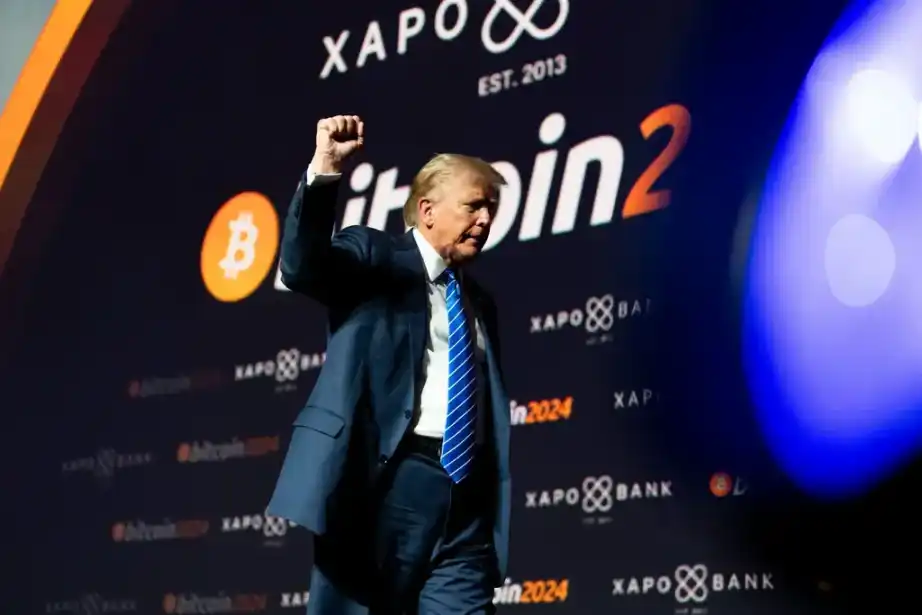
2024 marked a turning point, with Trump's attitude completely shifting from skepticism to endorsement of cryptocurrency. In a speech that July, he promised cryptocurrency practitioners that the "deliberate crackdown" on the industry would stop, proclaiming "I will fire Gary Gensler on day one."
The SEC, as an independent agency, has 5 presidentially appointed commissioners, with the chairman typically aligned with the administration that appointed him. Decisions on whether to file, settle, or dismiss cases require a vote by the commissioners, but the actual investigative work is done by dedicated enforcement staff. This mechanism allows for flexible adjustment of regulatory focus while avoiding major policy fluctuations due to sudden political shifts.

But after Trump's second electoral victory, the atmosphere at the SEC changed dramatically. Shortly after the election, Gensler announced his resignation. The cryptocurrency regulatory division, once a hot岗位 for career advancement, suddenly became a "hot potato."

According to anonymous sources familiar with the matter, during the presidential transition, Gensler's enforcement director Sanjay Wadhwa pleaded with enforcement staff to "do the job the American people pay us to do."

But some staff began to退缩 (hold back). Sources said one executive in the cryptocurrency regulatory team took several weeks of leave without authorization, ignoring emails related to cases; another executive refused to sign documents related to the few cryptocurrency cases filed by the SEC after the election;还有些工作人员干脆停止处理加密货币案件 (some staff simply stopped handling cryptocurrency cases),彻底阻碍 (completely hindering) Gensler's final efforts to advance regulation.

Victor Suthammanont, who worked at the SEC for ten years and served as an enforcement advisor to Gensler before leaving, said that after previous two government transitions, staff always坚守岗位、正常履职 (stayed at their posts and performed their duties normally). "But this transition was completely different, the internal atmosphere of the agency changed instantly," Suthammanont said, though he did not discuss specific cases.

Gary Gensler announced his resignation after Trump won re-election

After Trump was sworn in, the situation became irreversible. He first appointed SEC Republican commissioner Mark T. Uyeda as acting chairman, pending Senate confirmation of his nominee Paul S. Atkins. Uyeda had long opposed the SEC's approach to cryptocurrency cases, telling The New York Times in an interview that many of Gensler's regulatory moves were based on "new theories lacking support from existing law."

Gensler, in a 2022 speech, had expressed a diametrically opposite view, stating: "Even with new technologies, existing laws do not become obsolete."

In early February 2025, Uyeda transferred Jorge G. Tenreiro from his position as head of SEC litigation. Tenreiro had previously led the work of the cryptocurrency regulatory division and overseen many related cases; this transfer to the information technology department was seen within the SEC as a humiliating demotion.

After Tenreiro's departure, the SEC began to stop investigations into several cryptocurrency companies that might face lawsuits. Although some investigations continued, at least 10 companies announced they were no longer under SEC investigation, one of which issued such an announcement just last week.

No Room for Negotiation
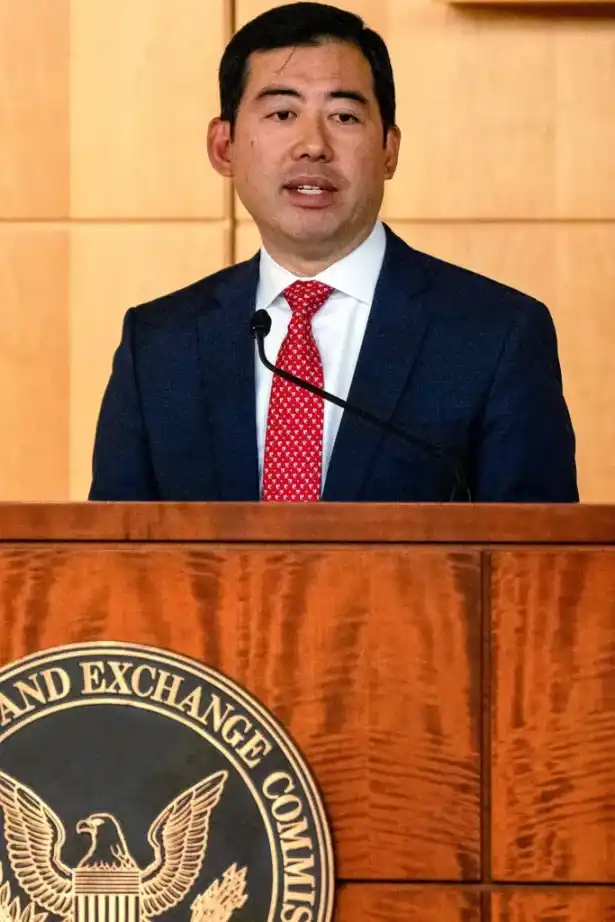
Uyeda soon faced a more棘手 (thorny) problem: how to handle the cryptocurrency lawsuits left over from the Biden administration that were still under adjudication. The SEC suspending investigations is common, but dismissing cases already in litigation is extremely rare and requires approval by a vote of the Commissioners.

The lawsuit against Coinbase, the largest U.S. cryptocurrency exchange, for failing to register, was a high-profile case in the cryptocurrency field. During the Biden administration, Coinbase adopted a tough defense strategy, successfully persuading a judge to allow a higher court to review the case before trial.

Now with the SEC under Trump's control, Coinbase was among the first companies to apply for dismissal of its case. Conventionally, the SEC chairman's office does not usually get involved in (介入) negotiations for such cases, leaving it to dedicated enforcement lawyers. But during these negotiations, staff from Uyeda's office participated in some of the talks with Coinbase alongside the enforcement lawyers.

Coinbase Chief Legal Officer Paul Grewal, a former federal judge, said in an interview: "We always ensured timely updates to the incoming chairman's office on the progress of case negotiations, ensuring they were fully informed." Uyeda said his staff's participation in such coordination meetings was "完全合乎规范 (completely within norms)."

Initially, the SEC under Uyeda's leadership was unwilling to dismiss the case entirely. Informed sources revealed that the SEC's initial proposal was only to suspend the case. But this proposal was rejected by Coinbase.

The SEC then made greater concessions (作出更大让步), proposing to dismiss the case but reserve the right to reopen it if leadership changed its mind later, but this proposal was also not accepted by Coinbase. Grewal stated firmly: "Our position was very clear, either they dismiss the case completely, or we continue to defend ourselves. There was no room for negotiation on this matter."

Ultimately, the SEC chose to compromise. By then, Gensler and another Democratic commissioner had left, leaving the SEC commission with only two Republican commissioners and one Democratic commissioner.

Uyeda did not respond specifically to this decision, but said: "It was not appropriate to continue pushing these types of cases, especially if the SEC might soon no longer endorse the theories underlying the litigation."

The remaining Democratic commissioner, Caroline A. Crenshaw, said bluntly in an interview that the SEC's approach gave the cryptocurrency industry a major advantage, "They can practically do whatever they want without facing any consequences."

Change in Attitude

After the Coinbase case was dismissed, the cryptocurrency industry saw it as a signal of the SEC's capitulation. Lawyers for other cryptocurrency companies followed suit, seeking similar outcomes for their clients. By the end of May, the SEC had dismissed another 6 cryptocurrency-related cases.

Analysis of court records by The New York Times found this phenomenon highly anomalous. During the Biden administration, the SEC never voluntarily dismissed any cryptocurrency case left over from Trump's first term. During that period, only one case was dismissed due to the death of a defendant, and in another case, part of the claims were dropped due to an unfavorable ruling by a judge.

After Trump began his second term, however, 33% of the cryptocurrency cases left over from the Biden administration were dismissed, compared to a dismissal rate of only 4% for cases in other industries.

Despite the SEC's repeated promises to continue pursuing securities fraud, it still dismissed the lawsuit against Binance. Previously, the SEC had accused two affiliated entities of Binance of fraudulent behavior, alleging they misled consumers about preventing manipulative trading.

Additionally, the SEC applied to the court to suspend the fraud case against Justin Sun and the Tron Foundation he founded. There are 4 such cases suspended pending settlement negotiations; the SEC has not yet announced the outcome of this case.

The Trump administration inherited a total of 23 cryptocurrency cases, 21 originating from the Biden era and 2 left over from Trump's first term. The SEC has relaxed its approach in 14 of these cases. Of these 14 cases, 8 involved companies that established connections with Trump and his family around the time the cases were handled.
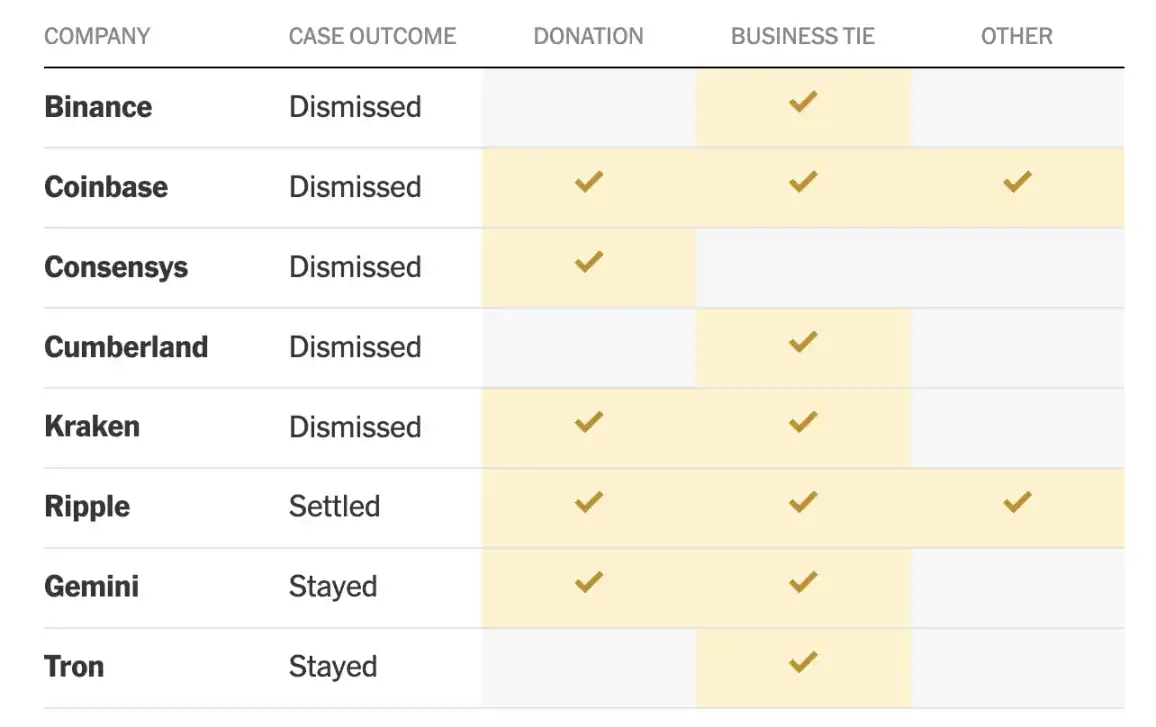
For example, Justin Sun spent $75 million to buy tokens issued by World Liberty Financial. The Tron Foundation did not respond to multiple requests for comment; Justin Sun and the Tron Foundation stated in court filings that the SEC lacked evidence to prove fraud and lacked the authority to sue them.

Weeks before the Binance case was dismissed, the company participated in a $2 billion business transaction using stablecoins issued by World Liberty Financial. This transaction was expected to bring tens of millions of dollars in annual revenue to the Trump family.

A spokesperson for World Liberty Financial stated that "the company has no connection whatsoever to the U.S. government" and "does not exert any influence on government policy-making or decision-making processes." Binance said in a statement that the SEC's lawsuit against it was essentially "targeted suppression of the cryptocurrency industry."

In March 2025, the SEC dismissed the case accusing cryptocurrency trader Cumberland of conducting unregistered securities business. About two months later, Cumberland's parent company, DRW, invested nearly $100 million in the Trump family's media company. DRW executives said the company only got the investment opportunity after the case was dismissed, and the SEC dismissed the case simply because the allegations lacked factual basis.

Ripple, which donated nearly $5 million to Trump's inauguration, was also embroiled in litigation. During Trump's first term, the SEC accused Ripple of failing to disclose key information to investors when issuing crypto tokens. Last year, a federal judge dismissed some of the SEC's charges but still ruled that Ripple violated securities laws and fined it $125 million.

After Trump took office again, the SEC tried to reduce the fine to $50 million. The judge sharply criticized the SEC for this reversal and rejected the request. Ripple argued to the judge that it deserved a lighter penalty, partly because the SEC had dismissed subsequent similar cryptocurrency cases. Ultimately, Ripple paid the full fine. In July of this year, the Trump family's media company announced plans to include Ripple's cryptocurrency in a public-facing investment fund.

Hester Peirce, an SEC Republican commissioner who heads the agency's new cryptocurrency task force, said in an interview that dismissing many cryptocurrency cases was correcting past mistakes, as these cases should never have been filed in the first place.

She said: "I believe the real overreach occurred in previous years, when the SEC filed many cases without any legal basis." She added that these lawsuits hindered legitimate industry innovation. Peirce emphasized that case handling is based solely on facts and specific circumstances, unrelated to "the connections of the involved parties," and involves no political or economic considerations.

Deep Pockets

Few in the cryptocurrency industry are closer to Trump than brothers Tyler Winklevoss and Cameron Winklevoss. The brothers founded and operate the cryptocurrency company Gemini Trust. They not only provided funding to committees supporting Trump's re-election and other Republican-related organizations but also contributed to the renovation of the White House banquet hall favored by Trump. Additionally, they provided funding for a high-end private club in Washington called Executive Branch, in which Trump's eldest son, Donald Trump Jr., is a shareholder.

The brothers' investment company recently also injected capital into a new cryptocurrency mining company called American Bitcoin. Trump's second son, Eric Trump, is a co-founder and chief strategy officer of this company, and eldest son Donald Trump Jr. is also an investor.
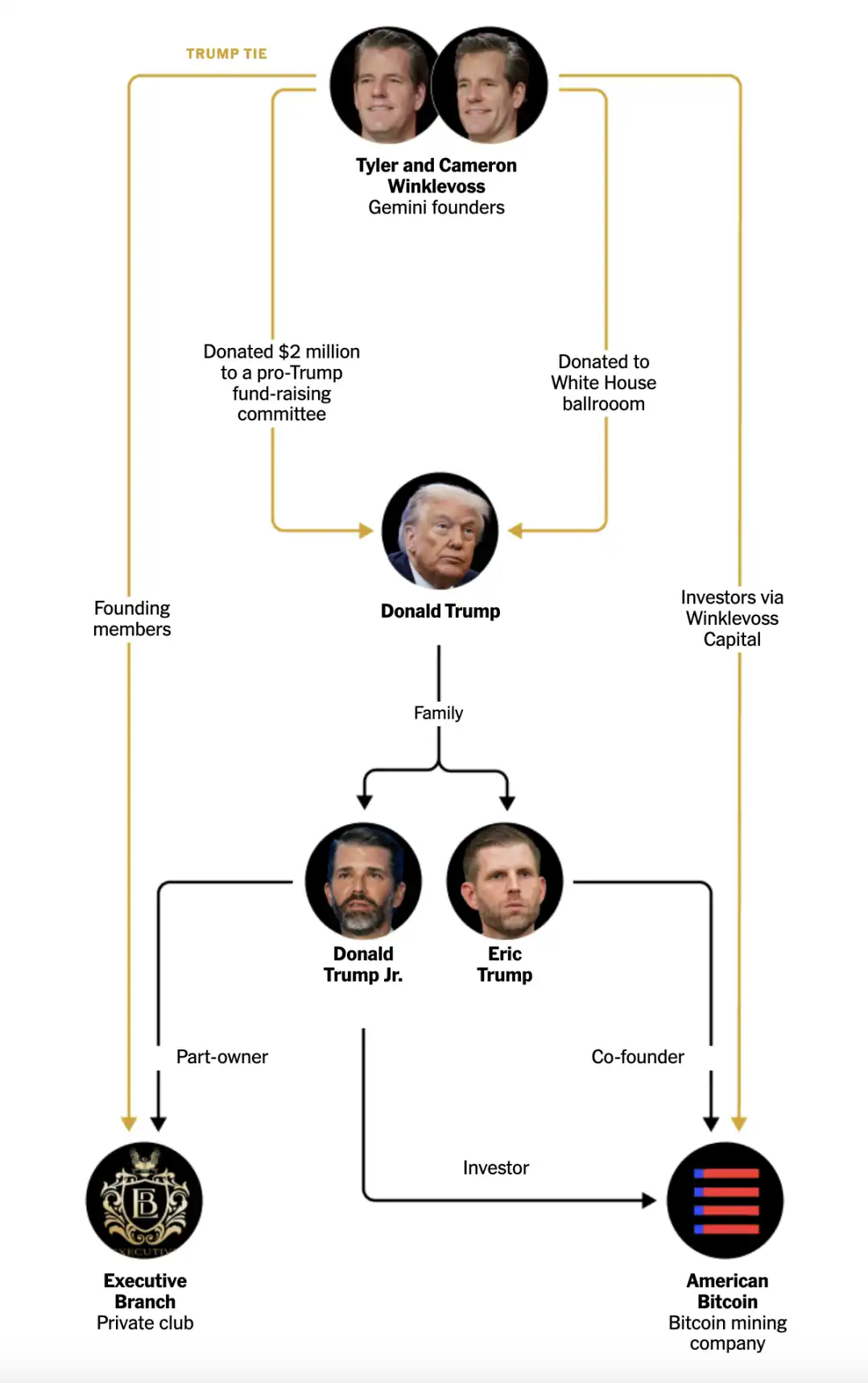
Trump has repeatedly publicly praised the brothers, calling them "talented and good-looking" people with both intelligence and looks. He remarked at a White House event: "They have the looks, the brains, and vast wealth."

But Gemini Trust has also been deeply involved in legal disputes.

In December 2020, Gemini Trust partnered with another company, Genesis Global Capital, to offer Gemini's clients a service to lend crypto assets to Genesis, which would then relend these assets to larger institutional investors.

Genesis would pay interest to users and promised they could redeem their assets at any time; Gemini acted as a middleman, earning a corresponding share. Gemini advertised that the project could provide account holders with an annualized yield of up to 8%.

San Diego data scientist Peter Chen said in an interview that he invested over $70,000 in the project because he trusted Gemini.

"Gemini gave me the impression of being compliantly operated, strictly following rules, one of the most well-regulated companies in the cryptocurrency field," he recalled.

However, in late 2022, Genesis, facing bankruptcy crisis, froze the accounts of 230,000 clients.

A 73-year-old grandmother pleaded with Gemini to return her life savings of $199,000. According to lawsuit documents filed by New York state regulators, she wrote in her plea: "Without this money, I am completely desperate."

In May 2024, Genesis reached a $2 billion settlement with New York state regulators, and clients' funds were eventually recovered. Gemini also settled with New York state, agreeing to pay up to $50 million if necessary to cover remaining client losses. Gemini insisted it had done nothing wrong, blaming the crisis on Genesis, and emphasized that ultimately no client suffered losses.

But the SEC also sued both companies, accusing them of offering crypto assets without registration. Tyler Winklevoss called the lawsuit on social media "deliberately fabricated charges."

Genesis chose to settle with the SEC, but Gemini insisted on defending the lawsuit until April 2025, when the SEC suddenly proposed suspending the case to negotiate a resolution. In September of the same year, the SEC disclosed that it had reached a settlement agreement with Gemini, which is still pending a vote by the commissioners.

The SEC told the federal judge overseeing the case that the agreement "will completely end this litigation dispute."


Preguntas relacionadas

QWhat significant change did the SEC make in its approach to cryptocurrency lawsuits after Trump's return to the White House?

AThe SEC paused, reduced penalties, or outright dismissed over 60% of the cryptocurrency-related lawsuits it was pursuing, with a particular focus on cases involving firms connected to Donald Trump.

QAccording to the article, what was a common factor among many of the SEC dropped cases against?

AMany of the cryptocurrency firms that had their cases dropped had financial or business ties to Donald Trump, who called himself the 'crypto president'.

QHow did the SEC justify its change in enforcement direction regarding cryptocurrency cases?

AThe SEC stated in a declaration that the shift was due to legal and policy considerations, including doubts about its own authority to regulate the cryptocurrency industry, and denied any political favoritism.

QWhat was one notable example of a high-profile case that the SEC dropped under the new administration?

AThe SEC dropped its high-profile lawsuit against the largest cryptocurrency exchange, Binance, which had been accused of misleading consumers about its safeguards against manipulative trading.

QHow did the actions of some SEC staff change during the transition to the Trump administration, as described in the article?

ASome staff became reluctant to work on crypto cases, with one executive taking extended leave, another refusing to sign off on case filings, and others simply stopping work on them, hindering final enforcement efforts.

Lecturas Relacionadas

The World Cup is Here: The Battle for Entry into Prediction Markets Has Begun

The 2026 FIFA World Cup has begun, and alongside the on-field competition, a new off-field battleground is emerging: prediction markets. These blockchain-based platforms, which convert crowd wisdom into tradable probabilities, are gaining significant traction. However, their complexity—involving wallets, gas fees, and smart contracts—has historically limited participation to crypto-native users. Centralized exchanges (CEXs), like Gate, are tackling this adoption barrier. By integrating with leading prediction market protocol Polymarket, Gate simplifies the user experience. Users can participate directly with their exchange account and USDT, bypassing complex Web3 steps. Gate offers a streamlined "Prediction Mode" for casual users and a professional "Trading Mode" with advanced tools. Key features include two-way trading (allowing users to buy or sell positions before event resolution), support for diverse markets (sports, crypto, macroeconomics), and a suite of information tools like a "Smart Money" leaderboard, wallet tracking, and AI-powered insights. For the World Cup, Gate launched a dedicated hub aggregating schedules, standings, and relevant markets. This allows fans to seamlessly follow games and trade on outcomes, transforming passive viewing into active participation where they can monetize their predictions and trade on shifting consensus throughout a match. The article argues that prediction markets have proven their value in event forecasting. The next challenge is mass adoption. The competition is shifting from building effective protocols to creating accessible user entry points. By lowering technical barriers and building a complete ecosystem for information and trading, platforms like Gate aim to transition prediction markets from a niche crypto tool to a mainstream platform for expressing and trading on collective intelligence.

Odaily星球日报Hace 13 min(s)

The World Cup is Here: The Battle for Entry into Prediction Markets Has Begun

Odaily星球日报Hace 13 min(s)

Spain Held to a Draw by Cape Verde, Jucom Prediction Market Witnesses Historic Upset

In a major upset at the 2026 FIFA World Cup, tournament favorites Spain were held to a surprising 0-0 draw by debutants Cape Verde in their Group H opener on June 16, Beijing time. Despite dominating possession (74%) and recording 27 shots with an expected goals figure of 2.16, Spain failed to break down a resilient Cape Verde defense, with their 40-year-old goalkeeper Vozinha making 7 saves to earn Man of the Match. Pre-match predictions on the Jucom prediction market had heavily favored Spain, assigning them a 92% win probability. The actual result, a goalless draw, triggered significant volatility across related prediction markets. This outcome forces a market-wide reassessment of several key probabilities, including Spain's likelihood of winning the group and the tournament itself, while Cape Verde's previously near-zero chance of advancing is now being re-evaluated. The event highlights both the efficiency and the inherent limitations of prediction markets. While prices aggregate known information, football's low-scoring, high-variance nature means unquantifiable in-game factors can lead to unlikely results. The core value of such markets lies not in perfect foresight but in their ability to dynamically reflect how new information is incorporated into collective expectations. Platforms like Jucom, which track outcomes from single matches to the final champion, provide a real-time lens into how global consensus evolves with each game.

链捕手Hace 17 min(s)

Spain Held to a Draw by Cape Verde, Jucom Prediction Market Witnesses Historic Upset

链捕手Hace 17 min(s)

Standard Chartered Bank Places a 40x 'Bet', Calls for UNI to Rise to $100

Standard Chartered Bank’s digital asset research head, Geoff Kendrick, initiated coverage on Uniswap with a highly bullish long-term price target of $100 for its UNI token by 2030—a roughly 40-fold increase from its ~$2.60 trading price at the time of the report. The bank’s thesis hinges on the exponential growth of tokenized real-world assets (RWA), projected to surge from ~$340 billion to $4 trillion by 2028. It expects the share of these assets deployed in DeFi to rise from 3.5% to 30%, driving total DeFi TVL to around $2.7 trillion. As the leading decentralized exchange (DEX), Uniswap is positioned to capture a significant portion of this liquidity influx. A key catalyst is Uniswap’s “fee switch,” activated in late 2024, which directs a portion of protocol fees to UNI token buybacks and burns. This transforms UNI from a pure governance token into a yield-generating, deflationary asset, narrowing its valuation gap with centralized exchanges like Coinbase. The report draws an analogy: Coinbase operates like Netflix (centralized, high-cost), while Uniswap functions like YouTube (open, user-generated, network-effect driven). Despite its dominant market share and recent institutional adoption—such as BlackRock’s BUIDL fund and Fidelity’s stablecoin using Uniswap for liquidity—the path faces challenges. Competition from Solana-based DEXs and aggregators threatens user mindshare, while regulatory delays or setbacks in RWA adoption could slow the projected growth. Furthermore, UNI remains down over 92% from its 2021 peak, reflecting persistent market skepticism. Ultimately, Standard Chartered’s report signals a shift in traditional finance’s perception of DeFi, valuing network effects and cash flow potential. However, realizing the $100 target depends on Uniswap successfully navigating intense competition, regulatory hurdles, and the multi-year timeline for massive tokenized asset adoption.

marsbitHace 41 min(s)

Standard Chartered Bank Places a 40x 'Bet', Calls for UNI to Rise to $100

marsbitHace 41 min(s)

Trading

Spot
Futuros

Artículos destacados

Qué es $S$

Entendiendo SPERO: Una Visión General Completa Introducción a SPERO A medida que el panorama de la innovación continúa evolucionando, la aparición de tecnologías web3 y proyectos de criptomonedas juega un papel fundamental en la configuración del futuro digital. Un proyecto que ha atraído la atención en este campo dinámico es SPERO, denotado como SPERO,$$s$. Este artículo tiene como objetivo reunir y presentar información detallada sobre SPERO, para ayudar a entusiastas e inversores a comprender sus fundamentos, objetivos e innovaciones dentro de los dominios web3 y cripto. ¿Qué es SPERO,$$s$? SPERO,$$s$ es un proyecto único dentro del espacio cripto que busca aprovechar los principios de descentralización y tecnología blockchain para crear un ecosistema que promueva la participación, la utilidad y la inclusión financiera. El proyecto está diseñado para facilitar interacciones de igual a igual de nuevas maneras, proporcionando a los usuarios soluciones y servicios financieros innovadores. En su esencia, SPERO,$$s$ tiene como objetivo empoderar a los individuos al proporcionar herramientas y plataformas que mejoren la experiencia del usuario en el espacio de las criptomonedas. Esto incluye habilitar métodos de transacción más flexibles, fomentar iniciativas impulsadas por la comunidad y crear caminos para oportunidades financieras a través de aplicaciones descentralizadas (dApps). La visión subyacente de SPERO,$$s$ gira en torno a la inclusividad, buscando cerrar brechas dentro de las finanzas tradicionales mientras aprovecha los beneficios de la tecnología blockchain. ¿Quién es el Creador de SPERO,$$s$? La identidad del creador de SPERO,$$s$ sigue siendo algo oscura, ya que hay recursos públicos limitados que proporcionan información de fondo detallada sobre su(s) fundador(es). Esta falta de transparencia puede derivarse del compromiso del proyecto con la descentralización, una ética que muchos proyectos web3 comparten, priorizando las contribuciones colectivas sobre el reconocimiento individual. Al centrar las discusiones en torno a la comunidad y sus objetivos colectivos, SPERO,$$s$ encarna la esencia del empoderamiento sin señalar a individuos específicos. Como tal, comprender la ética y la misión de SPERO sigue siendo más importante que identificar a un creador singular. ¿Quiénes son los Inversores de SPERO,$$s$? SPERO,$$s$ cuenta con el apoyo de una diversa gama de inversores que van desde capitalistas de riesgo hasta inversores ángeles dedicados a fomentar la innovación en el sector cripto. El enfoque de estos inversores generalmente se alinea con la misión de SPERO, priorizando proyectos que prometen avances tecnológicos sociales, inclusión financiera y gobernanza descentralizada. Estas fundaciones de inversores suelen estar interesadas en proyectos que no solo ofrecen productos innovadores, sino que también contribuyen positivamente a la comunidad blockchain y sus ecosistemas. El respaldo de estos inversores refuerza a SPERO,$$s$ como un contendiente notable en el dominio de proyectos cripto que evoluciona rápidamente. ¿Cómo Funciona SPERO,$$s$? SPERO,$$s$ emplea un marco multifacético que lo distingue de los proyectos de criptomonedas convencionales. Aquí hay algunas de las características clave que subrayan su singularidad e innovación: Gobernanza Descentralizada: SPERO,$$s$ integra modelos de gobernanza descentralizada, empoderando a los usuarios para participar activamente en los procesos de toma de decisiones sobre el futuro del proyecto. Este enfoque fomenta un sentido de propiedad y responsabilidad entre los miembros de la comunidad. Utilidad del Token: SPERO,$$s$ utiliza su propio token de criptomoneda, diseñado para servir diversas funciones dentro del ecosistema. Estos tokens permiten transacciones, recompensas y la facilitación de servicios ofrecidos en la plataforma, mejorando la participación y la utilidad general. Arquitectura en Capas: La arquitectura técnica de SPERO,$$s$ apoya la modularidad y escalabilidad, permitiendo la integración fluida de características y aplicaciones adicionales a medida que el proyecto evoluciona. Esta adaptabilidad es fundamental para mantener la relevancia en el cambiante paisaje cripto. Participación de la Comunidad: El proyecto enfatiza iniciativas impulsadas por la comunidad, empleando mecanismos que incentivan la colaboración y la retroalimentación. Al nutrir una comunidad sólida, SPERO,$$s$ puede abordar mejor las necesidades de los usuarios y adaptarse a las tendencias del mercado. Enfoque en la Inclusión: Al ofrecer tarifas de transacción bajas e interfaces amigables para el usuario, SPERO,$$s$ busca atraer a una base de usuarios diversa, incluyendo a individuos que anteriormente pueden no haber participado en el espacio cripto. Este compromiso con la inclusión se alinea con su misión general de empoderamiento a través de la accesibilidad. Cronología de SPERO,$$s$ Entender la historia de un proyecto proporciona información crucial sobre su trayectoria de desarrollo y hitos. A continuación se presenta una cronología sugerida que mapea eventos significativos en la evolución de SPERO,$$s$: Fase de Conceptualización e Ideación: Las ideas iniciales que forman la base de SPERO,$$s$ fueron concebidas, alineándose estrechamente con los principios de descentralización y enfoque comunitario dentro de la industria blockchain. Lanzamiento del Whitepaper del Proyecto: Tras la fase conceptual, se lanzó un whitepaper completo que detalla la visión, los objetivos y la infraestructura tecnológica de SPERO,$$s$ para generar interés y retroalimentación de la comunidad. Construcción de Comunidad y Primeras Interacciones: Se realizaron esfuerzos de divulgación activa para construir una comunidad de primeros adoptantes y posibles inversores, facilitando discusiones en torno a los objetivos del proyecto y obteniendo apoyo. Evento de Generación de Tokens: SPERO,$$s$ llevó a cabo un evento de generación de tokens (TGE) para distribuir sus tokens nativos a los primeros seguidores y establecer liquidez inicial dentro del ecosistema. Lanzamiento de la dApp Inicial: La primera aplicación descentralizada (dApp) asociada con SPERO,$$s$ se puso en marcha, permitiendo a los usuarios interactuar con las funcionalidades centrales de la plataforma. Desarrollo Continuo y Alianzas: Actualizaciones y mejoras continuas a las ofertas del proyecto, incluyendo alianzas estratégicas con otros actores en el espacio blockchain, han moldeado a SPERO,$$s$ en un jugador competitivo y en evolución en el mercado cripto. Conclusión SPERO,$$s$ se erige como un testimonio del potencial de web3 y las criptomonedas para revolucionar los sistemas financieros y empoderar a los individuos. Con un compromiso con la gobernanza descentralizada, la participación comunitaria y funcionalidades diseñadas de manera innovadora, allana el camino hacia un paisaje financiero más inclusivo. Como con cualquier inversión en el espacio cripto que evoluciona rápidamente, se anima a los posibles inversores y usuarios a investigar a fondo y participar de manera reflexiva con los desarrollos en curso dentro de SPERO,$$s$. El proyecto muestra el espíritu innovador de la industria cripto, invitando a una mayor exploración de sus innumerables posibilidades. Mientras el viaje de SPERO,$$s$ aún se desarrolla, sus principios fundamentales pueden, de hecho, influir en el futuro de cómo interactuamos con la tecnología, las finanzas y entre nosotros en ecosistemas digitales interconectados.

73 Vistas totalesPublicado en 2024.12.17Actualizado en 2024.12.17

Qué es $S$

Qué es AGENT S

Agent S: El Futuro de la Interacción Autónoma en Web3 Introducción En el paisaje en constante evolución de Web3 y las criptomonedas, las innovaciones están redefiniendo constantemente cómo los individuos interactúan con las plataformas digitales. Uno de estos proyectos pioneros, Agent S, promete revolucionar la interacción humano-computadora a través de su marco agente abierto. Al allanar el camino para interacciones autónomas, Agent S busca simplificar tareas complejas, ofreciendo aplicaciones transformadoras en inteligencia artificial (IA). Esta exploración detallada profundizará en las complejidades del proyecto, sus características únicas y las implicaciones para el dominio de las criptomonedas. ¿Qué es Agent S? Agent S se presenta como un marco agente abierto innovador, diseñado específicamente para abordar tres desafíos fundamentales en la automatización de tareas informáticas: Adquisición de Conocimiento Específico del Dominio: El marco aprende inteligentemente de diversas fuentes de conocimiento externas y experiencias internas. Este enfoque dual le permite construir un rico repositorio de conocimiento específico del dominio, mejorando su rendimiento en la ejecución de tareas. Planificación a Largo Plazo de Tareas: Agent S emplea planificación jerárquica aumentada por la experiencia, un enfoque estratégico que facilita la descomposición y ejecución eficiente de tareas complejas. Esta característica mejora significativamente su capacidad para gestionar múltiples subtareas de manera eficiente y efectiva. Manejo de Interfaces Dinámicas y No Uniformes: El proyecto introduce la Interfaz Agente-Computadora (ACI), una solución innovadora que mejora la interacción entre agentes y usuarios. Utilizando Modelos de Lenguaje Multimodal de Gran Escala (MLLMs), Agent S puede navegar y manipular diversas interfaces gráficas de usuario sin problemas. A través de estas características pioneras, Agent S proporciona un marco robusto que aborda las complejidades involucradas en la automatización de la interacción humana con las máquinas, preparando el terreno para una multitud de aplicaciones en IA y más allá. ¿Quién es el Creador de Agent S? Si bien el concepto de Agent S es fundamentalmente innovador, la información específica sobre su creador sigue siendo elusiva. El creador es actualmente desconocido, lo que resalta ya sea la etapa incipiente del proyecto o la elección estratégica de mantener a los miembros fundadores en el anonimato. Independientemente de la anonimidad, el enfoque sigue siendo en las capacidades y el potencial del marco. ¿Quiénes son los Inversores de Agent S? Dado que Agent S es relativamente nuevo en el ecosistema criptográfico, la información detallada sobre sus inversores y patrocinadores financieros no está documentada explícitamente. La falta de información disponible públicamente sobre las bases de inversión u organizaciones que apoyan el proyecto plantea preguntas sobre su estructura de financiamiento y hoja de ruta de desarrollo. Comprender el respaldo es crucial para evaluar la sostenibilidad del proyecto y su posible impacto en el mercado. ¿Cómo Funciona Agent S? En el núcleo de Agent S se encuentra una tecnología de vanguardia que le permite funcionar de manera efectiva en diversos entornos. Su modelo operativo se basa en varias características clave: Interacción Humano-Computadora Similar a la Humana: El marco ofrece planificación avanzada de IA, esforzándose por hacer que las interacciones con las computadoras sean más intuitivas. Al imitar el comportamiento humano en la ejecución de tareas, promete elevar las experiencias de los usuarios. Memoria Narrativa: Empleada para aprovechar experiencias de alto nivel, Agent S utiliza memoria narrativa para hacer un seguimiento de las historias de tareas, mejorando así sus procesos de toma de decisiones. Memoria Episódica: Esta característica proporciona a los usuarios una guía paso a paso, permitiendo que el marco ofrezca apoyo contextual a medida que se desarrollan las tareas. Soporte para OpenACI: Con la capacidad de ejecutarse localmente, Agent S permite a los usuarios mantener el control sobre sus interacciones y flujos de trabajo, alineándose con la ética descentralizada de Web3. Fácil Integración con APIs Externas: Su versatilidad y compatibilidad con varias plataformas de IA aseguran que Agent S pueda encajar sin problemas en ecosistemas tecnológicos existentes, convirtiéndolo en una opción atractiva para desarrolladores y organizaciones. Estas funcionalidades contribuyen colectivamente a la posición única de Agent S dentro del espacio cripto, ya que automatiza tareas complejas y de múltiples pasos con una intervención humana mínima. A medida que el proyecto evoluciona, sus posibles aplicaciones en Web3 podrían redefinir cómo se desarrollan las interacciones digitales. Cronología de Agent S El desarrollo y los hitos de Agent S pueden encapsularse en una cronología que resalta sus eventos significativos: 27 de septiembre de 2024: El concepto de Agent S fue lanzado en un documento de investigación integral titulado “Un Marco Agente Abierto que Usa Computadoras Como un Humano”, mostrando las bases del proyecto. 10 de octubre de 2024: El documento de investigación fue puesto a disposición del público en arXiv, ofreciendo una exploración profunda del marco y su evaluación de rendimiento basada en el benchmark OSWorld. 12 de octubre de 2024: Se lanzó una presentación en video, proporcionando una visión visual de las capacidades y características de Agent S, involucrando aún más a posibles usuarios e inversores. Estos marcadores en la cronología no solo ilustran el progreso de Agent S, sino que también indican su compromiso con la transparencia y la participación comunitaria. Puntos Clave Sobre Agent S A medida que el marco Agent S continúa evolucionando, varios atributos clave destacan, subrayando su naturaleza innovadora y potencial: Marco Innovador: Diseñado para proporcionar un uso intuitivo de las computadoras similar a la interacción humana, Agent S aporta un enfoque novedoso a la automatización de tareas. Interacción Autónoma: La capacidad de interactuar de manera autónoma con las computadoras a través de GUI significa un salto hacia soluciones informáticas más inteligentes y eficientes. Automatización de Tareas Complejas: Con su metodología robusta, puede automatizar tareas complejas y de múltiples pasos, haciendo que los procesos sean más rápidos y menos propensos a errores. Mejora Continua: Los mecanismos de aprendizaje permiten a Agent S mejorar a partir de experiencias pasadas, mejorando continuamente su rendimiento y eficacia. Versatilidad: Su adaptabilidad en diferentes entornos operativos como OSWorld y WindowsAgentArena asegura que pueda servir a una amplia gama de aplicaciones. A medida que Agent S se posiciona en el paisaje de Web3 y criptomonedas, su potencial para mejorar las capacidades de interacción y automatizar procesos significa un avance significativo en las tecnologías de IA. A través de su marco innovador, Agent S ejemplifica el futuro de las interacciones digitales, prometiendo una experiencia más fluida y eficiente para los usuarios en diversas industrias. Conclusión Agent S representa un audaz avance en la unión de la IA y Web3, con la capacidad de redefinir cómo interactuamos con la tecnología. Aunque aún se encuentra en sus primeras etapas, las posibilidades para su aplicación son vastas y atractivas. A través de su marco integral que aborda desafíos críticos, Agent S busca llevar las interacciones autónomas al primer plano de la experiencia digital. A medida que nos adentramos más en los reinos de las criptomonedas y la descentralización, proyectos como Agent S sin duda desempeñarán un papel crucial en la configuración del futuro de la tecnología y la colaboración humano-computadora.

486 Vistas totalesPublicado en 2025.01.14Actualizado en 2025.01.14

Qué es AGENT S

Cómo comprar S

¡Bienvenido a HTX.com! Hemos hecho que comprar Sonic (S) sea simple y conveniente. Sigue nuestra guía paso a paso para iniciar tu viaje de criptos.Paso 1: crea tu cuenta HTXUtiliza tu correo electrónico o número de teléfono para registrarte y obtener una cuenta gratuita en HTX. Experimenta un proceso de registro sin complicaciones y desbloquea todas las funciones.Obtener mi cuentaPaso 2: ve a Comprar cripto y elige tu método de pagoTarjeta de crédito/débito: usa tu Visa o Mastercard para comprar Sonic (S) al instante.Saldo: utiliza fondos del saldo de tu cuenta HTX para tradear sin problemas.Terceros: hemos agregado métodos de pago populares como Google Pay y Apple Pay para mejorar la comodidad.P2P: tradear directamente con otros usuarios en HTX.Over-the-Counter (OTC): ofrecemos servicios personalizados y tipos de cambio competitivos para los traders.Paso 3: guarda tu Sonic (S)Después de comprar tu Sonic (S), guárdalo en tu cuenta HTX. Alternativamente, puedes enviarlo a otro lugar mediante transferencia blockchain o utilizarlo para tradear otras criptomonedas.Paso 4: tradear Sonic (S)Tradear fácilmente con Sonic (S) en HTX's mercado spot. Simplemente accede a tu cuenta, selecciona tu par de trading, ejecuta tus trades y monitorea en tiempo real. Ofrecemos una experiencia fácil de usar tanto para principiantes como para traders experimentados.

1.0k Vistas totalesPublicado en 2025.01.15Actualizado en 2026.06.02

Cómo comprar S

Discusiones

Bienvenido a la comunidad de HTX. Aquí puedes mantenerte informado sobre los últimos desarrollos de la plataforma y acceder a análisis profesionales del mercado. A continuación se presentan las opiniones de los usuarios sobre el precio de S (S).

活动图片