Moore Threads, Having Just Raised 8 Billion, Is Already Planning a Hong Kong IPO

marsbitPublicado a 2026-08-10Actualizado a 2026-08-10

Resumen

On August 9th, Moore Threads announced plans for a Hong Kong IPO alongside a strong first-half 2026 earnings report. Listed on the Shanghai STAR Market in December 2025 as the "first domestic GPU stock," the company raised 8 billion yuan. Its stock price initially surged but has since fallen 40% from its peak. This decline followed market concerns over its use of substantial idle raised funds for low-risk financial products instead of promised projects. The company's H1 2026 revenue reached 1.74 billion yuan, a 147.4% year-over-year increase, already surpassing its full-year 2025 revenue. This growth is attributed to strong demand for AI and full-feature GPUs, particularly its Kuae AI computing clusters. Despite the revenue surge, Moore Threads remains unprofitable on a non-GAAP basis, with a net loss of 115 million yuan after adjustments. R&D and sales expenses grew significantly. The proposed Hong Kong listing aims to support its global strategy, attract international talent, and improve corporate governance, following the path of other Chinese tech firms pursuing dual listings. However, its港股 IPO valuation may face challenges as international investors could benchmark it against peers like Biren Technology, potentially demanding a discount. In summary, while Moore Threads is expanding rapidly and strategically seeking a港股 listing for global growth, it continues to face profitability challenges amid high costs and market skepticism about its capital allocation and valuat...

On August 9th, Moore Threads announced two major pieces of news: a plan for a Hong Kong listing and a stellar semi-annual report.

The announcements immediately sparked heated discussions in comment sections. Some investors pointed out: "The listed company is now sitting on a huge sum of raised capital, investing it in wealth management products, and is about to seek secondary financing in Hong Kong."

8 Months After Listing, A-Share Market Cap Has Shrunk by 40%

In December 2025, Moore Threads debuted on the STAR Market as the "first domestic GPU stock," raising 8 billion yuan.

On its first trading day, its stock price soared 468%, and on December 11th, it even touched a high of 941.08 yuan, pushing its market capitalization to a historical peak of 442.3 billion yuan.

However, on December 12th, it announced that to improve the efficiency of its raised funds, it would use idle capital for wealth management, purchasing principal-guaranteed products—a move that sparked market controversy.

Some shareholders expressed dissatisfaction: "In principle, after a company goes public and takes investors' money, it should be used for promised projects. Is it appropriate to use it to buy principal-guaranteed wealth management products?"

Subsequently, Moore Threads' stock price experienced significant fluctuations. As of August 10th, the stock price fell to 573.97 yuan per share, with a market cap of 269.8 billion yuan, a 40% drop from its peak.
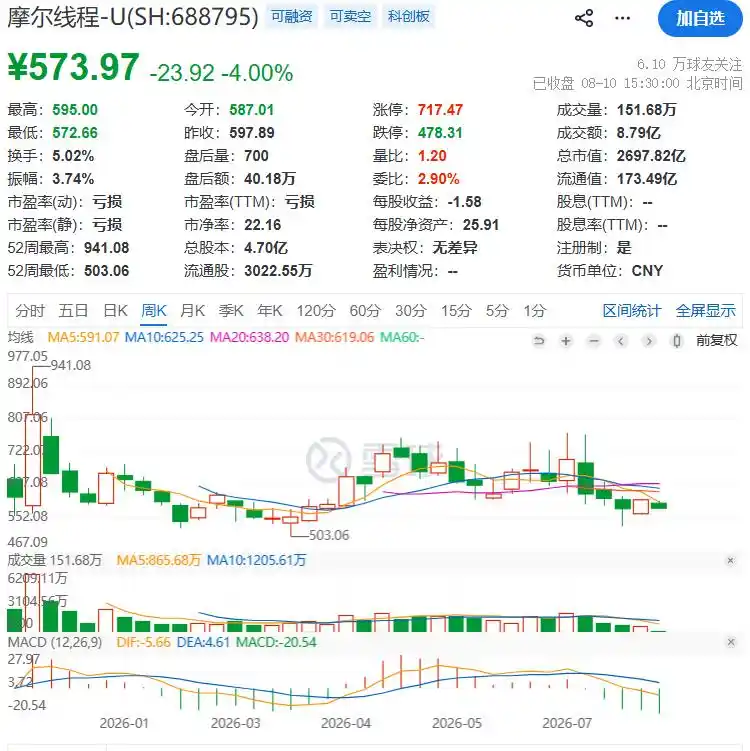
Behind this, Moore Threads' valuation was excessively hyped during its initial listing, with its price-to-sales ratio severely deviating from fundamentals. Its dynamic P/S ratio once exceeded 1,000x, significantly higher than the industry's static P/E ratio of around 60x. Meanwhile, its wealth management actions created a huge gap with investor expectations, impacting investor confidence.

Around July, the AI computing power sector experienced a collective pullback, with many stocks halving in value, and Moore Threads was no exception.

Planning Hong Kong IPO, Valuation Faces Test

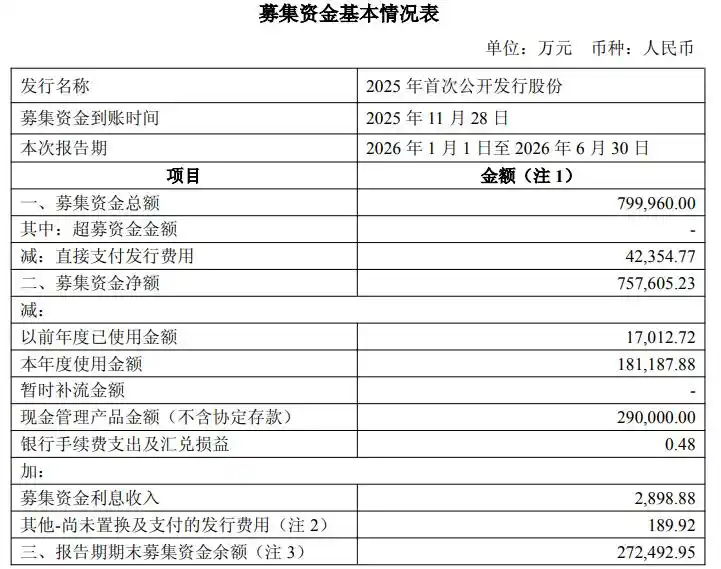
According to Moore Threads' fund usage announcement, it still has money on its books. It received 7.57 billion yuan from its A-share issuance, spent nearly 2 billion yuan, invested 2.9 billion yuan in wealth management products, and has 2.7 billion yuan deposited in banks.
The purpose of its Hong Kong listing is to "deepen its international strategic layout, continuously attract and gather outstanding global R&D and management talent, and enhance corporate governance and core competitiveness."

For the GPU industry it operates in, characterized by rapid technological iteration and intense capital competition, listing in Hong Kong helps open international capital channels and attract top overseas talent.

Industry insiders indicate that the perception of the "A+H" platform among enterprises has fundamentally shifted from a financing tool to a core strategic pillar for globalization.

Now is a golden window for "A+H" listings. In 2024, the China Securities Regulatory Commission proposed supporting leading domestic industry enterprises to list in Hong Kong; the Hong Kong Stock Exchange simultaneously reformed IPO rules, lowering listing thresholds.

Since 2024, over 270 mainland enterprises have listed in Hong Kong, raising over 650 billion Hong Kong dollars. Leading hard-tech companies like CATL, InnoLight, and Montage Technology have already completed or are pursuing the A+H path.

Among the "Four Little Dragons" of domestic GPUs, Biren Technology has already listed in Hong Kong. MetaX, which went public on the A-share market at the end of last year, swiftly announced plans for a Hong Kong listing in June.

However, for Moore Threads, it will be challenging for its Hong Kong IPO pricing to break through Biren Technology's valuation ceiling. International investors may use Biren's Hong Kong valuation as a benchmark and demand a discount for Moore Threads.

Revenue Surged in First Half, Still in the Red

In terms of performance, Moore Threads' revenue grew significantly in the first half, but it still hasn't turned a profit.

In the first half, Moore Threads achieved revenue of 1.74 billion yuan, a year-on-year increase of 147.4%, exceeding its full-year revenue from last year.

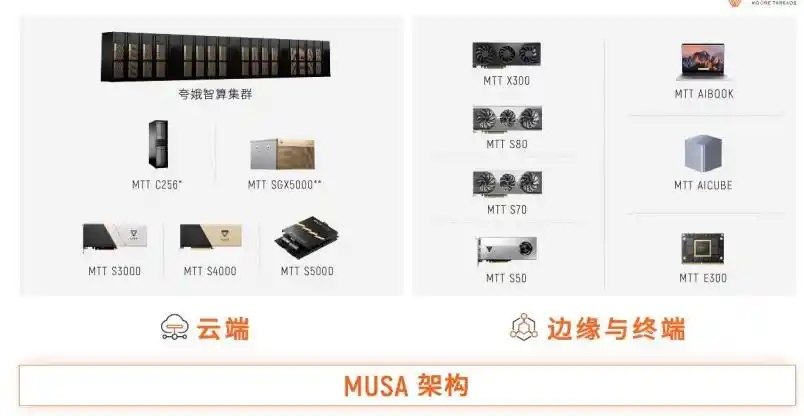
The semi-annual report explains that the significant revenue growth was driven by the development of the AI industry and strong market demand for full-feature GPUs, coupled with the accelerated commercialization of the company's Kua'e Intelligent Computing Cluster, whose performance has been highly recognized by customers.

The Kua'e Intelligent Computing Cluster is a "super factory" built by Moore Threads specifically for large language models, providing the computing power needed for training and inference of trillion-parameter-scale models.

Currently, almost all of Moore Threads' revenue comes from its cloud product line, including cloud intelligent computing cards, all-in-one intelligent computing machines, and intelligent computing clusters, generating about 1.7 billion yuan in the first half.

The edge and terminal product lines are still relatively small in scale and have not yet formed significant volume.
Moore Threads' net loss narrowed sharply from 271 million yuan in the same period last year to 11.563 million yuan. The company is very close to profitability, but its non-GAAP net profit attributable to the parent company still showed a loss of 150 million yuan in the first half, with non-recurring gains coming from government subsidies and investment income.

According to its previous disclosures, the earliest it expects to turn profitable is 2027.

In the first half, Moore Threads' total operating costs also surged, exceeding 1.8 billion yuan.

Among these, R&D investment reached 770 million yuan, a year-on-year increase of 38%; operating costs and sales expenses grew by 245% and 121% respectively, squeezed by both rising raw material prices and sales team expansion.

Conclusion

Moore Threads' initiation of a Hong Kong listing aims to broaden financing channels, facilitate attracting international talent, and enhance corporate governance, representing a strategic layout for the future.

Its revenue grew rapidly in the first half, but it is still not profitable on a non-GAAP basis, with R&D and sales investments continuing to increase. On the GPU track, whether Moore Threads can continue to narrow the gap with global industry leaders remains to be seen. Faced with market skepticism, it ultimately needs to respond with performance and technological breakthroughs.

This article is from the WeChat public account "Yijian Caijing," author: Feng Jianhong

Preguntas relacionadas

QWhat major announcements did Moore Threads make on August 9th?

AOn August 9th, Moore Threads announced two major pieces of news: its plan to list on the Hong Kong stock exchange (IPO) and the release of its strong first-half financial report.

QHow did Moore Threads' share price and market value change after its A-share IPO?

AAfter its A-share IPO, Moore Threads' stock price surged 468% on the first day and reached a historical high market value of 442.3 billion yuan. However, its market value subsequently declined. As of August 10th, its share price was 573.97 yuan/share, with a market value of 269.8 billion yuan, representing a 40% decrease from its peak.

QAccording to the article, what is the main purpose of Moore Threads seeking a Hong Kong IPO?

AAccording to the article, the main purpose of Moore Threads' Hong Kong IPO is to deepen its international strategic layout, continuously attract and gather top global R&D and management talent, and enhance its corporate governance level and core competitiveness.

QWhat were Moore Threads' financial results for the first half of the year, particularly regarding revenue and profitability?

AIn the first half of the year, Moore Threads achieved revenue of 1.74 billion yuan, a year-on-year increase of 147.4%, exceeding its full-year revenue from the previous year. However, it still reported a net loss of 11.563 million yuan on a non-GAAP basis, with non-recurring gains coming from government subsidies and investment income.

QWhat concerns did some investors express regarding Moore Threads' use of its IPO proceeds?

ASome investors expressed dissatisfaction, questioning the appropriateness of Moore Threads using a large portion (29 billion yuan) of its IPO proceeds to purchase low-risk financial products instead of investing in the promised projects for which the funds were raised, as this action created a gap with investor expectations and impacted market confidence.

Lecturas Relacionadas

Stock Price Doubles Within the Year, Plummets 20% After Resumption, Baolai Medical's 'Chip Backdoor Listing' Script Ends

On August 10, 2026, BPL (300246.SZ) resumed trading after a nearly week-long suspension and immediately fell by a 20% limit-down. This plunge was triggered by the termination of a planned controlling stake transfer, dashing earlier market speculation. In January 2026, Zhejiang Quwei Zhihe Partnership entered as a significant shareholder, sparking hopes. Investors speculated that its backer, Weigu Information—a specialized "little giant" company in high-reliability solid-state storage chips—might be seeking a backdoor listing through BPL. This "cross-industry restructuring" expectation fueled a strong rally, with BPL's stock price more than doubling in 2026 prior to the halt. However, the deal was called off on August 7, directly causing the sharp sell-off. Underlying BPL's vulnerability is its fundamentally weak business. The company, a medical device firm, is mired in losses, having reported three consecutive years of net losses totaling over 200 million yuan. Its core hemodialysis business is squeezed by government procurement price cuts, while growth in its patient monitor segment has stalled. Furthermore, BPL faces imminent debt pressure with convertible bonds worth approximately 218 million yuan due in September 2026, and its current stock price is far below the conversion price. The failed control transfer may represent a delayed release of negative news, but BPL's core challenges remain: reversing operational losses and addressing its urgent liquidity crisis.

marsbitHace 40 min(s)

Stock Price Doubles Within the Year, Plummets 20% After Resumption, Baolai Medical's 'Chip Backdoor Listing' Script Ends

marsbitHace 40 min(s)

Hassabis Predicts: AI's 'Move 37' in Mathematics is Only a Matter of Time

Demis Hassabis, the co-founder of DeepMind, predicts that AI achieving a "Move 37" level breakthrough in mathematics—solving a major unsolved problem like a Millennium Prize problem—is only a matter of time. He draws a parallel to the pivotal "Move 37" in the 2016 AlphaGo vs. Lee Sedol match, where AI's unconventional play challenged human understanding. Conversely, Lee Sedol's "Move 78" victory highlighted human resilience and the potential for human-AI collaboration. The article details AI's rapid progress in mathematics. Starting from basic arithmetic errors in 2023, AI systems like AlphaProof and Gemini Deep Think reached gold-medal levels in the International Mathematical Olympiad by 2025. The shift from problem-solving to genuine research began in 2025, with AI (e.g., GPT-5, Claude Fable 5) contributing key ideas to solve or refute long-standing conjectures like the Erdős problem 848 and the Jacobian conjecture. In 2026, AI achieved breakthroughs such as OpenAI's solution to the plane unit-distance problem and DeepMind's Aletheia agent autonomously tackling multiple open problems. Hassabis envisions a "centaur" era of science, where human intuition guides AI in complex, less-verifiable fields like biology and drug discovery. While AI can enhance human creativity and efficiency, as seen in post-AlphaGo围棋, there is a risk of over-reliance diminishing human judgment. The core challenge is for humanity to find its own "Move 78"—leveraging AI while maintaining critical insight and direction.

marsbitHace 1 hora(s)

Hassabis Predicts: AI's 'Move 37' in Mathematics is Only a Matter of Time

marsbitHace 1 hora(s)

Trading

Spot
活动图片