The Most Short-Sell Targeted Company on Wall Street: How to Play 'Digital Credit' with Bitcoin?

比推Publicado a 2026-02-27Actualizado a 2026-02-27

Resumen

Financial Times' Alphaville column reported that MicroStrategy holds the highest short interest (14% of market cap) among S&P 500 companies, ranking as Wall Street's most shorted stock. Despite crypto's mainstream adoption, critics like former Merrill Lynch executive Craig Coben argue that MicroStrategy’s business model—aggressively buying Bitcoin using raised capital and issuing high-yield perpetual preferred shares ("digital credit")—lacks sustainable cash flow and depends entirely on continuous financing and Bitcoin's perpetual appreciation. CEO Michael Saylor positions Bitcoin as "digital capital," the foundation for a broader monetary system including digital credit and currency. The company claims it can sustain this model unless Bitcoin falls below $8,000 for 4-5 years—a scenario that would cripple the entire crypto industry. While short-term liquidity isn’t imminently at risk, skeptics view MicroStrategy as an ideal hedge against Bitcoin downside. Saylor’s ambition to build a new monetary system using the very dollar he aims to disrupt illustrates the paradoxical nature of the strategy, which remains deeply tied to Bitcoin’s volatile price movements.

Author: Eric, Foresight News

Original Title: The Most Short-Sell Targeted Company on Wall Street Turns Out to Be a Leading Cryptocurrency Stock


On February 24, the Financial Times' Alphaville column published an article titled "Mirror mirror on the wall, what is the most shorted stock of them all?" providing some very interesting data.

The article shows that the median short interest in S&P 500 index constituents has climbed to 2.7%, reaching one of the highest levels in nearly a decade. Among all the constituents, Strategy tops the list with a short interest accounting for 14% of its market value, while Coinbase ranks fourth with 11%. This means that among all U.S. listed companies with a market cap exceeding $25 billion, Strategy is the least favored.

Articles published in the Alphaville column do not represent the views of the Financial Times. Its style is known for being sharp-tongued and unsparing. Even as cryptocurrencies gradually move into the mainstream, articles about cryptocurrencies in the Alphaville column still spare no effort in criticizing them. Whether Bitcoin is $10 or $100,000, they consistently believe that cryptocurrencies are meaningless.

On February 2, Craig Coben, a seasoned investment banker who previously served as Vice Chairman of Global Capital Markets at Merrill Lynch and Head of Global Equity Capital Markets, also published an article in the Alphaville column criticizing Strategy's model.

Craig Coben's views are not extreme; he also believes that Strategy does not face a "run" risk in the short term and currently has no liquidity crisis. However, he pointed out some core issues, such as the fact that hoarding Bitcoin does not generate cash flow, requiring continuous financing and diluting common shareholders' equity. Additionally, Strategy's tendency to buy when market sentiment is high and Bitcoin prices are elevated is a systemic and unsolvable problem.

Regarding Strategy's high short interest, some analysts believe that not all short positions are "naked shorts" against the company; some may be used by hedge funds to hedge their Bitcoin spot holdings. Nevertheless, it still indicates that many are bearish on Strategy, at least believing that if Bitcoin falls, Strategy cannot remain unscathed.

In Craig Coben's article, he mentioned that Strategy refers to its five types of perpetual preferred stock as "digital credit," a concept that Michael Saylor has been emphasizing since the end of last year.
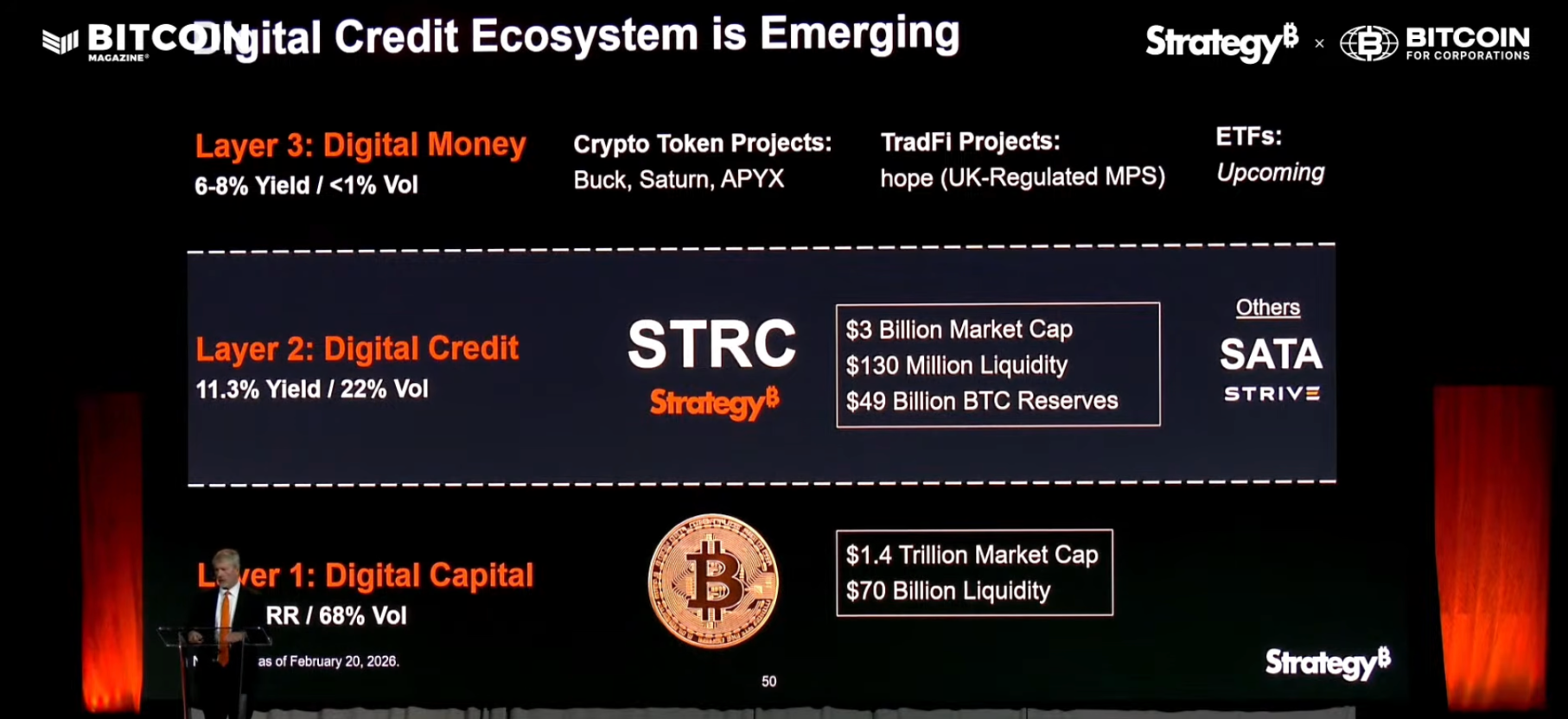
In this concept, the first layer, "digital capital," is Bitcoin. The second layer, "digital credit (or digital lending)," consists of the various perpetual preferred stocks issued by Strategy. These preferred stocks come with high yields, and Strategy must pay corresponding interest to holders annually.

The third layer is "digital currency," which includes stablecoins and other currencies issued based on the financial products in the second layer for trading purposes. For example, Saturn in the above image plans to issue USDat, a stablecoin based on STRC and U.S. Treasury bonds. This project has also received investment from YZi Labs.

If this logic is unclear, you can draw an analogy with the United States. The U.S. continuously issues Treasury bonds based on its influence, only needing to pay interest before maturity and using new debt to repay old debt upon maturity. As long as the international influence of the U.S. and the status of the dollar do not weaken, this game can continue indefinitely. For Strategy, Bitcoin is equivalent to U.S. influence, and digital credit is equivalent to Treasury bonds. Strategy also needs to borrow new debt to pay the annual interest on preferred stocks. However, as long as the price of Bitcoin continues to rise in the long term and drives up Strategy's stock price, the company can continuously issue new shares to raise funds, buy more Bitcoin, and pay interest, continuing this cycle indefinitely.

Michael Saylor is a firm believer that Bitcoin will change everything. In his view, Bitcoin's infinite rise is a more reliable bet than the U.S. always winning, so he is more willing to issue currency based on an asset that is "destined" to continuously appreciate, much like how the U.S. dollar was initially pegged to gold.

Strategy's strategy is not new. It only needs to ensure sufficient cash to pay interest, enabling it to continuously finance and buy Bitcoin. Like U.S. Treasury bonds, this is a game that everyone knows will eventually end but cannot determine how long it will last. Strategy's current financial reserves are also ample. Its CEO stated that Strategy would only be forced to sell Bitcoin if the price remains below $8,000 for 4 to 5 consecutive years.

If this extreme condition were to materialize, not only Strategy but the entire Web3 industry might disappear.

Even a traditional banker like Craig Coben must admit that Strategy will not face financial problems in the short term. However, for hedge funds, Strategy is an excellent tool to hedge against Bitcoin declines. For short sellers, it is reasonable to short a system that relies on Bitcoin's rise to function properly during a cryptocurrency downturn. At least for now, there are not many reasons to be bullish on Strategy.

Michael Saylor's attempt to launch a new currency using Bitcoin is itself interesting. U.S. dollars are used to buy Bitcoin, and U.S. dollars are used to pay interest. The goal of building a system with billions of U.S. dollars is ultimately to destroy the very bricks that built it. Perhaps Wall Street elites are also chuckling; after all, they have no interest in studying whether Strategy can truly become a century-old company. They only care about when your stock price will rise and when it will fall.

Michael Saylor believes that Bitcoin will inevitably continue to hit new highs, so he uses it as the foundation for everything. Holders and users of the U.S. dollar believe that the U.S. will continue to prosper, so they tolerate the continuous raising of the debt ceiling. Both are acts of belief—so who is to say which is superior?


Twitter:https://twitter.com/BitpushNewsCN

Bitpush TG Discussion Group:https://t.me/BitPushCommunity

Bitpush TG Subscription: https://t.me/bitpush

Original link:https://www.bitpush.news/articles/7615105

Preguntas relacionadas

QAccording to the article, which company has the highest short interest as a percentage of market cap among S&P 500 constituents, and what is the figure?

AMicroStrategy has the highest short interest at 14% of its market capitalization.

QWhat are the three layers in Michael Saylor's 'Digital Credit' concept as described in the article?

AThe three layers are: 1. 'Digital Capital' (Bitcoin), 2. 'Digital Credit' (various perpetual preferred shares issued by MicroStrategy), and 3. 'Digital Currency' (currencies, including stablecoins, issued for transaction purposes and based on the second-layer financial products).

QWhat extreme condition would force MicroStrategy to sell its Bitcoin holdings, according to its CEO?

AThe CEO stated that MicroStrategy would only be forced to sell its Bitcoin if the price remained below $8,000 for a sustained period of 4 to 5 years.

QWhy do some analysts believe the high short interest in MicroStrategy might not be entirely a bearish bet?

ASome analysts suggest that not all of the short positions are 'naked shorts' and that some may be used by hedge funds to hedge their spot Bitcoin holdings.

QHow does the article compare MicroStrategy's strategy to the United States' financial system?

AThe article compares Bitcoin to the influence of the United States, MicroStrategy's 'digital credit' (its perpetual preferred shares) to U.S. Treasury bonds, and explains that the company plans to continuously issue new debt (shares) to pay interest on the old ones, relying on the long-term appreciation of Bitcoin, similar to how the U.S. manages its debt based on the continued strength of the dollar.

Lecturas Relacionadas

Three Months, 35 Billion Yuan: Investors Rush to Grab the OpenAI of the Physical World

Investors flock to a physical AI startup as the race for the "OpenAI of the physical world" heats up. Ji Jia Shi Jie (GigaWorld), a company dedicated to developing Artificial General Intelligence (AGI) for the physical world, has raised 3.5 billion RMB (approximately $490 million) in just three months, according to a report from investment media outlet Touzijie. The latest B2 funding round of 1 billion RMB attracted a wide range of top-tier investors, including sovereign wealth funds, industrial capital, and financial institutions. This brings the total funding for the young company, now valued over 10 billion RMB, to 3.5 billion RMB across three recent rounds. The company is led by Huang Guan, a post-90s Tsinghua University PhD with extensive experience in AI, autonomous driving, and entrepreneurship. Its core innovation is a "dual-pyramid" system comprising a five-layer data pyramid (from internet videos to real-world robot data) and a three-layer algorithm pyramid focused on world simulation, action alignment, and reinforcement learning. This system underpins its key models: the "World Action Model" (e.g., GigaBrain series for robot control) and the "World Generation Model" (e.g., GigaWorld series for simulating and understanding the physical world). Its models have reportedly achieved top rankings in global robotics benchmarks. Ji Jia Shi Jie argues that while current digital AGI excels in information processing, the next frontier is physical AGI—systems that can understand and interact with the real world. The company believes the field is approaching its "GPT-3 moment," a key inflection point in capability scaling. To achieve this, the company is pursuing a dual-market strategy. For the consumer (C) market, it launched the "SeeLight" brand and its S1 general-purpose humanoid robot, which has secured initial orders for deployment in real homes. For the business (B) market, it focuses on industrial automation with its Maker series robots, having signed agreements for large-scale deployment in factories, and its DriveDreamer world model for autonomous driving, which is already in use with over 30 automakers and tech companies. The report concludes that by bridging the gap between digital intelligence and physical action, Ji Jia Shi Jie aims to unlock a new wave of productivity, ultimately bringing physical AGI into everyday life.

marsbitHace 22 min(s)

Three Months, 35 Billion Yuan: Investors Rush to Grab the OpenAI of the Physical World

marsbitHace 22 min(s)

What's the Connection Between Pinduoduo's Huang Zheng and Blockchain?

This text explores the unexpected connection between Pinduoduo founder Colin Huang and blockchain, as suggested in his article *Turning Capitalism Upside Down*. Huang argues Pinduoduo's core business is about managing "uncertainty." He posits that wealth flows to the rich because they absorb life's uncertainties (e.g., illness, job loss) that devastate the poor, who pay a premium for certainty through insurance or stable prices. Pinduoduo's model attempts a "reverse insurance": by aggregating consumer demand via group-buying and flash sales, it creates a large, predictable order for manufacturers. This certainty allows factories to remove risk premiums, passing savings back as lower prices, thus partially reversing the wealth flow. The key obstacle, Huang notes, is that an individual's buying intent is an unreliable promise. He then asks if blockchain is the natural solution for this "reverse insurance." The text elaborates that blockchain, through smart contracts with binding deposits, could transform casual intent into a costly-to-break, enforceable commitment. This replaces interpersonal trust with coded rules, making promises credible, pricable, and resistant to fraud. Finally, the author draws a parallel to Bitcoin, framing two paths to creating certainty: the "Pinduoduo path" of aggregating decentralized will into scale, and the "Bitcoin path" of locking rules into immutable code. Both sacrifice something—personal freedom or system flexibility—to manufacture trust and predictability.

链捕手Hace 1 hora(s)

What's the Connection Between Pinduoduo's Huang Zheng and Blockchain?

链捕手Hace 1 hora(s)

The Storage Magnate Who Conquered a Trillion-Dollar Kingdom, Yet Ultimately Could Not Become the Richest

**Summary:** "The Memory Magnate Who Built a Trillion-Dollar Empire, Yet Never Became the Richest" explores the journey of Zhu Yiming, founder of GigaDevice (603986) and co-founder of the soon-to-IPO ChangXin Memory Technologies (CXMT). The article positions GigaDevice, a fabless chip designer now valued at ~¥340 billion, as a prequel to the massive IDM (Integrated Device Manufacturer) venture, CXMT. Starting in 2005 with minimal capital, Zhu strategically "picked up the pieces" by focusing on niche markets like NOR Flash and microcontrollers (MCUs), areas major players were exiting. This allowed GigaDevice to grow into a diversified semiconductor company, maintaining robust profitability even during industry downturns by controlling costs. However, the piece argues that in the highly cyclical and capital-intensive memory chip industry, the fabless model has limits. True resilience and scale require the ability for "counter-cyclical expansion" – investing heavily during downturns – a tactic only possible for IDMs like Samsung or SK Hynix. This insight led Zhu to partner with the Hefei city government in 2016 to establish CXMT, an IDM focused on DRAM. Zhu's symbolic moves, like forfeiting salary and diluting his equity, were crucial in securing the massive state and bank funding needed. CXMT's equipment base is now valued even higher than that of BYD's vast auto manufacturing empire. Despite the potential for CXMT to reach a market cap of ¥1-2 trillion upon its IPO, Zhu's indirect stake in both companies is estimated below 3%, placing his personal wealth far below that of China's top billionaires. The article concludes that his strategic vision built a trillion-yuan memory landscape, but the capital structure necessary to achieve it precluded a personal fortune of similar scale.

marsbitHace 1 hora(s)

The Storage Magnate Who Conquered a Trillion-Dollar Kingdom, Yet Ultimately Could Not Become the Richest

marsbitHace 1 hora(s)

XRP Ledger Daily Fees Drop Below $400 As Network Activity Question Returns

The XRP Ledger is drawing attention as daily network fees have fallen below $400. While low fees align with XRPL's design for affordable transactions and are often seen as a strength, the metric can also serve as an indicator of network demand and paid transaction volume. This data point of around $3,100 in weekly fee burn highlights the stark contrast with higher-fee chains like Ethereum and Bitcoin. The development fuels an ongoing debate. Proponents view low fees as a sign of efficiency and accessibility, while critics may question if the network is generating sufficient high-value activity relative to its market cap and payments-focused narrative. The article cautions against overstating the finding, noting a single low-fee day does not signify network failure. It instead adds context to discussions about XRPL's usage, especially alongside Ripple's broader initiatives in stablecoins (RLUSD), AI payments, and enterprise infrastructure. The report recommends monitoring for a fee rebound, checking transaction counts for a fuller picture, and confirming the trend via native explorers like Bithomp. It frames the story within a larger market shift where on-chain data, protocol updates, and infrastructure developments are becoming crucial alongside price action. The editorial stance is to present the verified data, explain its significance for assessing network activity, and avoid hype, positioning it as part of the daily crypto conversation.

bitcoinistHace 6 hora(s)

XRP Ledger Daily Fees Drop Below $400 As Network Activity Question Returns

bitcoinistHace 6 hora(s)

Trading

Spot
Futuros

Artículos destacados

Qué es BITCOIN

Entendiendo HarryPotterObamaSonic10Inu (ERC-20) y Su Posición en el Espacio Cripto En los últimos años, el mercado de criptomonedas ha sido testigo de un aumento en la popularidad de las monedas meme, capturando el interés no solo de los comerciantes, sino también de aquellos que buscan compromiso comunitario y valor de entretenimiento. Entre estos tokens únicos se encuentra HarryPotterObamaSonic10Inu (ERC-20), un proyecto intrigante que mezcla referencias culturales en el tejido de las criptomonedas. Este artículo profundiza en los aspectos clave de HarryPotterObamaSonic10Inu, explorando sus mecanismos, ethos impulsado por la comunidad y su relación con el paisaje cripto más amplio. ¿Qué es HarryPotterObamaSonic10Inu (ERC-20)? Como su nombre sugiere, HarryPotterObamaSonic10Inu es una moneda meme construida sobre la blockchain de Ethereum, clasificada bajo el estándar ERC-20. A diferencia de las criptomonedas tradicionales que pueden enfatizar la utilidad práctica o el potencial de inversión, este token prospera en el valor de entretenimiento y la fuerza de su comunidad. El proyecto tiene como objetivo fomentar un entorno donde los usuarios comprometidos puedan reunirse, compartir ideas y participar en actividades inspiradas por diversos fenómenos culturales. Una característica notable de HarryPotterObamaSonic10Inu es su cero impuestos en las transacciones. Este atractivo elemento tiene como objetivo incentivar el comercio y la participación comunitaria, sin cargos adicionales que puedan disuadir a los comerciantes de pequeña escala. El suministro total de la moneda está establecido en mil millones de tokens, una cifra que marca su intención de mantener una circulación sustancial dentro de la comunidad. Creador de HarryPotterObamaSonic10Inu (ERC-20) Los orígenes de HarryPotterObamaSonic10Inu están algo envueltos en misterio; los detalles sobre el creador siguen siendo desconocidos. El desarrollo de este token carece de un equipo identificable o de un plan explícito, lo cual no es inusual dentro del sector de monedas meme. En cambio, el proyecto ha surgido de manera orgánica, con su progreso muy dependiente del entusiasmo y la participación de su comunidad. Inversores de HarryPotterObamaSonic10Inu (ERC-20) En cuanto a inversiones externas y respaldo, HarryPotterObamaSonic10Inu también sigue siendo ambiguo. El token no lista ninguna fundación de inversión conocida o apoyo organizacional significativo. En cambio, la savia del proyecto es su comunidad de base, que informa su crecimiento y sostenibilidad a través de la acción colectiva y el compromiso en el espacio cripto. ¿Cómo Funciona HarryPotterObamaSonic10Inu (ERC-20)? Como una moneda meme, HarryPotterObamaSonic10Inu opera principalmente fuera de los marcos tradicionales que a menudo rigen el valor de los activos. Hay varios aspectos distintivos que definen cómo funciona el proyecto: Transacciones Sin Impuestos: Sin tarifas impositivas en las transacciones, los usuarios pueden comprar y vender el token libremente sin preocuparse por costos ocultos. Compromiso Comunitario: El proyecto prospera en la interacción comunitaria, aprovechando plataformas de redes sociales para crear entusiasmo y facilitar la participación. Las discusiones, el intercambio de contenido y el compromiso son elementos cruciales que ayudan a expandir su alcance y fomentar la lealtad entre los seguidores. Sin Utilidad Práctica: Cabe señalar que HarryPotterObamaSonic10Inu no ofrece utilidad concreta dentro del ecosistema financiero. Más bien, se clasifica como un token principalmente para actividades de entretenimiento y comunitarias. Referencia Cultural: El token incorpora astutamente elementos de la cultura popular para atraer interés, conectando con entusiastas de los memes y seguidores de las criptomonedas por igual. HarryPotterObamaSonic10Inu ejemplifica cómo las monedas meme operan de manera diferente a los proyectos de criptomonedas más tradicionales, ingresando al mercado como construcciones sociales innovadoras en lugar de activos utilitarios. Cronología de HarryPotterObamaSonic10Inu (ERC-20) La historia de HarryPotterObamaSonic10Inu está marcada por varios hitos notables: Creación: El token surgió de un meme viral, capturando la imaginación de muchos entusiastas de las criptomonedas. Las fechas específicas de creación no están disponibles, subrayando su ascenso orgánico. Listado en Exchanges: HarryPotterObamaSonic10Inu ha llegado a varios exchanges, permitiendo un acceso y comercio más fácil por parte de la comunidad. Iniciativas de Compromiso Comunitario: Actividades continuas destinadas a mejorar la interacción comunitaria, incluyendo concursos, campañas en redes sociales y generación de contenido por parte de fanáticos y defensores. Planes de Expansión Futuros: La hoja de ruta del proyecto incluye el lanzamiento de una colección de NFT, mercancía y un sitio de comercio electrónico relacionado con sus temas culturales, involucrando aún más a la comunidad e intentando añadir más dimensiones a su ecosistema. Puntos Clave Sobre HarryPotterObamaSonic10Inu (ERC-20) Naturaleza Impulsada por la Comunidad: El proyecto prioriza la participación colectiva y la creatividad, asegurando que la involucración de los usuarios esté a la vanguardia de su desarrollo. Clasificación como Moneda Meme: Representa la epítome de las criptomonedas basadas en el entretenimiento, diferenciándose de los vehículos de inversión tradicionales. Sin Afiliación Directa con Bitcoin: A pesar de la similitud en el nombre del ticker, HarryPotterObamaSonic10Inu es distinto y no tiene relación con Bitcoin u otras criptomonedas establecidas. Enfoque en la Colaboración: HarryPotterObamaSonic10Inu está diseñado para crear un espacio para la colaboración y el intercambio de historias entre sus poseedores, proporcionando una vía para la creatividad y el vínculo comunitario. Perspectivas Futuras: La ambición de expandirse más allá de su premisa inicial hacia NFTs y mercancías describe un camino para que el proyecto potencialmente ingrese a avenidas más tradicionales dentro de la cultura digital. A medida que las monedas meme continúan capturando la imaginación de la comunidad de criptomonedas, HarryPotterObamaSonic10Inu (ERC-20) se destaca debido a sus lazos culturales y su enfoque centrado en la comunidad. Si bien puede no encajar en el molde típico de un token impulsado por la utilidad, su esencia radica en la alegría y la camaradería fomentadas entre sus seguidores, destacando la naturaleza en evolución de las criptomonedas en una era cada vez más digital. A medida que el proyecto continúa desarrollándose, será importante observar cómo las dinámicas comunitarias influyen en su trayectoria en el cambiante paisaje de la tecnología blockchain.

1.8k Vistas totalesPublicado en 2024.04.01Actualizado en 2024.12.03

Qué es BITCOIN

Cómo comprar BTC

¡Bienvenido a HTX.com! Hemos hecho que comprar Bitcoin (BTC) sea simple y conveniente. Sigue nuestra guía paso a paso para iniciar tu viaje de criptos.Paso 1: crea tu cuenta HTXUtiliza tu correo electrónico o número de teléfono para registrarte y obtener una cuenta gratuita en HTX. Experimenta un proceso de registro sin complicaciones y desbloquea todas las funciones.Obtener mi cuentaPaso 2: ve a Comprar cripto y elige tu método de pagoTarjeta de crédito/débito: usa tu Visa o Mastercard para comprar Bitcoin (BTC) al instante.Saldo: utiliza fondos del saldo de tu cuenta HTX para tradear sin problemas.Terceros: hemos agregado métodos de pago populares como Google Pay y Apple Pay para mejorar la comodidad.P2P: tradear directamente con otros usuarios en HTX.Over-the-Counter (OTC): ofrecemos servicios personalizados y tipos de cambio competitivos para los traders.Paso 3: guarda tu Bitcoin (BTC)Después de comprar tu Bitcoin (BTC), guárdalo en tu cuenta HTX. Alternativamente, puedes enviarlo a otro lugar mediante transferencia blockchain o utilizarlo para tradear otras criptomonedas.Paso 4: tradear Bitcoin (BTC)Tradear fácilmente con Bitcoin (BTC) en HTX's mercado spot. Simplemente accede a tu cuenta, selecciona tu par de trading, ejecuta tus trades y monitorea en tiempo real. Ofrecemos una experiencia fácil de usar tanto para principiantes como para traders experimentados.

5.2k Vistas totalesPublicado en 2024.12.12Actualizado en 2026.06.02

Cómo comprar BTC

Qué es $BITCOIN

ORO DIGITAL ($BITCOIN): Un Análisis Integral Introducción al ORO DIGITAL ($BITCOIN) ORO DIGITAL ($BITCOIN) es un proyecto basado en blockchain que opera en la red Solana, cuyo objetivo es combinar las características de los metales preciosos tradicionales con la innovación de las tecnologías descentralizadas. Aunque comparte un nombre con Bitcoin, a menudo referido como “oro digital” debido a su percepción como un refugio de valor, ORO DIGITAL es un token separado diseñado para crear un ecosistema único dentro del paisaje Web3. Su meta es posicionarse como un activo digital alternativo viable, aunque los detalles sobre sus aplicaciones y funcionalidades aún están en desarrollo. ¿Qué es ORO DIGITAL ($BITCOIN)? ORO DIGITAL ($BITCOIN) es un token de criptomoneda diseñado explícitamente para su uso en la blockchain de Solana. A diferencia de Bitcoin, que proporciona un papel de almacenamiento de valor ampliamente reconocido, este token parece centrarse en aplicaciones y características más amplias. Aspectos notables incluyen: Infraestructura Blockchain: El token está construido sobre la blockchain de Solana, conocida por su capacidad para manejar transacciones de alta velocidad y bajo costo. Dinámicas de Suministro: ORO DIGITAL tiene un suministro máximo limitado a 100 cuatrillones de tokens (100P $BITCOIN), aunque los detalles sobre su suministro circulante no se han divulgado actualmente. Utilidad: Si bien las funcionalidades precisas no están delineadas explícitamente, hay indicios de que el token podría ser utilizado para diversas aplicaciones, potencialmente involucrando aplicaciones descentralizadas (dApps) o estrategias de tokenización de activos. ¿Quién es el Creador de ORO DIGITAL ($BITCOIN)? En la actualidad, la identidad de los creadores y el equipo de desarrollo detrás de ORO DIGITAL ($BITCOIN) sigue siendo desconocida. Esta situación es típica entre muchos proyectos innovadores dentro del espacio blockchain, particularmente aquellos alineados con las finanzas descentralizadas y fenómenos de monedas meme. Si bien tal anonimato puede fomentar una cultura impulsada por la comunidad, intensifica las preocupaciones sobre la gobernanza y la responsabilidad. ¿Quiénes son los Inversores de ORO DIGITAL ($BITCOIN)? La información disponible indica que ORO DIGITAL ($BITCOIN) no tiene patrocinadores institucionales conocidos ni inversiones destacadas de capital de riesgo. El proyecto parece operar en un modelo de peer-to-peer centrado en el apoyo y la adopción de la comunidad en lugar de rutas de financiamiento tradicionales. Su actividad y liquidez se sitúan principalmente en intercambios descentralizados (DEX), como PumpSwap, en lugar de plataformas de trading centralizadas establecidas, lo que resalta aún más su enfoque de base. Cómo Funciona ORO DIGITAL ($BITCOIN) Los mecanismos operativos de ORO DIGITAL ($BITCOIN) pueden elaborarse en función de su diseño blockchain y atributos de red: Mecanismo de Consenso: Al aprovechar el único proof-of-history (PoH) de Solana combinado con un modelo de proof-of-stake (PoS), el proyecto asegura una validación de transacciones eficiente que contribuye al alto rendimiento de la red. Tokenómica: Si bien los mecanismos deflacionarios específicos no se han detallado extensamente, el vasto suministro máximo de tokens implica que podría atender microtransacciones o casos de uso nicho que aún están por definirse. Interoperabilidad: Existe el potencial de integración con el ecosistema más amplio de Solana, incluyendo varias plataformas de finanzas descentralizadas (DeFi). Sin embargo, los detalles sobre integraciones específicas permanecen no especificados. Cronología de Eventos Clave Aquí hay una cronología que destaca hitos significativos relacionados con ORO DIGITAL ($BITCOIN): 2023: El despliegue inicial del token ocurre en la blockchain de Solana, marcado por su dirección de contrato. 2024: ORO DIGITAL gana visibilidad al estar disponible para trading en intercambios descentralizados como PumpSwap, permitiendo a los usuarios comerciar contra SOL. 2025: El proyecto presencia actividad de trading esporádica y potencial interés en compromisos liderados por la comunidad, aunque no se han documentado asociaciones notables o avances técnicos hasta el momento. Análisis Crítico Fortalezas Escalabilidad: La infraestructura subyacente de Solana soporta altos volúmenes de transacciones, lo que podría mejorar la utilidad de $BITCOIN en varios escenarios de transacción. Accesibilidad: El potencial bajo precio de trading por token podría atraer a inversores minoristas, facilitando una participación más amplia debido a oportunidades de propiedad fraccionada. Riesgos Falta de Transparencia: La ausencia de patrocinadores, desarrolladores o un proceso de auditoría conocidos públicamente puede generar escepticismo sobre la sostenibilidad y confiabilidad del proyecto. Volatilidad del Mercado: La actividad de trading depende en gran medida del comportamiento especulativo, lo que puede resultar en una volatilidad de precios significativa y en incertidumbre para los inversores. Conclusión ORO DIGITAL ($BITCOIN) surge como un proyecto intrigante pero ambiguo dentro del ecosistema de Solana en rápida evolución. Si bien intenta aprovechar la narrativa del “oro digital”, su alejamiento del papel establecido de Bitcoin como refugio de valor subraya la necesidad de una diferenciación más clara de su utilidad y estructura de gobernanza previstas. La aceptación y adopción futura dependerán probablemente de abordar la actual opacidad y de definir sus estrategias operativas y económicas de manera más explícita. Nota: Este informe abarca información sintetizada disponible hasta octubre de 2023, y pueden haber ocurrido desarrollos más allá del período de investigación.

83 Vistas totalesPublicado en 2025.05.13Actualizado en 2025.05.13

Qué es $BITCOIN

Discusiones

Bienvenido a la comunidad de HTX. Aquí puedes mantenerte informado sobre los últimos desarrollos de la plataforma y acceder a análisis profesionales del mercado. A continuación se presentan las opiniones de los usuarios sobre el precio de BTC (BTC).

活动图片














