Author: SOL I Don't Understand
Why does the market often rise or fall before data is even released?
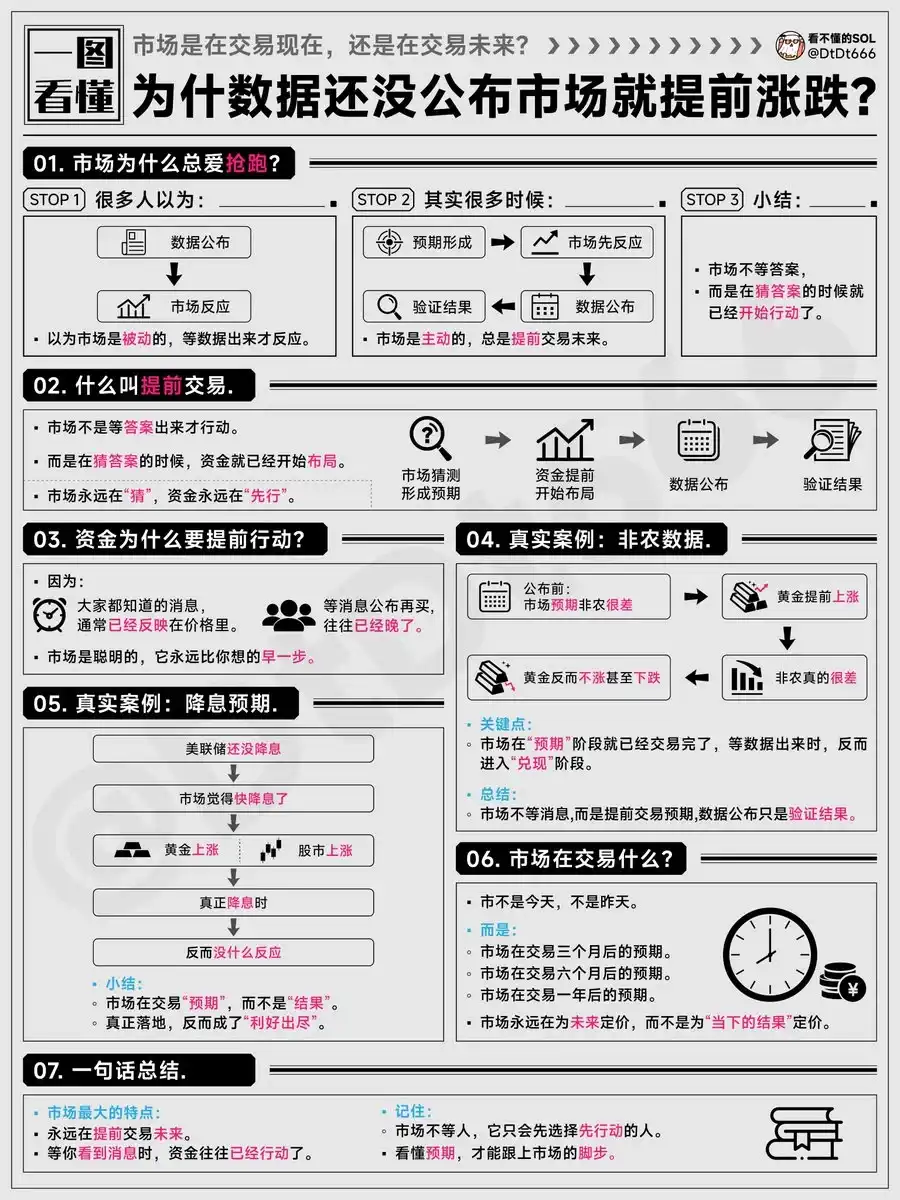
Because the market never trades solely on the "outcome"; more often, it trades on "expectations."
Many people understand the market like this:
Data is released, the market sees it, and then starts reacting.
But the real market often isn't like that.
Truly sensitive capital rarely waits for the answer to come out before acting. It first assesses: How might policy change next, where will capital flow, and how will sentiment shift.
Once expectations form, prices move first.
For example, if the market thinks the Fed is about to cut rates, gold, growth stocks, and BTC might react in advance. But by the time the actual rate cut happens, the market may show little movement, or even pull back.
It's not that the positive news is useless.
It's because that positive news was already traded during the preceding rally.
The same goes for Non-Farm Payroll data.
If before the release, the market already expects employment to weaken, gold and bonds might rise in advance. When the NFP data truly comes out weak, gold might not necessarily continue rising.
Because for the market, this isn't "new information," it's merely "confirmation."
So you often see:
Positive news comes out, but no rise.
Negative news comes out, but no fall.
Many people think the market makes no sense.
Actually, it's not that the market is crazy; it's that the market has already moved ahead of the news.
Where ordinary investors lose money most easily is by only reading news headlines.
Seeing good news, they chase; seeing bad news, they flee.
But the real question should be:
Did the market anticipate this news beforehand?
Has capital already priced it in?
Is this the beginning of pricing it in, or is it the stage of realization?
The market isn't trading today; it is constantly trading the future.
Behind price movements is capital continuously betting on what will happen next.
So when looking at the market, don't just focus on "what happened."
Look more at:
What did people previously think would happen.
Does the current result exceed expectations.
Is capital continuing to price it in, or starting to cash out.
Many market moves seem illogical because you're looking at the result, while the market trades on the deviation from expectations.
To summarize in one sentence:
The market doesn't wait for answers.
The market only chooses, in advance, the future it believes in.
By the time you see the news, capital has often been moving for a long time.