
The Hometown of 'Brokeback Mountain' Is Issuing a New American Dream

比推Publicado a 2026-01-08Actualizado a 2026-01-08

Resumen

Wyoming, the iconic but sparsely populated American West known for Yellowstone National Park and as the setting of "Brokeback Mountain," is pioneering a new financial future. Facing a severe fiscal crisis as its coal industry collapses, the state is leveraging its libertarian business laws to become a crypto hub. In a landmark move, it launched $FRNT, the first U.S. state-backed dollar stablecoin, issued on Solana and EVM-compatible chains. Backed by 102% reserves in U.S. Treasuries and cash managed by Franklin Templeton, the profits are directed to the state's school fund. This initiative aims to replace lost coal revenue and position Wyoming at the forefront of digital finance. However, the benefits are not evenly distributed, highlighting a stark contrast between the wealthy elite in places like Jackson Hole and the struggling local workforce. The move signifies a shift for stablecoins from private ventures to public financial tools, testing whether digital innovation can heal deep economic and social divisions.

On the map of the United States, Wyoming is an easily overlooked "western asset."

Mention it, and most people's first thought is the erupting Old Faithful geyser in Yellowstone National Park, or the perpetually snow-capped peaks of the Grand Tetons.

This is the least populous state in the U.S. On nearly 260,000 square kilometers of land, fewer than 600,000 people live—a number even smaller than the population of a distant suburban town in Shanghai.

In literary and cinematic memory, this is the cruel wilderness that Annie Proulx described as "unfixable, only to be endured," the mountains that trapped the cowboys for a lifetime in "Brokeback Mountain," and the blood-stained frontier besieged by a blizzard in Quentin Tarantino's "The Hateful Eight."

It is contradictory and distinct: deeply conservative, it is the "deepest red" state in the U.S., where the Republican Party has held a monopoly for forty years. In the 2024 U.S. election, over 70% of voters cast their ballots for Trump. Yet it was also once at the forefront of its time; as early as 1869, it became the "Equality State," the first in the U.S. to grant women the right to vote.

But Wyoming is by no means a financial desert. Every summer, the world's "most powerful" people gather here: at the serene Jackson Hole resort in Wyoming, the Global Central Bankers' Symposium, hosted by the Federal Reserve Bank of Kansas City, is held. From Alan Greenspan (the 13th Chairman of the Federal Reserve) to Jerome Powell, nearly every key turning point in global monetary policy has been set amidst these snow-capped mountains and meadows.

It is this aloof and unique "western spirit" that once again brought Wyoming into the public eye in early 2026.
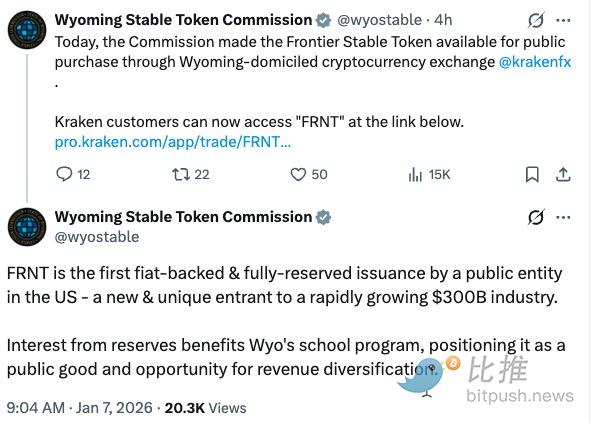
On January 7th local time, the state officially announced the launch of the $FRNT stablecoin, initially issued on the Solana blockchain and supporting six EVM-compatible chains. This is the world's first dollar stablecoin backed by "state government credit."

Finding Light in the Mining Ruins: The Path to Regeneration Through Energy Transition

Wyoming's radical move stems from a deep fiscal anxiety: the "underground wealth" that has supported this land for a century is drying up.

As the energy heartland supplying 40% of the U.S.'s coal, it once created the myth of a "tax-free heaven" through mineral resource taxes: residents pay no personal income tax, and businesses pay no corporate tax.

A key reason is that, thanks to the continuous resource exports from the Powder River Basin, this sparsely populated state created astonishing wealth: its per capita has long ranked among the top ten in the U.S., and in peak energy years, it could even rival New York and California.

This prosperity once gave Wyoming the confidence to refuse to levy personal income tax, corporate tax, and inheritance tax. However, this is a fragile prosperity built on heavy energy.
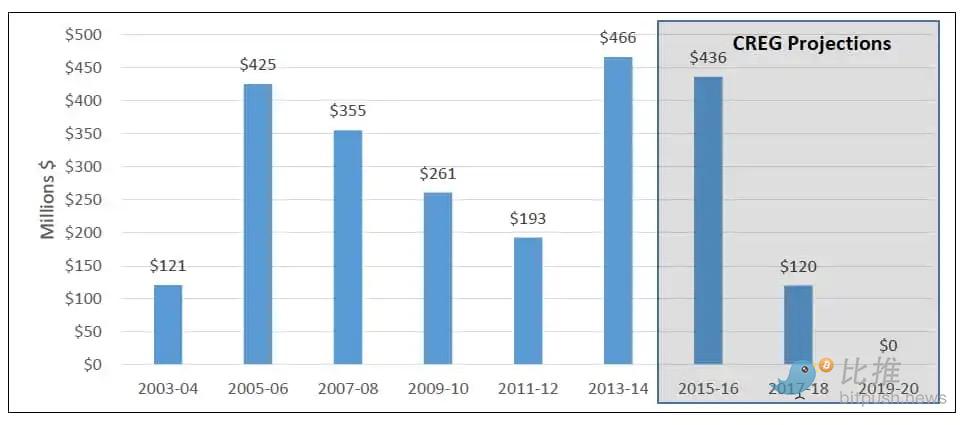
Source: University of Wyoming Center for Energy Economics and Public Policy

Since 2011, Wyoming's pillar industry began a decade-long "avalanche":

  • Ruthless market substitution: The rise of low-cost shale gas and renewable energy delivered a dimensional blow to coal in terms of power generation costs.

  • Tightening environmental constraints: The advancement of U.S. federal carbon emission regulations (such as the Clean Power Plan) led to the closure of coal-fired power plants across the country in batches.

  • A cliff-like fiscal gap: According to CREG official data cited by Wyoming Public Media, the state's coal resource tax plummeted from $290 million in 2011 to $170 million in 2022, with coal production in 2025 expected to fall to the second lowest point in history, only half of the 2008 peak. The "Coal Lease Bonuses," once a crucial source for school infrastructure, have even dropped to zero.
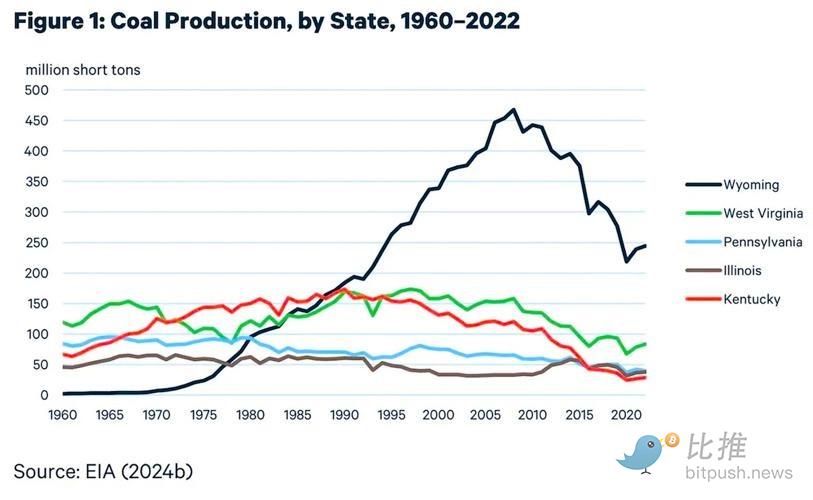
"If we don't stir things up, we'll be the next West Virginia (Note: a traditional mining region in the U.S. that became one of the poorest states after the coal industry declined)." – This visceral pain has created an urgent awareness among the most conservative cowboy politicians locally.

They realized that since they cannot change the trend of energy transition, they must leverage Wyoming's core asset—extremely liberal business legislation. In fact, Wyoming's innovative基因早有先例基因 has precedents. In 1977, it pioneered the LLC (Limited Liability Company), the most popular business entity to this day, nationwide.

Starting in 2018, to save itself, this most "red" conservative state was forced to embark on a long journey of institutional innovation in the crypto world.

In 2019, the Wyoming State Legislature passed House Bill 74 (HB 74), creating a new type of financial entity: the SPDI license (Special Purpose Depository Institution). This is not a traditional bank but an institution that "does not engage in lending业务, only handles custody and settlement." In September 2020, the crypto exchange Kraken obtained the first SPDI license in the U.S. here, establishing Kraken Bank, marking the first time crypto assets received "bank" status加持 under a state legal framework.

In 2021, the state率先 passed the "DAO Act," allowing code-controlled organizations to register as legal LLC entities.

As for the recently launched $FRNT, according to the规划 of the Wyoming Stable Token Commission (WST), the $FRNT stablecoin is over-collateralized by 102% in U.S. Treasury bonds and cash.

Reserve management is handled by investment giant Franklin Templeton, which manages approximately $1.6 trillion in assets, and custody is provided by its affiliate Fiduciary Trust Company International. Its core business logic lies in: the state government absorbs U.S. dollars, buys U.S. Treasury bonds, and the interest generated is directly allocated to the "School Foundation Fund" to support local public education.

Stablecoins: Who Are They Really Serving?

Wyoming's leap actually marks the entry of the stablecoin track into the second half: transitioning from a "credit game" of private companies to a "public good" at the government level.

In the past, discussions about stablecoins focused on the compliance risks of Tether or Circle; but in Wyoming's narrative, stablecoins return to their essence—an extremely efficient, low-cost payment rail (settlement fees are typically below $0.01). They are no longer speculative chips in the hands of geeks but begin to possess public fiscal attributes.

However, this "digital highway" has encountered invisible barriers in the real world.

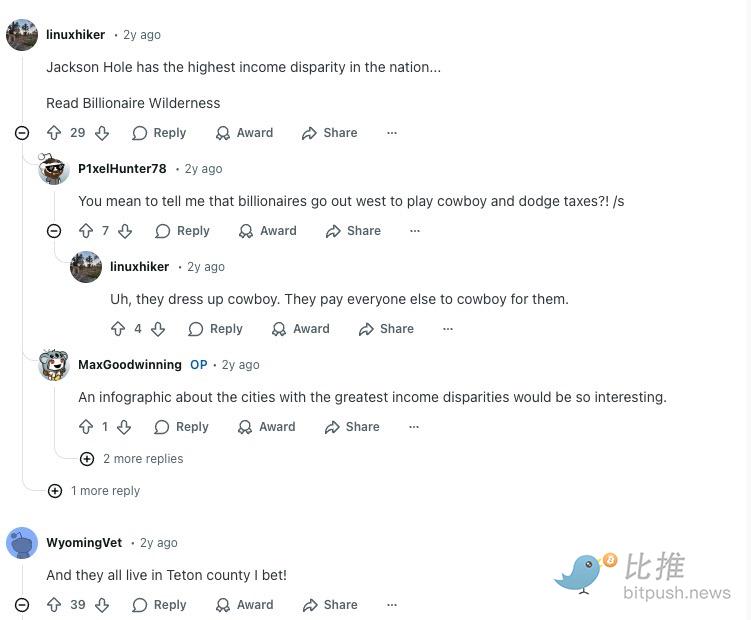
In Wyoming's Jackson Hole resort area, the monthly rent for an ordinary two-bedroom apartment has reached $4,000, 25% higher than in Los Angeles. Although the local per capita GDP ranks among the highest in the U.S., about 10% of residents still face food shortages. For blue-collar workers who catch the early morning commuter bus every day and rely on two or three jobs to make ends meet, "stablecoins" seem more like a distant technological concept.

This divide is somewhat maintained institutionally. A state treasury official told prospect.org that through land acquisition and price thresholds, this resort has been designed to be "invisible to slums." No matter how fast the settlement speed of stablecoins is, their benefits struggle to penetrate the already solidified social structure.

Writer Annie Proulx once described the harshness of the Wyoming land; today, this harshness is folded by technology and capital into two layers of reality that do not penetrate each other. On one side, the wealthy class creates tax havens and pastoral myths amidst the vast mountains and forests; on the other, ordinary Americans who支撑着这一切 but find it difficult to put down roots here—their lives, in both现实 and online narratives, have become the folded side.
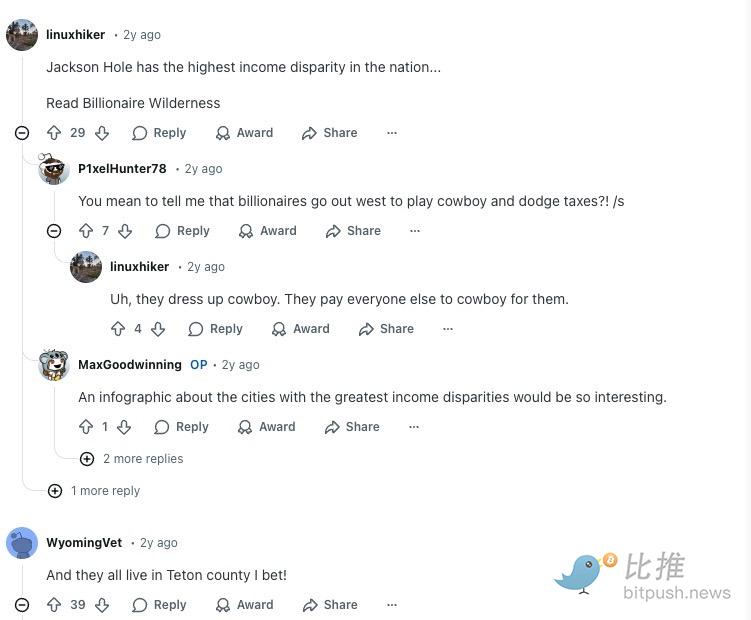
It is against this backdrop that the state government is attempting to build fiscal autonomy for the digital age on the gradually沉寂的煤矿废墟, using law and stablecoin收益. Data shows that Wyoming has 348 limited liability companies per 1,000 adults, surpassing Delaware to become the new institutional洼地 in the United States.

But can this "digital rent" flowing into the "Cowboy State" truly bridge the fissures on that land?

References:

  • Consensus Revenue Estimating Group (2025.10)

  • CNBC: Wyoming is pushing crypto payments and trying to beat the Fed to a digital dollar

  • The American Prospect: Down and Out on the Crypto Frontier

  • wyofile: Clean Power Plan may cut Wyo coal revenue 31-63 percent

Author: Bootly


Twitter:https://twitter.com/BitpushNewsCN

Original article link:https://www.bitpush.news/articles/7600841

Preguntas relacionadas

QWhat is the name of the stablecoin launched by the state of Wyoming, and on which blockchain was it initially issued?

AThe stablecoin is named $FRNT, and it was initially issued on the Solana blockchain with support for six EVM-compatible chains.

QWhat major economic challenge is Wyoming facing that motivated it to launch a state-backed stablecoin?

AWyoming is facing a severe fiscal crisis due to the rapid decline of its coal industry, which has been the state's economic pillar, providing significant tax revenue that previously allowed it to avoid income and corporate taxes.

QHow are the reserves for the $FRNT stablecoin managed and what is their purpose?

AThe reserves for $FRNT are 102% over-collateralized with U.S. Treasuries and cash, managed by the investment giant Franklin Templeton. The interest income generated is directed into the state's 'School Foundation Fund' to support public education.

QWhat significant legal innovation did Wyoming introduce for the crypto industry in 2019?

AIn 2019, Wyoming passed House Bill 74 (HB 74), which created the SPDI (Special Purpose Depository Institution) license, a new type of financial entity for crypto asset custody and settlement, with Kraken becoming the first company to receive this license.

QDespite its economic innovations, what social issue does the article highlight as a challenge within Wyoming, particularly in areas like Jackson Hole?

AThe article highlights a severe wealth gap and social stratification. In places like Jackson Hole, high living costs and rent of $4000 for a two-bedroom apartment create a reality where about 10% of residents face food insecurity, making the benefits of technological innovations like stablecoins inaccessible to many blue-collar workers.

Lecturas Relacionadas

Sequoia Dialogue with Jensen Huang: Computing Model Undergoes a 60-Year Transformation; You Won't Be Replaced by AI, But You Will Be Dimensionality-Reduced by 'Those Who Master AI'

NVIDIA founder and CEO Jensen Huang, in a conversation with Sequoia Capital's Konstantine Buhler, argues that we are witnessing the most significant computing shift in 60 years—from retrieval-based to generative computing. Instead of just storing and retrieving data, future systems will generate highly personalized content (text, images, video) on demand, powered by massive "AI factories." Huang envisions a global "intelligence network" that will envelop the planet, following the historical patterns of energy and communication grids. He outlines a five-layer investment framework: 1) Energy, 2) Chips/Computers, 3) Infrastructure (data centers), 4) AI Models, and 5) Applications. He predicts this ecosystem will reach a scale of $20 trillion annually. Crucially, Huang pushes back against fears of AI-driven job loss. He distinguishes between specific "tasks" (e.g., typing, analyzing images) and overall "jobs" (e.g., CEO, radiologist). While AI automates tasks, it increases efficiency and demand for the higher-value problem-solving aspects of professions, thus creating more jobs and "up-leveling" careers. The real risk, he asserts, is not being replaced by AI, but being outperformed by someone who effectively leverages it. He urges everyone to embrace AI as a tool for augmented capability and innovation.

marsbitHace 48 min(s)

Sequoia Dialogue with Jensen Huang: Computing Model Undergoes a 60-Year Transformation; You Won't Be Replaced by AI, But You Will Be Dimensionality-Reduced by 'Those Who Master AI'

marsbitHace 48 min(s)

"I Don't Need a Better Model Anymore": A Panorama of AI Users Under a Reddit Hot Post

Titled "I Don't Need a Better Model Anymore": AI User Reactions on Reddit Anthropic recently released Claude Fable 5, its first publicly available 'Mythos'-tier model, achieving 80.3% on the SWE-Bench Pro benchmark and significantly outperforming its predecessor and competitors. However, a viral Reddit post titled "Claude Fable made me realize I don't need better models anymore" highlighted a growing user sentiment of "good enough." Top comments expressed "model fatigue," with users stating that earlier models like Opus 4.5/4.8 already sufficed for their workflows. High cost was a key concern, as Fable 5's API is nearly twice the price of Opus 4.8, with users questioning the return on investment and suggesting the field has hit a plateau. The most frequent complaint targeted Fable 5's stringent safety filters. Designed to intercept high-risk requests (e.g., cybersecurity), the system was perceived as overly conservative. Users reported frequent rejections for routine security-related tasks, leading to automatic fallbacks to the older Opus model. Paying users were particularly frustrated, feeling they paid a premium for a less usable product. Dissenting voices came from users with heavy, complex tasks. For workloads like high-energy physics simulations with thousands of code lines, Fable 5's improved long-context understanding and error detection represented a significant, worthwhile leap—described as moving from a "college player to an NBA starter." The debate underscores a divergence between benchmark performance and practical utility. For most users, current models meet their needs, making further advances relevant only for extreme use-cases. The discussion also raised concerns about a potential "Public AI Freeze," where the most powerful models (like the restricted Mythos 5) remain exclusive to enterprises and governments, while public offerings stagnate. The launch presents two report cards: one of technical excellence and another of user skepticism. Fable 5's ultimate reception may depend on Anthropic's ability to refine its safety filters and justify its cost for specialized, high-demand users.

marsbitHace 55 min(s)

"I Don't Need a Better Model Anymore": A Panorama of AI Users Under a Reddit Hot Post

marsbitHace 55 min(s)

When AI Traffic Surpasses Humans, How Do You Prove You're Human?

With AI-generated web traffic surpassing human activity, websites face a crisis as AI agents bypass ads, avoid clicks, and scrape data without generating revenue. This disrupts the ad-based internet economy, diverting traffic and reducing site visits. In response, sites are blocking AI crawlers and deploying traps like Cloudflare's "honeypot" pages. Traditional CAPTCHAs are now ineffective against advanced AI. The focus has shifted to behavioral biometrics—analyzing unique human patterns such as cursor movement, typing rhythm, and keystroke dynamics. Companies like IBM and BioCatch use this data to distinguish humans from bots, even detecting fraud through behavioral inconsistencies. Two competing approaches aim to verify human identity centrally. Sam Altman’s World (formerly Worldcoin) uses iris scanning to create unique credentials, though it faces privacy concerns and regulatory bans. Alternatively, cryptographic zero-knowledge proofs offer anonymous verification without revealing personal data, championed by Vitalik Buterin to avoid centralized surveillance. However, both systems have flaws. Centralized solutions risk biometric data misuse, while decentralized models may be exploited through identity rental markets in economically unequal regions. Despite challenges, the author favors cryptographic methods for preserving privacy over pervasive behavioral monitoring that permanently captures and controls personal biometric data.

marsbitHace 1 hora(s)

When AI Traffic Surpasses Humans, How Do You Prove You're Human?

marsbitHace 1 hora(s)

2026 Landscape of Decentralized AI: Why is Blockchain the Inevitable "Antidote" for AI?

**The 2026 Landscape of Decentralized AI: Why Blockchain is the "Cure" AI Cannot Ignore** Decentralized AI addresses fundamental bottlenecks of centralized AI: scarce and expensive computational resources, excessive control concentration, unverifiable model outputs, and increasing difficulty in acquiring training data due to privacy and regulation. Blockchain offers a path to make intelligence open, verifiable, and economically accessible. The technical stack comprises three layers: 1. **Applications & Services**: The main crypto use cases are "Agentic Finance" (converting natural language into on-chain actions) and "Agentic Payments" for machine-to-machine commerce. Projects like Giza, Infinity Labs, Coinvest AI, and x402 (handling 173M+ transactions) are key players. 2. **Middleware**: This coordination layer enables agents to discover, identify, and transact. Notable projects include Gokite AI (specialized L1), Virtuals (an OS for the agent economy), and especially Bittensor—a network of specialized subnets forming competitive AI micro-economies. 3. **Infrastructure**: The capital-intensive layer providing raw resources. It includes decentralized compute (Akash, Render, Aethir), verifiable inference (Venice AI, OpenGradient), distributed training (Prime Intellect, Templar AI), decentralized storage (Filecoin, Walrus), and privacy/verification layers (Nillion, Arcium, Phala Network) using technologies like ZKPs, MPC, and TEEs. The outlook for 2026-2027 indicates AI demand outpacing infrastructure, with AI agents as a primary growth engine. Computation is becoming an asset class, with on-chain markets as its financial layer. Tokenomics is emerging as a structural advantage for coordinating capital, compute, and data in decentralized AI networks. While still early—with adoption uneven and revenue often trailing token incentives—projects like Bittensor, NEAR, and Virtuals demonstrate a shift from speculative narrative to a new model for coordinating intelligence.

marsbitHace 1 hora(s)

2026 Landscape of Decentralized AI: Why is Blockchain the Inevitable "Antidote" for AI?

marsbitHace 1 hora(s)

a16z Crypto Partner: Cash Flow is the Moat

Cash Flow as the Moat: A Playbook for Crypto Founders Historically, the most enduring businesses have been built by positioning themselves within the "flow of funds"—facilitating the creation and transfer of value in a network and extracting a portion of it. Cryptocurrency is the first modern technology natively built for this purpose. For startups, failing to architect products and businesses to leverage these principles means missing a major opportunity. Blockchains are inherently network businesses. Each transaction settles on a shared ledger, and every new participant strengthens the underlying network for all. Well-designed network tokens amplify this by aligning users, developers, and validators around growing the network, with value flowing back to contributors in a transparent feedback loop. This model is not new; companies from railroads and Standard Oil to Google, Meta, and AWS have thrived by inserting themselves into critical flows of value (goods, attention, compute). Financial markets make it even clearer: firms like Visa and major market makers generate immense revenue not by predicting markets but by being in the path of transactions. The combination of fund flow and network effects creates one of the most durable business structures. The high margins in traditional finance (payments, custody, lending, FX) represent prime targets. Crypto founders have the opportunity to build the next version—programmable, instant, global, and natively in the flow of funds. The frontier extends beyond finance to areas like computing/GPUs, AI training data, energy, robotics, and space—markets without entrenched intermediaries, ripe for building new, efficient value rails on programmable infrastructure. Founders should ask: Are you in the flow of funds today? Does your revenue scale 10x with the value of activity on your platform? Where in your target market are profit margins highest relative to value created? The opportunity is clear: embed your startup into the new flows of value and let the network effects accumulate.

marsbitHace 1 hora(s)

a16z Crypto Partner: Cash Flow is the Moat

marsbitHace 1 hora(s)

Trading

Spot
Futuros
活动图片





