Author:angelilu, Foresight News
ARB briefly touched $0.094 during trading today, rising nearly 20% over the past week, making it one of the strongest performing mainstream L2 tokens of the week.
The catalyst for this round of gains is the launch of "Robinhood Chain"—a RWA (Real World Asset) Layer 2 built by Robinhood using Arbitrum technology, which officially went live on mainnet during a launch event in London on July 1.
The more subtle logic behind it is an old rule that's been in place for a year and a half being brought back into the spotlight: a portion of Robinhood Chain's revenue will automatically flow back into the Arbitrum ecosystem, with a large chunk going directly to the ArbitrumDAO treasury. This is not a new policy, but a revenue-sharing mechanism that was previously lukewarm. With the entry of the heavyweight TradFi brand Robinhood, it is being seriously priced by the market for the first time.
The First Major Tenant in a Year and a Half
This rule is called the Arbitrum Expansion Program (AEP), launched in January 2024 by the Arbitrum Foundation and Offchain Labs. In simple terms, it allows Arbitrum to open its technology for others to build chains on, with the condition of revenue sharing.
The sharing logic is simple: any independent chain built using Arbitrum Orbit technology but not settling on Arbitrum One/Nova (e.g., settling directly on Ethereum or Base) must allocate 10% of its net protocol revenue to the Arbitrum ecosystem—8% to the DAO treasury, 2% to the Developer Guild. However, L3 chains that settle back to Arbitrum One/Nova, such as Xai and Sanko, are exempt from this sharing and retain their status as first-tier members of the ecosystem.
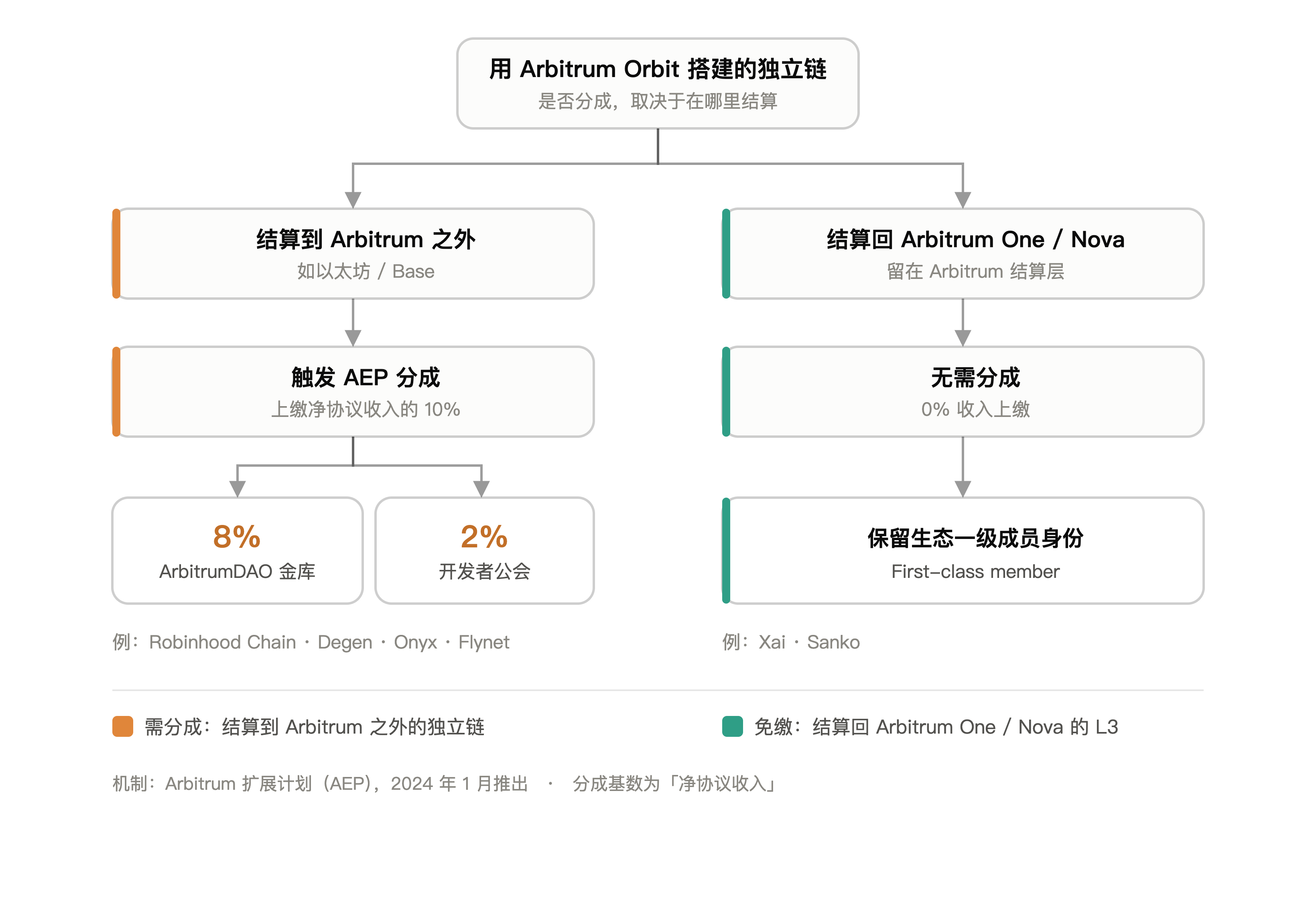
The key point is that Robinhood Chain is not the first chain to trigger the AEP. Smaller chains like Degen Chain, Onyx, and Flynet, which settle on Base, have been paying this share all along. Their scale was just too small for anyone to care. The difference with Robinhood Chain lies solely in it being the first heavyweight chain to bring tangible scale to the sharing amount.
Great Data, But the Landlord's Rent Income is Still Tiny
According to the latest data disclosed by Johann, Head of Robinhood International and Crypto Business: as of July 10, a little over a week after launch, Robinhood Chain has recorded over 17 million transactions, over 350,000 addresses, a TVL of approximately $250 million, and DEX trading volume exceeding $1 billion. For a newly launched chain, this report card is indeed impressive.
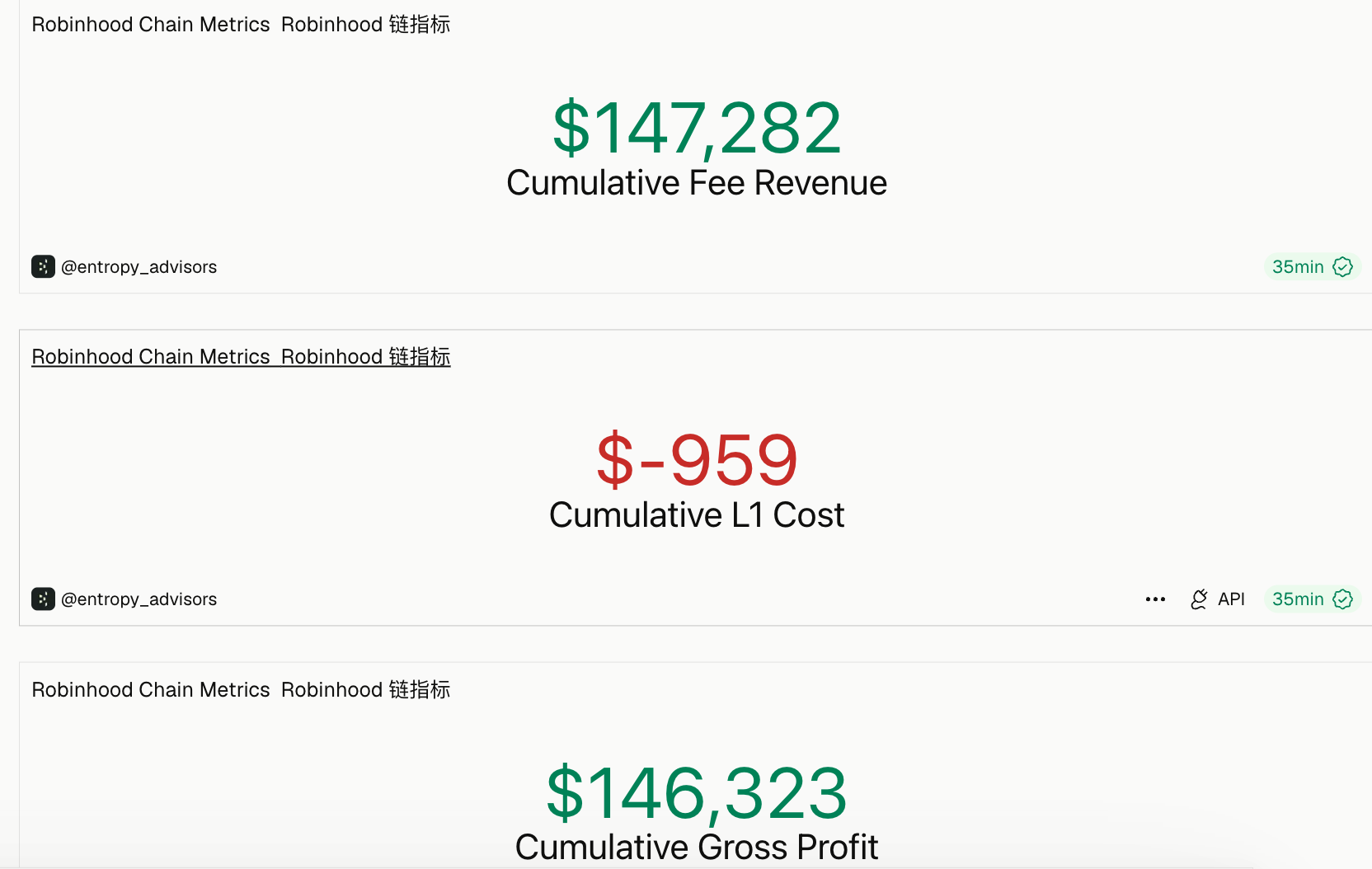
But the rental income is nowhere near that scale. According to Dune data, as of the time of writing, Robinhood Chain's current protocol revenue is about $147,000. After deducting the costs of data settlement back to the Ethereum L1, it amounts to a mere $146,000. Even with the 10% allocation to Arbitrum DAO, this amount is pitifully small. ARB's rise reflects the market's premium valuation on the future expansion potential of the AEP protocol—a typical narrative-driven rally.
Laying out the imagination, the ceiling for AEP is indeed not low: Robinhood's platform holds approximately $324 billion in total assets and $143.6 billion in custody assets. Tokenized stocks have expanded to over 2000 tokens, covering 120 countries. Most of these assets are not yet on-chain today. Once settlement gradually migrates over, the $57,000 sharing base will reach a completely different scale.
Old Landlord Losing its Biggest Tenant, New Landlord Just Got a Major Client
Arbitrum's "landlord" model is actually not new. Optimism has been running the "landlord" business for quite some time.
The Optimism Collective collects rent from all Superchain member chains (Base, Zora, Mode, Unichain, etc.) via OP Stack—charging 2.5% of sequencer revenue or 15% of net profit (whichever is higher). OP Mainnet itself also contributes its net revenue to the treasury. However, its rental income has been gradually shrinking, dropping to approximately $2.9 million in Q1 2026 (with Base alone contributing about $1.4 million), a 21.5% sequential decrease from the previous quarter's $3.7 million.
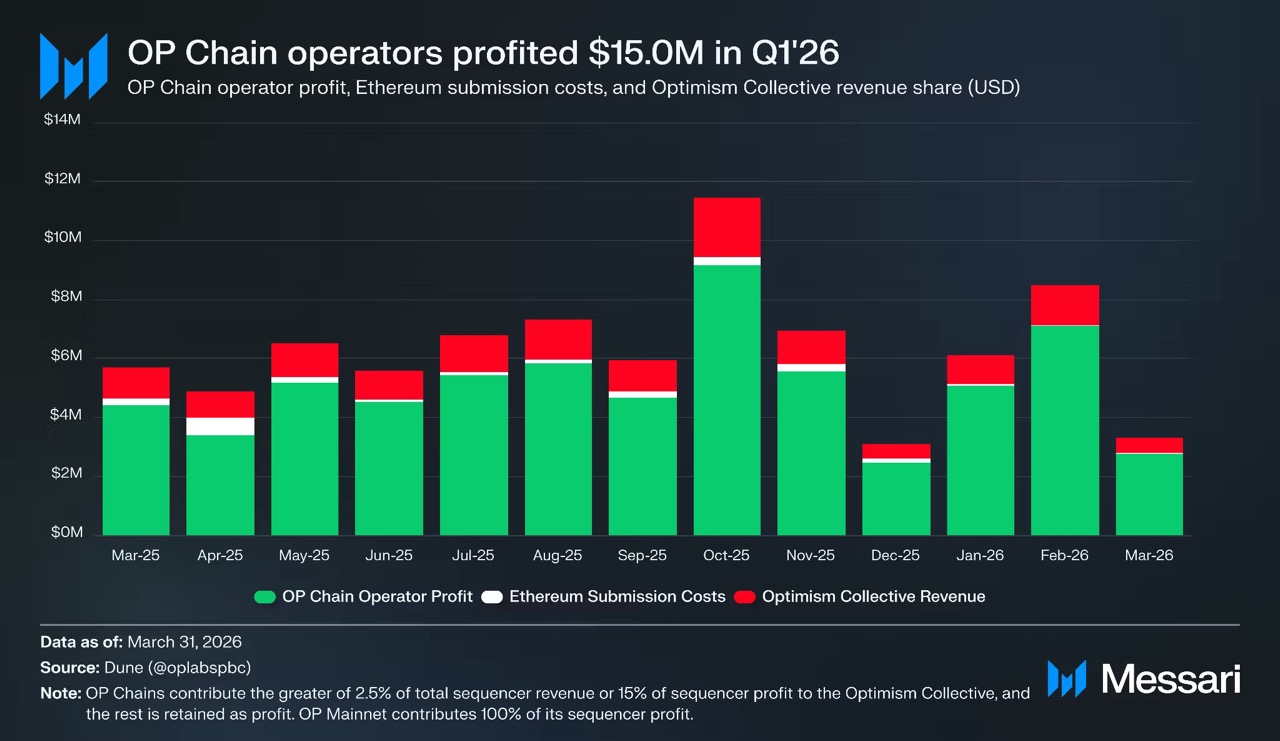
In February this year, Base officially announced its departure from OP Stack—based on the Gas fee metric, Base contributed about 96.5% of the revenue flowing into the Collective. Upon this news, the OP token dropped 28% within two days.
Meanwhile, Arbitrum just revived its landlord business from scratch with Robinhood Chain. The structures are completely symmetrical—both collect rent from external chains using their underlying technology, with the money going to their respective DAO treasuries (ArbitrumDAO vs. Optimism Collective). The only difference is that although Arbitrum's AEP rules were written in 2024, it never had a major tenant until this week, finally giving its "rent collection" a tangible sense of scale for the first time.
But Can This Major Tenant Be Kept?
It is precisely this history with Base that some analysts use to pour cold water. Some believe that, following the same script, Robinhood Chain will eventually detach from Arbitrum Orbit and align directly with Ethereum, just as Base did from OP Stack. According to growthepie data, Robinhood Chain's single-day sequencer revenue is now nearly $60,000, second only to Base's $72,000 among Ethereum L2s, approaching three times that of its parent chain Arbitrum.
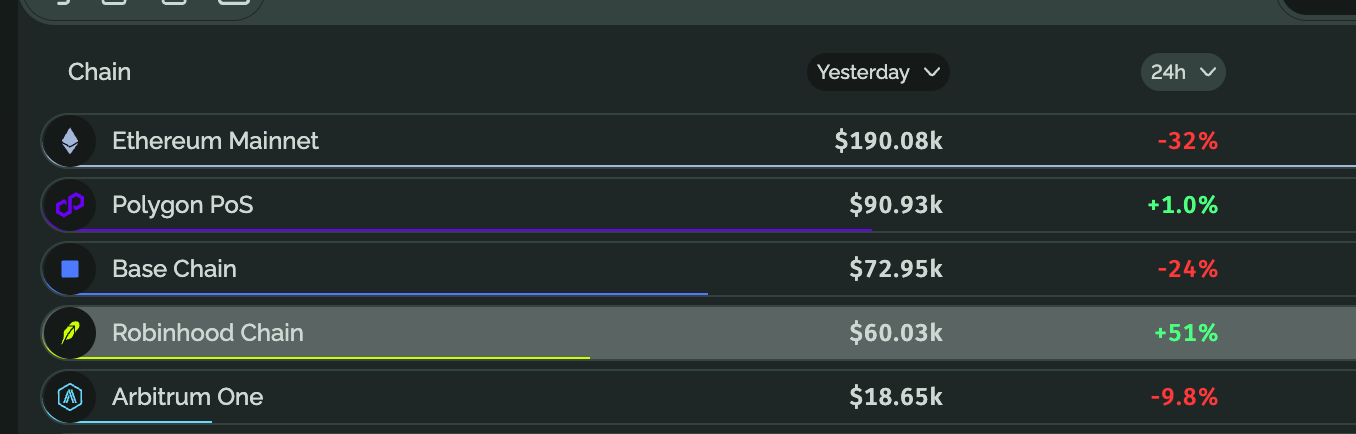
The beneficiary issue is even more subtle. Within a week of its launch, Robinhood Chain has become the second-largest demand source for Ethereum DA, second only to Base. Its sequencer pays blob fees, settles in ETH, and permanently burns them. Analysts therefore argue that if there can only be one ecosystem currency for this chain, it's more likely to be ETH, not ARB.