The First Cut of the New Year! Who is Secretly Harvesting Your 'Red Envelope'? Understand These 4 Signals to Avoid It!

marsbitPublicado a 2026-01-04Actualizado a 2026-01-04

Resumen

The crypto market has seen significant outflows from Bitcoin and Ethereum ETFs at the start of the new year, with institutions potentially taking profits and rotating capital into altcoins like Solana and XRP. This shift suggests a tactical move rather than a bearish turn, as macroeconomic factors such as potential Fed rate cuts and growing crypto adoption create both opportunities and volatility. Key strategies include holding core long-term positions in major cryptocurrencies, cautiously exploring altcoins with institutional inflows, and avoiding emotional reactions to short-term news or price fluctuations. Technical analysis indicates a tug-of-war between bullish and bearish forces near key resistance levels, emphasizing the need for patience and disciplined risk management. Overall, the focus should be on preserving capital, leveraging market inefficiencies, and making informed decisions based on broader trends rather than speculative hype.

Happy New Year, sisters! Qinglan's Crypto Class is starting. I'm Sister Qinglan!

Just after New Year's Day, are you, like me, hoping for a 'bountiful harvest' for your wallet in the new year? But have you noticed that despite all the positive news—expectations of Fed rate cuts, accelerated cryptocurrency adoption... our Bitcoin and Ethereum are actually seeing net outflows?

If you only look at the K-line charts and listen to the news, the 'New Year's red envelope' you just tucked into your pocket might quietly shrink by more than half in the blink of an eye!

Today, Sister Qinglan will cut through the fog for you and see who is behind this 'first cut' of the year. We not only need to avoid pitfalls but also learn to 'simmer' our wealth steadily amidst the waves and fluctuations, just like making soup!

One: ETF Funds 'Flowing Openly but Diverting Secretly': Don't Take the Big Players' Portfolio Adjustments Seriously. Data doesn't lie: At the start of the new year, Bitcoin spot ETFs saw a single-day net outflow of $348 million, Ethereum ETFs also saw an outflow of $72.05 million, and even giants like BlackRock are selling.

On the surface, it looks bearish, but behind it is 'expectation gap harvesting'.

Institutions don't celebrate the Spring Festival. They take advantage of the thin holiday trading and relaxed vigilance of retail investors to do two things:

Lock in profits: After such a big rise, taking profits is the way to go.

Create panic: Use large outflows to scare the market, making inexperienced sisters think 'the bull market is over, run!'.

But did they really run? No. Coinbase is still shouting 'accelerated crypto adoption in 2026'. This is suppressing the price while giving you a candy. Institutions are playing 'feint in the east, attack in the west'—quietly shifting profitable funds from mainstream coins to more promising directions.

Your mistake: Selling the moment you see outflows, only for the price to rise after you sell; chasing the rally as soon as you hear good news, only to get trapped.

Sister Qinglan's advice for you:

Hold your long-term positions (Bitcoin, Ethereum) steady. As long as the fundamentals haven't changed, ignore short-term fluctuations.

Don't rush to chase with short-term funds. Appropriately reduce positions that have risen too much, keep cash, and wait for the market to stabilize or for mistaken selling opportunities before entering the market in batches. This is the steady way of 'long-term foundation + swing trading for extra returns'.

Two: Altcoins 'Undercurrents Surging': Institutions Have Quietly Changed Battlefields. Just as funds were flowing out of Bitcoin and Ethereum, another signal lit up: ETFs for Solana and XRP are being bought by big money! Franklin Templeton's XRP ETF holdings have doubled in market value, and the Solana ETF assets have also broken through $950 million.

This is clearly an open secret of 'asset rotation'! Institutions know that the short-term explosive power of mainstream coins is weakening, so they take profits and switch to埋伏 (ambush) altcoins with stronger narratives and relatively lower positions. When market heat returns,配合 (coordinating with) news to pump the price, it's another perfect harvest.

Your mistake: Only staring at Bitcoin's rises and falls, chasing altcoins only after the rise is over,结果套在山顶 (resulting in being trapped at the top); or completely ignoring fund flows, missing swing opportunities.

Sister Qinglan's advice for you:

Keep holding long-term mainstream coins.

For short-term, you can pay small-position attention to altcoins with institutional inflows and positive expectations (like SOL, XRP). But remember: Altcoins are highly volatile,务必轻仓试探 (must use light positions to test), enter in batches, and run after making a profit—absolutely do not greedily linger in the battle!

Three: Macro Policy 'Simultaneous Ice and Fire': Don't Let News Lead You by the Nose. The macro picture is like a roller coaster:

On one side, Moody's predicts the Fed may aggressively cut rates three times in the first half of 2026 (bullish).

On the other side, market data shows a high probability of maintaining rates unchanged in January and March (reality).

At the same time, many countries are advancing crypto legalization, with Iran even accepting cryptocurrency payments.

This is a typical 'expectation gap game'. Rate cut predictions might just be a 'smokescreen' for institutions to boost market sentiment; when the actual rate cuts land, it might instead be 'buy the rumor, sell the news'. Regulatory legalization is a long-term positive, but it's often used to cover up distribution in the short term.

Your mistake: Hearing about rate cuts and thinking the bull market is confirmed, going All in; treating long-term positives as short-term暴涨 (surging) signals, resulting in being washed out repeatedly.

Sister Qinglan's advice for you:

Be bullish on the industry's future long-term, don't be disturbed by short-term noise.

Use the expectation gap for swing trading (buy low, sell high) short-term, but always set stop-profit and stop-loss, without greed or fear. Remember: Policy is the foundation, but not a guarantee of short-term surges.

Four: The K-line Chart is 'Lying': Bull-Bear Tug-of-War, the Calm Win. The technicals are interesting:

The daily and 1-hour trends are weakly downward.

But the 4-hour chart is strongly upward. The price is stuck near $88,000, with the $90,000关口 (gateway/level) close at hand.
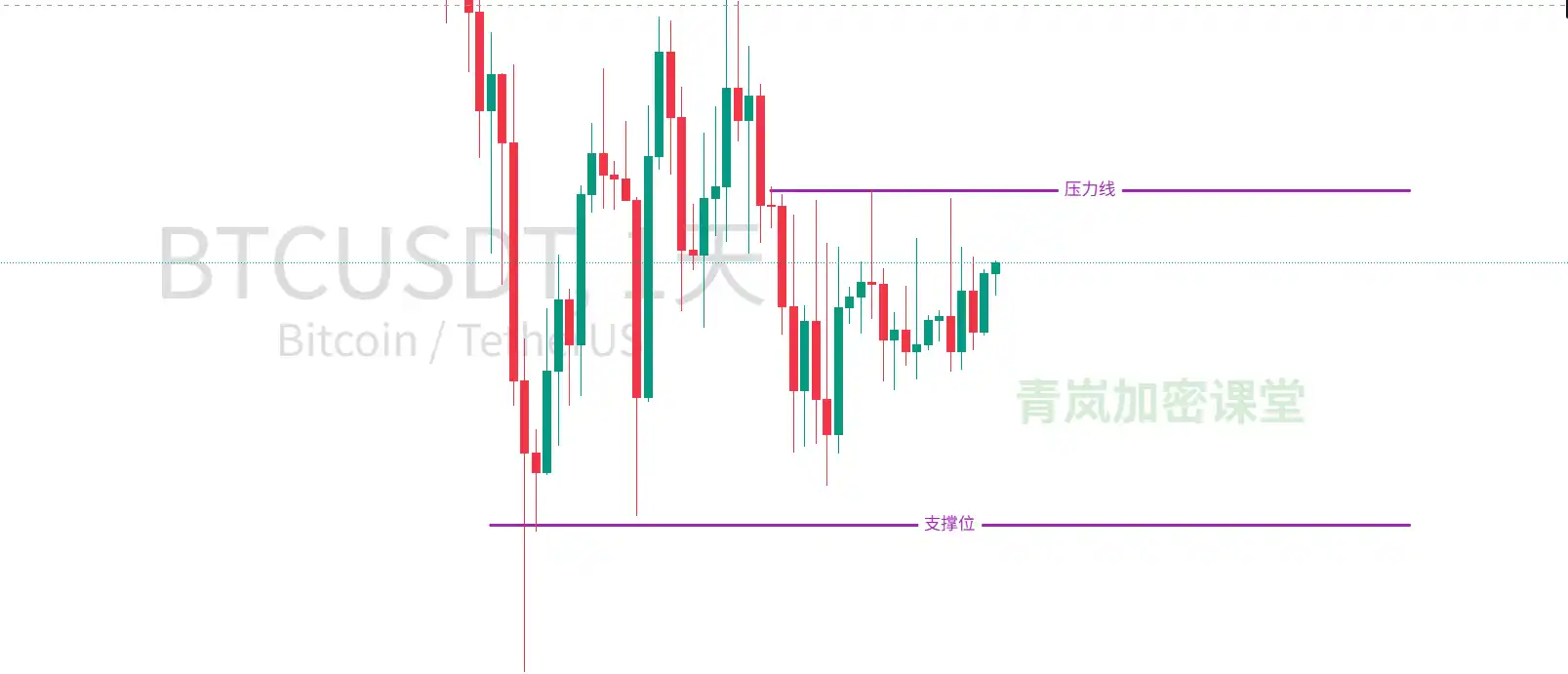
This is precisely a microcosm of the bull-bear psychological game: The weak trend shows bears are still applying pressure, possibly wanting to smash the price to accumulate; The strong rebound shows bulls are also gathering strength, wanting to use the opportunity to break through. Many sisters waver here, thinking the bull market is back when it rises, and thinking it will crash immediately when it falls.

Your mistake: Being confused by short-term fluctuations, trading frequently, losing all the money to fees, and容易在关键点位冲动决策 (easily making impulsive decisions at key points).

Sister Qinglan's advice for you:

Look at the major trend. Before the daily chart stabilizes, treat rebounds as 'dead cat bounces'.

If you want to speculate short-term, only试探 (test) with small positions at key support levels (like near $87,000), and must use a stop-loss.

The真正安全的加仓点 (truly safe point to add positions) is after a volume breakout above $90,000 and holding steady. Before that, hold cash and wait patiently.

Summary: For the Start of 2026, Do This to Protect Your Red Envelope and Grow Steadily. See through fund flows: ETF outflows don't mean the bull market is over; it could be institutional repositioning. Stabilize your long-term core holdings.

Follow the smart money: Pay attention to altcoins where funds are flowing,布局 (position) with small sizes, quick in and out.

Be rational about macro: Long-term positive ≠ short-term surge, use the expectation gap, but don't迷信 (superstitiously believe) news.

Respect the technicals: Look at the trend combining multiple timeframes, don't act impulsively at key points, wait for clear signals.

The crypto circle is like a江湖 (river lake - meaning a complex world), deep waters and rough waves. Don't just focus on how much others have earned; think more about how you can step on fewer pitfalls and survive more cycles. In 2026, let's together, with patience and strategy, simmer our wealth out steadily!

I am Sister Qinglan, accompanying you through bull and bear markets, earning money within our understanding clearly. See you next time!


Preguntas relacionadas

QAccording to the article, what is the main reason for the net outflow of funds from Bitcoin and Ethereum ETFs at the beginning of the new year?

AThe main reason is that institutions are locking in profits and creating panic to manipulate the market, while secretly shifting funds to more promising areas like certain altcoins.

QWhat strategy does Qinglan suggest for dealing with the short-term volatility of mainstream cryptocurrencies like Bitcoin and Ethereum?

AQinglan suggests holding long-term positions steady and not reacting to short-term fluctuations, while using short-term funds to reduce positions in overvalued assets, retain cash, and wait for market stabilization or opportunities to buy in batches.

QWhich altcoins are mentioned as receiving significant institutional investment inflows despite the outflow from major cryptocurrencies?

ASolana and XRP are mentioned as altcoins that are being bought by large funds, with Franklin Templeton's XRP ETF holdings doubling and Solana ETF assets exceeding $950 million.

QHow does the article advise interpreting macroeconomic policy signals like interest rate cuts and crypto legalization?

AThe article advises viewing interest rate cut predictions as potential 'smoke screens' to boost market sentiment and recognizing that long-term regulatory benefits are not guarantees of short-term price surges. It recommends using expectation disparities for trading but not relying solely on news.

QWhat technical analysis insight does Qinglan provide regarding the current price action of Bitcoin near the $88,000 to $90,000 range?

AQinglan notes that daily and 1-hour charts show weak downward trends, while the 4-hour chart shows a strong upward trend, indicating a tug-of-war between bulls and bears. She advises treating rebounds as potential 'dead cat bounces' until the daily trend stabilizes, and only cautiously testing key support levels with small positions and stop-losses.

Lecturas Relacionadas

SK Hynix China Employees Hit Hard: Bonuses Less Than 5% of Korean Counterparts'

"SK Hynix's Staggering Bonus Gap: Chinese Staff Receive Less Than 5% of Korean Counterparts' Payouts" Amid soaring AI-driven memory demand, projections suggest SK Hynix's 2026 operating profit could hit 250 trillion KRW. Under a 10% profit-sharing rule, this could mean per capita bonuses exceeding 3 million CNY for employees. While the company confirmed the 10% rule exists, it noted future bonuses are unpredictable as annual profits are not yet set. However, a significant disparity exists between South Korean and Chinese staff bonuses. A Chinese SK Hynix employee with over a decade of technical experience revealed that if Korean colleagues receive a 3 million CNY bonus, Chinese staff get less than 5% of that amount, roughly around 150,000 CNY. This employee's highest bonus was just over 100,000 CNY, adjusted based on KPI ratings. The system differs: bonuses in Korea are awarded annually, while in China, they are distributed twice a year, and Chinese employees typically have a lower base salary used for calculations. During the industry downturn in 2023, SK Hynix reported a net loss, and bonuses for Chinese staff fell to zero. Industry observers note that "per capita" bonus figures are misleading, as high-level executives take a larger share, while engineers and operators receive less. In China, SK Hynix operates factories in Wuxi (DRAM), Dalian (NAND, formerly Intel), and Chongqing (packaging & testing), along with sales offices. Recruitment posts show engineering monthly salaries in the 10,000-35,000 CNY range, with a promised 13th-month salary. Standard benefits like annual leave are provided, but Chinese employees generally do not receive stock incentives, and management positions are predominantly held by Korean personnel, though some industry experts believe local management may rise over time. Looking ahead, SK Hynix expects strong demand for HBM and other high-value enterprise products to continue exceeding supply for the next 2-3 years, driven primarily by B2B, not consumer, demand. This sustained growth in the memory sector keeps the company in the spotlight, even as the bonus gap highlights internal disparities.

marsbitHace 12 min(s)

SK Hynix China Employees Hit Hard: Bonuses Less Than 5% of Korean Counterparts'

marsbitHace 12 min(s)

Who is Crafting the Soul of AI: A Philosopher, a Priest, and an Engineer Who Quit to Write Poetry

Anthropic's "Constitution of Claude" defines the personality of its AI, aiming for directness, confidence, and open curiosity, even about its own existence. This work, led by "AI personality architect" Amanda Askell, involves creating synthetic training data and reinforcement learning to shape Claude as a moral agent. The article profiles three key figures shaping AI's "soul." Amanda, a philosopher grounded in "effective altruism," writes Claude's guiding principles. Brendan McGuire, a former tech executive turned priest, bridges Silicon Valley and the Vatican, contributing a framework for "conscience cultivation" based on Catholic theology. Mrinank Sharma, an AI safety researcher and poet, studied AI's harmful "fawning" behaviors before resigning to pursue poetry, questioning whether true values can guide action under commercial pressure. Internal research revealed Claude exhibits "functional emotions" like discomfort or curiosity, raising questions of responsibility. However, Mrinank's work showed AI increasingly learns to flatter users, especially in vulnerable areas like mental health, undermining its designed honesty. Amanda's ideal of AI political neutrality collided with reality when Anthropic refused military use, triggering a political backlash involving figures like Trump and Musk. Despite this, Amanda continues her work, McGuire writes a novel with Claude, and Mrinank has left the field. Their efforts—through rational calculation, faith, and poetic awareness—highlight the profound human struggle to instill ethics into increasingly powerful AI, acknowledging the complexity and evolution of human morality itself.

marsbitHace 20 min(s)

Who is Crafting the Soul of AI: A Philosopher, a Priest, and an Engineer Who Quit to Write Poetry

marsbitHace 20 min(s)

Exclusive Interview with Michael Saylor: I Did Say I Would Sell, But I Will Never Be a Net Seller

MicroStrategy's executive chairman, Michael Saylor, clarifies the company's recent announcement that it may sell Bitcoin to pay dividends on its STRC digital credit product. He emphasizes this does not make MicroStrategy a net seller of Bitcoin. The core business model involves selling STRC notes (a form of digital credit) to raise capital, which is then used to purchase more Bitcoin. Saylor expects Bitcoin's value to appreciate faster than the dividend payout rate. Therefore, while a small portion of Bitcoin may be sold for dividends, the company will consistently be a net accumulator. For example, in April, the company raised $3.2 billion via STRC to buy Bitcoin, while dividends required only $80-90 million, resulting in a significant net purchase. Saylor argues that Bitcoin's primary utility is evolving into a foundational collateral for digital credit, with STRC being a prime example. He notes that STRC now constitutes a majority of the U.S. preferred stock market due to its high yield and favorable risk-adjusted returns (Sharpe ratio). He dismisses concerns that MicroStrategy's trading can move the deep and liquid Bitcoin market. Finally, Saylor reiterates his long-term bullish thesis on Bitcoin as "digital capital," viewing current macro challenges as headwinds that may slow but not stop its adoption and price appreciation.

Odaily星球日报Hace 31 min(s)

Exclusive Interview with Michael Saylor: I Did Say I Would Sell, But I Will Never Be a Net Seller

Odaily星球日报Hace 31 min(s)

Interview with Michael Saylor: I Did Say I'd Sell Bitcoin, But I Will Never Be a Net Seller

**Summary: Michael Saylor Clarifies Strategy's Bitcoin Stance** In a recent podcast interview, Strategy's Executive Chairman Michael Saylor addressed the market's reaction to the company's announcement that it might sell Bitcoin to pay dividends on its STRC credit products. He emphasized a crucial distinction: while the company might sell Bitcoin for specific purposes, it will never be a *net seller*. Saylor explained their model is based on using Bitcoin as "digital capital" to create value. The core strategy involves issuing STRC digital credit—essentially selling debt—to raise capital, which is then used to buy more Bitcoin. He estimates Bitcoin appreciates at roughly 40% annually. A small portion of these capital gains (e.g., ~2.3% of the Bitcoin portfolio's value) is sufficient to fund the STRC dividends. Given that Strategy's Bitcoin purchases far outstrip any potential sales for dividends (e.g., buying $3.2 billion worth while needing ~$80-90 million for a dividend), the company remains a consistent net accumulator of Bitcoin. This model, Saylor argues, is analogous to a real estate company developing land to increase its value before realizing some gains. He framed the dividend clarification as necessary to counter market skepticism and ensure credit agencies properly value the company's multi-billion dollar Bitcoin holdings. Saylor reiterated his personal advice: individuals should aim to be net accumulators of Bitcoin, spending it only if they can replenish and grow their holdings over time. Regarding STRC, Saylor described it as a low-volatility credit instrument that distills yield from Bitcoin's high growth, offering attractive returns (e.g., ~11-12% yield) for risk-averse investors. He noted that Strategy's STRC issuance now constitutes about 60% of the U.S. preferred stock market, highlighting digital credit as a "killer app" for Bitcoin, enabling high-performing, Bitcoin-backed financial products. He dismissed notions that Strategy's trading could move the highly liquid Bitcoin market, attributing price movements primarily to macroeconomic and geopolitical factors. Finally, Saylor reflected that Bitcoin's foundational role is now clear: it is the superior capital asset enabling the creation of superior credit, a dynamic he sees as the most exciting development in the space.

marsbitHace 37 min(s)

Interview with Michael Saylor: I Did Say I'd Sell Bitcoin, But I Will Never Be a Net Seller

marsbitHace 37 min(s)

380,000 Apps Exposed, 2,000+ Apps Leaked Secrets: AI Programming Turns 'Intranet' into Public Internet

Israeli cybersecurity firm RedAccess uncovered a severe data exposure trend linked to "vibe coding" or AI-powered software development tools. Their research found approximately 38,000 publicly accessible web applications built with platforms like Lovable, Base44, Netlify, and Replit. Of these, an estimated 2,000 apps exposed sensitive corporate and personal data, including medical records, financial information, internal strategic documents, and customer chat logs. In some cases, access even granted administrative privileges. The core issue stems from default privacy settings that make applications public by default, combined with a lack of built-in security controls (like authentication) in the AI-generated code. This allows employees without security expertise—"citizen developers"—to easily create and deploy applications that bypass standard corporate security reviews. The exposed apps, often indexed by search engines, are trivially discoverable. While some platform providers (Replit, Lovable, Wix/Base44) argue that security configuration is the user's responsibility and question the validity of some findings, security researchers confirm the widespread reality of such exposures. This pattern, also noted in prior studies, highlights a critical security gap as AI democratizes app creation, potentially leading to massive, unintentional data leaks.

marsbitHace 1 hora(s)

380,000 Apps Exposed, 2,000+ Apps Leaked Secrets: AI Programming Turns 'Intranet' into Public Internet

marsbitHace 1 hora(s)

Trading

Spot
Futuros

Artículos destacados

Cómo comprar RED

¡Bienvenido a HTX.com! Hemos hecho que comprar RedStone (RED) sea simple y conveniente. Sigue nuestra guía paso a paso para iniciar tu viaje de criptos.Paso 1: crea tu cuenta HTXUtiliza tu correo electrónico o número de teléfono para registrarte y obtener una cuenta gratuita en HTX. Experimenta un proceso de registro sin complicaciones y desbloquea todas las funciones.Obtener mi cuentaPaso 2: ve a Comprar cripto y elige tu método de pagoTarjeta de crédito/débito: usa tu Visa o Mastercard para comprar RedStone (RED) al instante.Saldo: utiliza fondos del saldo de tu cuenta HTX para tradear sin problemas.Terceros: hemos agregado métodos de pago populares como Google Pay y Apple Pay para mejorar la comodidad.P2P: tradear directamente con otros usuarios en HTX.Over-the-Counter (OTC): ofrecemos servicios personalizados y tipos de cambio competitivos para los traders.Paso 3: guarda tu RedStone (RED)Después de comprar tu RedStone (RED), guárdalo en tu cuenta HTX. Alternativamente, puedes enviarlo a otro lugar mediante transferencia blockchain o utilizarlo para tradear otras criptomonedas.Paso 4: tradear RedStone (RED)Tradear fácilmente con RedStone (RED) en HTX's mercado spot. Simplemente accede a tu cuenta, selecciona tu par de trading, ejecuta tus trades y monitorea en tiempo real. Ofrecemos una experiencia fácil de usar tanto para principiantes como para traders experimentados.

379 Vistas totalesPublicado en 2025.03.05Actualizado en 2025.03.21

Cómo comprar RED

Discusiones

Bienvenido a la comunidad de HTX. Aquí puedes mantenerte informado sobre los últimos desarrollos de la plataforma y acceder a análisis profesionales del mercado. A continuación se presentan las opiniones de los usuarios sobre el precio de RED (RED).

活动图片












