The Era of Encryption: The Boundary Between Payment and Investment Is Disappearing

marsbitPublicado a 2026-04-02Actualizado a 2026-04-02

Resumen

The boundaries between payments and investment are dissolving in the age of programmable money. While payments represent a $2.5 trillion revenue stream driven by essential, daily transactions, investment management generates $850–900 billion from a much smaller, more passive user base. Payments are a universal financial behavior, whereas investing remains a luxury activity for a minority. Historically, these systems operated separately—with distinct infrastructure, products, and user experiences. However, blockchain technology now enables a unified account model: the same balance in a single application can simultaneously serve both payment and investment functions. This means funds can be used for transactions while also earning yield or participating in DeFi protocols, all within the same interface. This convergence allows users to benefit from both high-frequency, low-value payment activity and capital appreciation from investments without transferring between separate systems—a significant shift from traditional finance.

Written by: Jack Simison

Compiled by: Chopper, Foresight News

Payments and investments collectively generate $3 trillion in annual revenue, surpassing the total market capitalization of cryptocurrencies. They rely on entirely different user behaviors, completely different underlying infrastructures, and until today, they correspond to entirely different product systems. Here, I want to directly compare these two worlds.
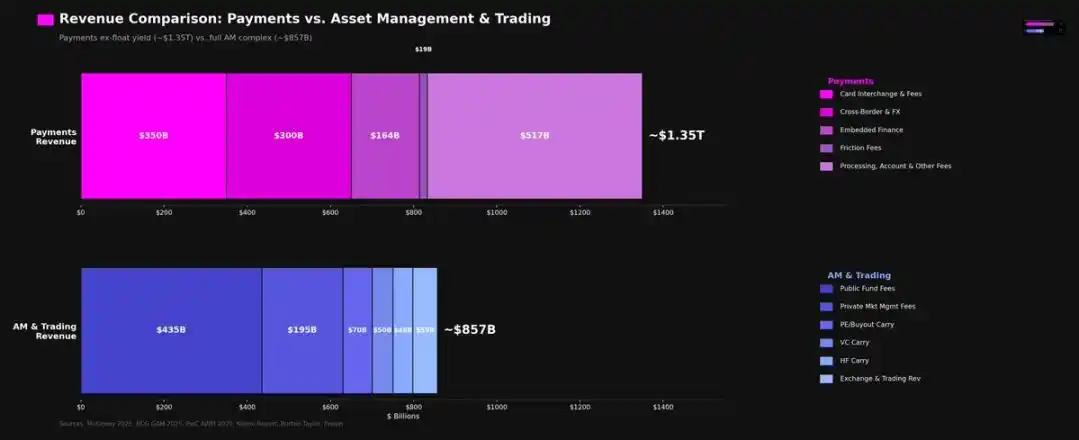
One sector earns money that everyone must pay—payment is a necessity for survival, a rigid demand. The other sector earns money that the majority of people will never choose to invest—investment is a luxury behavior.

Payment and investment management are the two largest revenue-generating areas in financial services. They have long operated within independent systems: different products, different accounts, different regulatory frameworks, and different interfaces. This is both a legacy of historical system architecture and because there was no practical need to integrate payments and investments in the past.

Programmable money is breaking down this barrier. The same balance, stored in the same wallet, blockchain, or application, can now participate in both revenue streams. The two worlds are converging in the form of unified accounts.

To understand why this is important, one must see the huge differences in their underlying behavioral logic.
Payment: A Universal Behavior

Payment is the only necessary financial behavior for participating in daily economic life. Buying food, paying rent, settling utility bills... without payment, one cannot survive.

In 2025, about two-thirds of adults globally made or received digital payments. In the United States, consumers complete about 48 payments per month; in India, UPI has over 500 million unique users; in Brazil, Pix has increased the average annual transactions per person to about 193; in parts of sub-Saharan Africa, mobile payments are no longer just a convenient payment method but a core component of the financial system.

Payment is not an optional financial activity for a minority of active people but a daily behavior for the masses. It is instant, high-frequency, with low psychological burden, and the cost is usually negligible. Consumers do not consciously calculate fees at the checkout counter. Compared to cash, digital payments reduce the pain of payment, further increasing usage frequency. The lower the friction, the higher the transaction volume.

This behavioral foundation brings enormous business coverage. According to McKinsey data, the global payment system processes about 3.4–3.6 trillion transactions annually, with an annual fund flow scale of about $1.8–2.0 quadrillion. Salary payments, merchant payments, cross-border remittances, bill payments, subscription services, personal transfers... at every step, intermediaries can take a cut.

Every layer of the payment chain is profiting from it.

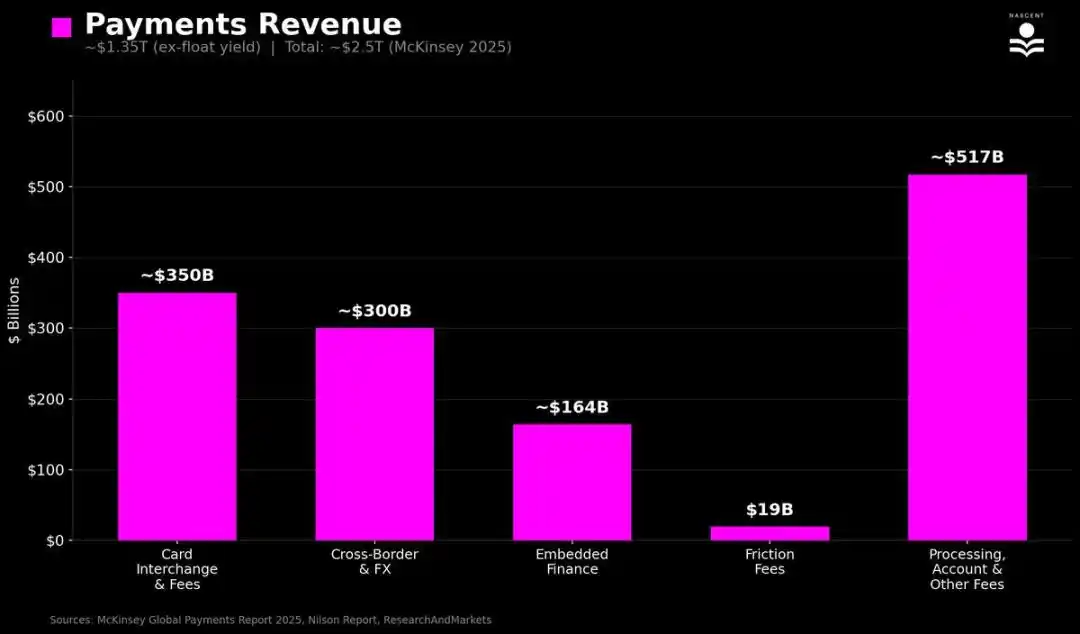
McKinsey's "2025 Global Payments Report" shows that global payment revenue is about $2.5 trillion. But nearly half of that (about $1.15 trillion) is net interest income: the earnings from idle funds in bank and payment accounts during transaction intervals. This is more like idle fund earnings rather than pure payment fees. Excluding this part, the core payment revenue from fund transfers, interchange fees, processing fees, embedded finance (Shopify, installment payments, Stripe), and friction charges (ATMs, overdrafts, on-chain fees) still amounts to about $1.35 trillion.
Investment: A Luxury Behavior

In contrast, investment is a financial behavior that no one is forced to undertake. A person can go through their entire economic life without buying stocks, opening a brokerage account, or consulting a financial advisor. Most people do just that. Active individual traders are statistically a minority.

Unlike payments, investment directly confronts loss aversion and carries a heavy cognitive burden. People instinctively avoid trading, so the funds of ordinary investors mostly lie in pension accounts, investment portfolios, ETFs, and index funds, bought and then held long-term without further action. Among those who participate in investment through pension accounts, 94% do not adjust their plans once joined and almost never trade.

The result is: the behavioral foundation of investment is narrow, passive, but extremely sticky.

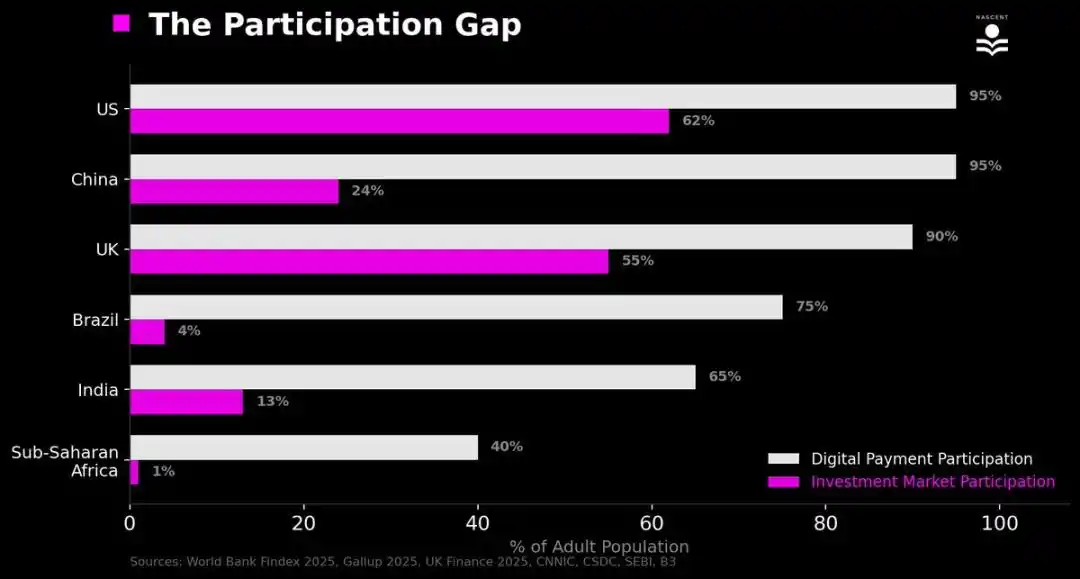
The participation rate comparison is telling: even in countries with the highest investment penetration, only about half the population participates in the investment market in some form, while digital payment penetration is as high as 95%.

  • United States: About 62% of adults hold some investment, mostly in rarely touched pension accounts
  • United Kingdom: Follows closely, about 55%
  • China: About 24% of adults have securities accounts
  • India: About 13%
  • Brazil: 4%
  • Sub-Saharan Africa: Only about 1%

Even having an account does not mean active operation.

This leads to a global asset management scale of about $147 trillion managed by professional intermediaries, including ETFs, mutual funds, pensions, and private market funds, accounting for 43% of global household financial wealth (about $305 trillion). The vast majority of this is passive index funds with extremely low fees: stock ETFs average only 14 basis points, bond ETFs 10 basis points. Even so, the global fund industry, managing about $135 trillion in assets, still has annual revenue of about $435 billion.

A minority of assets managed by private equity, venture capital, real estate, and hedge funds (about $13 trillion) charge 1%–2% management fees + 12.5%–20% performance fees, with annual revenue of about $363 billion.

Combining private market advisory fees, hedge fund performance fees, PE/VC carry, securities lending, trading commissions, etc., the total annual revenue of the investment industry is about $850–900 billion.
The overall revenue of the payment industry is still higher than that of investment, but the per capita revenue in the investment industry is much higher than in payments.

The Collapse of the Boundary

This asymmetric pattern has been stable for decades because the two fields have long operated in separate systems with independent infrastructures.

Payment business is scattered among banks, card networks, and payment processors. Asset management business is scattered among fund companies, wealth advisors, and pension platforms, while trading business is handled by brokerage firms.

Even if the same bank offers both checking accounts and investment services, they are packaged and operated as independent products, including separate customer registration, compliance processes, and user experience. The behavioral barrier between "spending money" and "investing" is further reinforced by the system.

The real change is that blockchain infrastructure allows modern payment applications to offer real investment services, and investment applications can offer real payment services, all using the same underlying system.

Investment balances can be directly used for payments without transferring through independent systems. The traditional brokerage process is: deposit funds → buy → sell → transfer to bank → spend. Crypto infrastructure compresses this into one step.

Wallets, neobanks, trading applications, or any programmable balance can allow the same dollar to complete cross-border transfer settlement while earning yield in a lending protocol, or be exchanged for other assets in the same interface, within the same operating session. Account holders can profit from both investment and payment ends simultaneously.

For the first time in history, the same balance, the same interface, can earn returns from both tracks at the same time.


Preguntas relacionadas

QWhat is the main argument of the article regarding the relationship between payments and investments in the crypto era?

AThe article argues that the boundary between payments and investments is disappearing due to programmable money and blockchain infrastructure, allowing the same balance in a unified account to simultaneously participate in both payment and investment activities, generating revenue from both sectors.

QAccording to the article, what are the key behavioral differences between payments and investments?

APayments are a universal, daily necessity for economic survival, characterized by high frequency, low psychological burden, and low cost. Investments, in contrast, are a luxury behavior that is not mandatory, with low participation rate, high cognitive burden, and passive, long-term holding patterns.

QHow does the revenue of the global payment industry compare to the investment management industry, as cited in the article?

AThe global payment industry generates approximately $2.5 trillion in annual revenue, with a core revenue of about $1.35 trillion after removing net interest income. The investment management industry has an annual revenue of about $850-900 billion, meaning the overall payment industry revenue is higher, but investment revenue per participant is much higher.

QWhat role does blockchain infrastructure play in merging payments and investments?

ABlockchain infrastructure enables modern payment applications to offer real investment services and vice versa, using the same underlying system. It allows an investment balance to be used directly for payments without transfers between independent systems, compressing multiple traditional steps into a single action within a unified interface.

QWhat does the article cite as the traditional reason for the separation between payment and investment systems?

AThe separation was a legacy of historical system architecture, with different products, accounts, regulatory frameworks, and interfaces for each. There was previously no practical need to integrate payments and investments, and the behavioral barrier between 'spending' and 'investing' was further reinforced by institutional structures.

Lecturas Relacionadas

The Midlife Crisis of Crypto GPs: No PMF, No Next Check from LPs

The article "The Midlife Crisis of Crypto GPs: No PMF, No Next LP Check" analyzes the shifting crypto fundraising landscape. It argues the era of selling grand visions to LPs is over; GPs must now offer products with clear Product-Market Fit (PMF). The author categorizes crypto fundraising products into three types: Primary (VC funds), Liquid (trading strategies), and CeFi/DeFi Native Yield. This summary focuses on the Primary market. Key points include: * **Market Shift:** LPs are impatient, demand immediate returns, and are skeptical of future promises. The "easy money" narrative has faded. * **GP Value Erosion:** LP learning curves have shortened (aided by AI), reducing the value of a GP's basic "crypto knowledge." Superior judgment is now rare. * **Weakened LP Motivations:** Traditional reasons for LPs to invest in crypto VC funds (capturing industry beta, gaining access, leveraging GP judgment) have weakened due to new products like ETFs and increased LP sophistication. * **Surviving in Primary:** The primary market will likely persist for: 1) large funds in endowment mandates treating it as a lottery ticket, 2) family offices/HNWIs using proprietary capital, 3) a few funds with proven recent outperformance, and 4) funds with strong ecosystem "deal-making" capabilities. * **Conclusion:** For most GPs, rebuilding trust requires starting over in a niche, demonstrating alpha-generating ability, or providing concrete value/services to LPs.

marsbitHace 22 min(s)

The Midlife Crisis of Crypto GPs: No PMF, No Next Check from LPs

marsbitHace 22 min(s)

Crypto GPs' Midlife Crisis: No PMF, No LP's Next Check

The article "The Midlife Crisis of Crypto GPs: No PMF, No LP's Next Check" analyzes the shifting crypto fundraising landscape. It argues that the era of LPs funding vague "vision" is over; GPs must now offer products with clear Product-Market Fit (PMF) to secure capital. The market has matured. LPs, disillusioned by the last cycle's failures and wary of long lock-up periods, now demand tangible, near-term returns rather than speculative narratives. The proliferation of accessible crypto ETFs and other liquid products has reduced the need for VC blind pools as an entry point. The author categorizes crypto fundraising products into three types: Primary (VC funds, with blind pools or clear pipelines), Liquid (alpha/beta, directional/market-neutral strategies), and CeFi/DeFi Native Yield (crypto-specific mechanisms like staking, farming). Focusing on the Primary market, the piece details why traditional LP rationales for investing in crypto VCs have weakened: easier beta access via ETFs, diminished "access" and "judgement" premiums as LPs build internal teams, and a widespread lack of proven superior returns from GPs. Ultimately, only specific players are likely to remain at the primary VC table: large funds with access to patient endowment capital, family offices/HNWIs investing proprietary capital, the few funds with demonstrable excess returns from the last cycle, and those with clear "deal-making" or ecosystem resource advantages. For others, the path forward is to rebuild trust by proving alpha-generation capability in a niche or providing concrete, valuable services.

链捕手Hace 46 min(s)

Crypto GPs' Midlife Crisis: No PMF, No LP's Next Check

链捕手Hace 46 min(s)

The Age of Decoupling Has Arrived: Bitcoin is No Longer the Sole Compass of Crypto

The era of the cryptocurrency market moving in lockstep with Bitcoin is ending, as the industry splits into two distinct asset categories: endogenous and exogenous. Endogenous assets, like Bitcoin, derive value purely from the crypto market's cycles. Their narratives swing between being "interstellar money" in bull markets and "digital collectibles" in bear markets. Exogenous assets, however, are nominally crypto but operate with independent value drivers. Examples include: * **Venice:** An AI inference service using tokens for payments; its consumer-AI business model is decoupled from crypto price swings. * **Figure:** A fintech lender using blockchain to speed up loan approvals; its core value is in credit, not crypto. * **Stablecoin firms like BVNK:** Acquired by traditional finance giants (Mastercard, Stripe), their growth is tied to payment infrastructure, not market cycles. Hybrid projects like **Hyperliquid** (a decentralized exchange) show a shift, with a growing share of non-crypto trading (e.g., prediction markets). This divergence is fundamental. Endogenous assets remain highly correlated to Bitcoin, similar to gold miners to gold. Exogenous assets are evolving to have their own fundamentals, like the weak correlation between gold and the S&P 500. This changes investment analysis. Evaluating exogenous assets requires traditional fundamental research—assessing user bases, unit economics, and moats—more akin to fintech investing than charting Bitcoin. Promising exogenous sectors include: on-chain exchanges/brokers, AI-crypto fusion, privacy-focused digital banks, lending (institutional/private credit), stablecoins/real-world asset tokenization, payment rails, and non-financial crypto-consumer products. Currently, investing via equity is often safer than via tokens, as token value accrual mechanisms need further regulatory and industry development (e.g., the CLARITY Act). Nonetheless, the core trend is clear: crypto market drivers are diversifying from a single factor (Bitcoin) to multiple fundamentals, ending the era of uniform market moves.

marsbitHace 1 hora(s)

The Age of Decoupling Has Arrived: Bitcoin is No Longer the Sole Compass of Crypto

marsbitHace 1 hora(s)

Five Cryptos That Could Outperform Bitcoin Over the Next Cycle Due To Higher Growth Velocity

Bitcoin's growth often sets market trends, but analysts believe the next cycle's highest percentage gains may come from assets with greater growth velocity. While Bitcoin provides stability, several cryptocurrencies are positioned for stronger relative upside. This article highlights five such assets, with a particular focus on Ozak AI as the potential high-growth standout of the cycle. Ethereum (ETH) is noted for its ongoing evolution and institutional adoption. Solana (SOL) is recognized for its high throughput and history of sharp rallies. Chainlink (LINK) is highlighted as essential infrastructure for DeFi and AI applications. Avalanche (AVAX) is mentioned for its subnet architecture and enterprise potential. Ozak AI ($OZ) is presented as a distinct early-stage opportunity, currently in presale at $0.014 with a target listing price of $1.00. The project is building a full AI-native blockchain ecosystem, including prediction agents, a data stream network, and structured data vaults. Analysts suggest its early valuation stage and focus on AI infrastructure could allow for exponential growth velocity compared to more mature assets like Bitcoin, which requires massive capital inflows for significant price movement. The final takeaway positions Ozak AI as a high-asymmetry bet for investors seeking exponential upside alongside more stable assets.

TheNewsCryptoHace 2 hora(s)

Five Cryptos That Could Outperform Bitcoin Over the Next Cycle Due To Higher Growth Velocity

TheNewsCryptoHace 2 hora(s)

Trading

Spot
Futuros

Artículos destacados

Cómo comprar ERA

¡Bienvenido a HTX.com! Hemos hecho que comprar Caldera (ERA) sea simple y conveniente. Sigue nuestra guía paso a paso para iniciar tu viaje de criptos.Paso 1: crea tu cuenta HTXUtiliza tu correo electrónico o número de teléfono para registrarte y obtener una cuenta gratuita en HTX. Experimenta un proceso de registro sin complicaciones y desbloquea todas las funciones.Obtener mi cuentaPaso 2: ve a Comprar cripto y elige tu método de pagoTarjeta de crédito/débito: usa tu Visa o Mastercard para comprar Caldera (ERA) al instante.Saldo: utiliza fondos del saldo de tu cuenta HTX para tradear sin problemas.Terceros: hemos agregado métodos de pago populares como Google Pay y Apple Pay para mejorar la comodidad.P2P: tradear directamente con otros usuarios en HTX.Over-the-Counter (OTC): ofrecemos servicios personalizados y tipos de cambio competitivos para los traders.Paso 3: guarda tu Caldera (ERA)Después de comprar tu Caldera (ERA), guárdalo en tu cuenta HTX. Alternativamente, puedes enviarlo a otro lugar mediante transferencia blockchain o utilizarlo para tradear otras criptomonedas.Paso 4: tradear Caldera (ERA)Tradear fácilmente con Caldera (ERA) en HTX's mercado spot. Simplemente accede a tu cuenta, selecciona tu par de trading, ejecuta tus trades y monitorea en tiempo real. Ofrecemos una experiencia fácil de usar tanto para principiantes como para traders experimentados.

369 Vistas totalesPublicado en 2025.07.17Actualizado en 2026.06.01

Cómo comprar ERA

Discusiones

Bienvenido a la comunidad de HTX. Aquí puedes mantenerte informado sobre los últimos desarrollos de la plataforma y acceder a análisis profesionales del mercado. A continuación se presentan las opiniones de los usuarios sobre el precio de ERA (ERA).

活动图片












