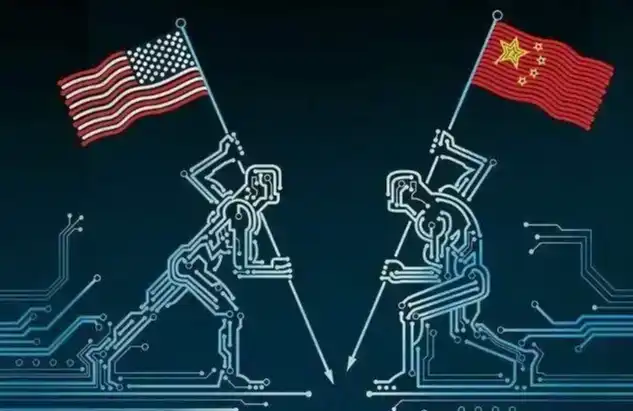
The End of the 'Talk-to-Earn' Era? X Delivers Heavy Blow, Bans InfoFi, Cutting Off Funding for a Batch of Projects

比推Publicado a 2026-01-16Actualizado a 2026-01-16

Resumen

On January 15, X (formerly Twitter) revoked API access for InfoFi applications, effectively ending the "post-to-earn" model. The platform cited concerns over AI-generated spam and low-quality replies as the reason for the policy change, prioritizing user experience over the significant revenue these apps generated. Major InfoFi platforms like Kaito and Cookie DAO are now pivoting to alternative models, such as content marketing tools and market intelligence services. The move triggered sharp declines in related token values and NFT floor prices, with some teams accused of insider trading prior to the announcement. The crackdown is seen as a necessary step to combat spam and improve content quality on the platform, though it also reflects broader challenges in the crypto content ecosystem.

Author: Nancy, PANews

Original Title: 'Talk-to-Earn' Players' 'World Collapses'! Twitter Bans InfoFi, Ecosystem Projects Forced to Adapt Drastically


On the night of January 15th, the crypto Twitter circle (CT) was suddenly hit by a silent 'earthquake'.

With X (formerly Twitter) issuing an announcement cutting off API access for InfoFi applications, the 'post-to-earn' mechanism was brought to a halt. Project teams are choosing to pivot, while 'talk-to-earn' players exclaim that 'the sky has fallen'.

Revoking API Access, Rejecting Millions in 'Toll Fees'

The InfoFi sector changed overnight.

X's Product Lead and Solana Ecosystem Advisor, Nikita Bier, officially announced last night that the platform is revising its developer API policy and will no longer allow applications that reward users for posting, directly naming InfoFi.

Nikita stated bluntly that such incentive mechanisms are the root cause of the platform being flooded with a large amount of AI-generated spam and low-quality replies. Currently, X has revoked the API access permissions for these applications. Once the bots realize they are no longer being paid, the user experience should begin to improve soon.

For developers whose accounts were terminated, Nikita also 'thoughtfully' suggested that teams could help them transition their business to Meta's Threads and the decentralized social media platform Bluesky, a comment full of sarcasm.

More importantly, X resolutely chose to forgo this revenue, even though high-frequency API-calling applications like InfoFi contributed significant 'toll fees'. "InfoFi applications were already paying us millions of dollars for enterprise API access. We don't want that money," Nikita said. This statement also indicates that user experience is X's current strategic priority, especially since these earnings are insignificant compared to X's overall annual revenue.

This officially宣告 (declares) the end of the InfoFi model寄生 (parasitizing) the X ecosystem. The simple and brutal 'talk-to-earn' era is gone for good.

In fact, this is not the first time Nikita has 'declared war' on low-quality content.

Not long ago, he criticized crypto tweets for heading towards suicidal demise. Nikita posted at the time that since last October, a notion has been spreading within CT that users need to reply hundreds of times a day to achieve account growth. However, each post consumes part of the day's influence. Since the average user only browses 20 to 30 posts per day, the platform cannot show all posts from one user to all their followers. Therefore, crypto Twitter users end up wasting all their influence on hundreds of 'gm' replies. When they post substantive content like project announcements, very few people see it. The decline of crypto tweets stems from their own behavior, not algorithm issues.
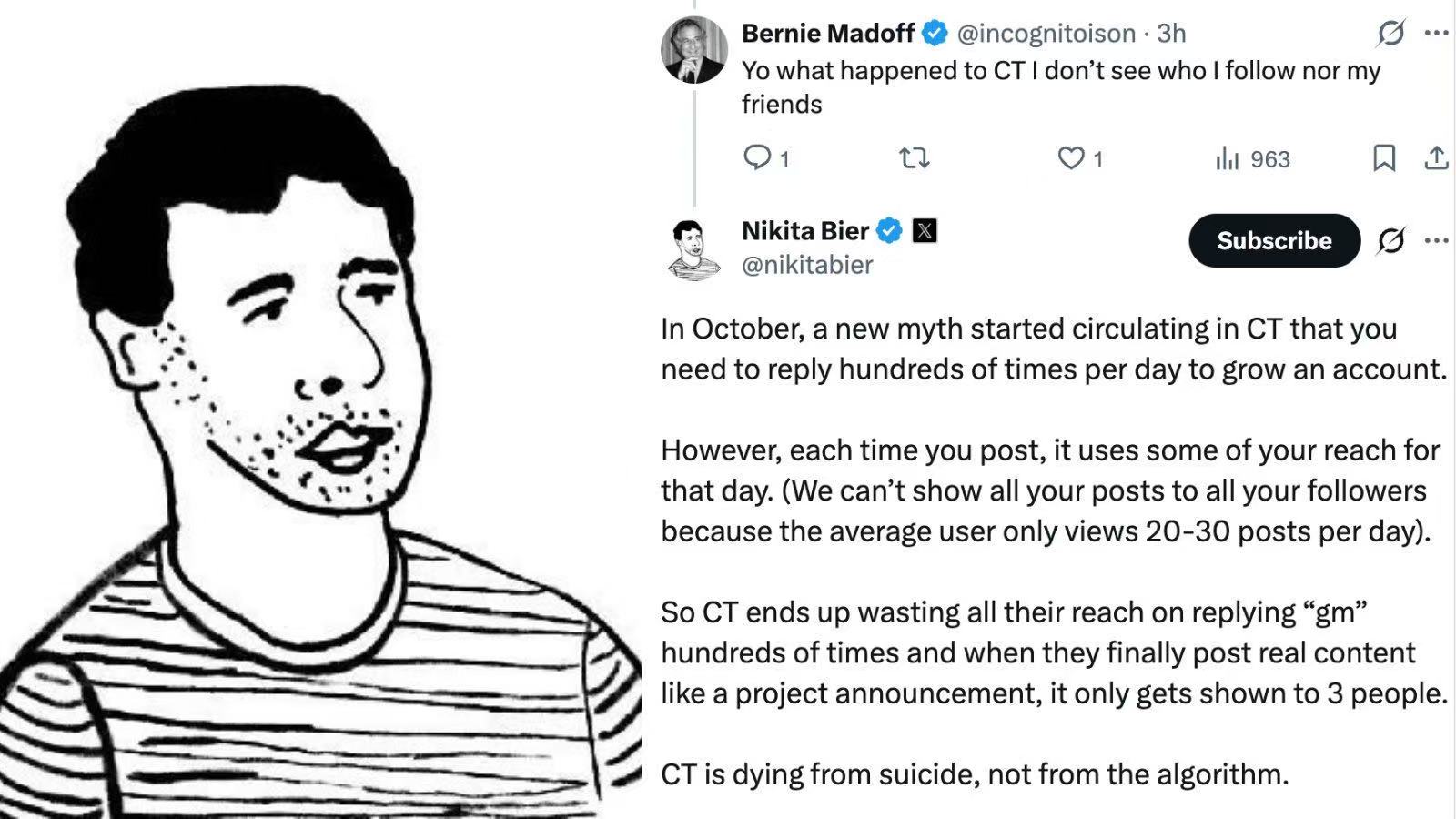
This post sparked strong dissatisfaction within the crypto community at the time, even leading to a large-scale 'GM' counter-attack, which eventually resulted in the tweet being deleted. But in hindsight, X's determination to clean up low-quality content had already been foreshadowed.

Ecosystem Projects Make Drastic Survival Moves, Teams Accused of Dumping Tokens Early

As X tightens its API policy, the InfoFi narrative is facing a cold spell.

CoinGecko data shows that in the past 24 hours, the market capitalization of the InfoFi sector fell to $350 million, with many tokens experiencing double-digit declines. Even the floor price of Yapybaras NFT from Kaito couldn't escape, plummeting.

Faced with a survival test, multiple InfoFi applications have announced pivots.

Yu Hu, founder of the representative project Kaito, stated that the company will gradually terminate Yaps and the incentivized leaderboard system, instead launching a new Kaito Studio. This decision stems from the platform's issues with low-quality content and spam, as well as a shift in the crypto industry from a high-frequency global distribution model towards more precise marketing. After discussions with the X platform, both parties reached a consensus: a completely permissionless distribution system is no longer viable and does not meet the needs of high-quality brands, serious content creators, or the X platform itself. Over the past few months, the platform has been developing Kaito Studio. This product will adopt a layered traditional marketing model, connecting brands with high-quality creators through top-tier analytical tools, covering multiple platforms like X, YouTube, TikTok, and expanding beyond cryptocurrency into areas like finance and AI.

Meanwhile, Cookie DAO, after consulting with the X team, decided to immediately shut down the Snaps platform and all creator activities. Cookie DAO stated it will wait for confirmation and guidance from the X platform to determine if creator activities similar to Snaps can operate in any form in the future. Simultaneously, the platform is communicating directly with all project teams running Snaps activities. Some situations are more complex, involving pre-paid activity fees and promised rewards. While full solutions are not yet available, they will adhere to principles of fairness and communicate directly with each project. The platform has taken snapshot archives of all active activities and will provide updates to creators as soon as possible. Other products under Cookie are unaffected. Additionally, over the past six months, the platform has been continuously developing Cookie Pro, a crypto real-time market intelligence tool, planned for launch in the first quarter.

Judging from the project teams' statements, this policy adjustment is not a sudden black swan event; the teams were already aware of the changing winds and had布局 (laid out plans for) a pivot in advance. This has also sparked market controversy, with the community质疑 (questioning) whether projects knew about the negative news in advance and dumped their tokens.
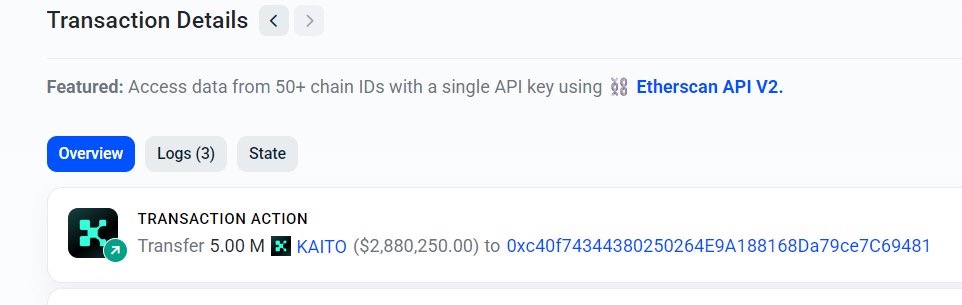
Taking Kaito as an example, its multi-signature contract address distributed and transferred a cumulative 24 million KAITO (approx. $13.31 million) to 5 addresses two weeks ago. Among them, according to monitoring by crypto KOL "vasucrypto", the 0x049A address associated with the Kaito team transferred 5 million KAITO to Binance 7 days ago, possibly for sale. More intriguingly, crypto KOL "加密无畏" (Crypto Fearless) added that Kaito's staking unlocks also peaked in the past few days. 1.1 million KAITO tokens are also scheduled to unlock tomorrow (January 17th), with the unstaking period being 7 days.

Farewell to the 'Talk-to-Earn' Era, Long-Overdue Content Justice

X's brutal industry purge is not just an adjustment of platform rules but also a reshaping of the crypto content ecosystem.

For X, which highly relies on advertising revenue and subscription services, facing external pressures like slowing user growth, inefficient traffic monetization, and the strong rise of competitors, this adjustment is an inevitable choice for survival. In fact, over the past few months, X has already begun making sweeping reforms in content and traffic distribution, including adjusting algorithm weights and increasing revenue for high-quality creators. Ultimately, X's true target is not solely the InfoFi model, but the low-quality content that severely dilutes the platform's value and drives away real users.

For the crypto Twitter circle, this is also a long-overdue form of content justice. Although the original intention of the InfoFi model was to encourage creators to produce high-quality content through token incentives, and it did shine briefly, this mechanism was also hijacked by 'airdrop farming' behavior, where a large number of profit-seekers疯狂制造 (frantically produced) low-quality and repetitive spam information. This false流量繁荣 (traffic prosperity) not only made content dull but also caused truly deep and valuable content to be drowned out by noise, accelerating the loss of real users.

This 'ban' is undoubtedly a 'noise filter' for CT users who are tired of spam; their timelines can finally catch a breath.

However, the decline in CT's热度 (heat) is not entirely attributable to InfoFi; it is also closely related to the overall downturn cycle of the crypto industry. Even the viewership of crypto content on YouTube has fallen to its lowest level since January 2021.

Regardless, the end of this InfoFi model is a necessary path to improving the readability of crypto content and returning to the essence of content. For InfoFi projects, now that the shortcut of寄生 (parasitizing) Web2 giant traffic has been cut off, how to establish a SocialFi mechanism based on the flow of real value is a难题 (challenge) that urgently needs answering.


Twitter:https://twitter.com/BitpushNewsCN

Bitpush TG Discussion Group:https://t.me/BitPushCommunity

Bitpush TG Subscription: https://t.me/bitpush

Original Link:https://www.bitpush.news/articles/7603422

Preguntas relacionadas

QWhat major change did X (formerly Twitter) announce regarding InfoFi applications on January 15th?

AX revoked API access for InfoFi applications, effectively ending the 'post-to-earn' model that rewarded users for posting.

QAccording to X's product lead Nikita Bier, why was the API access for InfoFi apps terminated?

ABecause these incentive mechanisms were identified as the main cause of a large amount of AI-generated spam and low-quality replies on the platform, which degraded user experience.

QHow did the InfoFi ecosystem react to X's policy change, as mentioned in the article?

AProjects like Kaito and Cookie DAO announced they were pivoting or shutting down their incentivized platforms, with Kaito developing a new marketing tool and Cookie DAO focusing on a market intelligence product.

QWhat controversy emerged concerning the Kaito team's actions prior to the official announcement?

AThe community questioned if the team had prior knowledge of the policy change, as a team-associated address transferred a large amount of KAITO tokens to Binance potentially for selling, and a significant token unlock was scheduled around the same time.

QWhat does the article suggest is the broader implication of X's crackdown on InfoFi for the crypto content ecosystem?

AIt is seen as a necessary step to filter out low-quality content and spam, a 'long-overdue content justice' that could improve readability and push the ecosystem to focus on genuine value and content quality rather than artificial engagement for rewards.

Lecturas Relacionadas

Breaking: OpenAI Undergoes Major Reorganization, President Brockman Assumes Command

OpenAI has announced a major internal reorganization just months before its anticipated IPO. The company is merging its three flagship product lines—ChatGPT, Codex, and the API platform—into a single, unified product organization. The most significant leadership change involves co-founder and President Greg Brockman moving from a background technical role to take full, permanent control over all product strategy. This follows the indefinite medical leave of AGI Deployment CEO Fidji Simo. Additionally, ChatGPT's longtime lead, Nick Turley, has been reassigned to enterprise products, with former Instagram executive Ashley Alexander taking over consumer offerings. The consolidation, internally framed as a strategic move towards an "Agentic Future," aims to break down internal silos and create a cohesive "Super App." This planned desktop application would integrate ChatGPT's conversational abilities, Codex's coding power, and a rumored internal web browser named "Atlas" to autonomously perform complex user tasks. The reorganization occurs amid significant internal and external pressures. OpenAI has recently seen a wave of high-profile departures, including Sora co-lead Bill Peebles and other senior technical leaders, leading to concerns about a thinning executive bench. Externally, rival Anthropic recently secured funding at a staggering $900 billion valuation, surpassing OpenAI's own. Google's upcoming I/O developer conference also poses a competitive threat. Analysts suggest the dramatic restructure is a pre-IPO move to present a clearer, more focused narrative to Wall Street—streamlining operations and demonstrating decisive leadership under Brockman to counter internal turbulence and intense market competition.

marsbitHace 1 hora(s)

Breaking: OpenAI Undergoes Major Reorganization, President Brockman Assumes Command

marsbitHace 1 hora(s)

Two Survival Structures of Market Makers and Arbitrageurs

Market makers and arbitrageurs represent two distinct survival structures in high-frequency trading. Market makers primarily use limit orders (makers) to profit from the bid-ask spread, enjoying high capital efficiency (nominally 100%) but bearing inventory risk. This "inventory risk" arises from passive, fragmented, and discontinuous order fills in the limit order book (LOB). This risk, while a potential cost, can also contribute to excess profit if managed within control boundaries, allowing for mean reversion. Market makers essentially sell "time" (uncertainty over execution timing) to the market for price control and low fees. In contrast, cross-exchange arbitrageurs typically use market orders (takers) to exploit price differences or funding rates, resulting in lower nominal capital efficiency (requiring capital on both exchanges) and higher transaction costs. Their risk exposure stems from asymmetries in exchange rules (e.g., minimum order sizes), execution latency, and infrastructure risks (e.g., ADL, oracle drift). These exposures are active, exogenous gaps that primarily erode profits rather than contribute to them. Arbitrageurs essentially sell "space" (capital sunk across venues) for localized, immediate certainty. Both strategies engage in a trade-off between execution friction and residual risk. Optimal systems allow for temporary, controlled risk exposure rather than enforcing zero exposure at all costs. Their evolution converges towards hybrid models: arbitrageurs may use maker orders to reduce costs, while market makers may use taker orders or hedges for risk management. Ultimately, both use different forms of risk exposure—market makers exposing inventory, arbitrageurs immobilizing capital—to extract marginal, hard-won certainty from the market.

链捕手Hace 1 hora(s)

Two Survival Structures of Market Makers and Arbitrageurs

链捕手Hace 1 hora(s)

Who Will Define the Rules of the AI Era? Anthropic Discusses the 2028 US-China AI Landscape

This article, based on Anthropic's analysis, outlines the intensifying systemic competition between the U.S./allies and China for AI leadership by 2028. It argues that access to advanced computing power ("compute") is the critical bottleneck, where the U.S. currently holds a significant advantage through chip export controls and allied innovation. However, China's AI labs remain competitive by exploiting policy loopholes—via chip smuggling, overseas data center access, and "model distillation" attacks to copy U.S. model capabilities—keeping them close to the frontier. The piece presents two contrasting scenarios for 2028. In the first, decisive U.S. action to tighten compute controls and curb distillation locks in a 12-24 month AI capability lead, cementing democratic influence over global AI norms, security, and economic infrastructure. In the second, policy inaction allows China to achieve near-parity through continued access to U.S. technology, enabling Beijing to promote its AI stack globally and integrate advanced AI into its military and governance systems, altering the strategic balance. Anthropic contends that maintaining a decisive U.S. lead is essential for shaping safe AI development and governance. The core recommendation is for U.S. policymakers to urgently close compute and model access loopholes while promoting global adoption of the U.S. AI technology stack to secure a lasting strategic advantage.

marsbitHace 3 hora(s)

Who Will Define the Rules of the AI Era? Anthropic Discusses the 2028 US-China AI Landscape

marsbitHace 3 hora(s)

Trading

Spot
Futuros

Artículos destacados

Cómo comprar ERA

¡Bienvenido a HTX.com! Hemos hecho que comprar Caldera (ERA) sea simple y conveniente. Sigue nuestra guía paso a paso para iniciar tu viaje de criptos.Paso 1: crea tu cuenta HTXUtiliza tu correo electrónico o número de teléfono para registrarte y obtener una cuenta gratuita en HTX. Experimenta un proceso de registro sin complicaciones y desbloquea todas las funciones.Obtener mi cuentaPaso 2: ve a Comprar cripto y elige tu método de pagoTarjeta de crédito/débito: usa tu Visa o Mastercard para comprar Caldera (ERA) al instante.Saldo: utiliza fondos del saldo de tu cuenta HTX para tradear sin problemas.Terceros: hemos agregado métodos de pago populares como Google Pay y Apple Pay para mejorar la comodidad.P2P: tradear directamente con otros usuarios en HTX.Over-the-Counter (OTC): ofrecemos servicios personalizados y tipos de cambio competitivos para los traders.Paso 3: guarda tu Caldera (ERA)Después de comprar tu Caldera (ERA), guárdalo en tu cuenta HTX. Alternativamente, puedes enviarlo a otro lugar mediante transferencia blockchain o utilizarlo para tradear otras criptomonedas.Paso 4: tradear Caldera (ERA)Tradear fácilmente con Caldera (ERA) en HTX's mercado spot. Simplemente accede a tu cuenta, selecciona tu par de trading, ejecuta tus trades y monitorea en tiempo real. Ofrecemos una experiencia fácil de usar tanto para principiantes como para traders experimentados.

356 Vistas totalesPublicado en 2025.07.17Actualizado en 2025.07.17

Cómo comprar ERA

Discusiones

Bienvenido a la comunidad de HTX. Aquí puedes mantenerte informado sobre los últimos desarrollos de la plataforma y acceder a análisis profesionales del mercado. A continuación se presentan las opiniones de los usuarios sobre el precio de ERA (ERA).

活动图片