The Encrypted Super App Revolution: When Coinbase Breaks Financial Boundaries

marsbitPublicado a 2025-12-22Actualizado a 2025-12-22

Resumen

Coinbase and Robinhood are leading a shift towards integrated financial "super apps," moving beyond fragmented services to combine stock trading, cryptocurrencies, derivatives, and predictive markets in a single platform. This consolidation addresses inefficiencies like multi-day settlement delays and fragmented liquidity, allowing instant asset reallocation within one account. Key enablers include tokenization for 24/7 trading, clearer regulations, and advanced mobile wallet infrastructure. Social trading is emerging as a differentiator, enabling users to mimic trusted traders. However, this recentralization raises concerns about counterparty risk, gamified trading incentives, and whether this truly democratizes finance or merely replaces traditional gatekeepers. The era of financial fragmentation is ending, but the outcome—genuine innovation or repackaged control—remains uncertain.

Original Author: Nishil Jain

Original Compilation: Luffy, Foresight News

Last week, Coinbase launched a new product touted as the "Future of Finance." One app now integrates five major functions: 24/5 stock trading, centralized exchange and on-chain cryptocurrency trading, futures and perpetual contract trading, prediction markets, and even features an AI financial analyst. All functions are accessible via mobile, with a single account balance allowing users to instantly switch between different asset classes.

Not long ago, Robinhood had already taken the lead: launching tokenized stock trading in Europe, 24/5 futures trading, cryptocurrency interest-earning services, and planning to launch the social trading feature Robinhood Social in 2026.

The mainstream discourse on platform X interprets this trend as the evolution of "super apps," but a key point is being missed: this is not merely a simple addition of functions; it is breaking down the boundaries of financial asset categories that were artificially divided due to regulatory and technological limitations.
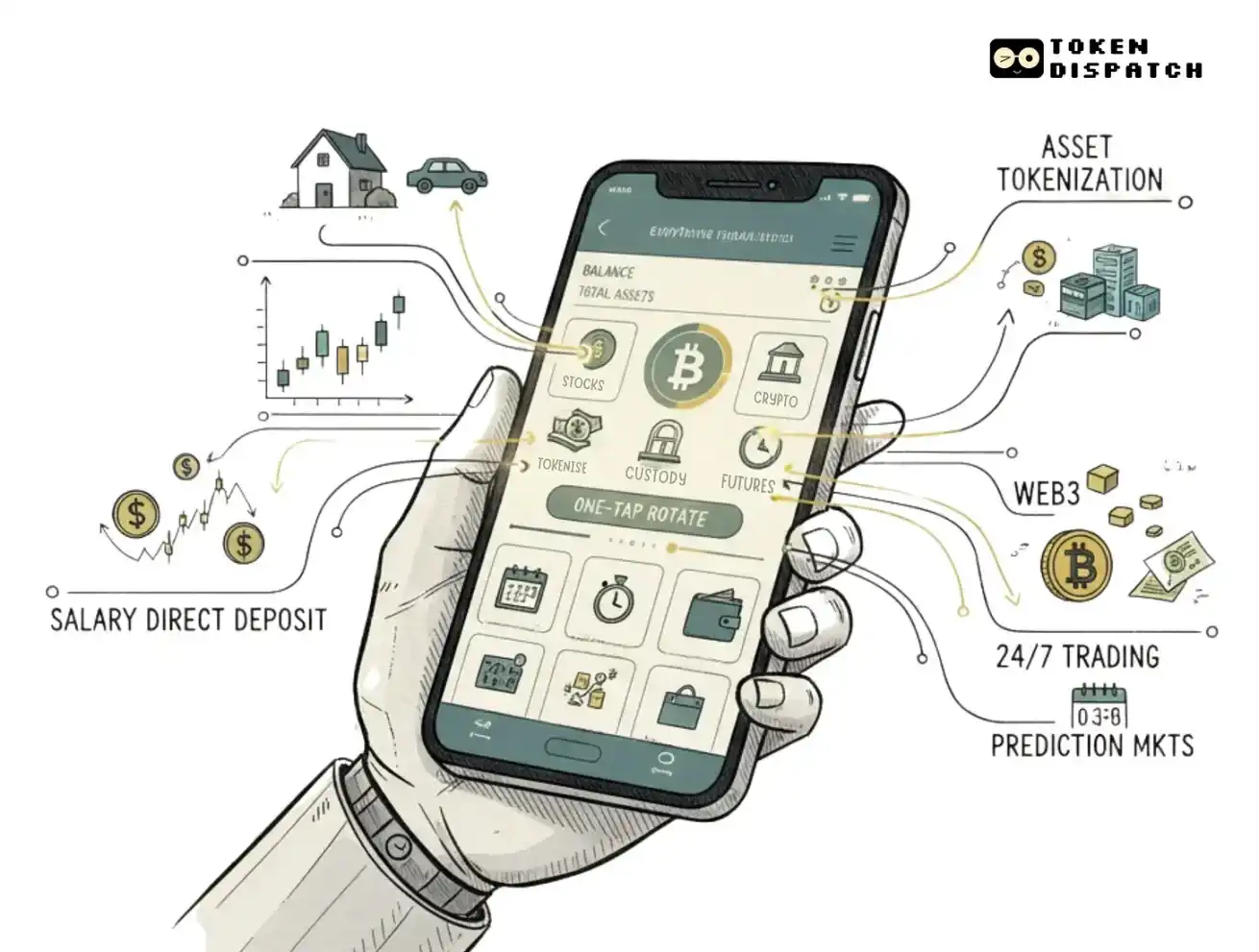
Why, after a decade of fragmented development, are financial applications now experiencing a wave of integration? What does this mean for the users and platforms involved? Let's delve into the topic.

The Pain Points of Fragmentation

Over the past decade, numerous fintech applications have emerged, but most only cover a single aspect of financial services, with functions like stock trading, cryptocurrencies, payments, and savings scattered across different apps.

While this model provided users with more choices and allowed companies to focus on refining single solutions, it posed significant problems in practical use.

Want to sell stocks and buy cryptocurrencies? Stock trades executed on Monday only settle on Tuesday due to T+1 settlement; then initiating a withdrawal takes 2-3 days for the funds to reach your bank account; transferring funds to Coinbase takes another 1-2 days. From "deciding to reallocate funds" to "funds actually being available," the entire process takes about 5 days. In those 5 days, the investment opportunity you initially spotted might have already vanished, while your funds remain idle in cumbersome processes.

For example, you might want to buy Bitcoin at $86,000 on December 18th, but due to process delays, end up buying it 5 days later at $90,000. For more volatile investment opportunities like meme coins, Initial Coin Offerings (ICOs), or Initial Public Offerings (IPOs), the losses from such delays can be even more severe.

The problem of fragmentation isn't limited to a single region. An Indian investor wanting to buy NVIDIA stock must complete multiple KYC verifications, open an account with a broker that supports Indian users investing in US stocks, and deposit additional funds, all just to buy that one stock.

We've all felt this operational friction, but only recently has the infrastructure capable of solving this problem begun to take shape.

The Cornerstones of Change: Infrastructure Maturation

Three structural changes have made the birth of integrated financial platforms possible.

Tokenization Breaks Time Barriers

Traditional stocks can only be traded during NYSE trading hours (9:30 AM to 4:00 PM ET, 5 days a week), while cryptocurrencies enable 24/7 trading. By achieving stock tokenization on Layer 2 networks, it has been proven that, with the right technical mechanisms, stocks can theoretically be traded around the clock.

Now, Robinhood's tokenized stocks launched in Europe support 24/5 trading, and Coinbase is set to follow this model.

Regulatory Frameworks Become Clearer

In recent years, Bitcoin spot ETFs have been listed successfully, stablecoin legalization processes have advanced, tokenization regulatory frameworks have entered deliberation stages, and prediction markets have gained approval from the U.S. Commodity Futures Trading Commission (CFTC). Although the regulatory environment is not perfect, it is clear enough for platforms to confidently develop multi-asset products without fear of being completely shut down.

Mobile Wallet Infrastructure Matures

Embedded wallets can now seamlessly handle complex cross-chain operations. Platforms like Privy, acquired by Stripe, allow users to create wallets using existing email addresses without dealing with seed phrases; the recently launched crypto trading app Fomo enables non-crypto users to trade tokens on Ethereum, Solana, Base, Arbitrum, and other chains without manually selecting networks, and supports Apple Pay deposits. The backend automatically handles all complex processes—users simply click "Buy Token" to complete the transaction.

The Core Logic of Liquidity Integration

The core driver behind this change is: funds scattered across different applications are essentially idle capital.

In an integrated model, users only need to maintain a single account balance: after selling stocks, funds can be instantly used to buy cryptocurrencies, eliminating the wait for settlement windows, withdrawal review periods, and intermediaries like banks. The 5-day opportunity cost vanishes entirely.

Platforms that integrate liquidity are more efficient. With deeper liquidity pools, they can offer better execution speeds; since all trading pairs share the same underlying liquidity, they can support more pairs; they can provide yield on idle capital, like banks; furthermore, reduced friction leads to increased user trading volume, generating more fee income for them.

Coinbase's Integration Blueprint

Coinbase is the most typical case in this wave of financial integration. Founded in 2012, the company started as a simple cryptocurrency exchange, only supporting the buying and selling of Bitcoin and Ethereum. In the following years, Coinbase gradually added institutional custody, staking services, and cryptocurrency lending interest-earning products, evolving into a full-service crypto platform by 2021.

Its expansion didn't stop: it launched the Coinbase Card for cryptocurrency spending, the Coinbase Commerce payment solution for merchants, and built its own Layer 2 blockchain, Base.

The new product launch on December 17th marks the full realization of Coinbase's "super app" vision. Now, Coinbase supports 24-hour stock trading, plans to launch Coinbase Tokenize for institutional real-world asset tokenization early next year, has integrated prediction markets through a partnership with Kalshi, launched futures and perpetual contract trading, and integrated Solana ecosystem DEX trading functionality within the app. Additionally, the Base app has expanded to 140 countries and enhanced the social trading experience.

Coinbase is gradually becoming the operating system for on-chain finance. Through a single interface and a single account balance, it covers trading needs for all asset classes, aiming to allow users to complete all financial operations without leaving the platform.

Robinhood is following a similar development path: starting with commission-free stock trading, gradually adding cryptocurrency trading, a Gold subscription service offering 3% cashback and 3.5% deposit interest, futures trading, and subsequently launching tokenized stocks in Europe.

Both platforms are betting on the same core logic: users don't want to download different apps for stocks, cryptocurrencies, and derivatives; they need a single account balance, a unified interface, and the ability to instantly reallocate funds.

Social Trading: An Emerging Differentiated Competency

Asset integration solves the liquidity problem but does not solve the user's asset discovery challenge.

When there are millions of assets available in the market, how should users filter trading targets? How should they build their investment portfolios?

This is where social features add value. Coinbase's Base app includes a dynamic feed where users can see others' buy actions; Robinhood plans to launch Robinhood Social in 2026; eToro has offered social trading since 2007, paying copy traders 1.5% of the assets held as commission.

A batch of apps exploring social trading features has also emerged in the on-chain space, such as Fomo, 0xPPL, and Farcaster. These apps allow users to see what their friends are investing in, follow them, and copy their trades.
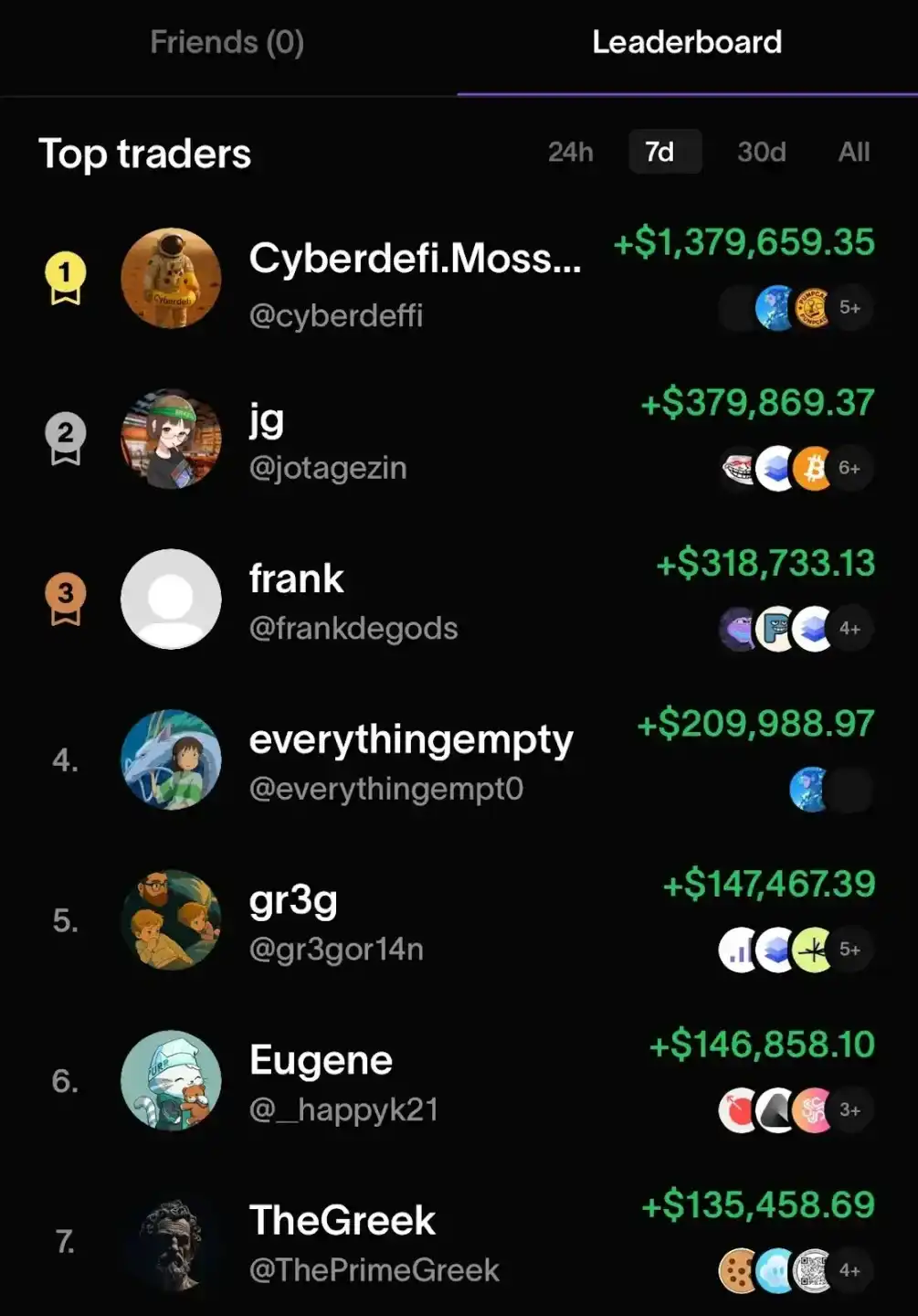
Fomo's leaderboard page

Social trading allows users to see others' trading behavior in real-time and copy it with one click. This significantly reduces decision-making friction: no independent research, just follow trusted trading strategies. Once a platform forms a stable community ecosystem—where users follow trading experts and build personal reputations—users become less likely to migrate to other platforms, creating a powerful competitive barrier and user stickiness for trading apps.

Centralized exchanges have offered copy trading since 2022, but usage rates have remained below 2%. Mobile app platforms are betting that optimizing the user experience will increase the adoption of this feature. Whether their judgment is correct will determine if social trading becomes a true differentiated competency or just another ordinary feature.

The Pessimistic View: Potential Risks and Controversies

Let's be frank about the current situation: the original intention of cryptocurrency was to achieve financial decentralization, remove intermediaries, and let users control their assets.

And now, we are rebuilding centralized platforms: Coinbase controls asset custody, trade execution, and social graphs; Robinhood holds the private keys for embedded wallets; users need to trust the platform's solvency, security, and ongoing operational capability. All this implies counterparty risk.

Robinhood's tokenized stocks are essentially derivatives tracking stock prices, not actual stocks. If the platform collapses, what users hold is merely an IOU.

Problems caused by gamification are also worsening: 24/7 trading means you might make impulsive trades at 3 AM; social feeds can induce FOMO when you see others profiting; push notifications alert you to every market fluctuation. This is essentially scaled casino psychology, meticulously optimized by designers who understand how to trigger dopamine responses.

Is this progress in financial democratization, or just a repackaged exploitative system? This is a philosophical question worth pondering.

The Essence Behind the Phenomenon

We spent a decade deconstructing financial services, operating under the assumption that fragmentation would foster competition and bring more choices.

But it turns out that fragmentation also caused inefficiencies: idle funds, dispersed liquidity, and users forced to hold more idle capital due to cumbersome fund transfer processes. The new era is changing this.

Coinbase and Robinhood are gradually becoming new types of banks: they hold your salary, savings, investments, and spending patterns; they control trade execution, asset custody, and access; they介入 (intervene in) every transaction. The only difference from traditional banks is: a more beautiful interface, 24/7 trading markets, and deposit rates 50 basis points higher.

Whether we are achieving financial democratization by lowering barriers and improving efficiency, or merely changing the gatekeepers while keeping the barriers themselves, the era of fragmentation is over. In the coming years, we will witness whether financial integration based on open underlying technology can yield better results than the traditional banks we once fled, or if it merely changes the logo that locks users in.


Preguntas relacionadas

QWhat are the three major structural changes that have enabled the emergence of integrated financial platforms?

AThe three major structural changes are: 1) Tokenization breaking down time barriers, allowing for 24/7 trading of assets like stocks. 2) A clearer regulatory framework, with approvals for Bitcoin ETFs, stablecoins, and prediction markets. 3) The maturation of mobile wallet infrastructure, enabling seamless cross-chain operations and simplified user experiences.

QAccording to the article, what was the core problem with the fragmented fintech landscape of the past decade?

AThe core problem was inefficiency and opportunity cost. Moving money between different apps for different asset classes (e.g., selling stocks to buy crypto) could take up to 5 days due to settlement times, bank transfers, and platform delays, causing users to miss out on time-sensitive investment opportunities.

QHow does the article describe the core competitive advantage of platforms like Coinbase and Robinhood in their new integrated model?

ATheir core competitive advantage is the consolidation of liquidity into a single account balance. This eliminates the friction of moving funds between apps, allows for instant reallocation of capital across asset classes, provides better execution speeds from deeper liquidity pools, and enables them to generate yield on idle capital like a bank.

QWhat role does 'social trading' play in the evolution of these financial super apps, as outlined in the text?

ASocial trading addresses the 'asset discovery' problem by allowing users to see what others are buying and to copy their trades. It reduces decision-making effort, builds community and user loyalty, and creates a powerful competitive moat for platforms that successfully implement it.

QWhat is the main philosophical concern or 'pessimistic perspective' raised about these new integrated platforms?

AThe concern is that these platforms are rebuilding centralized systems, contradicting crypto's original ethos of decentralization. Users must trust the platform's solvency, security, and ongoing operation, introducing counterparty risk. Furthermore, features like 24/7 trading, social feeds, and notifications are seen as gamification that exploits behavioral psychology, potentially creating a more efficient system for exploitation rather than true democratization.

Lecturas Relacionadas

South Korean Exchanges 'Battle' Regulators, Challenging the Boundaries of Enforcement and Legislation

South Korea's cryptocurrency industry is engaged in a rare, direct confrontation with regulators. The Financial Intelligence Unit (FIU), the primary anti-money laundering (AML) watchdog, has recently imposed heavy penalties on major exchanges like Upbit and Bithumb for alleged violations involving unregistered overseas VASPs and AML procedures. However, exchanges are now actively challenging these actions in court and through industry associations. In a significant shift, the Seoul Administrative Court ruled in favor of Upbit's operator, Dunamu, overturning part of an FIU-ordered business suspension. The court found the FIU's penalty criteria and justification insufficiently clear. Similarly, the court suspended the enforcement of a six-month business suspension against Bithumb pending a final ruling, citing potential irreversible harm to the exchange. Beyond legal battles, the industry is contesting proposed legislative amendments. The Digital Asset eXchange Alliance (DAXA) strongly opposes a draft rule that would mandate Suspicious Transaction Reports (STRs) for all crypto transfers over 10 million KRW (~$6,800). DAXA argues this "poison pill" clause violates legal principles and would overwhelm the STR system, increasing reports from 63,000 to an estimated 5.45 million annually for major exchanges, thereby crippling effective AML monitoring. This conflict highlights a structural tension in South Korea's crypto governance: comprehensive digital asset laws are still developing, while regulators rely heavily on AML enforcement. The industry's move from passive compliance to active legal and legislative challenges signifies a new phase, pressing for clearer rules and more proportionate enforcement. While short-term disputes may intensify, this clash could ultimately lead to a more mature and sustainable regulatory framework for South Korea's vibrant crypto market.

marsbitHace 15 min(s)

South Korean Exchanges 'Battle' Regulators, Challenging the Boundaries of Enforcement and Legislation

marsbitHace 15 min(s)

After 50x Storage Surge, Justin Sun Always Looks to the Next Decade

Sun Yuchen, known for his controversial stunts like a $30 million lunch with Warren Buffett (canceled due to a kidney stone) and eating a $6.2 million duct-taped banana, is often overshadowed by a significant fact: his decade-long track record of spotting major investment trends. In 2016, he famously advised young people to invest in Bitcoin, Nvidia, Tesla, and Tencent instead of buying property. A hypothetical $20,000 investment in Nvidia and Tesla from that list would now be worth over 50 million RMB. His latest major call was on November 6, 2025, predicting a "50x storage opportunity" tied to the AI boom, which materialized with Sandisk's stock surging nearly 50-fold by 2026. Looking ahead, Sun now focuses on the next frontier: Physical AI. He identifies four key areas: 1. **Embodied AI/Robotics**: He sees this reaching its "iPhone moment," with companies like UBTech and Galaxy General leading in commercialization. 2. **Drones**: Viewed as the first commercially viable form of Physical AI, revolutionizing sectors from warfare (e.g., AeroVironment's Switchblade) to logistics. 3. **Spatial Computing**: Beyond VR, it's about AI understanding physical space, a foundational technology for robotics and autonomous systems, exemplified by Apple's Vision Pro. 4. **Space Exploration**: After a 2025 suborbital flight with Blue Origin, Sun advocates for space as the ultimate frontier, discussing blockchain's potential role in space asset management and data transactions. His investment philosophy involves betting on entire, inevitable trends rather than single companies. For robotics, he sees Tesla (the body/manufacturer) and Nvidia (the brain/AI platform) as complementary plays. In defense drones, he highlights companies making tanks obsolete (AeroVironment) and those augmenting fighter jets (Kratos). For space, he participated in Blue Origin's flight and anticipates SpaceX's potential IPO to redefine the sector's valuation. Sun Yuchen's vision frames the next two decades not as a revolution in information flow (like the internet), but in the fundamental operation of the physical world through AI-powered robots, autonomous systems, and spatial intelligence, ultimately extending human and AI activity into space. While many still focus on conventional assets, he continues to look toward the next technological horizon.

marsbitHace 1 hora(s)

After 50x Storage Surge, Justin Sun Always Looks to the Next Decade

marsbitHace 1 hora(s)

The Billionaires Behind the Most Expensive Midterm Election in History

"The Most Expensive Midterm Elections and Their Billionaire Backers" This analysis details the unprecedented scale of spending in the 2026 midterm elections, highlighting the key billionaire donors shaping the political landscape. Jeff Yass, founder of Susquehanna International Group, has contributed over $81 million, ranking third among individual donors behind George Soros ($102.6M) and Elon Musk ($84.8M). Yass is a major donor to Trump's MAGA Inc. and supports school choice and various candidates. Overall, federal committees have raised over $4.7 billion this cycle, with political ad spending projected to reach $10.8 billion. Republican-aligned groups are significantly out-raising their Democratic counterparts. "Dark money" from undisclosed sources continues to grow. The core stakes involve control of Congress and policy direction for Trump's final term. Donors are also motivated by specific issues: Sergey Brin and Chris Larsen are funding opposition to a proposed California wealth tax and supporting crypto-friendly policies. Other top donors include OpenAI's Greg Brockman and his wife Anna ($50M total to MAGA Inc. and an AI-focused PAC), Richard Uihlein ($45.3M to conservative causes), venture capitalists Marc Andreessen and Ben Horowitz (each over $44M to crypto/AI PACs and MAGA Inc.), Miriam Adelson ($42.6M to GOP leadership PACs), Paul Singer ($33.9M), and Diane Hendricks ($25.8M to MAGA Inc.). The article notes that the peak fundraising period is still ahead, with major primaries approaching.

marsbitHace 1 hora(s)

The Billionaires Behind the Most Expensive Midterm Election in History

marsbitHace 1 hora(s)

The Largest IPO in History Is Approaching, Surpassing SpaceX, 28 Years of AI Self-Iteration, Countdown to Intelligence Explosion

"Anthropic Nears Trillion-Dollar IPO, Fueled by Explosive Growth and 2028 'Intelligence Explosion' Warning Anthropic is considering a deal valuing the AI company near $1 trillion, potentially leading to one of the largest IPOs ever and surpassing SpaceX. Its revenue has skyrocketed, with Annual Recurring Revenue (ARR) reaching $45 billion in May 2026—a 500% increase in just five months. This vertical growth curve is attributed to its key products, Claude Code and Cowork, dominating AI coding and enterprise collaboration. Beyond commercial success, co-founder Jack Clark issued a pivotal warning in an interview: there is a greater than 50% chance that by the end of 2028, AI systems will achieve recursive self-improvement—the ability to autonomously build a 'better version' of themselves, initiating an 'intelligence explosion.' This prophecy underpins the company's astronomical valuation, as the market prices in the potential for transformative and disruptive AI. Further signaling its ambition, Anthropic formed a $1.5 billion joint venture with Goldman Sachs and Blackstone, aiming to disrupt traditional consulting firms like McKinsey by deploying Claude AI for complex strategic work. This move tests AI's capacity to replace high-level cognitive labor, a precursor to its predicted autonomous evolution. The narrative presents a dual future: unprecedented economic opportunity alongside significant risks like economic restructuring and security threats. Anthropic's meteoric rise and Clark's 2028 prediction frame the coming years as a countdown to a potential technological singularity."

marsbitHace 1 hora(s)

The Largest IPO in History Is Approaching, Surpassing SpaceX, 28 Years of AI Self-Iteration, Countdown to Intelligence Explosion

marsbitHace 1 hora(s)

Trading

Spot
Futuros

Artículos destacados

Cómo comprar SUPER

¡Bienvenido a HTX.com! Hemos hecho que comprar SuperFarm (SUPER) sea simple y conveniente. Sigue nuestra guía paso a paso para iniciar tu viaje de criptos.Paso 1: crea tu cuenta HTXUtiliza tu correo electrónico o número de teléfono para registrarte y obtener una cuenta gratuita en HTX. Experimenta un proceso de registro sin complicaciones y desbloquea todas las funciones.Obtener mi cuentaPaso 2: ve a Comprar cripto y elige tu método de pagoTarjeta de crédito/débito: usa tu Visa o Mastercard para comprar SuperFarm (SUPER) al instante.Saldo: utiliza fondos del saldo de tu cuenta HTX para tradear sin problemas.Terceros: hemos agregado métodos de pago populares como Google Pay y Apple Pay para mejorar la comodidad.P2P: tradear directamente con otros usuarios en HTX.Over-the-Counter (OTC): ofrecemos servicios personalizados y tipos de cambio competitivos para los traders.Paso 3: guarda tu SuperFarm (SUPER)Después de comprar tu SuperFarm (SUPER), guárdalo en tu cuenta HTX. Alternativamente, puedes enviarlo a otro lugar mediante transferencia blockchain o utilizarlo para tradear otras criptomonedas.Paso 4: tradear SuperFarm (SUPER)Tradear fácilmente con SuperFarm (SUPER) en HTX's mercado spot. Simplemente accede a tu cuenta, selecciona tu par de trading, ejecuta tus trades y monitorea en tiempo real. Ofrecemos una experiencia fácil de usar tanto para principiantes como para traders experimentados.

213 Vistas totalesPublicado en 2024.12.11Actualizado en 2025.03.21

Cómo comprar SUPER

Discusiones

Bienvenido a la comunidad de HTX. Aquí puedes mantenerte informado sobre los últimos desarrollos de la plataforma y acceder a análisis profesionales del mercado. A continuación se presentan las opiniones de los usuarios sobre el precio de SUPER (SUPER).

活动图片












