The Boundaries and Channels of Finance: The New Pricing Logic of Global Markets

比推Publicado a 2026-03-11Actualizado a 2026-03-11

Resumen

The article "Financial Boundaries and Channels: The New Pricing Logic of Global Markets" explores the evolving relationship between traditional finance and decentralized finance (DeFi), focusing on the growing interest of asset management giants like BlackRock and Apollo in on-chain vaults and RWA (Real World Assets). It argues that while DeFi has adopted USDT/USDC as de facto standards due to their scale, this reliance on U.S. Treasury-backed stablecoins means DeFi is subject to external monetary policies without reciprocal influence. The piece highlights the absence of a native DeFi risk-free rate and examines past attempts, like algorithmic stablecoins, which failed to challenge this dominance. The author suggests that vaults and curators may become central to a new financial architecture, facilitating global capital flow and efficiency. However, these structures currently lack mechanisms for asset price inflation and face risks from code vulnerabilities and governance issues. The future may lie in broker-like channels that enhance capital fluidity beyond centralized exchanges, potentially leading to a more integrated and efficient global market system. Ultimately, the article concludes that while DeFi infrastructure matures, the real innovation opportunity resides in creating channels that enable seamless, scalable capital interaction, moving beyond traditional token economics.

Written by: Zuo Ye

Original Title: The Limits of Finance, The Channel Value of Global Markets


On-Chain Asset Management Vaults and Channels

No matter how many lies are woven, the truth will still illuminate the outline of light.

Asset management giants' interest in on-chain Vaults is growing daily, and the mainstreaming of the DeFi dream seems to be becoming a reality.

This is the best of times: BlackRock buys $UNI tokens, Apollo commits to buying hundreds of millions of dollars worth of $Morpho tokens, and Wall Street is collectively bullish on the future of DeFi.

This is the worst of times: BlackRock, Blackstone, and Blue Owl face concentrated redemption waves, and the founder of Aave warns that Wall Street is using RWA as a liquidity exit channel.

Crises always contain rare bargain prices. Faced with future asset price inflation, emerging forces are excited, completely disregarding the iceberg ahead.

No matter what it's called—DeFi/RWA/Vault—on-chain finance must eat the sugar coating and fire the cannonball back. Only by being good at breaking an old world can a new Eden possibly be built.

This sweet apple can even be made concrete—the risk-free rate.

The Dream of a Risk-Free Rate

Establish a risk-free rate market based on on-chain asset-backed stablecoins to have bargaining power against traditional asset management giants.

Let's start with a question to anchor our discussion: Why has DeFi not yet achieved a risk-free rate?

Or, reframe it as the linear narrative of how "U.S. Treasuries" became the benchmark rate for DeFi.
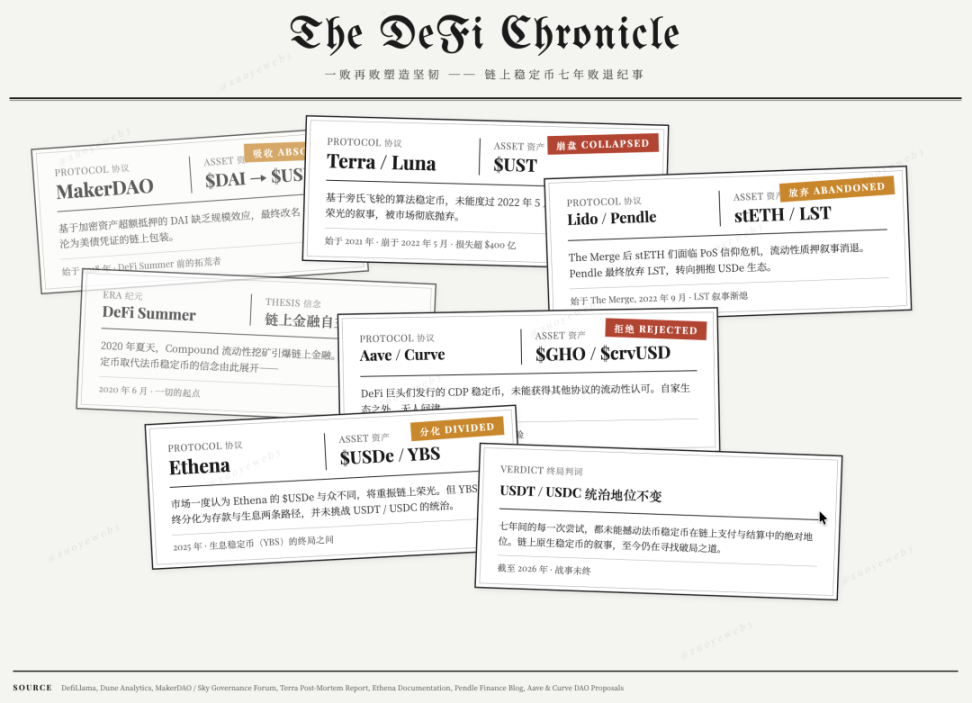
Image Caption: Stablecoin Chronicle

Image Source: @zuoyeweb3

Starting from the DeFi Summer of 2020, repeated defeats have forged resilience:

  • Starting in 2018, DAI based on crypto assets lacked scale, $USDS ultimately became a U.S. Treasury certificate

  • Starting in 2021, the ponzi-based $UST did not survive the 2022 bank run crisis; the story of rebuilding algorithmic stablecoin glory was abandoned

  • In 2022, stETH and others faced a PoS faith crisis post-The Merge; Pendle ultimately abandoned LST for USDe

  • In 2023/24, CDP stablecoins issued by DeFi giants like Aave/Curve were not recognized by other protocols

  • In 2025, the market once believed Ethena's $USDe was different, reviving on-chain glory, but yield-bearing stablecoins ultimately split into deposit and yield-bearing activities, failing to challenge the dominance of USDT/USDC in their respective domains.

The facts are very clear: it's not that USDT swallowed user profits, but that DeFi chose the scale effect of USDT/USDC.

Exchanging the Treasury profits generated by $300 billion for the entire market's trading foundation is not a bad deal for DeFi and the crypto market.

But at what cost?

The cost is not the evil claimed by yield-bearing stablecoin challengers that Tether takes profits, or the selfishness accused by Coinbase and Trump Jr. that banks prohibit interest-bearing accounts.

The bitter pill DeFi swallowed is that the U.S. Treasury rate, as the risk-free rate, is transmitted on-chain via stablecoins, but the U.S. Treasury is an asset of the U.S. government and its actions do not care about on-chain sentiments.

This is also the fundamental reason for the bankruptcy of tokenomics: UNI relies on A16Z, A16Z relies on USD financing, the USD is the embodiment of U.S. Treasuries, so UNI is just the fourth derivative relying on U.S. Treasuries. Why not just buy Treasuries directly, with no middleman taking a cut?

U.S. Treasuries are the de facto DeFi benchmark, but DeFi can only passively endure it, unable to interact with it bidirectionally. This is the root of all happiness or pain.
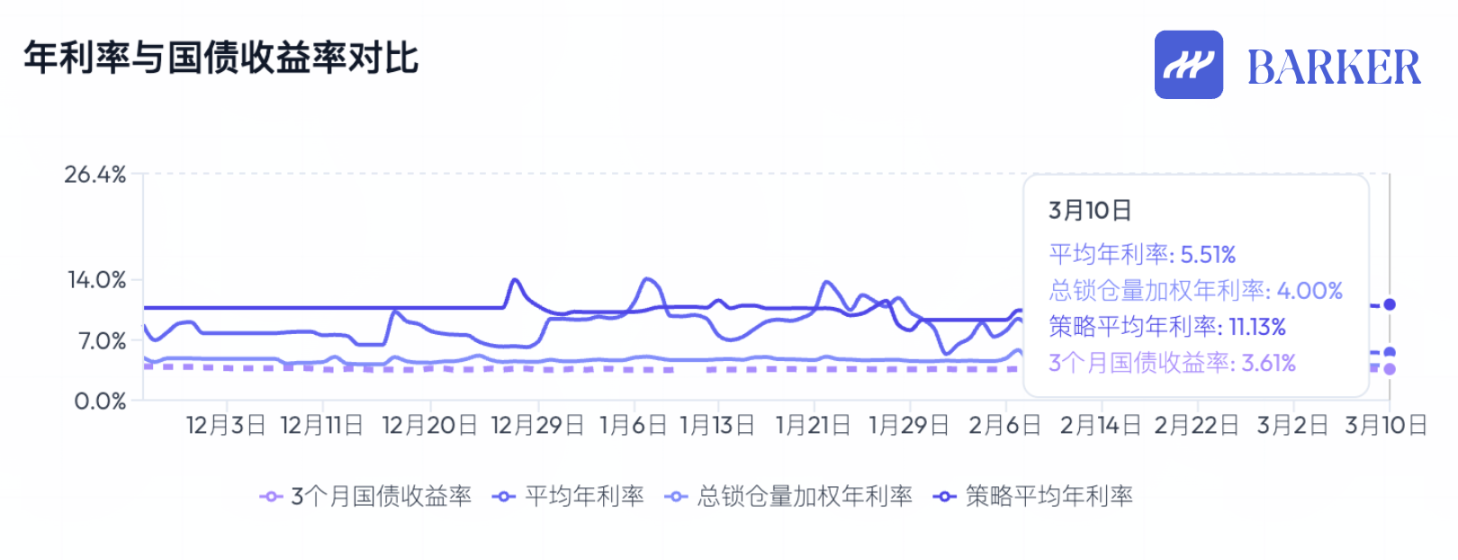
Image Caption: Comparison of On-Chain Stablecoin Yield APY and U.S. Treasuries

Image Source: @BarkerMoneyX

The salvation of DeFi never stops. Although tokenomics are bankrupt and DAO governance structures have collapsed, the overall direction of DeFi remains clear:

  1. Fixed-rate investment and financing,公认 risk grading system, unsecured credit lending –> The main themes of the next stage,蕴含某种形式的 mass-market products;

  2. The expansion period for public chains, exchanges, and DeFi protocols is over; new application forms are evolving into Vaults. It's not yet certain that Vaults are the form of mass-market products, but this is the starting point of the new stage.

Note here that public chains and exchanges are no longer the central links for value capture, but this does not mean their time is zero. Their period of asset price inflation is over, and only linear, steady growth remains.

This can also connect to the progressive relationship between UNI and U.S. Treasuries. Aave/Morpho are closer to asset management itself; their businesses don't have much narrative space, but are indispensable for the industry.

The real star products will definitely be Vaults used by the masses, based on public chains and DeFi protocols, utilizing分散 RWA assets, and triggering asset price inflation mechanisms.

For mass usage, Curators choose to ally with exchanges: Morpho enters Coinbase via Stakehouse, Aave expands to C-end users via Metamask and other U-cards.

Based on RWA assets, Curators partner with custodians like Galaxy to constantly maneuver between crypto and real-world assets, such as Grove buying Galaxy's CLO bonds.

But what's missing is the Vault that triggers the price inflation mechanism. Even before this wave of large-scale asset management moving on-chain, BlackRock's BUILD token was already live, and Circle's USYC also supports yield, but neither could replicate their own success.

It's not important that Vaults lack their own tokens. Asset price inflation is a mechanism. U.S. stocks, real estate, bonds, tulips, graphics cards, and Mac Minis all have their own price cycles. Current Vaults only have yield-bearing black boxes but始终 fail to solve two problems:

  1. Where does the high yield actually come from?

  2. How is high risk actually handled?

Towards a New Financial System

The form of channels is evolving; Vaults are not the endpoint.

The crypto industry evolves extremely fast. Before this year, we never dared to imagine that the global financial system would truly move on-chain, but today this is an undeniable ongoing process.

It's not yet time for a victory banquet. RWA can only serve as a funding source, Vaults are still boring deposit products, various Curators haven't demonstrated brand effects, and white-label Vaults like Veda are highly similar to SaaS, with the operator Curator only earning management fees.

This has no imagination for price inflation. If traditional asset management, with a scale of $2 trillion, endures cyclical煎熬, it's hard to imagine Vaults can withstand it.
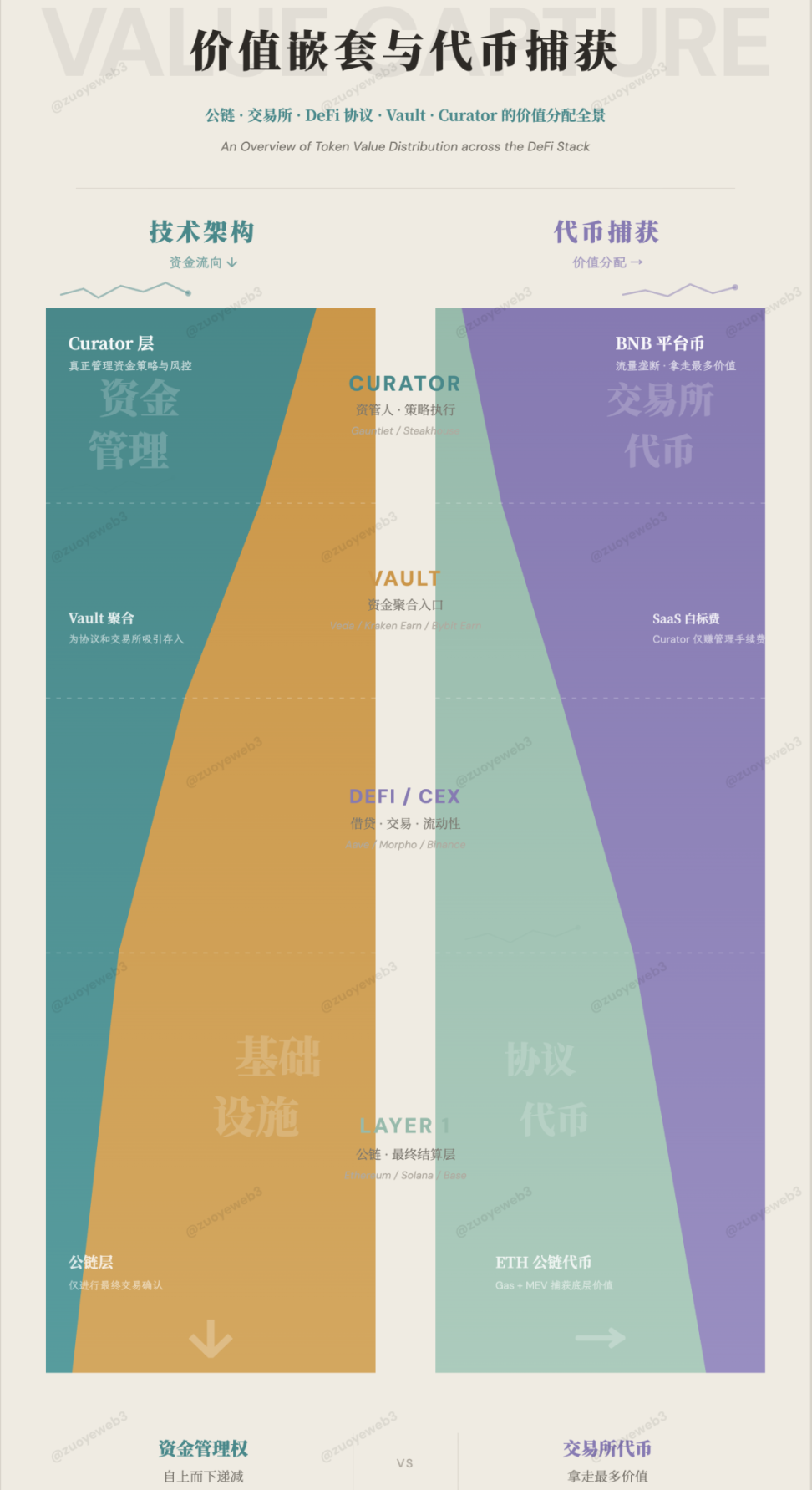
Image Caption: Fund Flows and Value Distribution

Image Source: @zuoyeweb3

Asset management moving on-chain is not driven by短暂 sentiment. In a sense, it's like the banking industry's IOE—you can't go back to the paper era. Even Spark has begun unifying the calculation of CEX/DEX position adjustment margins. DeFi is becoming the next step for TradFi.

Whether Vaults, after absorbing sufficient funds, will trigger the establishment of a risk-free rate is the biggest博弈 point of this cycle.

During the previous DeFi Summer, TVL was the decisive metric. The amount of资金 mapped to the get-rich coefficient of tokens, creating mining that continued into airdrop farming, studios, and Binance Alpha. The core logic was "projects need more funds to support token growth."

But with Vaults, for the first time, there is a huge demand for deposits but an inability to support their own tokens. Even if Morpho captures more market share from Aave, it cannot trigger a token surge.

Extending this, Hyperliquid compared to Binance, Lighter compared to Hyperliquid—their market sizes and token prices show a huge inversion. This is a great change unprecedented in DeFi.

On one hand, old infrastructure continues to吸血. For example, after the listing effect disappeared, $BNB should have declined, but CEXs still have a larger user base than the entire on-chain + DeFi. A very ironic fact: exchanges have retail users; DeFi protocols like Aave and Morpho have completely become the domain of a few professionals.

In this context, the high risk of Vault&Curator comes from code and structure:

  • Curve's immutable contract programming language can have problems; the xUSD team self-issued tokens

  • Aave ended the表面 harmony between the DAO and the development team; Re7 severely damaged on-chain asset management credibility

In this context, where does the high yield of Vault&Curator come from?

I know it's not regulatory arbitrage, HLP fees, or token incentives, but many still cling to these three, believing traditional finance's compliance creates too-big-to-fail credibility.

They completely forget that tokenomics are already bankrupt, while Vault deposits keep growing. Sky is already deeply integrated into the Morpho system, and the future of Aave V4 is also institutionalization and modularization.

Moreover, this article has always emphasized that the scale of Vault funds has not triggered some price inflation mechanism. This is the structural dilemma of Vaults.

The yield of Vaults essentially comes from the trading efficiency of global markets. If CEXs don't provide a certain Vault, then configure it on-chain. The personified Curator happens to be suitable for dealing with all sorts of people.

Even in TradFi's global markets, like U.S. stocks, one faces lengthy account opening, trading times, and process limitations. Can we really say that the gradual move towards全天候 trading for U.S. stocks and DTCC going on-chain is also for arbitrage?

The final question: What mechanism can actually trigger asset price inflation, allowing the funds沉淀 in Vaults to create a legendary price-to-dream ratio?

In other words, what is missing between Vaults and asset price inflation?

Channels are missing. Channels for funds to couple with each other. The personification of Curators hinders the programmability of DeFi Legos.

Currently, CEXs serve as a placeholder, still the fastest place for funds to intertwine.

Referencing the evolution of Perp DEXs, they are capturing market share from CEX futures. RWA funding sources are also抢夺 CEX market share.

CEXs only have存量. They themselves cannot solve user acquisition problems, let alone help Vaults expand to hundreds of millions of users. Vaults start by white-labeling, but in the future, they must build their own超级 factories.

I speculate the channel will be some form of Broker product.

Under高度 social division of labor, Super Apps like exchanges that integrate deposit/withdrawal, trading, custody, and清算 will gradually separate into different businesses. Binance's compliance framework in Abu Dhabi's ADGM is already divided into three parts.

This will fundamentally facilitate the professionalism of fund handling, utilize the unified ledger system of blockchain, and require the居中 coordination of Vault&Curator.

Referencing Neobrokers like Robinhood/Trade Republic, they attract年轻化, retail users to participate in professional trading, then build asset management, wealth management, and other business forms. The model of stablecoins at the front end and Curators managing Vaults is more efficient.

In summary, Binance monopolizes fund flow, BNB gets the strongest empowerment. Next, Brokers handle fund interaction. Some asset form, or even纯粹 business flow, could be highly profitable. After all, Robinhood is just a little disguise for a profitable market maker.

Conclusion

Compared to code and trading, regulation and tokens appear more stable.

Private credit and the RWA cycle have halted.抢先 issuing the 402 document feels prophetic. DeFi can serve as a liquidity exit channel, but it lacks the asset price inflation mechanism.

Asset Management ≈ Aave/Morpho will slowly, like public chains, end their historical mission. They will exist long-term but only with scale growth and stable token prices;

Vault&Curator ≈ Star fund managers are quickly acquiring customers and monopolizing markets. Giantization already shows preliminary signs. Whether they can continuously capture value is highly doubtful;

Channel ≈ CEX (temporary)反而 has the most innovation space. Facilitating the freedom of funds will always receive the highest reward.

A highly efficient global market is operating on a next-generation blockchain that doesn't need traditional tokens. This is the proposition of the next era, and everyone must provide an answer.


Twitter:https://twitter.com/BitpushNewsCN

Bitpush TG Discussion Group:https://t.me/BitPushCommunity

Bitpush TG Subscription: https://t.me/bitpush

Original Link:https://www.bitpush.news/articles/7618714

Preguntas relacionadas

QWhy does the article claim that DeFi has no risk-free rate, and what is the role of US Treasury bonds in this context?

AThe article states that DeFi lacks a true risk-free rate because it relies on USDT and USDC, which are backed by US Treasury bonds. These stablecoins transmit the US Treasury yield on-chain, but DeFi cannot interact with or influence US monetary policy, making it a passive recipient of this benchmark rate rather than an active participant in setting it.

QWhat is the significance of Vaults in the current evolution of DeFi and traditional finance integration?

AVaults represent a new application layer in DeFi, acting as on-chain asset management products that attract institutional and retail capital. They are seen as the starting point for mass adoption and value capture, but they currently lack a mechanism for asset price inflation and face challenges in generating sustainable yields and managing risks.

QHow does the article describe the relationship between CeFi (like CEXs) and DeFi in the context of global financial markets?

AThe article suggests that centralized exchanges (CEXs) currently serve as temporary channels for capital flow and liquidity, but their role may evolve as DeFi infrastructure matures. It predicts that super-apps like CEXs will eventually unbundle into specialized services (e.g., brokerage, custody), with DeFi Vaults and Curators facilitating more efficient global market operations.

QWhat are the main challenges facing Vaults and Curators in achieving sustainable growth and value capture?

AVaults and Curators struggle with two core issues: the source of high yields (beyond temporary incentives like token rewards or regulatory arbitrage) and the management of high risks (including smart contract vulnerabilities and governance failures). They also lack a price inflation mechanism to drive token value, unlike earlier DeFi protocols that benefited from TVL-driven speculation.

QWhat does the article propose as the potential solution to DeFi's structural limitations in establishing a independent financial system?

AThe article suggests that the future lies in creating efficient 'channels' or brokerage-like products that enhance capital fluidity and interoperability between TradFi and DeFi. This would involve unbundling CEX functions into specialized services, leveraging blockchain's unified ledger, and enabling Vaults to act as intermediaries for global asset allocation, ultimately fostering a new price discovery mechanism.

Lecturas Relacionadas

Trading

Spot
Futuros

Artículos destacados

Qué es G$

Entendiendo GoodDollar ($G$): Un Plano para Ingresos Básicos Universales Descentralizados Introducción En el panorama en constante evolución de las criptomonedas y la tecnología blockchain, las iniciativas que buscan abordar problemas sociales apremiantes han ganado una atención creciente. Uno de estos proyectos es GoodDollar ($G$), una solución de ingreso básico universal (UBI) basada en Web3. GoodDollar se esfuerza por abordar la desigualdad y cerrar la brecha de riqueza al crear y distribuir recursos económicos accesibles a aquellos que más los necesitan. A través de su innovador uso de las finanzas descentralizadas (DeFi), GoodDollar presenta un modelo único que podría reformar la forma en que se percibe y se entrega la asistencia financiera a nivel global. ¿Qué es GoodDollar ($G$)? GoodDollar es un protocolo de criptomonedas que facilita la emisión y distribución de tokens digitales, conocidos como $G$, a sus usuarios registrados a diario. Estos tokens funcionan como una forma de ingreso básico universal, promoviendo el empoderamiento financiero para individuos de diversos trasfondos, especialmente aquellos tradicionalmente excluidos del sistema financiero. Operando en la blockchain, GoodDollar utiliza múltiples cadenas, incluyendo Ethereum, Celo y Fuse, asegurando un acceso y una usabilidad amplios. El objetivo fundamental de GoodDollar es hacer que la criptomoneda sea accesible y beneficiosa para todos, independientemente de su punto de partida económico. El Creador de GoodDollar ($G$) Los detalles sobre el creador de GoodDollar permanecen algo oscuros. Sin embargo, se destaca notablemente que el proyecto cuenta con un fuerte respaldo de eToro, una plataforma de inversión ampliamente reconocida que proporcionó la financiación inicial y el apoyo fundamental para el desarrollo de GoodDollar. La visión detrás del proyecto no se basa únicamente en el lucro, sino que se inclina fuertemente hacia el emprendimiento social, buscando un cambio sistémico en la accesibilidad económica. Inversores de GoodDollar ($G$) GoodDollar disfruta del respaldo financiero y apoyo operativo de eToro. Esta asociación ha jugado un papel significativo en el lanzamiento del protocolo y sus desarrollos posteriores. Si bien eToro fue fundamental en el establecimiento de la base del proyecto, GoodDollar visualiza una transición hacia un modelo financiado por su comunidad a largo plazo. Este cambio hacia la financiación comunitaria está en línea con el compromiso de GoodDollar con la descentralización, permitiendo que sus usuarios tengan una participación directa en el futuro del proyecto. ¿Cómo Funciona GoodDollar ($G$)? El marco operativo de GoodDollar se basa en gran medida en los principios de DeFi para generar interés a partir de criptomonedas en staking. Este mecanismo permite al proyecto acuñar y distribuir tokens $G$ como un ingreso básico digital para usuarios en todo el mundo. Varios características clave contribuyen a la unicidad e innovación de GoodDollar: Ingreso Básico Universal (UBI): Cada día, los usuarios registrados reciben tokens gratuitos, estableciendo un flujo de ingresos automático destinado a aliviar las presiones financieras. Modelo Económico Sostenible: La tokenómica del proyecto busca equilibrar la oferta y la demanda de tokens $G$, asegurando que el valor permanezca estable a lo largo del tiempo. Tokens Respaladados por Reservas: Cada token $G$ está respaldado por una reserva de criptomonedas, proporcionándole un valor inherente y confiabilidad, un aspecto crucial para mantener la confianza de los usuarios. Gobernanza Descentralizada: GoodDollar incorpora un enfoque democrático para la toma de decisiones a través de una gobernanza descentralizada impulsada por tokens. Esto permite que los miembros de la comunidad participen activamente en la conformación de la trayectoria del proyecto, haciéndolo verdaderamente impulsado por la comunidad. Accesibilidad Global: GoodDollar ha establecido una considerable huella comunitaria, contando con más de 640,000 miembros en 181 países. Tal alcance generalizado es instrumental para facilitar UBI a escala global. Línea de Tiempo de GoodDollar ($G$) La evolución de GoodDollar está marcada por varios hitos significativos a lo largo de su historia: 2019: El lanzamiento de la billetera GoodDollar marcó el primer paso en la operacionalización de su visión de entregar UBI a través de criptomonedas. 2020: Tras el exitoso lanzamiento de la billetera, el protocolo GoodDollar se presentó oficialmente. Esto marcó una fase crucial en su misión de proporcionar ingresos distribuidos diariamente. 2021: El proyecto avanzó aún más con la introducción de su Organización Autónoma Descentralizada (DAO), fomentando un mayor nivel de participación y gobernanza comunitaria. 2022: GoodDollar presentó su versión 2 (V2) amigable con DeFi, esforzándose por una mayor participación del usuario y eficiencia operativa. El mismo año también se vio el cambio a una estructura de gobernanza descentralizada a través de GoodDAO. 2022: Se conceptualizó una nueva hoja de ruta, enfocándose en iniciativas como un programa de subvenciones diseñado para promover emprendimientos relacionados con $G$ y un Mercado GoodDollar mejorado. Características Clave de GoodDollar ($G$) El proyecto GoodDollar introduce numerosas características críticas destinadas a redefinir el panorama del ingreso básico: Ingreso Básico Universal: Entregar tokens gratuitos diarios a sus usuarios resalta fundamentalmente su misión de eliminar la precariedad económica. Operación Multi-Cadena: Aprovechar múltiples redes de blockchain mejora la accesibilidad y escalabilidad, asegurando una participación más amplia. Compromiso con las Finanzas Descentralizadas: El uso de DeFi permite la financiación sostenible del modelo UBI, reforzando su viabilidad como solución económica. Compromiso y Gobernanza Comunitaria: GoodDollar visualiza un modelo en el que la comunidad influencia las operaciones a través de la participación democrática, fomentando la transparencia y la rendición de cuentas. Comunidad Global: Contar con una comunidad global diversa permite al proyecto implementar soluciones UBI adaptadas a diversos contextos culturales y económicos. Conclusión GoodDollar representa un salto transformador hacia la incorporación de los principios de ingreso básico universal a través del innovador lente de la tecnología blockchain. Al aprovechar las finanzas descentralizadas, el proyecto no solo proporciona una solución a la desigualdad financiera sino que también involucra activamente a los usuarios en su gobernanza y operaciones. Con una comunidad en crecimiento y una hoja de ruta en evolución, GoodDollar se posiciona como un actor significativo en la intersección de las criptomonedas y el bien social, allanando el camino hacia un futuro financiero más equitativo. A medida que continúa evolucionando, el viaje de GoodDollar podría, en última instancia, inspirar otras iniciativas a considerar modelos similares, promoviendo así la causa del empoderamiento económico para todos.

112 Vistas totalesPublicado en 2024.04.05Actualizado en 2024.12.03

Qué es G$

Cómo comprar G

¡Bienvenido a HTX.com! Hemos hecho que comprar Gravity (G) sea simple y conveniente. Sigue nuestra guía paso a paso para iniciar tu viaje de criptos.Paso 1: crea tu cuenta HTXUtiliza tu correo electrónico o número de teléfono para registrarte y obtener una cuenta gratuita en HTX. Experimenta un proceso de registro sin complicaciones y desbloquea todas las funciones.Obtener mi cuentaPaso 2: ve a Comprar cripto y elige tu método de pagoTarjeta de crédito/débito: usa tu Visa o Mastercard para comprar Gravity (G) al instante.Saldo: utiliza fondos del saldo de tu cuenta HTX para tradear sin problemas.Terceros: hemos agregado métodos de pago populares como Google Pay y Apple Pay para mejorar la comodidad.P2P: tradear directamente con otros usuarios en HTX.Over-the-Counter (OTC): ofrecemos servicios personalizados y tipos de cambio competitivos para los traders.Paso 3: guarda tu Gravity (G)Después de comprar tu Gravity (G), guárdalo en tu cuenta HTX. Alternativamente, puedes enviarlo a otro lugar mediante transferencia blockchain o utilizarlo para tradear otras criptomonedas.Paso 4: tradear Gravity (G)Tradear fácilmente con Gravity (G) en HTX's mercado spot. Simplemente accede a tu cuenta, selecciona tu par de trading, ejecuta tus trades y monitorea en tiempo real. Ofrecemos una experiencia fácil de usar tanto para principiantes como para traders experimentados.

123 Vistas totalesPublicado en 2024.12.10Actualizado en 2025.03.21

Cómo comprar G

Qué es @G

Graphite Network, $@G: Conectando TradFi y Web3 Introducción a Graphite Network, $@G En el vibrante mundo de las criptomonedas y los proyectos web3, Graphite Network emerge como un faro de innovación. Con su token nativo, $@G, esta blockchain de Capa-1, Prueba de Autoridad (PoA) está diseñada para cerrar la brecha entre las finanzas tradicionales (TradFi) y el ecosistema Web3 en rápida evolución. A medida que las monedas digitales ganan tracción, Graphite Network se esfuerza por ofrecer una plataforma blockchain que prioriza la seguridad, el cumplimiento y la velocidad, presentándose como un facilitador de confianza y responsabilidad. ¿Qué es Graphite Network, $@G? Graphite Network no es simplemente otro proyecto de blockchain; busca redefinir cómo se perciben la descentralización, la seguridad y la responsabilidad del usuario en el ámbito de las finanzas digitales. El proyecto cuenta con una serie de características distintivas: Blockchain Basada en Reputación: En su núcleo, Graphite Network implementa una política de un usuario, una cuenta, reforzada con mecanismos integrados de Conozca a su Cliente (KYC) y verificación de puntuación. Este diseño asegura un equilibrio entre la privacidad del usuario y la transparencia, un aspecto crítico de las operaciones financieras en el mundo digital actual. Ingreso por Nodos de Punto de Entrada: La red incentiva a los usuarios a establecer nodos de punto de entrada, permitiendo a los operadores ganar recompensas de las transacciones de la red. Este modelo de generación de ingresos no solo aumenta el compromiso del usuario, sino que también refuerza la salud y descentralización de la red. Compatibilidad con EVM: Con una máquina virtual (VM) compatible con Ethereum, Graphite Network permite la integración fluida de aplicaciones descentralizadas (dApps) y contratos inteligentes existentes en Solidity, invitando a los desarrolladores a aprovechar sus capacidades sin modificaciones extensas. Integración de KYC: En una era donde el cumplimiento es primordial, el marco KYC integrado con múltiples niveles de verificación mejora el control sobre las operaciones financieras sin participación obligatoria, estableciendo un precedente para la autonomía del usuario. ¿Quién es el Creador de Graphite Network, $@G? Graphite Network nace de los esfuerzos de la Fundación Graphite, una organización sin fines de lucro dedicada al desarrollo, mantenimiento y evolución de Graphite Network. El compromiso de la fundación subraya la visión del proyecto de crear un entorno blockchain seguro y sostenible enfocado en un compromiso genuino del usuario y el cumplimiento. ¿Quiénes son los Inversores de Graphite Network, $@G? Actualmente, hay información limitada disponible sobre los inversores específicos que respaldan la iniciativa Graphite Network. La organización fundadora, la Fundación Graphite, funciona de manera independiente en la promoción del crecimiento del proyecto mientras busca asociaciones que resuenen con su visión de una plataforma blockchain accesible y en cumplimiento. ¿Cómo Funciona Graphite Network, $@G? La operación de Graphite Network se basa en su único mecanismo de consenso de Prueba de Autoridad, que logra un impresionante equilibrio entre un alto rendimiento y la descentralización. Vamos a profundizar en los diversos componentes que definen su operación: Nodos de Transporte: Sirviendo como nodos de punto de entrada, estos son críticos para el ecosistema. Los operadores pueden ganar ingresos de las transacciones que atraviesan la red, lo que no solo empodera a los usuarios individuales, sino que también refuerza la descentralización de la red. Nodos Autorizados: En el corazón de Graphite Network se encuentran los validadores centrales que se someten a rigurosas pruebas de cumplimiento, que abarcan una sólida verificación KYC junto con evaluaciones técnicas. Este nivel de confianza es esencial para garantizar que las transacciones dentro de la red mantengan un alto nivel de integridad. Sistema de Tickers: Graphite Network emplea un sistema de ticker distintivo para sus tokens envueltos, denotados como @G. Esta característica mejora la claridad en la integración de activos, haciendo que las transacciones de los usuarios sean comprensibles y directas. El enfoque innovador de Graphite Network refleja un paso significativo para abordar los problemas cruciales de las finanzas digitales, posicionándose favorablemente para el futuro a medida que más usuarios transicionan de las formas tradicionales de finanzas al mundo de las aplicaciones descentralizadas. Cronología de Graphite Network, $@G Para entender la progresión y los hitos de Graphite Network, es beneficioso revisar los eventos clave en su cronología: 2021: La creación de Graphite Network por la Fundación Graphite marca el inicio de un nuevo capítulo en el desarrollo de blockchain, centrado en el cumplimiento y el empoderamiento del usuario. Desarrollos Clave: Tras su lanzamiento, la introducción de ingresos por nodos de punto de entrada, el establecimiento de un modelo basado en reputación, la verificación KYC integrada y la provisión de compatibilidad con EVM representan avances significativos en el proyecto. Actividades Recientes: Los esfuerzos continuos de desarrollo y cuidado de la Fundación Graphite se han centrado en aumentar las características de la red mientras fomentan el crecimiento del ecosistema, demostrando un compromiso a largo plazo con la sostenibilidad y la innovación. Puntos Clave Adicionales Más allá de sus componentes fundamentales, Graphite Network abarca varias herramientas y características que refuerzan su usabilidad: Graphite Wallet: Una extensión de Chrome fácil de usar que facilita el acceso a diversas características y aplicaciones de la red a través de cadenas compatibles con Ethereum, mejorando la conveniencia del usuario. Graphite Bridge: Esta utilidad permite transferencias sin problemas de activos de Graphite a través de diferentes redes, fomentando un ecosistema integrado e interoperable. Graphite Explorer: Sirviendo como una herramienta esencial dentro del ecosistema, esta característica permite a los usuarios ver y verificar el código fuente de contratos inteligentes, rastrear transacciones y explorar otra información vital en tiempo real. Graphite Testnet: El proyecto proporciona un entorno de pruebas robusto para los desarrolladores, permitiéndoles asegurar la estabilidad y escalabilidad antes del despliegue en la red principal. Esta iniciativa no solo empodera a los desarrolladores, sino que también mejora la confiabilidad de toda la red. Conclusión Graphite Network, con su token nativo $@G, representa un avance significativo hacia la conexión entre las finanzas tradicionales y la tecnología blockchain de vanguardia. Al centrarse en la seguridad, el cumplimiento y la descentralización, esta plataforma innovadora está lista para liderar la transición hacia la era Web3. A medida que el compromiso del usuario crece y más proyectos aprovechan sus capacidades, Graphite Network está preparada para hacer contribuciones duraderas al paisaje digital en rápida evolución. En conclusión, Graphite Network se erige como un testimonio de lo que se puede lograr cuando el pensamiento innovador se encuentra con las crecientes demandas de las finanzas y la tecnología modernas. A medida que el mundo explora el potencial de las finanzas descentralizadas, Graphite Network sin duda seguirá siendo un jugador notable en este ámbito.

7 Vistas totalesPublicado en 2025.01.06Actualizado en 2025.01.06

Qué es @G

Discusiones

Bienvenido a la comunidad de HTX. Aquí puedes mantenerte informado sobre los últimos desarrollos de la plataforma y acceder a análisis profesionales del mercado. A continuación se presentan las opiniones de los usuarios sobre el precio de G (G).

活动图片














