When AI agents begin to approach or even replace human knowledge work, how should the price of computing power be repriced?
In a recent blog post, renowned tech podcaster Dwarkesh Patel puts forward a bold extrapolation: if AI lab revenues continue to grow rapidly (e.g., Anthropic reaching $1 trillion in annualized revenue by the end of next year), while compute supply increases only about 3x per year, then the price of computation could surge more than 10x.
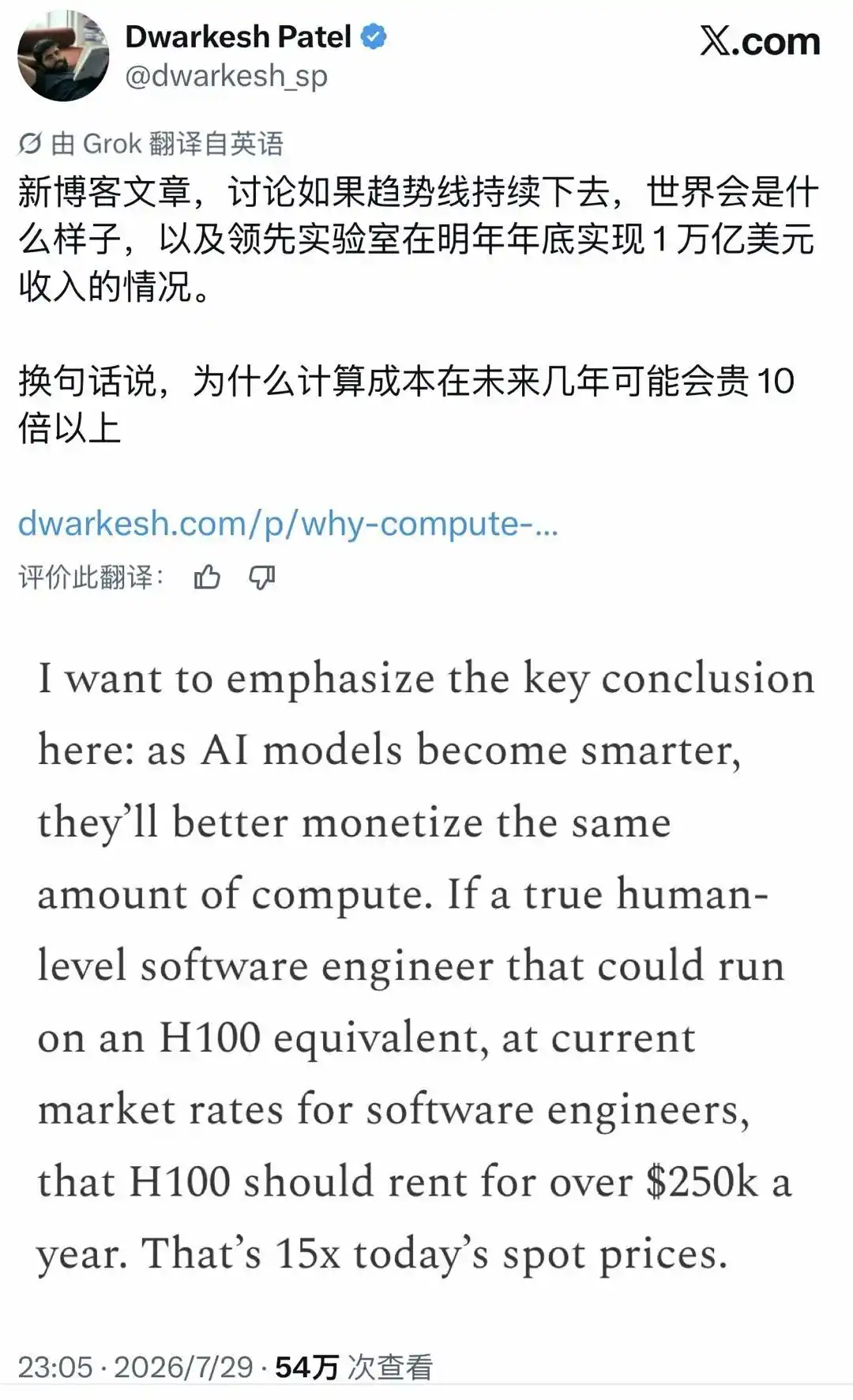
The Price of Silicon-Based Labor: H100 + AI = $250k Silicon Valley Programmer
For decades, computing power has been viewed as a "tool." Computers got faster, servers more numerous, and cloud computing cheaper.
But the AI era is undergoing a paradigm shift: GPUs are no longer just components of machines; they may become the carriers of digital labor.
If a single H100 can host an AI Agent approaching the level of a top-tier programmer, then its value should no longer be calculated based on the "server-hour price," but rather on the value of the human labor it replaces.
Imagine a "digital software engineer" that works tirelessly, responds instantly, and possesses technical skills at the human top tier—how much annual salary would you be willing to pay for it?
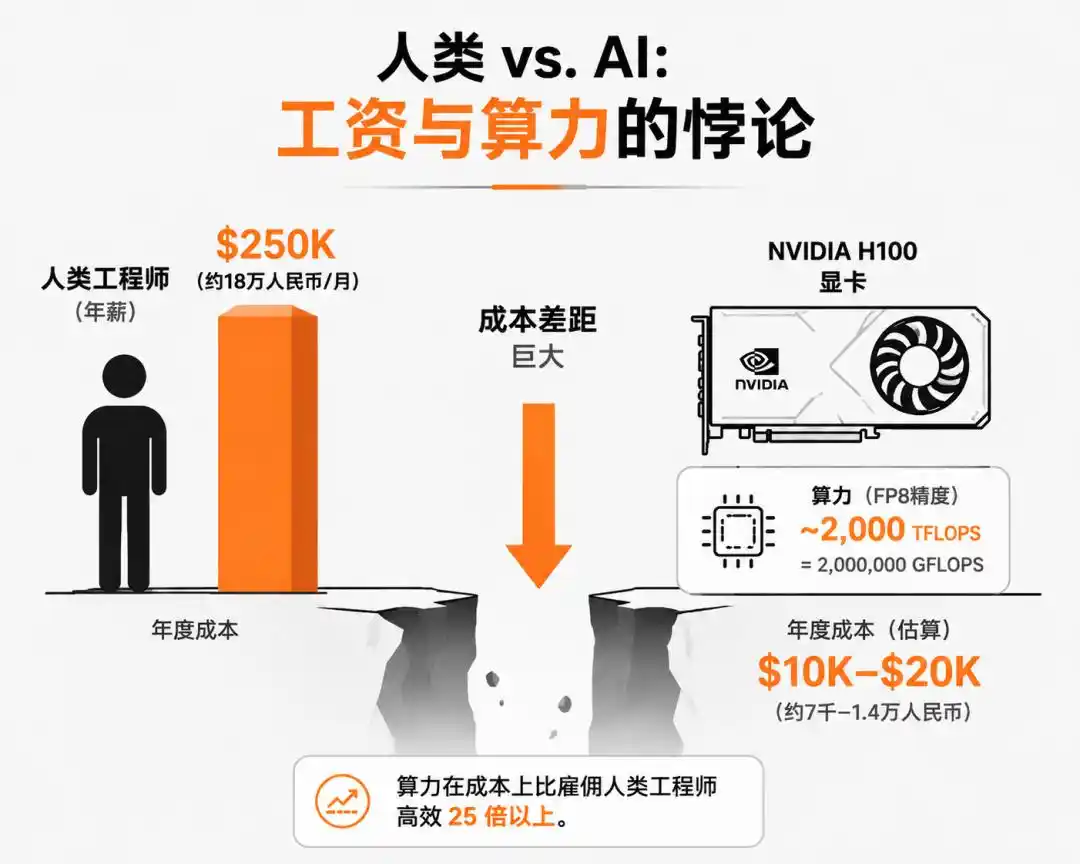
In Silicon Valley, the average market salary for a software engineer exceeds $250k. However, to host an intelligent agent (Agent) of equivalent intellectual capability might only require the computing power equivalent to a single NVIDIA H100 GPU.
Now, let's do the math:
If this H100 could perfectly replace a human programmer with a $250k annual salary, then from a pure business and economic logic standpoint, the theoretical annual rental price for this H100 should be set at $250k or above.
But at this very moment, the spot rental price for an H100 in the market, annualized, is only about $16,000. A difference of 15x.
This is what we are about to face: the largest "labor arbitrage black hole" in human history.
When the reproduction speed of intelligence in the virtual world far exceeds the manufacturing limits of the physical world, conflict erupts:
The growth rate of digital intelligence's value is far surpassing the expansion speed of physical computing infrastructure.
This 15x valuation gap will trigger a fierce backlash: in the coming years, the real price of computing power could face a super-inflation of 10x or higher.
Naturally, a question arises: will software engineer salaries plummet drastically in the future?
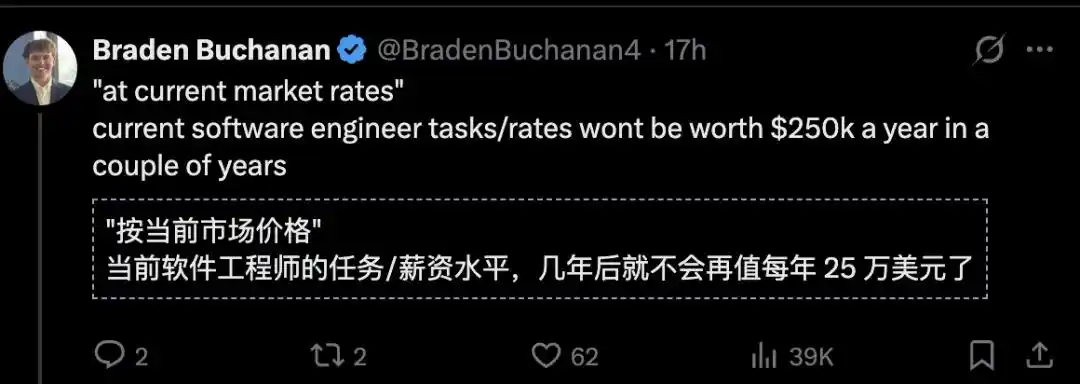
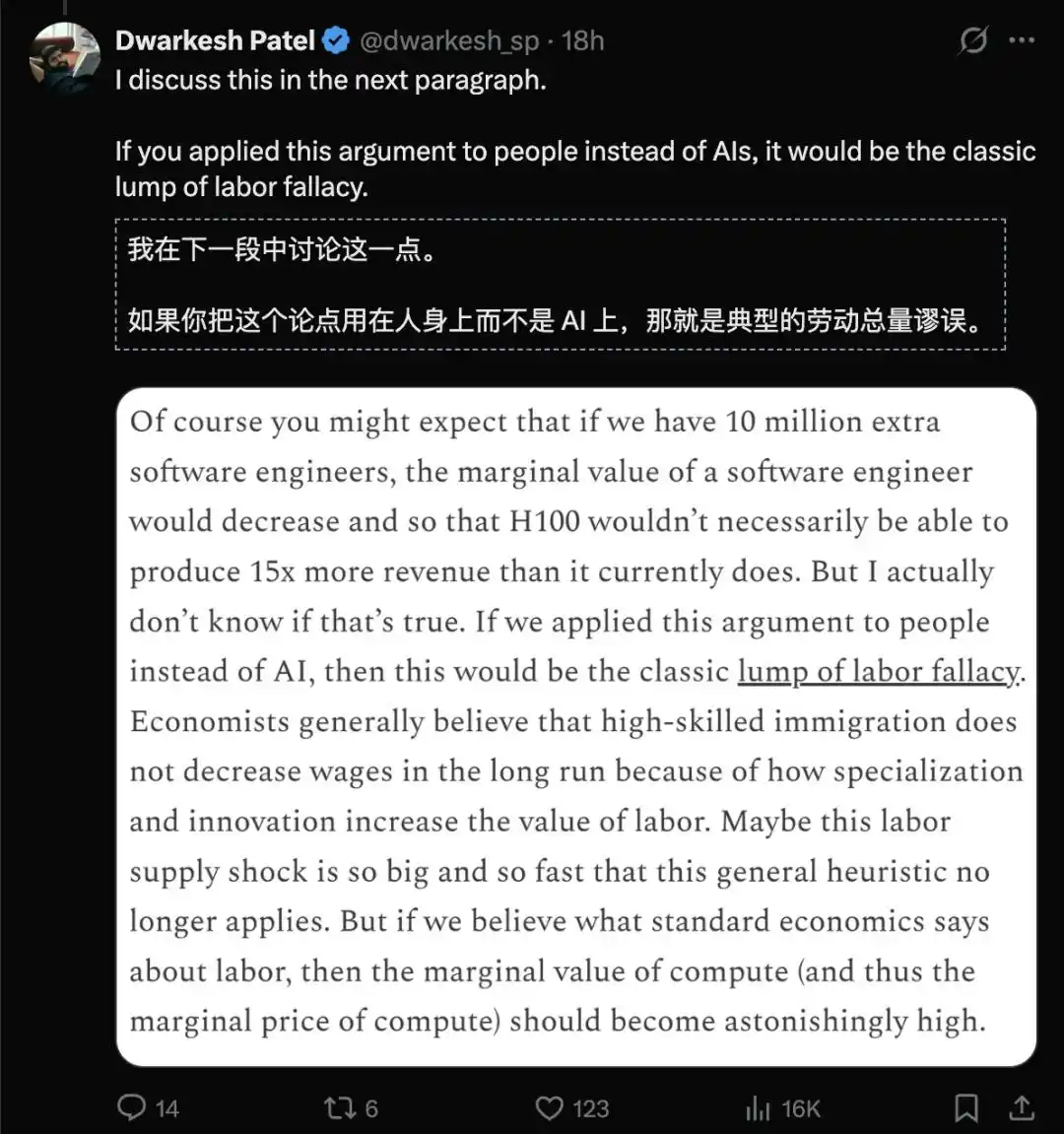
Dwarkesh Patel has also considered this issue:
But if we believe standard economic theory about labor, then the marginal value of compute (and hence the marginal price of compute) should become extremely high.
AI's Money-Making Speed Has Already Surpassed the Speed of Making AI
For the past few years, the AI industry has followed a simple logic: larger models, more data, more GPUs, stronger capabilities.
But now, a new contradiction is emerging: AI's growth speed is exceeding the growth speed of compute supply.
Take Anthropic as an example. Over the past year, its commercial revenue has grown about 10x.
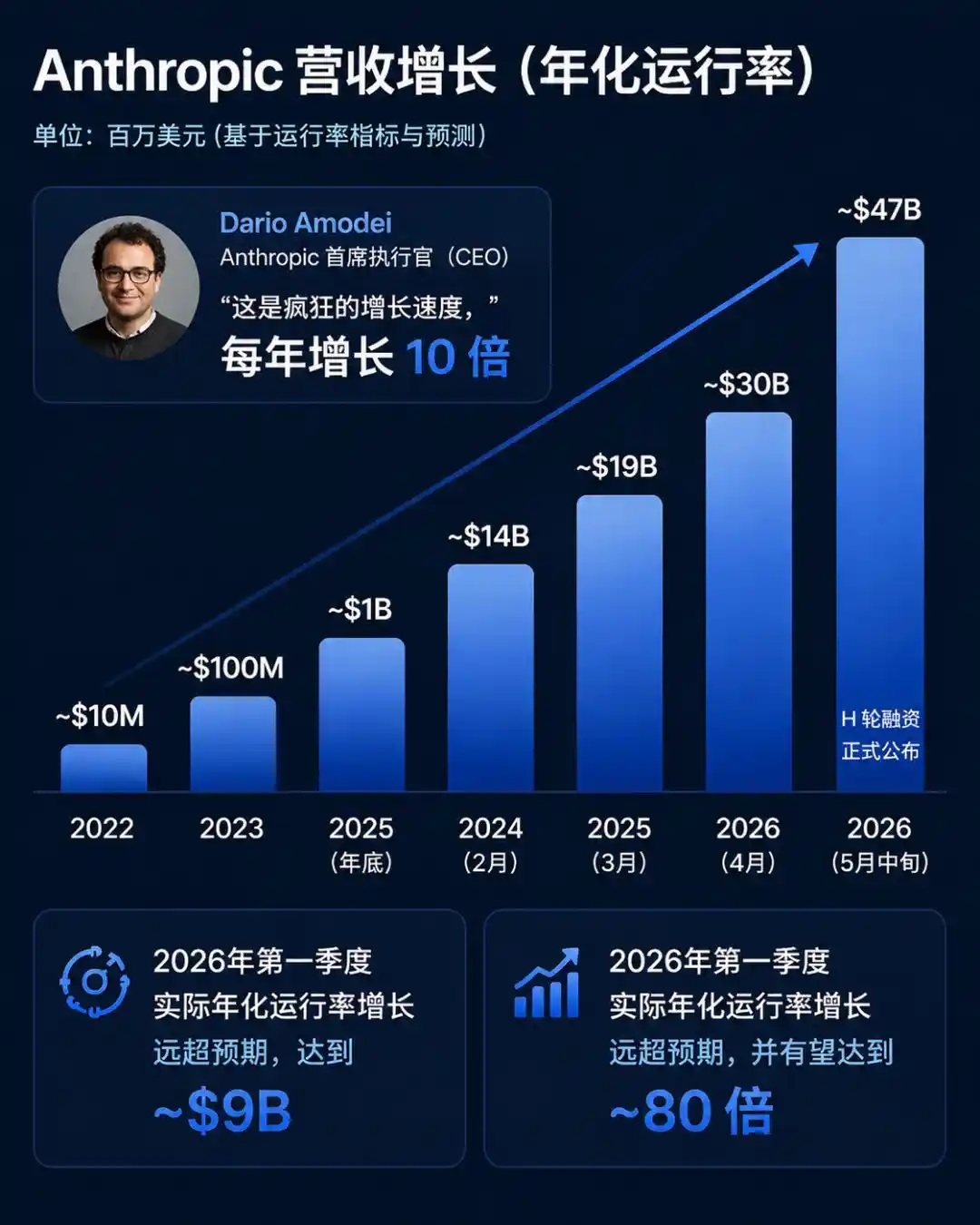
At this growth rate, by year-end its annualized revenue could reach the scale of $100-$150 billion. If this trend continues, next year it will face a crazy question: how to support a trillion-dollar "money-making prospect"?
The answer is only one: more intelligence. And more intelligence means: more training, more inference, more GPUs.
However, the problem is: compute supply is not growing at the same speed.
The physical compute expansion of leading industry labs can only sustain about 3x growth per year.
Thus, a massive misalignment appears:
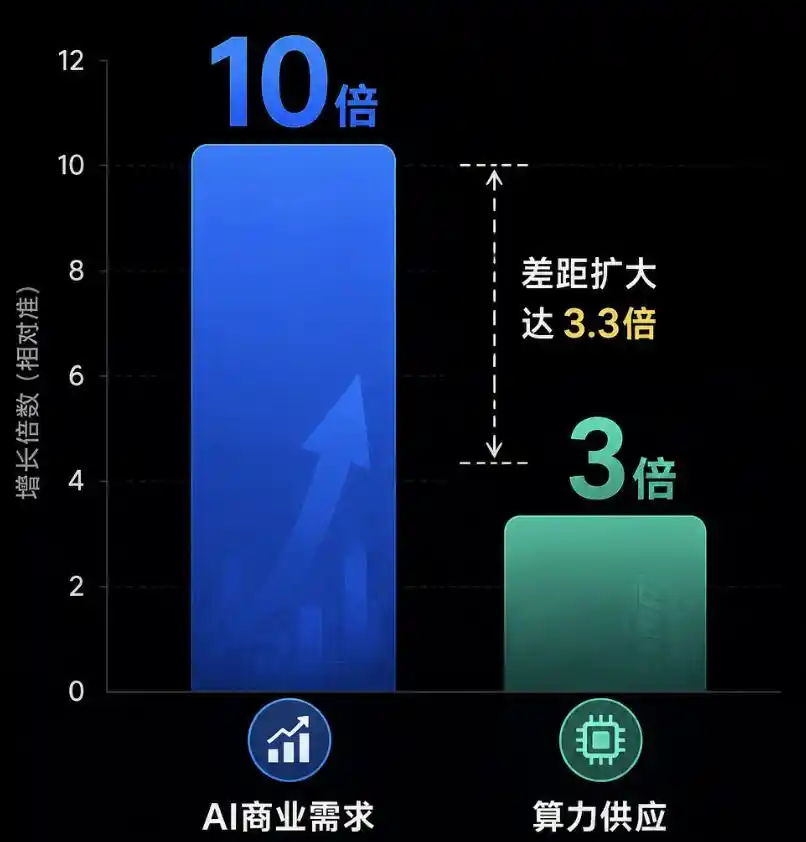
The digital world wants to run 10 kilometers, but the physical world can only provide 3 kilometers of road. What about the remaining distance?
There are only three choices: First, raise profit margins. Second, raise compute prices. Third, invest more compute into inference business.
The third path is actually what many AI labs are most reluctant to see.
Because making money from inference is essentially just to prove: "The AI business model works."
Then continue fundraising, continue buying more GPUs, continue training the next generation of models.
The true Silicon Valley cycle is:

Making money is not the end goal; it's just to buy more computing power.
Because what all labs truly believe is: today's most advanced model might be like yesterday's phone in a year—powerful, but obsolete.
This forces the solution back to the first two options: a surge in profit margins, or a climb in unit compute prices.
If relying entirely on profit margins to absorb this gap, by the end of next year, frontier labs' profit margins would have to reach the high 95% range.
In business history, aside from a few rare moments of absolute technological monopoly, this is almost fantasy.
Thus, all clues and logic ultimately converge on the same exit: the unit price of compute is about to experience an unprecedented surge.
GPUs Are Transforming from Servers into the Factories of the New Era
Many people haven't yet realized: AI competition is entering the infrastructure era.
Past internet wars fought over: users, traffic, portals. The AI era fights over: electricity, chips, data centers, supercomputing clusters.
Why? Because top AI labs cannot rely on ordinary cloud servers.
They need: dedicated GPU clusters; stable network architecture; extremely high utilization rates; data and model security.
This is no longer renting ordinary servers; this is leasing future intelligent production lines.
A typical case: Google and Anthropic leasing large-scale GPU resources from SpaceX.
Reportedly, Google's roughly 110,000 GPU cluster commands a monthly rent of $900 million.
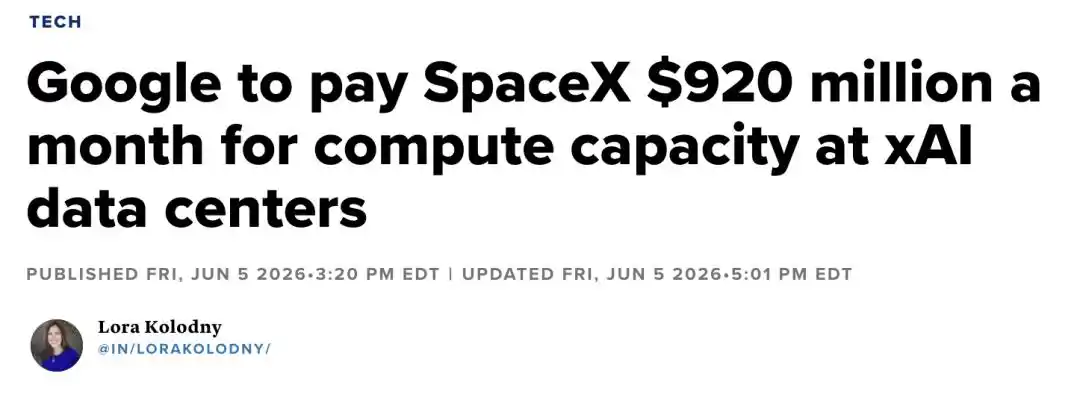
This translates to an hourly rental price per GPU that is almost twice the current spot rental unit price on the market. And don't forget, the current spot price itself is already 40% higher than the low point earlier this year.
Why?
Because top-tier computing power is increasingly resembling strategic resources like energy and power grids.
Imagine the Industrial Revolution: one factory has a steam engine, another doesn't.
Their gap isn't 10%, but a generational difference in the entire production method.
The GPU of the AI era is also becoming this new "steam engine."
Why would compute prices spiral out of control to this extent?
The answer lies in the physical formula on the supply side—this formula is firmly locked by the physical limits of TSMC and lithography machine giants.
The much-discussed industry myth of "compute growing 3x per year," when broken down, is merely a precarious combination of three multipliers at their limits:
Compute Annual Growth Rate (3x) ≈ 1.4x (Moore's Law iteration) × 1.2x (new wafer fab construction) × 1.8x (grabbing advanced node capacity).
And each of these three multipliers is approaching its ceiling.
Moore's Law: Each step of miniaturization is harder than the last; leakage and atomic limits make iteration precarious.
New wafer fab construction cycles are long; high-NA EUV lithography machine delivery bottlenecks hold up the entire chain, unsolvable until at least 2030.
Over the past two years, the only engine for compute growth has been grabbing capacity—AI chips snatching TSMC's advanced node capacity from smartphones and PCs.
But this last multiplier is about to drop to zero. By the end of 2027, AI chips will consume 86% of TSMC's N3 capacity, up from 60%—not growth, but absolute physical saturation, with no room left.
Three multipliers: two are already at their peak, the last is about to hit a wall. The story of compute supply is already over.
The more expensive compute gets, the less anyone dares to use cheap models.
Intuition says: if compute is expensive, one should use lightweight models, open-source trimmed versions, and spend frugally.
But AI economics works exactly the opposite.
The core logic is the Alchian-Allen effect: When a fixed additional cost is added to all goods, the expensive ones appear more cost-effective.
In AI, this "additional cost" is the compute depreciation cost—you have to pay it regardless of the model you use.
Do the math: H100 at $20 per hour.
- Top model: Gets the job done in 1 hour, $25 ($20 compute + $5 premium).
- Mediocre model: License fee $0, but not smart enough; trial and error drags on for 2 hours, $40.
Conclusion: Using a mediocre model is actually more expensive. It burns through compute and, more precious, time in ineffective attempts.
Therefore, the more expensive compute is, the more justification top models have to charge sky-high premiums. Since you have to pay the compute cost anyway, spending a bit more to use the smartest model is truly saving money.
Mediocre models have no path to survival.
Ultimately, society's capital will be sucked like a black hole towards the handful of trillion-dollar oligopolies capable of creating the absolute strongest models.
Compute Is Also a Resource; It Might Not Increase in Price?
Of course, there are dissenters.
In the comments, Eric Xu raised an interesting counterpoint: the $250k annual rental logic only holds in purely digital domains. Once it touches the physical world, such as the approval cycle for clinical trials or the decision-making process of government procurement, AI's monetization ceiling may not even reach $250k, being closer to $50k.
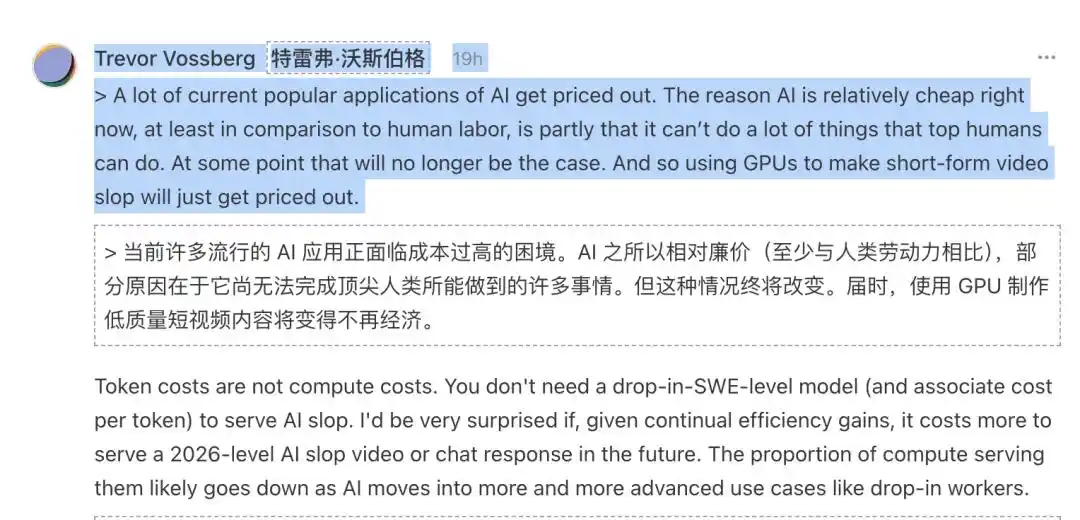
Senior software engineer Trevor points out: Low-quality content doesn't need top-tier models; they will shift to cheaper alternatives, not simply disappear. In other words, what gets squeezed may be the price, not the content itself.
History also isn't on Dwarkesh's side. In 1980, Stanford biologist Paul Ehrlich and economist Julian Simon bet on whether five metals would be more expensive in ten years.

Ten years later, all five had fallen in price, and Ehrlich lost and paid up. "Resources must become more expensive"—historically, most who bet this way lost.
Dwarkesh's response is: The elasticity of compute supply is far less than that of commodities. Copper mines can increase production when prices are high, but EUV lithography machines cannot—TSMC itself has no spare capacity to release. In these years where supply only grows 3x annually, there are no substitutes.
Interestingly, Dwarkesh himself admits: historical analogs to this prediction have almost all been wrong.

Perhaps compute will one day become as cheap as sand, but before that day arrives, we will have to endure the most brutal compute arms race and compute inflation.
References:
https://www.dwarkesh.com/p/why-compute-might-get-10x-more-expensive
https://x.com/dwarkesh_sp/status/2082482530209411419
This article is from the WeChat public account "新智元" (Xinzhiyuan), author: ASI启示录; editor: David