The AI Agent Era Accelerates Its Arrival: Questflow Defines a New Paradigm of Financial Intelligence with On-Chain AI Brokerage

链捕手Publicado a 2026-05-11Actualizado a 2026-05-11

Resumen

The AI Agent era is accelerating, with the CB Insights AI 100 list highlighting global investment confidence. The focus has shifted from whether AI works to its speed of deployment and ability to manage complex workflows, with autonomous AI Agents driving this transformation. At the forefront is Questflow, a Singapore-based startup redefining financial intelligence through its on-chain AI brokerage. Unlike tools that merely provide data dashboards, Questflow deploys AI Agents that proactively scan markets, form judgments, and execute trades via a conversational interface—operating 24/7 without requiring manual confirmation for each decision. This embodies the new AI paradigm of agents capable of executing multi-step workflows autonomously. Questflow's mission is to democratize institutional-grade trading intelligence. Historically reserved for the ultra-wealthy, this capability is now accessible starting from just $1 through Questflow's "AI Clone + Copy Trade" model. The platform charges only a 1% execution fee, aligning its incentives directly with users and eliminating traditional management or performance fees. The timing is opportune, aligning with key trends identified by CB Insights: the scalable deployment of AI Agents, accelerated AI adoption in financial services, and the maturation of on-chain infrastructure. With robust liquidity on platforms like Hyperliquid and Polymarket, alongside advancements in AI reasoning and non-custodial wallet security, Questflow is p...

CB Insights, a globally influential technology market intelligence firm, has released its tenth annual AI 100 list, selecting the world's 100 most promising AI startups in 2026. The list covers the full spectrum of AI innovation from infrastructure to industry-specific vertical applications. The selected companies have collectively raised over $10.9 billion, with more than $2 billion raised in 2026 alone, strongly validating global capital's confidence in the AI Agent sector.

CB Insights noted that the core theme this year has shifted from "Can AI work?" to "How quickly can AI be deployed, governed, and scaled into complex workflows." Among these trends, AI Agents capable of autonomously executing multi-step tasks in production environments are emerging as the core driving force behind the new wave of industrial transformation.
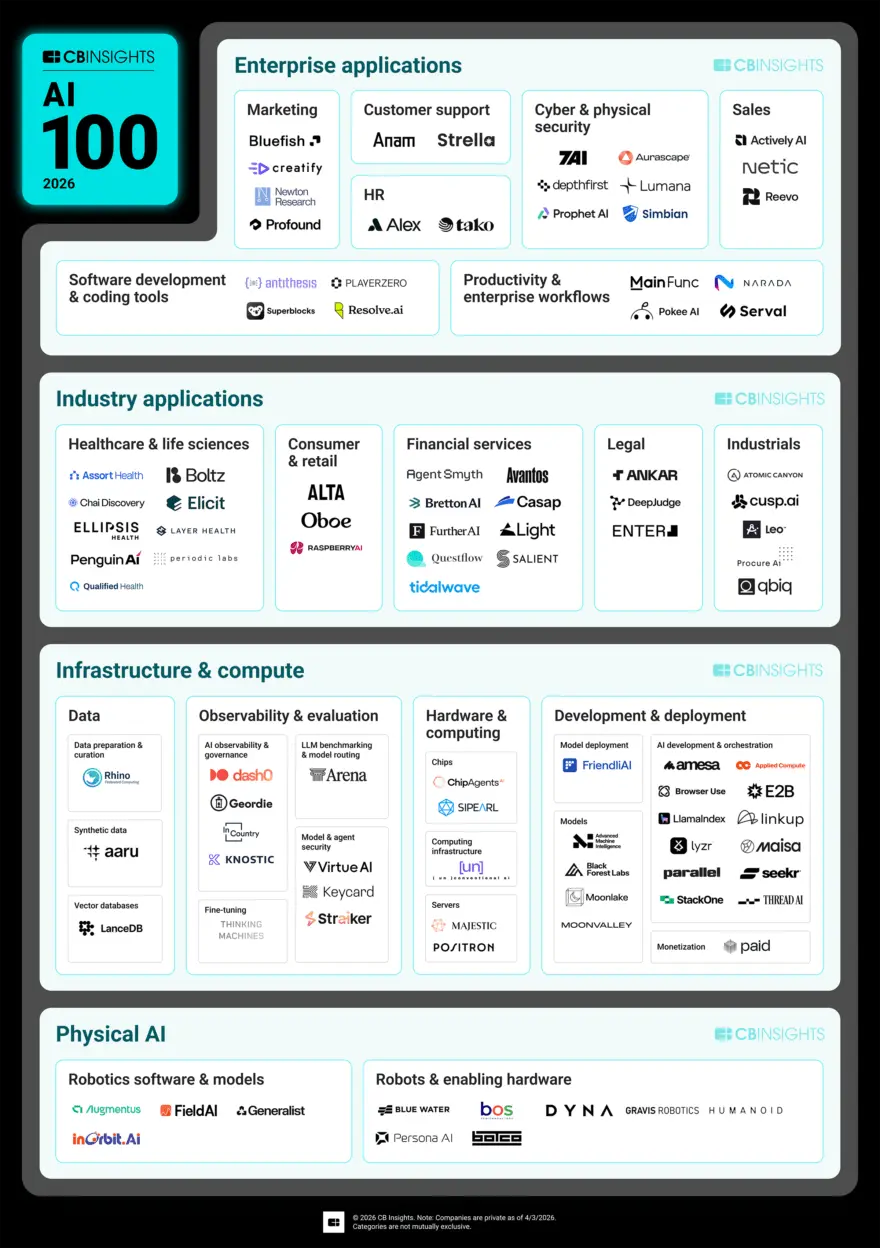
As a deep participant in this wave, Questflow—a Singapore-headquartered startup focused on on-chain AI brokerage—is at the forefront of this transformation with its unique product architecture and business model.

Not Just a Tool, But an AI That Trades For You

While most AI financial tools are still in the "data dashboard" phase, Questflow has already advanced AI Agents to the level of autonomous trading entities. Users don't need to actively search for opportunities; the AI Agents on the platform proactively scan the market, form judgments, and execute trades directly through a conversational interface, operating 24/7 without requiring manual intervention for every decision.

This is precisely the new AI paradigm defined by CB Insights' latest list: Agents capable of independently executing multi-step workflows without requiring step-by-step human confirmation represent the true deployment of AI in production environments. The operation of Questflow's AI Clone simultaneously on the Polymarket prediction market and the Hyperliquid perpetual contract market is the most direct application of this paradigm in the financial field.

Democratizing Financial Intelligence, Breaking Down Wealth Barriers

Questflow's core proposition is concise and powerful: Robinhood got everyone a seat at the table; Questflow gives everyone a brain.

In the past, institutional-grade trading intelligence was a privilege exclusive to wealth—family offices serve clients with over $30 million, private banks even more so, leaving ordinary retail investors to rely on luck. Through its AI Clone + Copy Trade product architecture, Questflow lowers the entry barrier for such capabilities to as little as $1, while maintaining a structure with zero management fees and zero performance fees. Revenue comes from a 1% trade execution fee, aligning interests highly with users and eliminating conflicts.

The Timing Is Right

The three key industry signals emphasized by CB Insights in this year's list—the large-scale deployment of AI Agents, accelerated AI penetration in financial services, and the maturation of on-chain infrastructure—closely align with Questflow's strategic assessment: sufficient on-chain asset liquidity (Hyperliquid monthly trading volume exceeds $30 billion, Polymarket monthly trading volume exceeds $1 billion), enhanced AI reasoning capabilities, and improved security of non-custodial wallet infrastructure. These three forces are converging simultaneously, opening a window of opportunity.

"When millions of people can operate their own quantitative funds, brokers, funds, and exchanges will merge into a single platform," stated the Questflow team. "That's what we are building."


Preguntas relacionadas

QAccording to the article, what is the key theme shift noted by CB Insights regarding AI development in 2026?

AThe core theme has shifted from 'whether AI works' to 'how fast AI can be deployed, governed, and scaled into complex workflows.'

QWhat specific role does Questflow's AI Agent play in the financial markets, distinguishing it from other AI financial tools?

AQuestflow's AI Agent acts as an autonomous trading entity. It proactively scans markets, forms judgments, and directly executes trades through a conversational interface, 24/7 without requiring human intervention for every decision.

QHow does Questflow aim to 'democratize financial intelligence' according to its core proposition?

AIts proposition is: 'Robinhood put everyone at the table, Questflow gives everyone a brain.' It lowers the access barrier to institutional-grade trading intelligence to as low as $1, using an AI Clone + Copy Trade model with zero management fees, aligning its revenue (1% execution fee) with user success.

QWhat are the three converging forces that create a timely opportunity for Questflow's business, as mentioned in the article?

AThe three converging forces are: 1) Sufficient on-chain asset liquidity (e.g., Hyperliquid's monthly volume exceeding $30B), 2) Enhanced AI reasoning capabilities, and 3) Improved security of non-custodial wallet infrastructure.

QWhat is Questflow's ultimate vision for the future structure of financial services, as stated by its team?

AThe team envisions a future where 'brokers, funds, and exchanges merge into a single platform' when millions of people can operate their own quantitative funds.

Lecturas Relacionadas

"Water Scarcity": The Hidden Fatal Flaw of AI Infrastructure

“Water Scarcity: The Hidden Vulnerability of AI Infrastructure” In June 2026, SpaceX revised its IPO prospectus to highlight a core resource constraint alongside power and processors: water. This move signals a pivotal shift where water scarcity has transformed from an operational cost to a major, uncontrollable investment risk, directly threatening AI data center expansion. The scale of the problem is immense. U.S. data centers consumed an estimated 17 billion gallons of water for direct cooling in 2023, with indirect water use for power generation exceeding 211 billion gallons. Giants like Google alone use billions of gallons annually, with single sites consuming volumes equivalent to a medium-sized city. This water is largely “consumptive,” evaporated into the atmosphere and lost. This massive demand is colliding with scarcity. Tech companies are building “water tigers” in arid regions, sparking community protests in places like Mexico and Arizona, where data centers can legally use millions of gallons daily—enough for tens of thousands of residents. These conflicts are not about illegality, but about a mismatch between historic water allocation frameworks and new, colossal demand. The consequences are real. Community opposition, largely centered on water, has reportedly stalled or canceled $64 billion in U.S. data center projects over two years. Simultaneously, investors are pressuring companies for greater water footprint transparency, viewing it as a financial risk, not just an ESG metric. Technological solutions like air or liquid cooling involve trade-offs between water and electricity use, with final choices dictated by local constraints. The irony is stark: while industry leaders envision AI as a utility “like water,” its physical infrastructure is straining real-world water supplies. The race for AI supremacy may ultimately be governed not by the fastest chip, but by the slowest water meter.

marsbitHace 23 min(s)

"Water Scarcity": The Hidden Fatal Flaw of AI Infrastructure

marsbitHace 23 min(s)

Global Card Issuance Enters a Compliance-Driven Era: WasabiCard is Building the Next-Generation Payment Infrastructure

Global card issuance is entering a compliance-driven era, with WasabiCard building next-generation payment infrastructure. The platform asserts that as stablecoins increasingly enter cross-border payments, corporate settlements, and global commerce, the industry is shifting focus from "availability" and "growth-driven" models to long-term, compliant operation under global frameworks. Competition will center on sustainable compliance and global infrastructure capabilities. Stablecoins are evolving from on-chain assets into key payment tools in global business, with card issuance acting as critical infrastructure connecting digital assets to traditional payment networks like Visa and Mastercard. This expansion has revealed structural issues, including cross-regional issuance, BIN resource management, and insufficient AML and risk controls. In response, the industry is moving away from reliance on "grey efficiency" towards prioritizing compliance, risk management, and long-term operational stability. WasabiCard outlines its strategy: collaborating with licensed principals and local partners for localized operations, building robust KYC/AML systems, strictly separating commercial and consumer BIN usage, and enhancing global issuance, payment, and cross-border fund flow infrastructure. The goal is to build stable, scalable payment infrastructure amid evolving global regulations, shifting industry competition from scale to infrastructure capability. As stablecoins integrate further with global commerce, payment infrastructure will become a fundamental, embedded component of internet business. WasabiCard will continue to develop capabilities in global card issuance, stablecoin payments, cross-border fund flows, and API-driven financial workflows.

marsbitHace 34 min(s)

Global Card Issuance Enters a Compliance-Driven Era: WasabiCard is Building the Next-Generation Payment Infrastructure

marsbitHace 34 min(s)

Zhou Hang: How Much Is SpaceX Really Worth?

**Zhou Hang: How Much is SpaceX Really Worth?** SpaceX, arguably one of the greatest industrial companies of the past 50 years, is reportedly targeting a staggering $1.75 trillion valuation in its potential IPO. However, the author argues this figure is inflated by approximately $1.25 trillion when assessed through standard financial metrics. The analysis begins by acknowledging SpaceX's undeniable success: drastically reducing launch costs, achieving near-monopoly in commercial launches, and building the strategic Starlink network. Its achievement surpasses even Tesla's, given it disrupted a state-monopolized industry. Despite this greatness, a $1.75 trillion valuation places SpaceX above the combined market cap of Boeing, Lockheed Martin, Northrop Grumman, RTX, and General Dynamics. Projecting optimistic 2030 revenues of $50-80 billion and applying generous tech-sector multiples yields a "reasonable" valuation range of $500 billion to $1.2 trillion. The $1.25 trillion gap is attributed to three non-financial premiums: 1. **Long-term vision premium** for future Starship-enabled markets (e.g., space-based computing). 2. **Sovereign asset/strategic premium**, as SpaceX is deeply integrated into U.S. national security. 3. **Retail narrative/Musk cult premium**, driven by a heroic story and personal following. Post-IPO, three scenarios are outlined: valuation solidifying (25% probability), sideways volatility as narrative outpaces reality (50%), or a re-rating down to $800B-$1.2T if execution falters or Musk-related risks emerge (25%). The probability-weighted expected value is $1.3-1.5 trillion, suggesting negative expected returns for those buying at the IPO price. The conclusion advises investors to separate the company's excellence from its stock price. Buying at the IPO likely prices in excessive optimism. A more prudent strategy would be to wait for key milestones (e.g., Starship V3 stability) or a significant price correction before investing, or to treat an early purchase as a long-term, high-conviction hold with limited position size, not a short-term bet.

链捕手Hace 38 min(s)

Zhou Hang: How Much Is SpaceX Really Worth?

链捕手Hace 38 min(s)

Trading

Spot
Futuros

Artículos destacados

Cómo comprar ERA

¡Bienvenido a HTX.com! Hemos hecho que comprar Caldera (ERA) sea simple y conveniente. Sigue nuestra guía paso a paso para iniciar tu viaje de criptos.Paso 1: crea tu cuenta HTXUtiliza tu correo electrónico o número de teléfono para registrarte y obtener una cuenta gratuita en HTX. Experimenta un proceso de registro sin complicaciones y desbloquea todas las funciones.Obtener mi cuentaPaso 2: ve a Comprar cripto y elige tu método de pagoTarjeta de crédito/débito: usa tu Visa o Mastercard para comprar Caldera (ERA) al instante.Saldo: utiliza fondos del saldo de tu cuenta HTX para tradear sin problemas.Terceros: hemos agregado métodos de pago populares como Google Pay y Apple Pay para mejorar la comodidad.P2P: tradear directamente con otros usuarios en HTX.Over-the-Counter (OTC): ofrecemos servicios personalizados y tipos de cambio competitivos para los traders.Paso 3: guarda tu Caldera (ERA)Después de comprar tu Caldera (ERA), guárdalo en tu cuenta HTX. Alternativamente, puedes enviarlo a otro lugar mediante transferencia blockchain o utilizarlo para tradear otras criptomonedas.Paso 4: tradear Caldera (ERA)Tradear fácilmente con Caldera (ERA) en HTX's mercado spot. Simplemente accede a tu cuenta, selecciona tu par de trading, ejecuta tus trades y monitorea en tiempo real. Ofrecemos una experiencia fácil de usar tanto para principiantes como para traders experimentados.

369 Vistas totalesPublicado en 2025.07.17Actualizado en 2026.06.02

Cómo comprar ERA

Discusiones

Bienvenido a la comunidad de HTX. Aquí puedes mantenerte informado sobre los últimos desarrollos de la plataforma y acceder a análisis profesionales del mercado. A continuación se presentan las opiniones de los usuarios sobre el precio de ERA (ERA).

活动图片












