The Advancing MM 3: Statistical Edge and Signal Design

深潮Publicado a 2025-12-28Actualizado a 2025-12-28

Resumen

Title: The Attack of MM 3: Statistical Edge and Signal Design Author: Dave This article, the third in the "Attack of MM" series, explores how market makers (MMs) actively gain a "micro alpha" advantage through statistical edges and signal design, rather than just passively adjusting quotes. Micro alpha refers to a conditional probability shift in predicting short-term price movements (within ~100ms to ~10s), such as the direction of the next price change, mid-price drift, or trade asymmetry. It is not about forecasting trends but detecting probabilistic biases that allow MMs to act preemptively—buying before likely price increases, withdrawing bids before declines, or reducing exposure during risky periods. Key signals discussed include: - **Order Book Imbalance (OBI)**: Measures the normalized volume difference between buy and sell orders near current prices. - **Order Flow Imbalance (OFI)**: Tracks aggressive taker orders that drive price changes. - **Queue Dynamics**: Analyzes order queue behavior, including hidden orders (icebergs) and spoofing (fake large orders to manipulate perception). - **Cancel Ratio (CR)**: Indicates liquidity withdrawal rates, signaling market instability. The article emphasizes that speed is MMs' absolute advantage. Lower latency enables faster reaction to market events, facilitating latency arbitrage by executing orders before competitors. In crypto exchanges, some players even get priority execution rights, highlighting th...

Author: Dave

"The Advancing MM 1: Market Maker Inventory Quoting System"

"The Advancing MM 2: Market Maker Order Book and Order Flow"

The first two parts discussed order flow and inventory quoting, making it sound like market makers can only adjust passively. But do they have proactive methods? The answer is yes. Today, we introduce statistical edge and signal design, which are the "micro alpha" pursued by market makers.

1. Market Maker's Alpha?

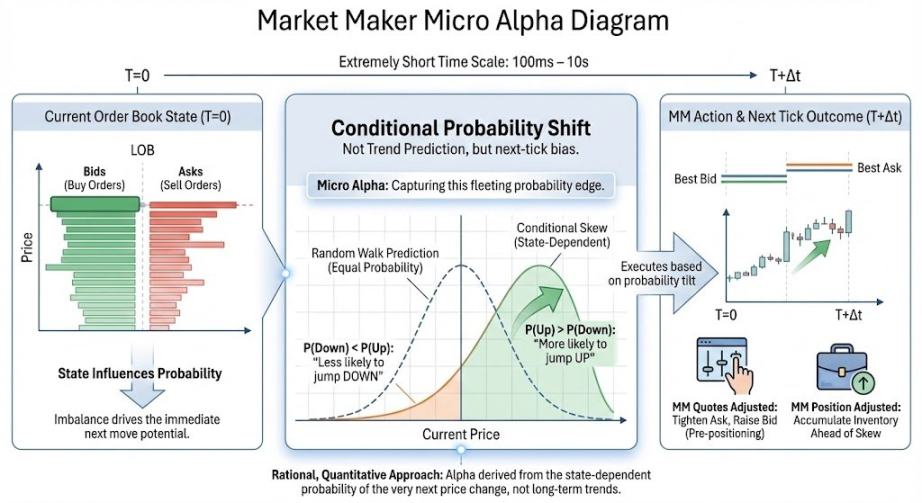
Micro alpha refers to the "conditional probability shift" in the direction of the next price movement / mid-price drift / trade asymmetry on an extremely short time scale (~100ms to ~10s). It's important to note that the alpha in the eyes of market makers is not about trend prediction or guessing price changes; it only requires a probability shift, which is different from the alpha we commonly talk about. Let me explain in simpler terms:

A market maker's statistical edge can be understood as whether, within an extremely short time window, the order book state is "inclined" to move the price in a certain direction first. If a market maker successfully calculates the probability of the next millisecond's price movement using some indicators, they can: 1. Be more willing to buy before a likely price increase. 2. Withdraw buy orders faster before a likely price drop. 3. Reduce exposure during risky moments.

The financial basis for predicting the next price direction is: Due to factors like order flow, order volume, and order book cancellation ratio (which we'll discuss later), the market is not a "random walk" Brownian motion in a short instant but has a direction. The above statement is the financial translation of the mathematical concept of "conditional probability."

With this alpha, market makers can directionally operate on prices. The "market makers" finally earn money from price movements, not just service fees like spreads.
2. Classic Signals Introduction

2.1 Order Book Imbalance: OBI

OBI measures which side has "more people standing" near the current price level. It is a standardized volume differential statistic.
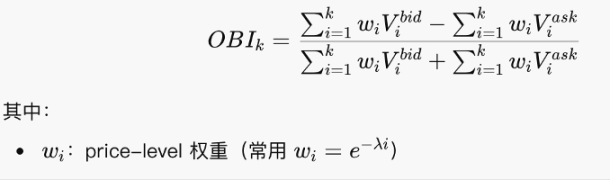
The formula is actually not difficult; it's just a proportional logic of summation. It checks whether there are more buy or sell orders. An OBI approaching 1 indicates almost all are buy orders, with a thick bottom. Approaching -1 indicates a thick top. Approaching 0 suggests a relatively symmetric buy-sell balance.

Note that OBI is a "static snapshot." It's a classic indicator but not very effective alone; it must be used with cancellation ratios, order book slope, etc.

2.2 Order Flow Imbalance (OFI)

OFI measures who has been actively attacking in a recent short period. OFI is the first-order driving factor of price changes because prices are pushed by taker orders, not by placed orders.
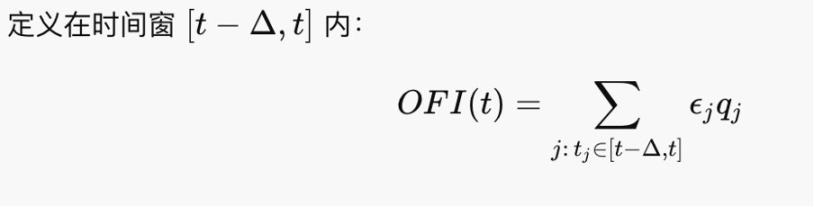
It feels like net buying/selling volume. In the Kyle (1985) framework, ΔP ≈ λ ⋅ OFI, where λ is tick depth. Thus, OFI is the factor driving price changes.

2.3 Queue Dynamics (Queue)

Most exchanges now use continuous auction rules based on best price and first-come-first-served (FCFS) principles, so submitted orders queue up to be filled. The queue represents the order placement situation, which determines the order book state. Abnormal order book states (including order replenishment and cancellation)暗示 directional price changes, i.e., micro alpha.

Two situations to note in the queue:

1. Iceberg: Hidden Orders

Example: Only 10 lots are shown on the surface, but every time they are filled, another 10 lots are immediately replenished. The real intention might be 1,000 lots. The method I introduced in Part 1 for annoying market makers to lower costs is essentially manually creating an iceberg. In practice, some players use iceberg orders to conceal their true volume.

2. Spoof (Fake Orders)

Placing a large order on one side to create a "false pressure illusion" and canceling it quickly before the price approaches. Spoofing pollutes OBI, slope, etc., making the queue artificially thicker and increasing movement risk. Additionally, large spoofs can intimidate the market and potentially manipulate prices. For instance, the London Stock Exchange caught someone manipulating forex in 2015 using spoofing. In crypto, we can also manually spoof to annoy market makers, but if you actually get filled, your exposure becomes significant.

2.4 Order Book Cancellation Ratio (Cancel Ratio)

The cancellation ratio is an estimate of the "disappearance rate" of liquidity:
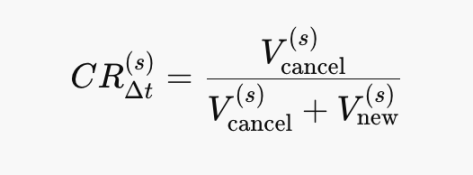
Cancel↑ ⇒ Slope↓ ⇒ λ↑ ⇒ ΔP more sensitive. It is an instability signal领先于 OFI. CR→1: Almost pure cancellations. CR→0: Almost pure order replenishment. The mathematical formulas in this part are very simple; you can interpret them by looking at the diagrams.

CR↑ ⟹ The passive side perceives future risk increasing. CR is also not used alone; it is used together with OFI and other indicators.

The above might just be some old-school order book games. The evolution of market making is rapid, and with stocks moving on-chain, market makers like JS might need to engage in on-chain market making. However, these indicators are still very useful and inspiring.

3. The Absolute Domain of Market Makers: Speed

We often hear in movies that a certain fund has faster internet speed, making it more powerful. Many market makers even move their server rooms closer to exchange servers. Why is that? Finally, let's talk about the advantages of physical equipment and the unique "trading advantages" of crypto exchanges.

Latency Arbitrage is not about predicting future prices but executing buy/sell orders at more favorable prices before others "react." In theoretical models: Prices are continuous, and information is synchronized. But in reality: The market is event-driven, and information arrives asynchronously. Why does information arrive asynchronously? Because receiving price signals from the exchange and sending order instructions to the exchange both take time—a limitation of the physical world. Even in fully compliant markets: Different exchanges, data sources, matching engines, and geographical locations cause delays. Thus, market makers with more advanced equipment have the initiative.

This tests the market maker's own capabilities and has little to do with other players, so I consider it their absolute domain.

A simple example: Suppose you want to sell a certain amount. You quote at the best selling price in the market, which should theoretically get filled. But I also want to sell. Since I see the price and quote faster than you, I get my order filled first. Your inventory cannot be sold, preventing your position from returning to neutral. Real situations are much more complex.

An interesting point: Since there are no regulatory laws yet, almost all crypto exchanges can directly grant priority filling rights to designated accounts. This means allowing certain accounts to jump the queue. This is especially common in smaller exchanges. It seems that being an "insider" in crypto is as important as in research. Whether you can execute trades safely is a crucial step from alpha theory to practice.
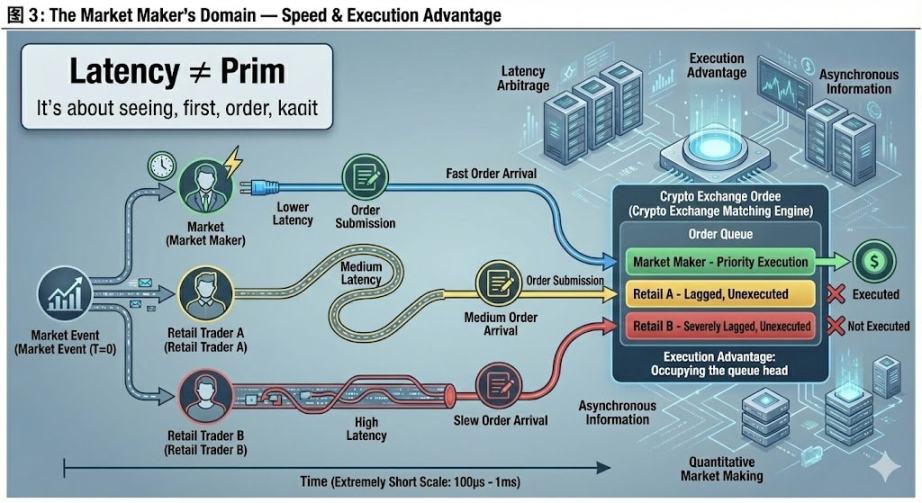
This part attempts to write from the perspective of a market maker. Actual operations are certainly more complex. For example, dynamic queue alone has many details to consider in practice. Welcome for comments from experts.

Postscript: There is a regret with this article. I originally wanted to use the title "Domain Expansion in Market Making" to discuss dynamic hedging and options, as I believe this is the conceptually most challenging part of market making, worthy of the big move "Domain Expansion." But after working on it for a day, I couldn't figure out how to explain it systematically, so I switched to discussing micro alpha. Teacher @agintender has an article mentioning many professional hedging concepts; I encourage everyone to take a look.


Preguntas relacionadas

QWhat is the concept of 'micro alpha' from a market maker's perspective, and how does it differ from traditional alpha?

AMicro alpha refers to a conditional probability shift in the direction of the next price movement, mid-price drift, or trade asymmetry over extremely short time scales (~100ms to ~10s). It is not about trend prediction or guessing price changes like traditional alpha, but rather about short-term probabilistic advantages derived from order flow, order book state, and cancellation ratios.

QHow does Order Book Imbalance (OBI) function as a signal, and what are its limitations?

AOBI measures the normalized volume difference between buy and sell orders near the current price level, indicating which side has more liquidity. It approaches 1 if buy orders dominate, -1 if sell orders dominate, and 0 if balanced. However, OBI is a static snapshot and is ineffective alone; it must be combined with other metrics like cancellation ratios and order book slope for practical use.

QWhat role does Order Flow Imbalance (OFI) play in price movement, and how is it mathematically related to price changes?

AOFI measures which side is actively attacking by tracking the net flow of taker orders over a short period. It is a primary driver of price changes, as prices are pushed by taker activity rather than passive orders. In the Kyle (1985) framework, the price change ΔP is approximately proportional to OFI multiplied by the tick depth (λ), i.e., ΔP ≈ λ · OFI.

QWhy is speed considered the 'absolute domain' of market makers, and how does latency arbitrage work?

ASpeed is critical because market information arrives asynchronously due to physical constraints like data transmission delays and geographical distances. Market makers with faster infrastructure can execute trades at favorable prices before others react, exploiting latency arbitrage. This involves acting on price signals and submitting orders more quickly than competitors, ensuring priority in trade execution.

QHow do spoofing and iceberg orders affect queue dynamics and market maker strategies?

AIceberg orders hide large order sizes by displaying only a small portion, replenishing after execution, which masks true intent. Spoofing involves placing large fake orders to create false pressure, which are canceled before execution. Both tactics distort signals like OBI and order book slope, increasing movement risk and complicating market makers' ability to gauge true liquidity and direction.

Lecturas Relacionadas

After the Passage of the GENIUS Act and the CLARITY Act, What Is the Correct Architecture for On-Chain Yield?

The article discusses the evolution of on-chain credit, distinguishing three markets: overcollateralized crypto lending, unsecured lending (largely unsuccessful), and asset-backed credit (ABC). ABC, backed by identifiable real-world collateral with legal recourse, is identified as the fastest-growing category and the only one credibly addressing adverse selection—the core problem in credit where the riskiest borrowers self-select. Current growth in on-chain Real World Assets (RWAs), particularly tokenized private credit funds (e.g., Maple Finance, Centrifuge), is substantial but often merely "wraps" existing fund structures, inheriting their risks rather than solving adverse selection at the protocol level. The regulatory landscape is a key driver, with the US GENIUS Act (prohibiting stablecoin issuers from paying yield) and the proposed CLARITY Act (closing loopholes on indirect yield) set to redefine permissible yield-bearing products. This makes vaults (like ERC-4626) the critical architecture—they become the primary compliant vehicle for delivering yield, functioning as issuance, disclosure, distribution, and recovery mechanisms. The author's thesis is that the correct post-GENIUS/CLARITY architecture involves building ABC solutions where credit assessment, structure, and recovery are encoded directly into the smart contract vault layer, moving beyond mere tokenized fund wrappers to solve adverse selection fundamentally and ensure regulatory compliance.

Foresight NewsHace 23 min(s)

After the Passage of the GENIUS Act and the CLARITY Act, What Is the Correct Architecture for On-Chain Yield?

Foresight NewsHace 23 min(s)

TechFlow Intelligence Bureau: Anthropic's New Model Fable Sparks Controversy by Restricting Biosafety Research, US CPI Soars to 4.2%, a Three-Year High

**Summary of TechFlow Intelligence Report:** The newsletter covers several key tech and finance developments. In AI, Anthropic's new Fable model faced backlash for secretly limiting biomedical research capabilities and enforcing a 30-day data retention policy, prompting the company to promise more transparent adjustments. In a related story, Anthropic's founder revealed his departure from OpenAI was due to dishonesty from Sam Altman, not safety concerns. Meanwhile, OpenAI is considering significant price cuts to compete with Anthropic, potentially sparking a price war. In crypto/Web3, BlackRock filed a new amendment for a yield-generating Bitcoin ETF, while Bank of America's CEO warned that stablecoin yields could drain trillions from traditional banks. U.S. Senator Cynthia Lummis advocated for the U.S. to officially accumulate Bitcoin reserves. In hardware, Nvidia released the DiffusionGemma-2-6B image model optimized for efficient inference, and AMD promoted its unified memory architecture to challenge Nvidia's dominance. TSMC's CFO hinted at possible price increases due to soaring AI chip demand. A major legal ruling in Germany held Google legally responsible for inaccurate information generated by its AI Overviews feature. Google Chrome also moved to fully block ad-blocker workarounds like uBlock Origin. Macroeconomic headlines included U.S. CPI rising to 4.2% (a 3-year high) and Iran's complete closure of the Strait of Hormuz, raising oil price and inflation fears. South Korean markets saw continued volatility with massive foreign capital outflow. Other notable stories: Microsoft expanded its Copilot AI assistant "Mico" globally; a study found r/wallstreetbets users' stock picks outperformed Wall Street; a fully autonomous drone killed a human soldier for the first time, raising AI ethics concerns; and a Chinese hospital used brain-computer interface technology to help a blind person "see." The overarching theme connects debates over AI boundaries and responsibility (Anthropic's restrictions, Google's liability, lethal autonomous drones) with real-world economic and geopolitical turmoil (inflation, Strait of Hormuz closure, market instability), highlighting the tense interplay between technological advancement and global chaos.

marsbitHace 36 min(s)

TechFlow Intelligence Bureau: Anthropic's New Model Fable Sparks Controversy by Restricting Biosafety Research, US CPI Soars to 4.2%, a Three-Year High

marsbitHace 36 min(s)

Alibaba's Yet Another New Business Division: What Signal Does It Send?

Alibaba has established a new "Token Foundry" business unit, merging its Tongyi large model division and Future Life Lab. Led directly by Group CEO Wu Yongming, this marks the company's third significant AI organizational reshuffle in 2026, following the creation of the Alibaba Token Hub (ATH) and a Group Technology Committee. The move signals a strategic shift from consolidating AI resources to accelerating productization and commercialization. The "Token Foundry" name reflects Alibaba's ambition to become a foundational supplier in the AI era, focusing on model development and commercial application. Key teams, including those behind the high-performing HappyHorse video generation model, have been integrated into the new unit. Concurrently, Zhou Jingren, architect of the Qwen model series, has been appointed Group Chief Scientist to lead a new AI Future Research Institute, focusing on long-term technological breakthroughs like Agent capabilities. This restructuring creates a clear four-layer AI architecture within Alibaba: the research institute for frontier exploration, Token Foundry for core models and commercialization, MaaS for platform services, and business units like Qianwen (C端) and Wukong (B端) for end-user applications. The adjustments align with a global trend among tech giants like Google and Microsoft to centralize AI leadership under the CEO and deeply integrate research with business units. The urgency is driven by a narrowing competitive window. Alibaba has announced its AI business is now entering a commercialization phase, with AI-related revenue seeing triple-digit growth for eleven consecutive quarters. The company faces intense competition in the MaaS (Model-as-a-Service) sector from rivals like ByteDance and Tencent. The Token Foundry initiative represents Alibaba's effort to streamline execution and enhance competitiveness in this critical, fast-evolving landscape.

marsbitHace 1 hora(s)

Alibaba's Yet Another New Business Division: What Signal Does It Send?

marsbitHace 1 hora(s)

From Return to Resignation: Chen Hang's 437 Days at DingTalk

The 437-Day Return and Departure of Chen Hang at DingTalk This article chronicles the 437-day period from March 31, 2025, to June 11, 2026, when Chen Hang (also known as "No Move") returned as CEO of DingTalk, the enterprise communication platform he originally founded, only to later step down. Chen Hang, the creator of DingTalk in 2015, was brought back by Alibaba in 2025 after the company acquired his subsequent startup, HHO. His return was driven by Alibaba's renewed focus on AI and DingTalk's strategic role as its key to-B AI application. However, his aggressive management style, marked by strict work policies like mandatory clock-ins and extended hours, quickly caused internal friction and was criticized as being at odds with Alibaba's culture. Despite the internal turmoil, Chen Hang drove significant product launches. In August 2025, he unveiled "AI DingTalk 1.0," featuring new products like the AI-native entry point "DingTalk ONE." By March 2026, he announced "Wukong," touted as the world's first enterprise-grade AI-native work platform, representing a fundamental rebuild of DingTalk's architecture. The turning point came in early June 2026. A detailed internal post criticizing DingTalk's work culture went viral, followed by a public critique from a former executive. This prompted an unprecedented public rebuke from the Alibaba Partners Committee, which stated such management was not aligned with company values. One day later, on June 11, Alibaba announced Chen Hang's departure. He was succeeded by Chen Yusen, a 32-year-old technical expert known for founding cybersecurity firm Changting Technology. While Chen Hang's tenure laid the technical foundation for DingTalk's AI transformation with "Wukong," his leadership style ultimately led to his replacement as the company seeks a new direction under younger leadership.

marsbitHace 1 hora(s)

From Return to Resignation: Chen Hang's 437 Days at DingTalk

marsbitHace 1 hora(s)

Trading

Spot
Futuros
活动图片




