The Advancing MM 3: Statistical Edge and Signal Design

深潮Publicado a 2025-12-28Actualizado a 2025-12-28

Resumen

Title: The Attack of MM 3: Statistical Edge and Signal Design Author: Dave This article, the third in the "Attack of MM" series, explores how market makers (MMs) actively gain a "micro alpha" advantage through statistical edges and signal design, rather than just passively adjusting quotes. Micro alpha refers to a conditional probability shift in predicting short-term price movements (within ~100ms to ~10s), such as the direction of the next price change, mid-price drift, or trade asymmetry. It is not about forecasting trends but detecting probabilistic biases that allow MMs to act preemptively—buying before likely price increases, withdrawing bids before declines, or reducing exposure during risky periods. Key signals discussed include: - **Order Book Imbalance (OBI)**: Measures the normalized volume difference between buy and sell orders near current prices. - **Order Flow Imbalance (OFI)**: Tracks aggressive taker orders that drive price changes. - **Queue Dynamics**: Analyzes order queue behavior, including hidden orders (icebergs) and spoofing (fake large orders to manipulate perception). - **Cancel Ratio (CR)**: Indicates liquidity withdrawal rates, signaling market instability. The article emphasizes that speed is MMs' absolute advantage. Lower latency enables faster reaction to market events, facilitating latency arbitrage by executing orders before competitors. In crypto exchanges, some players even get priority execution rights, highlighting th...

Author: Dave

"The Advancing MM 1: Market Maker Inventory Quoting System"

"The Advancing MM 2: Market Maker Order Book and Order Flow"

The first two parts discussed order flow and inventory quoting, making it sound like market makers can only adjust passively. But do they have proactive methods? The answer is yes. Today, we introduce statistical edge and signal design, which are the "micro alpha" pursued by market makers.

1. Market Maker's Alpha?

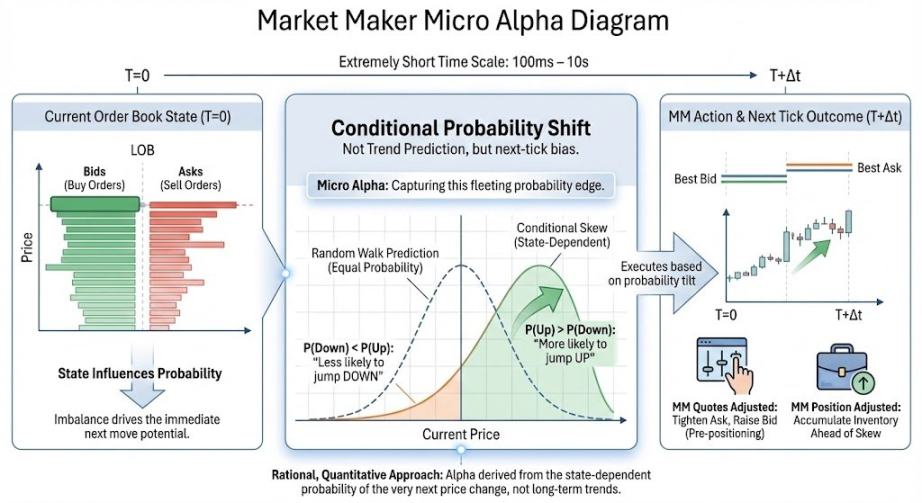
Micro alpha refers to the "conditional probability shift" in the direction of the next price movement / mid-price drift / trade asymmetry on an extremely short time scale (~100ms to ~10s). It's important to note that the alpha in the eyes of market makers is not about trend prediction or guessing price changes; it only requires a probability shift, which is different from the alpha we commonly talk about. Let me explain in simpler terms:

A market maker's statistical edge can be understood as whether, within an extremely short time window, the order book state is "inclined" to move the price in a certain direction first. If a market maker successfully calculates the probability of the next millisecond's price movement using some indicators, they can: 1. Be more willing to buy before a likely price increase. 2. Withdraw buy orders faster before a likely price drop. 3. Reduce exposure during risky moments.

The financial basis for predicting the next price direction is: Due to factors like order flow, order volume, and order book cancellation ratio (which we'll discuss later), the market is not a "random walk" Brownian motion in a short instant but has a direction. The above statement is the financial translation of the mathematical concept of "conditional probability."

With this alpha, market makers can directionally operate on prices. The "market makers" finally earn money from price movements, not just service fees like spreads.
2. Classic Signals Introduction

2.1 Order Book Imbalance: OBI

OBI measures which side has "more people standing" near the current price level. It is a standardized volume differential statistic.
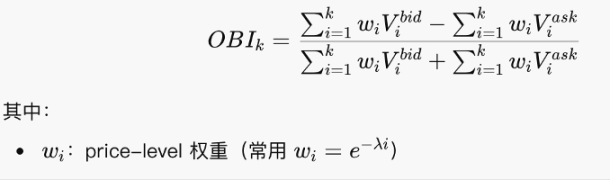
The formula is actually not difficult; it's just a proportional logic of summation. It checks whether there are more buy or sell orders. An OBI approaching 1 indicates almost all are buy orders, with a thick bottom. Approaching -1 indicates a thick top. Approaching 0 suggests a relatively symmetric buy-sell balance.

Note that OBI is a "static snapshot." It's a classic indicator but not very effective alone; it must be used with cancellation ratios, order book slope, etc.

2.2 Order Flow Imbalance (OFI)

OFI measures who has been actively attacking in a recent short period. OFI is the first-order driving factor of price changes because prices are pushed by taker orders, not by placed orders.
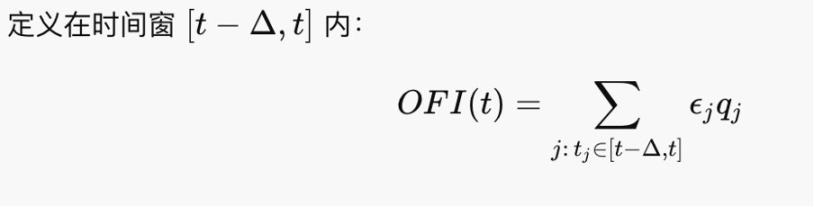
It feels like net buying/selling volume. In the Kyle (1985) framework, ΔP ≈ λ ⋅ OFI, where λ is tick depth. Thus, OFI is the factor driving price changes.

2.3 Queue Dynamics (Queue)

Most exchanges now use continuous auction rules based on best price and first-come-first-served (FCFS) principles, so submitted orders queue up to be filled. The queue represents the order placement situation, which determines the order book state. Abnormal order book states (including order replenishment and cancellation)暗示 directional price changes, i.e., micro alpha.

Two situations to note in the queue:

1. Iceberg: Hidden Orders

Example: Only 10 lots are shown on the surface, but every time they are filled, another 10 lots are immediately replenished. The real intention might be 1,000 lots. The method I introduced in Part 1 for annoying market makers to lower costs is essentially manually creating an iceberg. In practice, some players use iceberg orders to conceal their true volume.

2. Spoof (Fake Orders)

Placing a large order on one side to create a "false pressure illusion" and canceling it quickly before the price approaches. Spoofing pollutes OBI, slope, etc., making the queue artificially thicker and increasing movement risk. Additionally, large spoofs can intimidate the market and potentially manipulate prices. For instance, the London Stock Exchange caught someone manipulating forex in 2015 using spoofing. In crypto, we can also manually spoof to annoy market makers, but if you actually get filled, your exposure becomes significant.

2.4 Order Book Cancellation Ratio (Cancel Ratio)

The cancellation ratio is an estimate of the "disappearance rate" of liquidity:
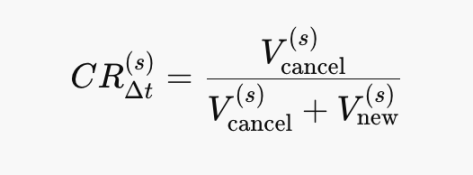
Cancel↑ ⇒ Slope↓ ⇒ λ↑ ⇒ ΔP more sensitive. It is an instability signal领先于 OFI. CR→1: Almost pure cancellations. CR→0: Almost pure order replenishment. The mathematical formulas in this part are very simple; you can interpret them by looking at the diagrams.

CR↑ ⟹ The passive side perceives future risk increasing. CR is also not used alone; it is used together with OFI and other indicators.

The above might just be some old-school order book games. The evolution of market making is rapid, and with stocks moving on-chain, market makers like JS might need to engage in on-chain market making. However, these indicators are still very useful and inspiring.

3. The Absolute Domain of Market Makers: Speed

We often hear in movies that a certain fund has faster internet speed, making it more powerful. Many market makers even move their server rooms closer to exchange servers. Why is that? Finally, let's talk about the advantages of physical equipment and the unique "trading advantages" of crypto exchanges.

Latency Arbitrage is not about predicting future prices but executing buy/sell orders at more favorable prices before others "react." In theoretical models: Prices are continuous, and information is synchronized. But in reality: The market is event-driven, and information arrives asynchronously. Why does information arrive asynchronously? Because receiving price signals from the exchange and sending order instructions to the exchange both take time—a limitation of the physical world. Even in fully compliant markets: Different exchanges, data sources, matching engines, and geographical locations cause delays. Thus, market makers with more advanced equipment have the initiative.

This tests the market maker's own capabilities and has little to do with other players, so I consider it their absolute domain.

A simple example: Suppose you want to sell a certain amount. You quote at the best selling price in the market, which should theoretically get filled. But I also want to sell. Since I see the price and quote faster than you, I get my order filled first. Your inventory cannot be sold, preventing your position from returning to neutral. Real situations are much more complex.

An interesting point: Since there are no regulatory laws yet, almost all crypto exchanges can directly grant priority filling rights to designated accounts. This means allowing certain accounts to jump the queue. This is especially common in smaller exchanges. It seems that being an "insider" in crypto is as important as in research. Whether you can execute trades safely is a crucial step from alpha theory to practice.
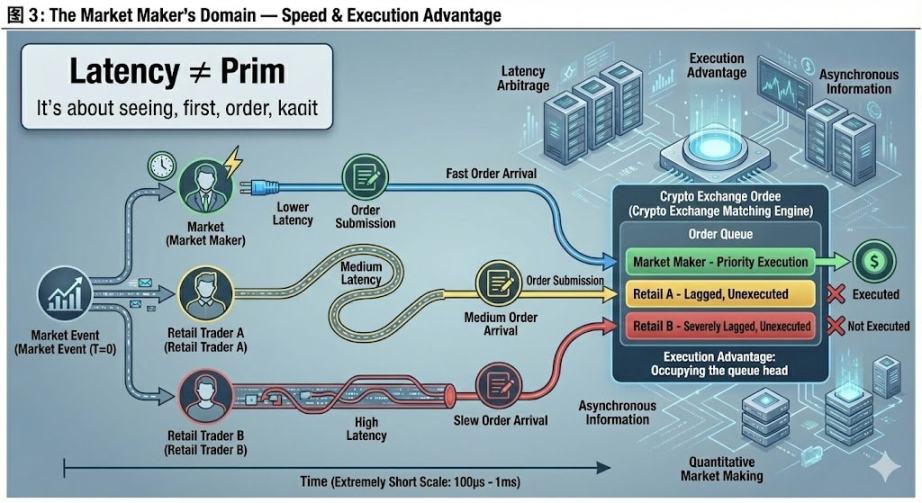
This part attempts to write from the perspective of a market maker. Actual operations are certainly more complex. For example, dynamic queue alone has many details to consider in practice. Welcome for comments from experts.

Postscript: There is a regret with this article. I originally wanted to use the title "Domain Expansion in Market Making" to discuss dynamic hedging and options, as I believe this is the conceptually most challenging part of market making, worthy of the big move "Domain Expansion." But after working on it for a day, I couldn't figure out how to explain it systematically, so I switched to discussing micro alpha. Teacher @agintender has an article mentioning many professional hedging concepts; I encourage everyone to take a look.


Preguntas relacionadas

QWhat is the concept of 'micro alpha' from a market maker's perspective, and how does it differ from traditional alpha?

AMicro alpha refers to a conditional probability shift in the direction of the next price movement, mid-price drift, or trade asymmetry over extremely short time scales (~100ms to ~10s). It is not about trend prediction or guessing price changes like traditional alpha, but rather about short-term probabilistic advantages derived from order flow, order book state, and cancellation ratios.

QHow does Order Book Imbalance (OBI) function as a signal, and what are its limitations?

AOBI measures the normalized volume difference between buy and sell orders near the current price level, indicating which side has more liquidity. It approaches 1 if buy orders dominate, -1 if sell orders dominate, and 0 if balanced. However, OBI is a static snapshot and is ineffective alone; it must be combined with other metrics like cancellation ratios and order book slope for practical use.

QWhat role does Order Flow Imbalance (OFI) play in price movement, and how is it mathematically related to price changes?

AOFI measures which side is actively attacking by tracking the net flow of taker orders over a short period. It is a primary driver of price changes, as prices are pushed by taker activity rather than passive orders. In the Kyle (1985) framework, the price change ΔP is approximately proportional to OFI multiplied by the tick depth (λ), i.e., ΔP ≈ λ · OFI.

QWhy is speed considered the 'absolute domain' of market makers, and how does latency arbitrage work?

ASpeed is critical because market information arrives asynchronously due to physical constraints like data transmission delays and geographical distances. Market makers with faster infrastructure can execute trades at favorable prices before others react, exploiting latency arbitrage. This involves acting on price signals and submitting orders more quickly than competitors, ensuring priority in trade execution.

QHow do spoofing and iceberg orders affect queue dynamics and market maker strategies?

AIceberg orders hide large order sizes by displaying only a small portion, replenishing after execution, which masks true intent. Spoofing involves placing large fake orders to create false pressure, which are canceled before execution. Both tactics distort signals like OBI and order book slope, increasing movement risk and complicating market makers' ability to gauge true liquidity and direction.

Lecturas Relacionadas

Only a 50% Chance of Passing This Year, Can the CLARITY Bill Succeed Before the Midterm Elections?

The CLARITY Act, which passed the House in July 2025 with strong bipartisan support (294-134), faces a critical juncture in the Senate. The Senate Banking Committee is expected to hold a markup soon, but key issues remain unresolved, including stablecoin yield provisions, DeFi regulations, and securing full Republican committee support. Other contentious points involve the Blockchain Regulatory Certainty Act (BRCA), ethics amendments for government officials, and SEC-related matters. The legislative calendar is tight, with limited time before the midterm elections. If the committee markup is delayed beyond mid-May, the chances of passage in 2026 drop significantly. Senator Cynthia Lummis has warned that failure this year could delay comprehensive crypto market structure legislation until 2030 or later. Galaxy estimates the probability of the CLARITY Act becoming law in 2026 is only about 50%. The bill provides crucial regulatory clarity by defining jurisdictional boundaries between the SEC and CFTC, establishing a path for decentralization, and bringing digital commodity intermediaries under federal regulation. Its passage is seen as vital before potential power shifts in the next Congress, which could bring less favorable leadership to key committees. The timeline is compressed, and the bill must compete for floor time with other priorities like Iran authorization and DHS appropriations. Key hurdles include finalizing the stablecoin yield compromise text, addressing law enforcement concerns about BRCA, and navigating political dynamics around SEC nominations. The outcome of the Banking Committee markup and the level of bipartisan support will be critical indicators of its future success.

marsbitHace 4 min(s)

Only a 50% Chance of Passing This Year, Can the CLARITY Bill Succeed Before the Midterm Elections?

marsbitHace 4 min(s)

Dialogue with Xinhuo Chief Economist Fu Peng: Macro Bear Market Expected to End This Year, Prioritize Allocation to Value Assets

Fu Peng, Chief Economist at New Huo Group, discusses the integration of crypto assets into traditional finance, marking a shift from a speculative phase to institutionalization. He highlights the current era as the second major fusion of finance and technology, driven by AI, data, and computing power, with crypto assets becoming part of the FICC+C (Fixed Income, Currencies, Commodities + Crypto) framework. Regulatory clarity in the U.S., such as the GENIUS and Clarity Acts, has paved the way for institutional adoption by defining digital assets as financial instruments. Fu views RWA (Real World Assets) as a tool for asset tokenization rather than a standalone asset class, noting that financial innovation differs between Eastern and Western markets due to cultural approaches to risk and regulation. He emphasizes that stablecoins are essential for future finance, but Asian markets, including Hong Kong, will adopt them cautiously. Macro liquidity now significantly influences crypto markets, as institutional participation increases correlation with traditional assets. Fu suggests the macro-driven bear market may end by year-end, reducing the relevance of Bitcoin’s four-year cycle. For asset allocation, he recommends value-oriented AI stocks for stability, Bitcoin for moderate certainty, and Ethereum for higher volatility.

marsbitHace 12 min(s)

Dialogue with Xinhuo Chief Economist Fu Peng: Macro Bear Market Expected to End This Year, Prioritize Allocation to Value Assets

marsbitHace 12 min(s)

Only a 50% Chance of Passing This Year, Can the CLARITY Bill Succeed Before the Midterm Elections?

The CLARITY Act, which passed the U.S. House in July 2025 with strong bipartisan support (294-134), faces a critical juncture in the Senate. The Senate Banking Committee is expected to hold a markup soon, but key issues remain unresolved, including stablecoin yield provisions, DeFi regulations, and securing full Republican committee support. Additional challenges involve the Blockchain Regulatory Certainty Act (BRCA), ethics amendments for government officials, and SEC-related concerns. Galaxy estimates only a 50% chance of the bill becoming law in 2026. The tight legislative calendar, competing priorities like Iran military authorization and DHS appropriations, and the impending midterm elections create significant time pressure. If the bill is not passed before the new Congress convenes in 2027, comprehensive crypto market structure legislation could be delayed until 2030 or later, especially if leadership changes result in less favorable committee chairs. The act provides crucial regulatory clarity by defining the jurisdictional boundaries between the SEC and CFTC, establishing a path for decentralized networks to be classified as non-securities, and bringing digital commodity intermediaries under federal regulation. The outcome of ongoing Senate negotiations, particularly the release of revised text on stablecoin yields, will be a key indicator of its future prospects.

Odaily星球日报Hace 14 min(s)

Only a 50% Chance of Passing This Year, Can the CLARITY Bill Succeed Before the Midterm Elections?

Odaily星球日报Hace 14 min(s)

Four-Dimensional Resonance: Hong Kong Web3 Carnival Sub-Forum Co-Creates Blueprint for Global Financial New Infrastructure

The "Four-Dimensional Resonance: 2026 Global Financial New Infrastructure" forum, a core event of the Hong Kong Web3 Festival, was successfully held at the Hong Kong Convention and Exhibition Centre. Co-hosted by Web3Labs and DeShang Singularity Tech, with joint support from Bitroot, Injective, Microsoft, and Z Oracle, the event gathered policymakers, industry leaders, and investors to explore the integration and innovation of global financial infrastructure, focusing on RWA, AI, DeFi, and compliant payments. Policy speakers, including Hong Kong Legislative Council Member Mr. Wu Jiezhuang, South Korean National Assembly Member Mr. Min Byung-duk, and ACED Chairman Mr. Yun Seok-hun, emphasized the importance of cross-border regulatory collaboration and an open policy environment for fintech innovation. Web3Labs CEO Caspar and DeShang Singularity Tech CEO Chang Shuai highlighted Hong Kong’s role as a financial innovation center and the approaching "singularity moment" for global financial infrastructure. Technical insights were shared by MagnetX, Bitroot, Microsoft, and Injective on topics including AI Agent economies, the evolution of public blockchains, and AI’s transformative role in finance. Key partnerships and initiatives were launched: - GWDC 2026 Korea collaboration between Hong Kong and South Korea. - A strategic agreement between Web3Labs and Microsoft. - The launch of a public anti-fraud alliance by Z Oracle and partners. - The "Injective Rising Star" program to support AI and Web3 projects. Panel discussions delved into AI-driven smart payments, compliant cross-border transactions, and the fusion of RWA and DeFi. Participants agreed that integrating RWA with DeFi is crucial for the next stage of financial infrastructure, enabling a shift from physical to digital finance. The forum underscored Hong Kong’s pivotal role in advancing a globalized and sustainable Asian fintech ecosystem.

marsbitHace 23 min(s)

Four-Dimensional Resonance: Hong Kong Web3 Carnival Sub-Forum Co-Creates Blueprint for Global Financial New Infrastructure

marsbitHace 23 min(s)

Trading

Spot
Futuros
活动图片