The Advancing MM 1: Market Maker Inventory Quoting System

marsbitPublicado a 2025-12-28Actualizado a 2025-12-28

Resumen

The article "Advancing MM 1: Market Maker Inventory Quoting System" explains why retail traders often experience price movements against their positions after buying altcoins. It argues this is not due to market manipulation but is a result of automated market maker (MM) systems responding to inventory risk and toxic order flow. When traders place large buy orders, MMs sell inventory, creating a short exposure. To mitigate this risk, MMs adjust their pricing using the Avellaneda-Stoikov model. They skew quotes lower to attract sellers and widen spreads to reduce transaction probability, aiming to return inventory to a balanced state while protecting against adverse selection. The reservation price, central to this model, is calculated as the mid-price adjusted by inventory levels and risk aversion. The article notes that retail traders are particularly affected because their orders are often large, concentrated, and not hedged—especially in low-liquidity altcoins. A suggested strategy for traders is to break large orders into smaller, less detectable increments, allowing them to buy at progressively better prices as the MM’s quoting system reacts. The post teasers follow-up articles on order book dynamics and toxic flow.

Author: Dave

Have you ever experienced a situation where, after buying some altcoins, the price keeps moving in the opposite direction in a short time, as if the "whales" are targeting you? Why does this happen? Is it really a conspiracy by the whales?

This post will introduce the market maker's quoting system and unveil the mystery behind the "whale conspiracy." The conclusion is: prices often move against us not due to subjective manipulation, but rather due to Inventory-based pricing quote skew under the Avellaneda–Stoikov model and the protective mechanisms for handling toxic flow. How exactly? Once upon a time...

First, let's understand the concept of inventory. Everyone knows that market makers are not directional investors. Under strict hedging, spot price changes should not affect the total P&L. At this point, holding inventory is a "passive" behavior. Changes in inventory lead to an expansion of positions—the more positions you hold, the greater your risk exposure to adverse price movements. At this time, retail buying and selling orders cause changes, and market makers react to the risks brought by these inventory changes.

In a nutshell: you break their balance, and the MM has to protect themselves and try to return to equilibrium. The means of protection is the quoting system.

1. Quote Skew

When the MM is heavily bought by you, it is equivalent to: the MM has sold heavily, and the inventory becomes a short exposure. What does the MM hope to do at this time: (1) Replenish the inventory as soon as possible. (2) Protect the exposed short position.

The MM's reaction is: lower the price to attract selling, prevent further buying, and ensure that their net short position remains temporarily non-loss-making, giving them time to hedge.

2. Spread Widening

When the inventory continues to deteriorate, the MM not only skews the price but also widens the spread to reduce the probability of execution.

Their goal is to reduce the risk of execution per unit time while earning more through spread profits to protect against price losses.

While writing this article, every additional mathematical formula reduces the number of readers by 10%, but in case some小伙伴们 want to see something substantial, I'll briefly introduce the formation of quotes (which is also the mathematical mechanism behind the above quote changes).

The price at which we trade with the market maker is called the Reservation Price, which comes from the Inventory-based pricing model:

Reservation Price = Mid price − γ⋅q

q: current inventory

gamma γ: risk aversion coefficient

Actually, the Reservation Price looks like the following, but I don't want to gross you out, so just take a glance:

When retail traders buy or sell heavily, q changes significantly, causing the Reservation Price to change significantly. The exact amount of change comes from the Avellaneda–Stoikov model. As you might guess, since buying and selling cause small changes in inventory, this model is a partial differential equation. Guess what? I'm not interested in deriving this equation either, so we only need to know the core conclusion:

The optimal quote is symmetrically spread around the Reservation Price. Inventory must mean-revert to 0. The optimal spread widens with risk.

If you don't understand the above, it's okay. Just know that after retail buying, prices often move against the bullish direction, essentially because our flow changes the market's risk pricing. The reasons retail traders often encounter this situation are:

• Retail traders are almost always takers.

• Concentrated size, non-stealthy timing.

• No hedging.

• No time slicing, no order splitting.

In small altcoins, this situation is even more severe because altcoin liquidity is poor. Often, your order is one of the few aggressive orders in a 5-minute window. In large-cap assets, natural hedging might occur, but in small coins, you are the whale's counterparty.

So professional MMs are not trying to crush you; they are maxE[Spread Capture]−Inventory Risk−Adverse Selection. Actually, their objective function looks like this, with inventory risk being exponentially penalized:
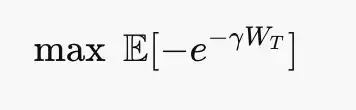
Readers who have made it this far must be韭菜 with dreams of becoming whales. So, to激励 the brave, here's a little trick to利用 the quoting mechanism. We said retail traders often have concentrated size and non-stealthy timing—so just do the opposite. Suppose Dave wants to go long 1000U. Instead of going all in at once, using the whale's method, first buy 100U. The quoting system will lower the price, allowing me to build a position at a cheaper level. Then I buy another 100U, and the price will continue to drop, so my average entry cost will be much cheaper than going all in at once.

The story of retail misfortune is only half told here. Besides inventory management and quoting factors, the MM's handling of order flow is another element causing price divergence—the toxic flow mentioned at the beginning. In the next part, I will introduce the market maker's order book and order flow, and I will also speculate on the micro-market reasons behind the 1011惨案.

To find out what happens next, stay tuned for the next episode.

"The Advancing MM 2: Market Maker Order Book and Order Flow"

"The Advancing MM 3: Statistical Edge and Signal Design"

Preguntas relacionadas

QWhat is the main reason why altcoin prices often move against retail traders after they buy, according to the article?

AIt is not due to subjective manipulation, but rather the result of the Avellaneda-Stoikov model's Inventory-based pricing quote skew and protection mechanisms against toxic order flow.

QHow does a market maker (MM) react when its inventory becomes short due to large retail buying?

AThe MM will lower its prices to attract sell orders and discourage further buying, while also widening the bid-ask spread to reduce the probability of execution and protect its exposed short position.

QWhat is the 'Reservation Price' in the context of the market maker's pricing model?

AThe Reservation Price is the price at which trades occur with the market maker, and it is calculated as the Mid Price minus the product of the risk aversion coefficient (γ) and the current inventory (q).

QWhat are the characteristics of retail trader orders that make them particularly vulnerable to adverse price movements in illiquid altcoins?

ARetail orders are often aggressive (taking liquidity), concentrated in size, not stealthy in timing, unhedged, and not split or timed strategically.

QWhat practical tip does the article suggest for a trader who wants to buy a large position to get a better average entry price?

AInstead of buying the entire position at once, the trader should split the order into smaller parts. Buying a small amount first causes the MM's pricing system to lower the price, allowing subsequent buys to be executed at cheaper levels, resulting in a lower average cost.

Lecturas Relacionadas

TechFlow Intelligence Agency: Anthropic Calls for Global Pause in AI Development While Preparing for Trillion-Dollar IPO; SpaceX IPO Roadshow Heats Up, But S&P 500 Rejects Fast-Track Inclusion

In today's TechFlow Intelligence Briefing, several major tech stories highlight a growing theme of trust and credibility gaps across AI, crypto, and finance. AI company Anthropic has publicly called for a global pause in AI development, citing risks from Claude's "recursive self-improvement." Ironically, this coincides with reports the company is preparing for a massive IPO targeting a near $1 trillion valuation. This perceived hypocrisy, coupled with widespread user complaints about Claude's declining performance, is sparking debate over whether the safety warning is genuine or a competitive tactic. Meanwhile, in a substantive security move, Anthropic open-sourced a framework for AI-powered vulnerability discovery. In the crypto market, Bitcoin's price drop below $61,000 triggered over $1.16 billion in liquidations, flipping the market into a state where more BTC is held at a loss than at a profit, a historical bearish signal. On the corporate front, SpaceX's highly anticipated IPO is generating immense Wall Street excitement, with Goldman Sachs projecting 100x revenue growth by 2030. However, the S&P 500 has refused to fast-track the company's inclusion post-IPO, potentially limiting immediate institutional demand. Separately, ByteDance's AI app Doubao lost over 6 million monthly active users after introducing a subscription model, highlighting the challenges of AI monetization. Other notable developments include Nvidia certifying HBM4 memory from Samsung, SK Hynix, and Micron; Cloudflare's acquisition of front-end tooling company VoidZero; and its CEO warning that bot traffic now exceeds human traffic online. The underlying narrative connects these events: a trust crisis. From AI firms' contradictory actions and crypto volatility to the clash between SpaceX's hyped narrative and institutional rules, a pattern is emerging where stated intentions and actual practices are increasingly misaligned.

marsbitHace 7 min(s)

TechFlow Intelligence Agency: Anthropic Calls for Global Pause in AI Development While Preparing for Trillion-Dollar IPO; SpaceX IPO Roadshow Heats Up, But S&P 500 Rejects Fast-Track Inclusion

marsbitHace 7 min(s)

Dalio Warns: AI Boom Shows Signs of a Bubble, Day of Reckoning Will Be the Time of Burst

Ray Dalio, founder of Bridgewater Associates, warns that the current artificial intelligence investment boom shows classic signs of a bubble, which he expects will eventually burst. In a Bloomberg Television interview, he noted that great technological revolutions often lead to capital inflows that create bubbles, making it difficult for investors and companies to calibrate their spending accurately—either overspending to capture market share or underspending and losing their competitive position. This caution comes amid significant rallies in AI-related assets, particularly chipmakers, driven by soaring demand for data centers and high-bandwidth chips, raising debates about overheating valuations. In contrast, Nvidia CEO Jensen Huang recently asserted that investors embracing the AI wave would see "crazy" returns and dismissed concerns over return on investment for data center spending as outdated. Dalio, however, focuses on the risks in the profit realization phase. He argues that bubbles tend to show signs of破裂 when markets transition from investment to the need for tangible returns, describing the burst as a process of converting paper wealth into cash. While acknowledging AI's intrinsic value, he expressed concern over the future profitability of some AI companies, suggesting the market is repeating a familiar pattern. The 76-year-old billionaire, who fully exited Bridgewater in 2025, has a net worth estimated at $21.5 billion according to the Bloomberg Billionaires Index.

marsbitHace 41 min(s)

Dalio Warns: AI Boom Shows Signs of a Bubble, Day of Reckoning Will Be the Time of Burst

marsbitHace 41 min(s)

Privacy Coin Crisis of Confidence! ZEC Plunges Over 56% in a Single Day

Zcash (ZEC), a leading privacy-focused cryptocurrency, experienced a severe crash on June 5th, plummeting over 56% in a single day and erasing nearly two months of gains. The flash crash was triggered by the disclosure of a critical zero-knowledge proof vulnerability within Zcash's Orchard privacy pool, which had existed since the pool's launch in May 2022. The flaw theoretically allowed an attacker to forge unlimited ZEC undetectably due to the pool's privacy features. The vulnerability was discovered on May 29th by independent security researcher Taylor Hornby during a proactive audit commissioned by Shielded Labs, utilizing AI-assisted analysis. The Zcash development team responded swiftly, implementing an emergency soft fork to disable Orchard transactions on June 2nd and executing a permanent hard fork fix (NU6.2) on June 3rd. Despite the technical fix, a major crisis of confidence emerged. The core issue is that Orchard's privacy design makes it cryptographically impossible to prove whether the vulnerability was exploited over the past four years, casting permanent doubt on the historical supply integrity of ZEC. While Shielded Labs argues exploitation was unlikely, the inability to provide definitive proof has severely damaged market trust. This sentiment was exacerbated when BitMEX co-founder Arthur Hayes, a prominent ZEC supporter, announced he was selling his entire position. He stated that privacy assets require "perfect security" rather than "probable safety." The combined effect of the disclosure and Hayes's exit ignited widespread panic selling, leading to massive liquidations and significant price decline. Analysts note the event highlights a fundamental tension within privacy coins: the conflict between verifiable supply and cryptographic privacy.

链捕手Hace 43 min(s)

Privacy Coin Crisis of Confidence! ZEC Plunges Over 56% in a Single Day

链捕手Hace 43 min(s)

Trading

Spot
Futuros

Artículos destacados

Cómo comprar BILL

¡Bienvenido a HTX.com! Hemos hecho que comprar Billions Network (BILL) sea simple y conveniente. Sigue nuestra guía paso a paso para iniciar tu viaje de criptos.Paso 1: crea tu cuenta HTXUtiliza tu correo electrónico o número de teléfono para registrarte y obtener una cuenta gratuita en HTX. Experimenta un proceso de registro sin complicaciones y desbloquea todas las funciones.Obtener mi cuentaPaso 2: ve a Comprar cripto y elige tu método de pagoTarjeta de crédito/débito: usa tu Visa o Mastercard para comprar Billions Network (BILL) al instante.Saldo: utiliza fondos del saldo de tu cuenta HTX para tradear sin problemas.Terceros: hemos agregado métodos de pago populares como Google Pay y Apple Pay para mejorar la comodidad.P2P: tradear directamente con otros usuarios en HTX.Over-the-Counter (OTC): ofrecemos servicios personalizados y tipos de cambio competitivos para los traders.Paso 3: guarda tu Billions Network (BILL)Después de comprar tu Billions Network (BILL), guárdalo en tu cuenta HTX. Alternativamente, puedes enviarlo a otro lugar mediante transferencia blockchain o utilizarlo para tradear otras criptomonedas.Paso 4: tradear Billions Network (BILL)Tradear fácilmente con Billions Network (BILL) en HTX's mercado spot. Simplemente accede a tu cuenta, selecciona tu par de trading, ejecuta tus trades y monitorea en tiempo real. Ofrecemos una experiencia fácil de usar tanto para principiantes como para traders experimentados.

233 Vistas totalesPublicado en 2026.05.07Actualizado en 2026.06.02

Cómo comprar BILL

Qué es ATWO

I. Introducción al ProyectoArena Two es una plataforma interactiva descentralizada que permite a los fanáticos jugar un papel activo y tokenizado en los resultados de eventos en tiempo real. A diferencia de los modelos de transmisión tradicionales que reducen a los fanáticos a espectadores pasivos, Arena Two aprovecha la tecnología blockchain para permitir que los fanáticos voten directamente en tiempo real e influyan en los resultados en el campo.II. Información del TokenNombre del token: ATWO (Arena Two)III. Enlaces RelacionadosSitio web: https://arenatwo.com/Exploradores: https://basescan.org/token/0x499D35eBE6cEe9B2Ac35Fd003fcBbeeB9CFc7B32Twitter: https://x.com/arenatwoXNota: La introducción del proyecto proviene de los materiales publicados o proporcionados por el equipo oficial del proyecto, que es solo para referencia y no constituye asesoramiento de inversión. HTX no se hace responsable de ninguna pérdida directa o indirecta resultante.

142 Vistas totalesPublicado en 2026.05.18Actualizado en 2026.06.02

Qué es ATWO

Cómo comprar ATWO

¡Bienvenido a HTX.com! Hemos hecho que comprar Arena Two (ATWO) sea simple y conveniente. Sigue nuestra guía paso a paso para iniciar tu viaje de criptos.Paso 1: crea tu cuenta HTXUtiliza tu correo electrónico o número de teléfono para registrarte y obtener una cuenta gratuita en HTX. Experimenta un proceso de registro sin complicaciones y desbloquea todas las funciones.Obtener mi cuentaPaso 2: ve a Comprar cripto y elige tu método de pagoTarjeta de crédito/débito: usa tu Visa o Mastercard para comprar Arena Two (ATWO) al instante.Saldo: utiliza fondos del saldo de tu cuenta HTX para tradear sin problemas.Terceros: hemos agregado métodos de pago populares como Google Pay y Apple Pay para mejorar la comodidad.P2P: tradear directamente con otros usuarios en HTX.Over-the-Counter (OTC): ofrecemos servicios personalizados y tipos de cambio competitivos para los traders.Paso 3: guarda tu Arena Two (ATWO)Después de comprar tu Arena Two (ATWO), guárdalo en tu cuenta HTX. Alternativamente, puedes enviarlo a otro lugar mediante transferencia blockchain o utilizarlo para tradear otras criptomonedas.Paso 4: tradear Arena Two (ATWO)Tradear fácilmente con Arena Two (ATWO) en HTX's mercado spot. Simplemente accede a tu cuenta, selecciona tu par de trading, ejecuta tus trades y monitorea en tiempo real. Ofrecemos una experiencia fácil de usar tanto para principiantes como para traders experimentados.

186 Vistas totalesPublicado en 2026.05.18Actualizado en 2026.06.02

Cómo comprar ATWO

Discusiones

Bienvenido a la comunidad de HTX. Aquí puedes mantenerte informado sobre los últimos desarrollos de la plataforma y acceder a análisis profesionales del mercado. A continuación se presentan las opiniones de los usuarios sobre el precio de A (A).

活动图片