The 2026 Showdown: Will the Financial Super App Ultimately Belong to HOOD or COIN?

marsbitPublicado a 2025-12-31Actualizado a 2025-12-31

Resumen

Coinbase and Robinhood are competing to build the ultimate financial super app, but with distinct strategies. Robinhood (HOOD) is creating an all-in-one platform for everyday financial life, targeting a young user base (75% under 44) with its digital banking features, Robinhood Gold subscription, and integrated services like stock trading, crypto, and a 3% cash-back card. It aims to capture the generational wealth transfer and keep users within its ecosystem. Coinbase (COIN) is building a crypto-native super app with recent updates like 24/5 commission-free stock trading, prediction markets via Kalshi, and a DEX aggregator. Beyond its user-facing app, Coinbase’s larger vision is to become the backend infrastructure for traditional finance (TradFi), offering crypto custody, stablecoin-as-a-service, and institutional solutions. Its revenue is diversifying, with 41% from subscriptions and services in Q3 2025. While both are expanding into each other’s territories—Robinhood with tokenized stocks and its own chain, Coinbase with extended trading hours and stock perps—their core visions differ: Robinhood wants to be the user’s financial home, and Coinbase aims to be the pipes powering the on-chain economy. Both face risks like costly incentives (HOOD) and stagnant user growth (COIN), and their stocks have seen significant rallies. The race in 2026 will test which foundation proves stronger.

Source: Bankless

Author: David Christopher

Compiled and Edited by: BitpushNews

The debate between Coinbase and Robinhood has been discussed many times by many observers—including us.

But the system update released by Coinbase on December 17 gives us reason to revisit this topic in depth. The company announced the launch of 24/5 commission-free stock and ETF trading, native prediction market integration via Kalshi, and a decentralized exchange (DEX) aggregator providing instant access to millions of tokens—a clear step towards becoming an "everything app" that can rival Robinhood's breadth.

These announcements clarify the future Coinbase is building and allow us to compare it more comprehensively with Robinhood. Their competitive goal is now unmistakable: to become the single platform for users to manage their entire financial lives. By mastering users' fund balances, they aim to master user behavior. But the way each is constructing this "super app" theory shows two distinctly different philosophies—and 2026 will test which foundation is more solid.

HOOD (Robinhood)

Robinhood is building a financial super app the old-fashioned way—by continuously stacking products until users can manage their entire financial life on one platform.

In addition to stock, options, and cryptocurrency trading, Robinhood offers its 3.9 million Robinhood Gold subscribers a suite of products that give it functionality comparable to a digital neobank. This subscription service, which saw 77% year-over-year growth, bundles a 3% cash-back credit card, 3.25% cash interest, and a 3% IRA (Individual Retirement Account) match. Users' salaries, savings, investments, and daily spending are all concentrated in one interface—a data advantage traditional brokerages cannot match.

This positioning seems particularly relevant when considering demographics—75% of Robinhood's 26.9 million funded customers are under the age of 44, a highly mobile-first and "financially conscious" user base. As argued by Omar Kanji of Dragonfly and others, this foundation helps position the company as a primary beneficiary of the anticipated over $10 trillion wealth transfer in the next decade, when older generations pass assets to younger ones. These inheritors are likely to consolidate assets into the platforms they use every day—and Robinhood is making itself very suitable for daily use.

Beyond digital banking features, Robinhood's revenue sources are already quite diversified. Options trading remains its "cash cow." Cryptocurrency contributes 21% of total revenue. Net interest income accounts for 35% of revenue. And the prediction market business via Kalshi is already generating $100 million in annualized revenue.

The data supports this:

  • Transaction-based revenue grew 129% year-over-year, primarily driven by cryptocurrency.
  • Q3 net profit reached a record $556 million—a 271% increase year-over-year.
  • Operating expenses have remained flat since September 2022.

COIN (Coinbase)

Coinbase is also building a super app—but with a distinct "crypto-native" flavor and an underlying second-layer ambition.

On the front end, Coinbase aims to be the single place for users to manage their on-chain and off-chain financial lives, though it currently remains more focused on the former. The December system update made this clear: 24/5 commission-free stock and ETF trading, prediction markets via Kalshi, and ongoing on-chain integration for instant access to millions of tokens. Add to that direct deposit, high-yield savings via USDC lending rates, borrowing up to $5 million against BTC (up to $1 million against ETH), and earning crypto rewards through debit card spending—the pieces of the super app are falling into place.

While cryptocurrency prices have fallen, the builders and deliverers are still in action.

However, Coinbase is not just building products for its own users. Its broader vision seems to be turning every product it offers into plug-and-play infrastructure powering all other institutions entering the on-chain space.

The theory here is that traditional finance (TradFi) giants like JPMorgan, Fidelity, and Morgan Stanley will not build their own crypto infrastructure. They will outsource it to Coinbase because it's cheaper, they lack the technical expertise, and Coinbase has 13 years of proven security. Over 200 institutions are already using Coinbase's "Crypto as a Service" platform—meaning users might be trading crypto on the front end of a traditional bank, but Coinbase handles everything behind the scenes.

This focus on infrastructure extends across the business. Coinbase holds Bitcoin and Ethereum for most major spot ETFs—a near-monopoly in cryptocurrency custody. They are allowing institutions to use Coinbase's infrastructure to issue their own stablecoins. The acquisition of Echo brought fundraising and token issuance in-house. And the acquisition of Deribit captured about 90% of Bitcoin options open interest.

The revenue structure reflects this dual focus. Q3 2025 revenue was $1.8 billion, with subscription and service revenue hitting a quarterly record of $747 million (41% of total revenue). Stablecoin revenue from the USDC partnership contributed $354.7 million, up 44% year-over-year. Staking brought in $185 million. Custodied assets exceeded $300 billion, driven by ETF inflows, generating custody fees of approximately $143 million.
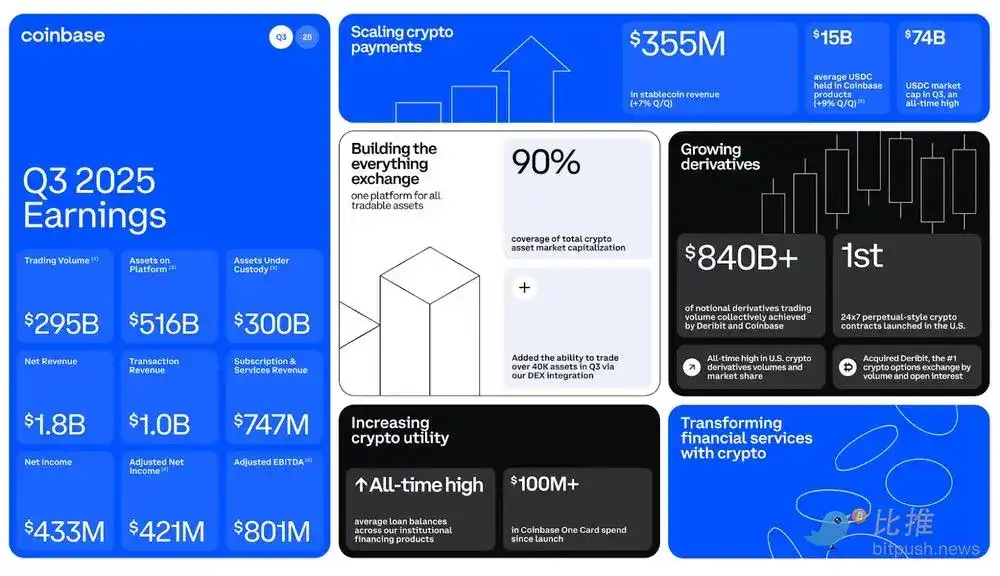
Robinhood's grand vision is to be the go-to place for handling all aspects of personal financial life, while Coinbase is playing two games at once: building the best crypto super app for its own users, while simultaneously becoming the backend powering crypto products for everyone else.

Diverging Crypto Strategies

Both companies see cryptocurrency as core to their super app ambitions, but their approaches reflect their origins.

Robinhood treats cryptocurrency as just another asset class alongside stocks and options. It is a revenue driver that fits perfectly into the existing product suite. The acquisition of Bitstamp ($200 million) provided it with global licenses and institutional infrastructure. Tokenized equities—currently around 800 available in the EU, including private companies like OpenAI and SpaceX—expand the product offering. The real test will be the success of Robinhood Chain, which should make many of these tokenized equities more versatile (e.g., for loans), though we currently have few details on the extent of "DeFi" or other on-chain activities the chain will support.

Beyond this, Robinhood faces more immediate limitations, such as token selection. In the U.S., users have access to fewer than 50 tokens on the platform, while Coinbase offers nearly unlimited tokens indirectly (via Jupiter and Base) and directly supports over 200.

Coinbase's approach to cryptocurrency is clearly different, offering everything from its own Layer 2 network to the various products mentioned in the previous section. It has set the standard for "crypto-specific" products to the point that it now seems to be shifting focus to building the rails for others to use. We see x402, aimed at becoming the industry standard for agent-to-agent (A2A) payments, and Coinbase's announcement that it will offer a "Stablecoin-as-a-Service" platform for companies to create whitelisted stablecoins, with Coinbase managing all technical complexity. From issuance to trading to custody, Coinbase occupies every stage of the asset lifecycle.

2026 Outlook

Both companies have very aggressive roadmaps—and the overlap is increasing.

Coinbase's December 2025 system update, with stock and ETF trading beyond traditional market hours (thanks to tokenization) and the announcement of stock perps launching next year, strongly encroached on Robinhood's territory. Native Kalshi integration brought prediction markets. There's also Coinbase Business, an all-in-one business operations platform powered by crypto, and Coinbase Tokenize, an "end-to-end" platform for institutional tokenization.

Robinhood's 2026 plans delve deeper into crypto infrastructure. Tokenized stocks will achieve 24/7 trading via Bitstamp in early 2026 and become extractable and composable in DeFi by late 2026. In prediction markets, Robinhood is moving from being a distribution partner to launching its own market. The platform hopes to offer cryptocurrency staking, pending regulatory approval. It also has ambitions to "socialize" trading with Robinhood Social, an upcoming feed where traders can post content and display their actual trades and P&L. And of course, there's Robinhood Chain.

The challenge for Robinhood Chain will be building a developer ecosystem—an area where Base has already built momentum. Crypto-native culture is hard to manufacture artificially.

Conclusion

Perhaps a better framework here is "COIN and HOOD," not "COIN vs. HOOD." These two companies occupy different lanes, touching but not fully overlapping.

Robinhood is both a "super app" bet and a demographic wealth transfer bet. With 75% of its users under 44 and a full-stack digital bank keeping assets on the platform, the company is poised to become a new hub for deposits, spending, investing, and speculation.

Coinbase is a bet on a technological transformation. It bets on the global economy moving on-chain, with Coinbase becoming the infrastructure layer powering everyone else—from ETF custody to stablecoin backends to Crypto-as-a-Service for traditional banks.

Both face risks. Robinhood's generous Gold incentives (3% match, 3% cash back, 3.25% cash interest) are costly and have already shown vulnerability to rate cuts—this rate was recently 4-5% and is directly tied to the Fed rate. Adoption of tokenization depends on issuer decisions, which are beyond Robinhood's control. For Coinbase, user growth remains a significant risk, with monthly active users stagnating since 2021.

Moreover, both stocks may already be at highs. Over the past few years, these two stocks have been major market winners—as of this writing, Coinbase (COIN) is up about 7x from its 2022 lows, and Robinhood (HOOD) is up 15x. Although they have pulled back from recent all-time highs, their valuations remain elevated after such stunning gains. This is worth investors pondering.

Ultimately, while both companies are building financial super apps—and increasingly encroaching on each other's turf in the process—their visions actually serve different goals.

Robinhood is committed to building a one-stop financial platform—allowing users to bank, spend daily, trade, and invest, all in one place without leaving the platform.

Coinbase is focused on building the infrastructure to get everyone on-chain—it does build a crypto super app for its own users, but more importantly, it is becoming the backend rails that financial institutions, fintech companies, and even traditional banks rely on to enter the crypto space.

One aims to be your financial home, the other aims to be the plumbing underneath everyone's financial home. Both could succeed.


Criptos en tendencia

Preguntas relacionadas

QWhat are the key differences between Robinhood and Coinbase in building their financial 'super apps'?

ARobinhood is building a traditional financial super app by layering products like banking suite, stock/options/crypto trading, and prediction markets, targeting a young demographic for wealth transfer. Coinbase is building a crypto-native super app with features like 24/5 stock trading, DEX aggregation, and high-yield savings via USDC, while also focusing on being a backend infrastructure provider for institutions through services like crypto custody, stablecoin-as-a-service, and institutional tokenization.

QHow does Robinhood's revenue diversification compare to Coinbase's?

ARobinhood's revenue is diversified with options trading as its cash cow, crypto contributing 21%, net interest income at 35%, and prediction markets via Kalshi generating $100M annualized. Coinbase's Q3 2025 revenue was $1.8B, with 41% from subscriptions/services ($747M), stablecoin revenue from USDC at $354.7M (up 44% YoY), staking at $185M, and custody fees around $143M driven by ETF inflows.

QWhat are the major strategic focuses for Robinhood and Coinbase in 2026?

AIn 2026, Robinhood plans to expand crypto infrastructure with 24/7 tokenized stock trading via Bitstamp, launch its own prediction markets, introduce crypto staking (pending regulatory approval), and develop Robinhood Social for trading socialization. Coinbase aims to enhance its super app with stock perpetual contracts, native Kalshi integration, Coinbase Business for crypto-driven operations, and Coinbase Tokenize for institutional tokenization, while continuing to build backend infrastructure for the crypto economy.

QWhat risks do both companies face in their super app strategies?

ARobinhood faces risks from costly Gold subscription incentives (3% match, cashback, and interest) that are vulnerable to interest rate cuts, and adoption of tokenization depends on issuer decisions beyond its control. Coinbase risks stagnant user growth, with monthly active users flat since 2021, and both companies have high valuations after significant stock price increases (COIN up 7x and HOOD up 15x from 2022 lows), posing potential overvaluation concerns.

QHow do Robinhood and Coinbase differ in their approach to cryptocurrency integration?

ARobinhood treats crypto as an asset class alongside stocks and options, with limited token selection (under 50 tokens in the U.S.) and a focus on tokenized equities and global expansion via Bitstamp. Coinbase offers extensive crypto access (over 200 directly supported tokens and millions via DEX aggregation), emphasizes crypto-native products like its Layer 2 network Base, and provides infrastructure services such as stablecoin-as-a-service and institutional custody, aiming to dominate the entire asset lifecycle from issuance to trading.

Lecturas Relacionadas

Low Investment Isn't Apple's Immunity Pass

While Meta and Google face investor scrutiny over ballooning AI capital expenditures, Apple's minimal AI investment has paradoxically become a strength. Its market cap recently reclaimed the global top spot, surpassing $5 trillion. The irony is deep: Apple's own AI efforts have lagged, with "Apple Intelligence" delayed and core talent lost, forcing reliance on partners like Google Gemini and Alibaba's Qianwen. Its Q3 FY2026 (Q2 CY) earnings initially seemed stellar. Revenue hit $109.4B (up 16% YoY), with iPhone and Mac sales, growing 22% and 29% respectively, driving most of the growth. However, the stock fell over 8% post-earnings. The primary concern was a weaker Q4 revenue growth forecast of 9-11%, below expectations, due to looming supply chain constraints. Apple is feeling the indirect cost of the AI boom. Soaring memory and chip prices, fueled by massive data center investments from Microsoft, Amazon, and others, are forcing Apple to raise Mac and iPad prices significantly. The upcoming iPhone launch is also expected to see substantial price hikes. Despite avoiding heavy AI infrastructure spending—its capital expenditures are actually down 28%—Apple cannot escape the industry-wide supply and cost pressures. While Apple's operating cash flow remains robust, its substantial R&D spending (up 32% YoY) has yet to yield major AI breakthroughs. As Tim Cook prepares to step down as CEO, Apple faces a challenging transition: balancing its premium hardware success against the strategic and cost pressures of the AI era it has so far cautiously navigated.

marsbitHace 18 min(s)

Low Investment Isn't Apple's Immunity Pass

marsbitHace 18 min(s)

PA Graphics Explanation | One Chart to Understand the Major Web3 Events in August 2026

**PANews Crypto Calendar: Key Web3 Events in August 2026** PANews introduces its revamped crypto calendar, featuring comprehensive coverage, flexible filtering, and easy export options. The market in August will be shaped by multiple key events across macroeconomics, regulation, tokenomics, and project developments: * **Macro & Policy:** Key US economic data releases (July Non-Farm Payrolls, CPI), the Federal Reserve meeting minutes, and the Jackson Hole Economic Symposium will be in focus. On the regulatory front, the US Senate plans to release a new draft of the *CLARITY Act*, while the EU's expanded crypto ban against Belarus comes into effect. * **Token Unlocks:** Significant token unlocks are scheduled for assets including ENA, AVAX, CONX, ZRO, and KAITO, which may influence market volatility. * **Project Updates & Shutdowns:** Several services, including Exchange Art, Ctrl Wallet, Zapper, NFTfi, and Summer.fi, are set to cease operations or undergo major adjustments. Users are advised to manage their assets accordingly. * **Corporate Activity:** Q2 earnings reports from companies like SpaceX, Circle, and Nvidia are due. Unitree Robotics will initiate its IPO subscription on the STAR Market, and Moonshot AI plans to begin a Pre-IPO financing round. * **Industry Events:** Major conferences such as Bitcoin Asia 2026 and the 2026 Digital Expo will take place. The overarching market narrative for August will revolve around macroeconomic expectations, regulatory developments, token unlock schedules, and ongoing industry consolidation.

marsbitHace 28 min(s)

PA Graphics Explanation | One Chart to Understand the Major Web3 Events in August 2026

marsbitHace 28 min(s)

Wall Street's Most Famous 'Cassandra' Now Has His Sights Set on Nvidia

Michael Burry, the famed "Big Short" investor, has once again captured Wall Street's attention with a series of short positions against major tech and semiconductor stocks, most notably Nvidia. In late June and July, through his "Cassandra Unchained" newsletter, Burry disclosed short bets against Nvidia, Tesla, Applied Materials, Caterpillar, the SOXX semiconductor ETF, and later, Micron Technology. His core thesis revolves around potential distortions in the AI infrastructure boom, specifically questioning whether extended depreciation schedules (e.g., 6 years vs. a realistic 2-3 years for AI chips) by cloud giants like Microsoft and Google artificially inflate profits. He also raises concerns about possible "off-balance-sheet circular financing," where chip demand might be propped up by vendor-backed funding to clients. Nvidia's stock experienced volatility following these disclosures, briefly dipping but largely holding near Burry's reported entry points, leaving his positions roughly flat or slightly underwater as of late July. This move is part of a pattern for Burry, whose track record since his legendary 2008 bet is mixed. He has faced notable losses, such as on Tesla in 2021, while scoring on broader market turns like the 2020 pandemic crash. His methodology focuses intensely on free cash flow and scrutinizing original financial documents to spot overvaluation and structural risks, but it often struggles with timing the market. The article contrasts Burry's stance with other prominent investors. Steve Eisman, another "Big Short" figure, is not shorting Nvidia, citing strong fundamentals but expressing nervousness about sustainability. Jim Chanos agrees with the broad "accounting mismatch" concern—comparing it to the dot-com bubble—but targets financial leverage in private equity firms rather than the chip stocks themselves. While Nvidia's short interest remains relatively low at 1.3-1.4% of float, the massive stock size means absolute short losses have been significant, exceeding $5 billion earlier this year. The piece concludes that for ordinary investors, the key takeaway is not replicating specific short bets but learning from the critical frameworks these investors use: questioning rosy accounting, identifying structural vulnerabilities, and maintaining skepticism during market euphoria, even if pinpointing the exact catalyst for a downturn remains elusive.

marsbitHace 53 min(s)

Wall Street's Most Famous 'Cassandra' Now Has His Sights Set on Nvidia

marsbitHace 53 min(s)

Weekly Selection丨Epic Stock Market Volatility, Changxin Tech's IPO Reshapes Storage Landscape, Saylor Aims to Re-Anchor STRC Around September 8th

PANews Weekly Digest: Market Turmoil, Tech Breakthroughs, and Crypto Developments. The week saw significant volatility across global markets. South Korea's KOSPI index experienced extreme turbulence, including multiple trading halts, largely driven by sharp declines in AI hardware stocks like SK Hynix. In contrast, China's Changxin Xinqiao (CXC) achieved a landmark IPO with a market cap surpassing 4 trillion yuan, marking a major success for the domestic DRAM industry after a decade of losses. In the crypto and Web3 space, several key narratives emerged. AI is driving demand for new infrastructure, with projects like AI agent wallets and programmable payments gaining traction, attracting interest from firms like Coinbase. The Bitcoin mining sector is pivoting, with companies like MARA focusing on energy management as electricity becomes a core AI-era asset. Meanwhile, the RWA (Real World Assets) sector faces a "utilization puzzle," with hundreds of billions in on-chain assets remaining dormant. Notable market movements included a historic single-day surge of over 17% for the KOSPI index and a significant migration of $16.5 billion in staked ETH within the Lido ecosystem. Michael Saylor announced a target to re-peg the STRC stablecoin around September 8th. Other highlights include discussions on Ethereum's ambitious 2030 roadmap for scaling and privacy, analysis showing high protocol revenues not always translating to token price gains, and warnings from Citi about potential extreme commodity price shocks by late 2026.

marsbitHace 58 min(s)

Weekly Selection丨Epic Stock Market Volatility, Changxin Tech's IPO Reshapes Storage Landscape, Saylor Aims to Re-Anchor STRC Around September 8th

marsbitHace 58 min(s)

When the Market Begins to Question AI Capex: A Full Analysis of Q2 Earnings Reports from Five Tech Giants

In late July 2026, five major US tech giants—Alphabet, Intel, Microsoft, Meta, and Apple—released their Q2 earnings reports. While all companies exceeded revenue and profit expectations, driven by strong AI-related business growth, investor reactions diverged sharply due to concerns over escalating AI capital expenditures (capex) and their impact on free cash flow. Alphabet reported strong revenue growth and a surging cloud business, but its stock fell after announcing a doubled year-on-year capex and negative quarterly free cash flow for the first time. Intel posted its strongest revenue growth in over 15 years, but its stock experienced volatile trading after significantly raising its full-year capex guidance. Microsoft saw its stock surge after beating estimates and, crucially, lowering its capex forecast while projecting positive free cash flow. Meta faced the most severe sell-off as its profits declined despite revenue beats, with free cash flow plunging over 90% and its capex guidance raised. Apple reported record June-quarter results, but its stock plummeted after providing Q4 revenue guidance that fell short of expectations, citing supply chain constraints and forex headwinds. The overall takeaway is that the market's focus has shifted from validating AI demand to scrutinizing the timeline for returns on massive AI investments. Companies demonstrating a clearer path to managing capex and preserving free cash flow, like Microsoft, were rewarded, while those signaling continued aggressive spending faced investor skepticism.

Odaily星球日报Hace 1 hora(s)

When the Market Begins to Question AI Capex: A Full Analysis of Q2 Earnings Reports from Five Tech Giants

Odaily星球日报Hace 1 hora(s)

Trading

Spot

Artículos destacados

Cómo comprar SUPER

¡Bienvenido a HTX.com! Hemos hecho que comprar SuperFarm (SUPER) sea simple y conveniente. Sigue nuestra guía paso a paso para iniciar tu viaje de criptos.Paso 1: crea tu cuenta HTXUtiliza tu correo electrónico o número de teléfono para registrarte y obtener una cuenta gratuita en HTX. Experimenta un proceso de registro sin complicaciones y desbloquea todas las funciones.Obtener mi cuentaPaso 2: ve a Comprar cripto y elige tu método de pagoTarjeta de crédito/débito: usa tu Visa o Mastercard para comprar SuperFarm (SUPER) al instante.Saldo: utiliza fondos del saldo de tu cuenta HTX para tradear sin problemas.Terceros: hemos agregado métodos de pago populares como Google Pay y Apple Pay para mejorar la comodidad.P2P: tradear directamente con otros usuarios en HTX.Over-the-Counter (OTC): ofrecemos servicios personalizados y tipos de cambio competitivos para los traders.Paso 3: guarda tu SuperFarm (SUPER)Después de comprar tu SuperFarm (SUPER), guárdalo en tu cuenta HTX. Alternativamente, puedes enviarlo a otro lugar mediante transferencia blockchain o utilizarlo para tradear otras criptomonedas.Paso 4: tradear SuperFarm (SUPER)Tradear fácilmente con SuperFarm (SUPER) en HTX's mercado spot. Simplemente accede a tu cuenta, selecciona tu par de trading, ejecuta tus trades y monitorea en tiempo real. Ofrecemos una experiencia fácil de usar tanto para principiantes como para traders experimentados.

241 Vistas totalesPublicado en 2024.12.11Actualizado en 2026.06.02

Cómo comprar SUPER

Discusiones

Bienvenido a la comunidad de HTX. Aquí puedes mantenerte informado sobre los últimos desarrollos de la plataforma y acceder a análisis profesionales del mercado. A continuación se presentan las opiniones de los usuarios sobre el precio de SUPER (SUPER).

活动图片