Tether may tokenize equity to ensure liquidity for investors: Report

cointelegraphPublicado a 2025-12-12Actualizado a 2025-12-12

Resumen

Tether, the issuer of USDT, is reportedly considering tokenizing equity and share buybacks to provide liquidity for investors as it aims for a $500 billion valuation. The company halted a shareholder’s attempt to sell a $1 billion stake, which would have valued Tether at $280 billion. Instead, Tether plans to offer liquidity solutions through tokenization or buybacks after closing a funding round aimed at raising $20 billion for a 3% stake. Tokenized equity enhances liquidity by enabling easier transfers, fractional ownership, and use as collateral in DeFi. The move aligns with growing regulatory support for onchain finance, including the SEC’s recent approval for DTCC to tokenize traditional assets like stocks and bonds.

Tether, the stablecoin company that issues the USDt (USDT) dollar-pegged token, is considering tokenizing investor equity and share buybacks to offer liquidity for investors as it seeks a $500 billion valuation.

Bloomberg reported on Friday, citing a source familiar with the matter, that Tether recently stopped an existing shareholder from selling their stake as the company is in talks to raise $20 billion for a 3% stake in the stablecoin's issuer business.

The investor sought to sell a $1 billion stake that valued Tether at $280 billion, Bloomberg reported. In response, Tether plans to offer investor liquidity through tokenization or share buybacks after the funding round closes.

Cointelegraph reached out to Tether but had not received a response by the time of publication.

Tokenizing a company’s equity can increase liquidity by making shares easier to transfer, fractionalize and borrow against. Onchain equity allows holders to maintain their positions while using a tokenized representation of their equity as collateral in decentralized finance (DeFi) applications.
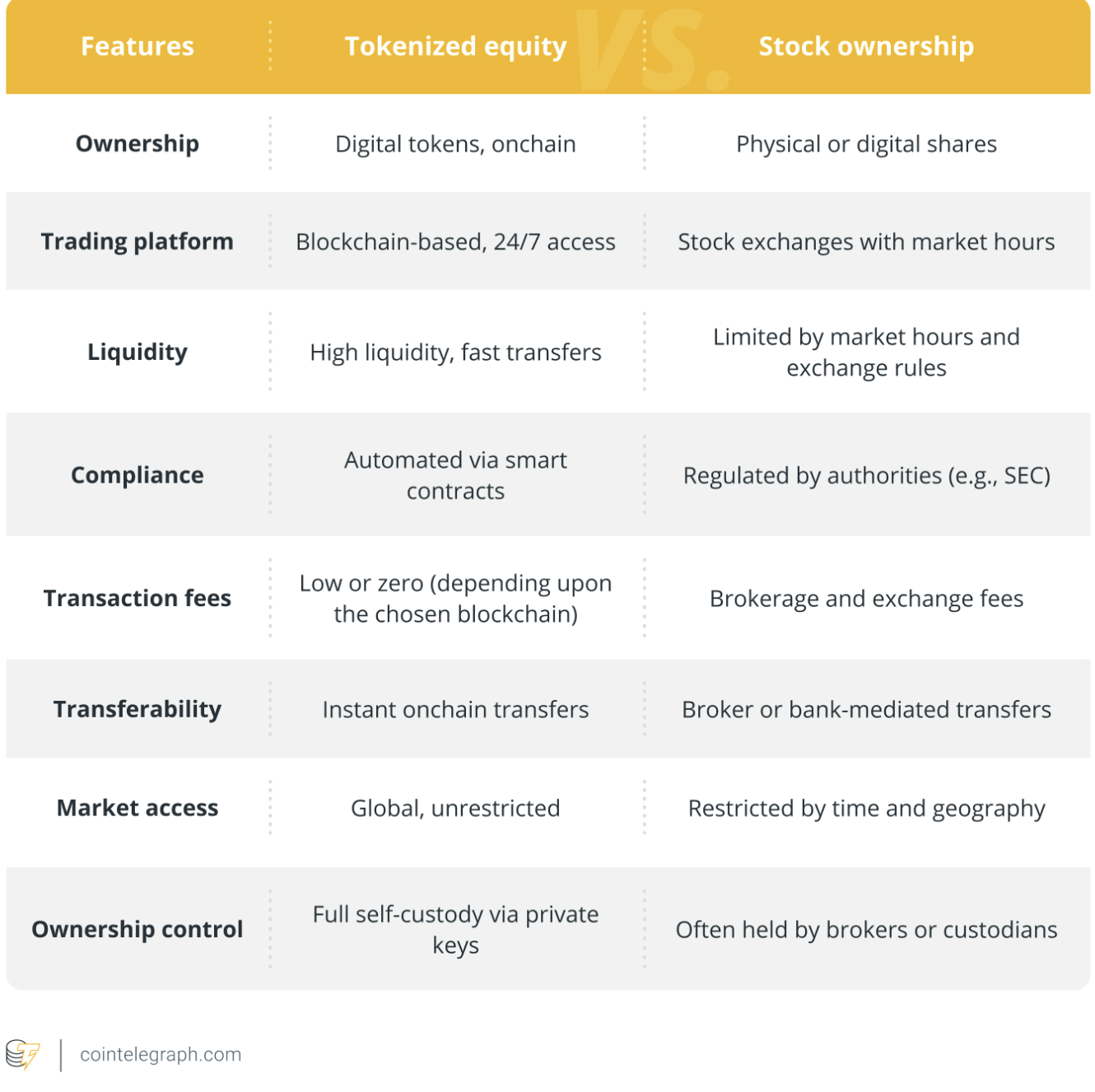
The differences between tokenized equity and shares issued through the traditional financial system. Source: Cointelegraph

Related: Tether solvency fears are ‘misplaced’ as company sits on large surplus: CoinShares

Tokenized finance is gaining steam as US regulators move to overhaul legacy financial tech

On Thursday, the US Securities and Exchange Commission (SEC) gave the green light to the Depository Trust and Clearing Corporation (DTCC), a clearinghouse and settlement company, to tokenize stocks, exchange-traded funds and bonds.

“US financial markets are poised to move onchain,” SEC Chair Paul Atkins said on Thursday, adding, “Onchain markets will bring greater predictability, transparency, and efficiency for investors.”

Source: Paul Atkins

Financial services company J.P. Morgan facilitated a $50 million tokenized bond issue for crypto investment company Galaxy Digital Holdings on the same day as Atkins’ announcement.

Crypto exchanges are also looking to expand trading of tokenized products, following the SEC’s nod to the DTCC and Atkins’ comments.

Coinbase, a US-based cryptocurrency exchange, is expected to announce its expansion into tokenized stocks and prediction markets as early as Wednesday.

The company told Cointelegraph that it will host a livestream to showcase new products, but did not specify which products would be unveiled.

Tokenized public stocks are still in the early stages of adoption, with nearly $700 million in public equities tokenized at the time of this writing, according to RWA.xyz data.

Magazine: Bitcoin whale Metaplanet ‘underwater’ but eyeing more BTC: Asia Express

Lecturas Relacionadas

In Jinjiang, Fujian, a Storage Super Unicorn Lies Quiet

In Fujian's Jinjiang, a city known for sportswear, lies a quiet semiconductor giant: Fujian Jinhua Integrated Circuit Co. (JHICC). Once a promising domestic DRAM manufacturer alongside Yangtze Memory and ChangXin Memory Technologies (CXMT), its journey was derailed in 2018 when the U.S. placed it on an Entity List and filed criminal charges for alleged trade secret theft. This halted production for years. A turning point came in February 2024 when a U.S. federal court found JHICC not guilty. However, it had lost crucial time. While CXMT soared to become a top-valued A-share company in 2024, JHICC, with an estimated valuation of 80 billion RMB, was just restarting. Its current output is primarily customized DDR4 chips, not the advanced DDR5/HBM demanded for AI, but it still benefits from the broader memory chip upcycle. JHICC's story is tied to Chen Zhengkun, a veteran engineer who left Micron to lead the venture. Founded in 2016 with state-backed funding, JHICC partnered with Taiwan's UMC to develop DRAM technology. Rapid progress was cut short by the U.S. actions, which Micron initiated, partly due to its heavy reliance on the Chinese market. Post-sanctions, Chen's team worked to rebuild the production line with reduced reliance on U.S. technology. According to its records, JHICC achieved small-scale production and revenue growth under immense pressure. It now focuses on the stable "niche" DRAM market (e.g., TVs, routers) with a monthly capacity of ~40,000 wafers, aiming for 60,000 by 2026. It holds over 1,000 patents but remains on the Entity List. For Jinjiang, investing in JHICC was a bold industrial leap. The local government provided unwavering financial and logistical support during the crisis, helping the company survive. JHICC has become the anchor for a growing local semiconductor cluster. Though its scale lags behind domestic peers, JHICC's persistence symbolizes a hard-won foothold in a global market long dominated by Samsung, SK Hynix, and Micron. Having missed one boom, it seeks a place in the new AI-driven memory supercycle.

marsbitHace 1 hora(s)

In Jinjiang, Fujian, a Storage Super Unicorn Lies Quiet

marsbitHace 1 hora(s)

Trading

Spot
活动图片




