Telegram Takes Direct Control of TON, Social Traffic Rewrites the Public Chain Narrative

marsbitPublicado a 2026-05-11Actualizado a 2026-05-11

Resumen

Telegram founder Pavel Durov announced that Telegram will replace the TON Foundation as the core driver and largest validator of The Open Network (TON). Key initiatives include a sixfold reduction in transaction fees, performance upgrades, and improved developer tools within the next few weeks. This marks a strategic shift from Telegram merely providing user access to deeply integrating TON into its platform's core infrastructure. The goal is to transform Telegram's massive social traffic into sustainable on-chain activity. While viral mini-apps like Notcoin have demonstrated Telegram's ability to drive user adoption, TON aims to support frequent, low-value transactions inherent to social platforms—such as tipping, in-app payments, and game rewards. Ultra-low fees and sub-second finality (0.6 seconds) are crucial to making blockchain interactions seamless and nearly invisible within the Telegram user experience. However, Telegram's increased central role raises questions about network decentralization. Durov argues that Telegram's participation will attract more large validators, thereby enhancing decentralization. TON also offers high annual staking rewards (18.8%), aiming to retain capital within its ecosystem. The fundamental challenge for TON is no longer leveraging Telegram's user base, but becoming an indispensable, seamless infrastructure layer for Telegram's everyday applications—moving from an adjacent chain to an embedded utility.

Author | Asher(@Asher_ 0210)
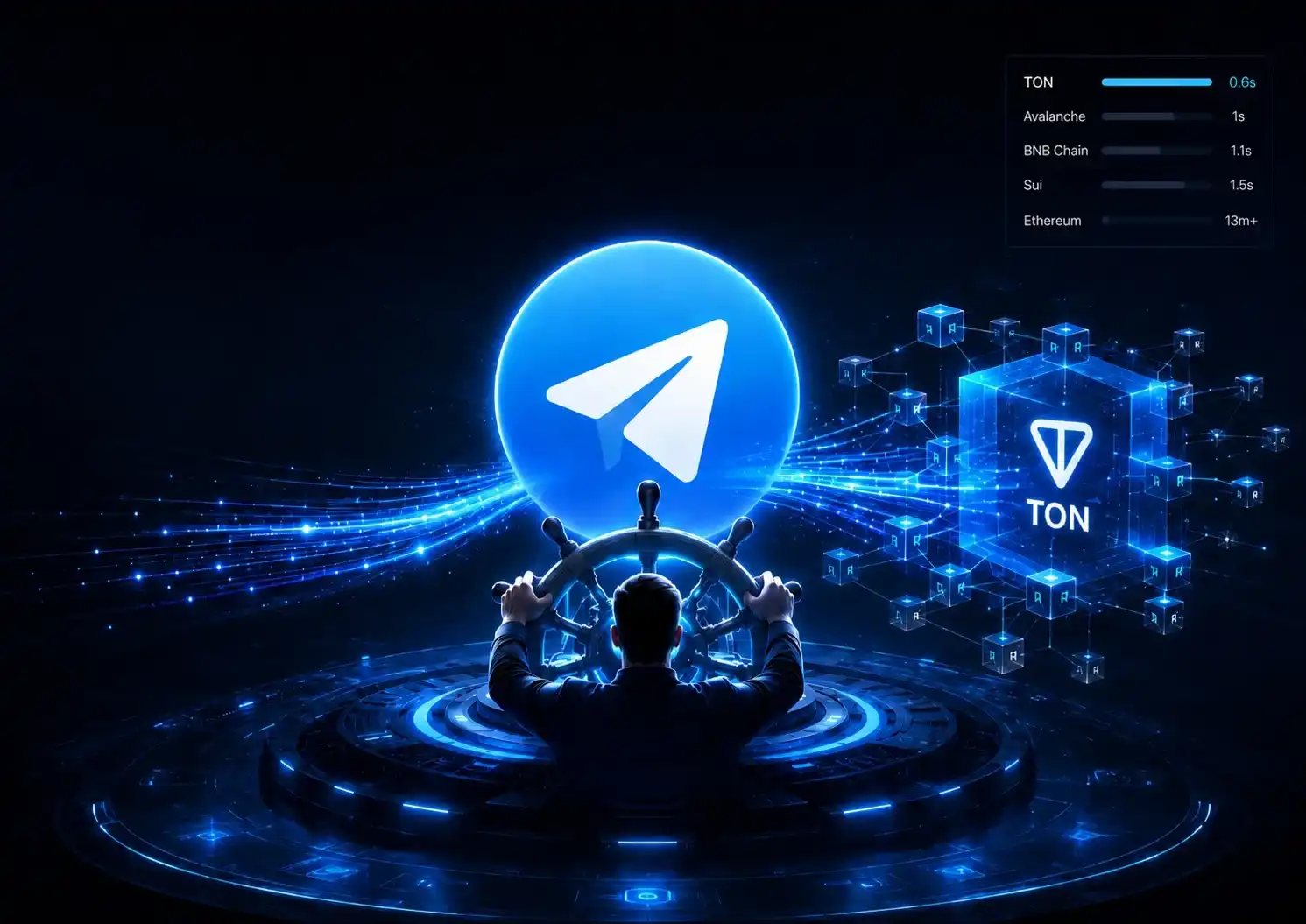
On May 4th, Telegram founder Pavel Durov announced on platform X that TON network transaction fees have been reduced by 6 times, nearing zero. More crucially, he stated that Telegram will replace the TON Foundation, becoming the new core driving force of the TON network and its largest validator. TON's focus will now shift to technological advantages, including a new ton.org, new developer tools, and performance upgrades, with a timeframe of the next 2 to 3 weeks.
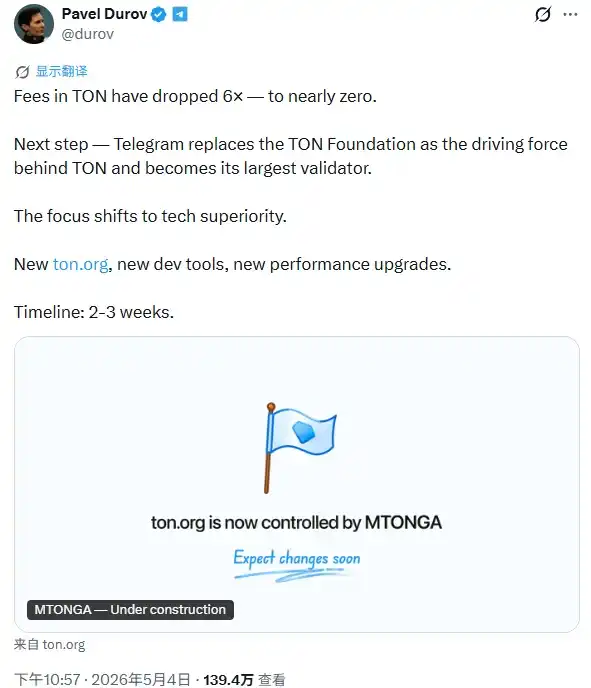
Telegram Founder: TON Fees Reduced by 6x, Telegram to Become Largest Validator

In the past, the relationship between TON and Telegram was more like a strong binding with weak leadership. Telegram provided the gateway, while the Foundation and community were responsible for advancement, with a layer of distance always between them. But this time, Telegram isn't just continuing to bring users to TON; it's beginning to enter more foundational positions such as validator, technical roadmap, and development tools. TON is no longer just a chain adjacent to the Telegram ecosystem but is being reintegrated into Telegram's product system.

TON Doesn't Lack a Gateway; It Lacks Turning the Gateway into Use Cases

Past market discussions about TON often revolved around Telegram's user scale. But for a public chain, having a gateway doesn't equal having an ecosystem, and having user reach doesn't equal having long-term usage. TON's unique aspect is its inherent attachment to a high-frequency social platform, where Mini Apps, wallets, channels, bots, games, and payments already exist within Telegram. This allows TON to avoid having to find users from scratch like most Layer1s. However, if these scenarios cannot solidify into sustained on-chain interactions, Telegram's traffic can only bring waves of short-term hype.

Projects like Notcoin and Dogs have proven that Telegram can quickly generate viral spreads. Simple gameplay combined with social relationship chains can indeed attract a large number of users into crypto applications in a short time. But such explosions come and go quickly. TG mini-games and airdrops can bring attention but can hardly alone sustain a long-term ecosystem.

Therefore, the fee reduction, speed increase, developer tools, and validator role emphasized by Pavel Durov this time point not to a single technological upgrade, but to TON addressing its most critical missing link—transforming Telegram's gateway into sustainable use cases. Only when fees are low enough, confirmation speeds are fast enough, and developer integration is simple enough can scenarios like channel tipping, Mini Apps tasks, game rewards, creator revenue, ad revenue sharing, bot calls, and group micropayments potentially evolve from product features into on-chain activities.

TON no longer needs to repeat the story of "backed by Telegram." What it truly needs to prove is whether the high-frequency behaviors within Telegram can be effectively borne by TON.

Fee Reduction and Speed Increase Aim to Enable Smaller, Higher-Frequency Transactions

The fee reduction by TON this time shouldn't be understood merely as cost optimization typical of public chains. Viewed within the context of Telegram, it actually solves the problem of whether small-amount, high-frequency interactions can become viable.

Most potential on-chain behaviors within Telegram are not large transfers but more fragmented daily operations. Individual transaction amounts are low, but occurrence frequency is high. If users have to perceive fees, wait for confirmations, and repeatedly handle wallet interactions with every button click, these scenarios can hardly truly take off.

Therefore, fee reduction and speed increase must be considered together. Fees approaching zero lower the usage barrier; reducing finality time to 0.6 seconds lowers the perception of waiting. For Telegram, the chain shouldn't become an extra layer perceived by users but should be hidden as much as possible behind product actions like sending messages, clicking buttons, and viewing balance changes.
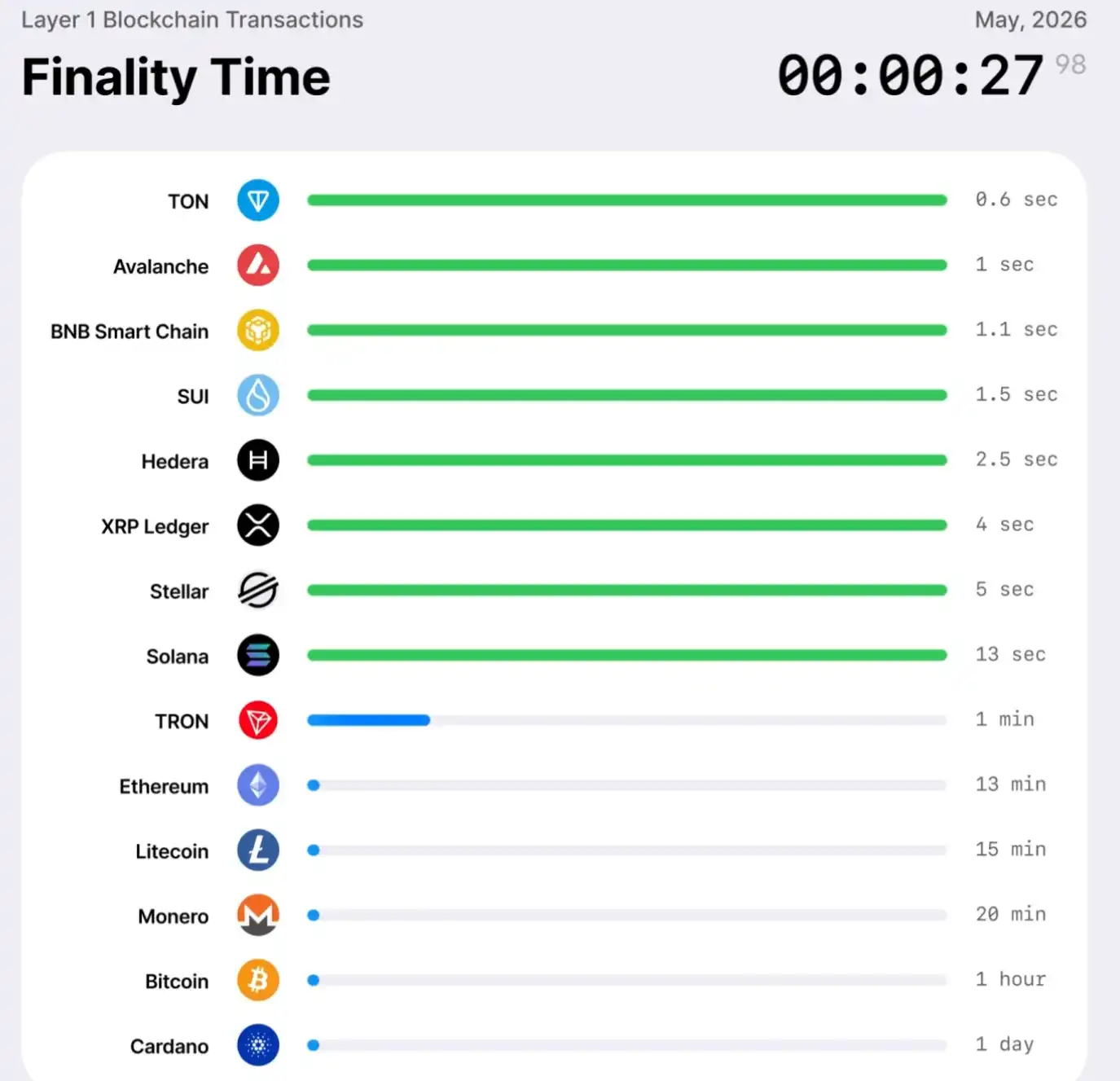
Comparison of "Finality Time" Among Mainstream Public Chains

This also distinguishes TON from many other Layer1s. Its goal isn't solely to make DeFi trades faster or transfers cheaper; it aims to embed the chain into Telegram's daily use. Only when cost, waiting time, and wallet operations are minimized enough can TON potentially evolve from a Telegram-related public chain into the underlying network directly invoked by Telegram's application layer.

From Gateway to Validator, Telegram Begins Penetrating TON's Core

Telegram becoming TON's largest validator is the most significant step in this change. It means Telegram is no longer just providing TON with a gateway and brand endorsement but is entering the network's security and operational mechanisms. Previously, TON was driven by the Foundation and community, which offered greater openness but a relatively decentralized pace. Now, with Telegram directly involved, its products, wallet, Mini Apps, payments, and developer tools have the opportunity to be realigned.

Efficiency may increase, but controversy will also grow. Telegram replacing the TON Foundation as the main driving force and becoming the largest validator will inevitably lead to renewed external discussions about TON's centralization risks. In response, Pavel Durov stated that Telegram's participation would attract more large-scale participants into the validator pool, thereby enhancing decentralization. This logic is not without merit, but the final judgment will depend on results, not statements.

The truly important aspects going forward are whether the validator structure can become more diverse, whether governance information is sufficiently transparent, whether the Foundation and community retain independent space, and whether ecosystem projects can continue developing without relying on Telegram's will.

Therefore, Telegram's return is not a simple positive but a trade-off. For TON to enter the mainstream application layer, it needs Telegram's strong execution capabilities; but the more prominent Telegram's role, the more TON needs to prove it is not merely an internal settlement chain serving Telegram.

High Staking Rewards Retain More Tokens for TON

Pavel Durov subsequently emphasized that TON ranks first in annual staking rewards among the top 50 cryptocurrencies by market cap, with a high rate of 18.8%. Compared to fee reduction and speed increase, high staking rewards are more likely to mobilize capital sentiment and provide TON with another layer of holding rationale in the market's eyes.
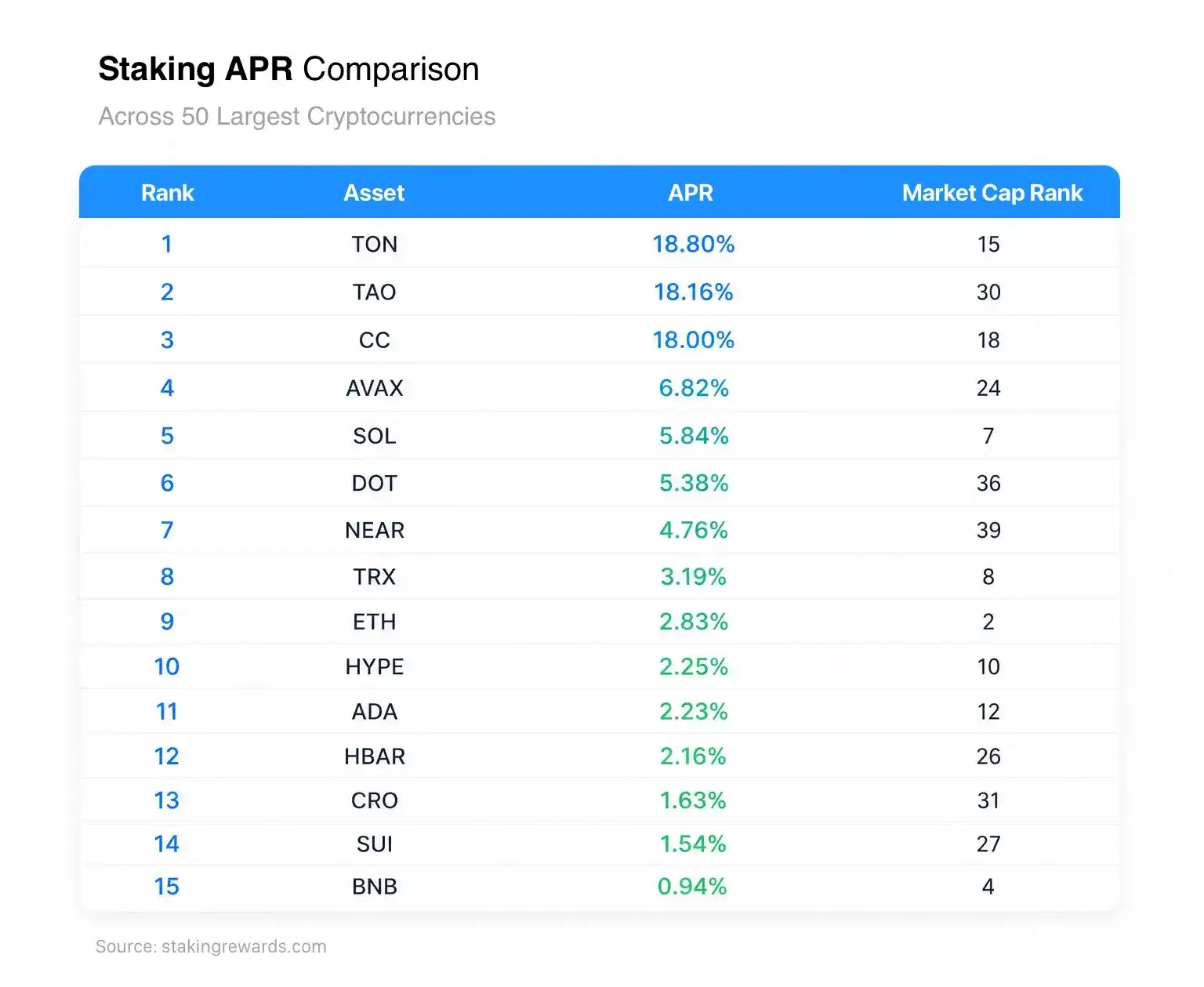
TON Annual Staking Rewards Rank First Among Top 50 Cryptocurrencies

This also makes TON's narrative somewhat more complete. It's not just relying on Telegram's user gateway to attract attention or improving experience through technical upgrades; it's also using staking rewards to keep capital within its ecosystem. The simultaneous presence of gateway, performance, validators, and rewards makes this change more substantial than a single positive factor.

Of course, high yield itself is not the end goal; it's more like buying TON a longer observation period. As long as subsequent developer tools and performance upgrades are delivered, and more capital is locked into the network, a positive feedback loop with real usage may form. For TON, the value of staking rewards isn't just about increasing holding returns but making the market willing to continue waiting for it to truly convert Telegram's gateway advantage.

TON's Return to Telegram Is Not the Finish Line, But a Tougher Challenge

The key for TON going forward is not to continue leveraging Telegram for traffic, but to truly become part of Telegram's application ecosystem. If Telegram's chat, payments, applications, creator economy, and automated interactions are gradually undertaken by TON, then TON's competitors will not just be other Layer1s, but all networks attempting to become the next-generation application infrastructure.

TON isn't just repeating the social traffic story; it's beginning to attempt to turn social traffic into on-chain order. The gateway is just the beginning; usage is the answer. Telegram can push TON to the forefront, but whether it stays there ultimately depends on whether TON can become the layer of infrastructure that operates behind user perception, within the functioning of applications.

If the past TON was still proving how close it is to Telegram, now it must prove how deeply integrated it can be within Telegram's daily use. True mainstream adoption isn't about making users aware they are using a chain, but about making the chain part of the application experience.

TON's opportunity lies here, and so does its pressure.

Preguntas relacionadas

QAccording to the article, what is the new role that Telegram will assume in the TON network, as announced by Pavel Durov?

ATelegram will become the new core driver of the TON network, replacing the TON Foundation. It will also become the network's largest validator.

QWhat is identified as the key challenge TON needs to overcome, beyond just having access to Telegram's large user base?

ATON needs to transform its access and user reach into sustainable, long-term usage scenarios. It must convert Telegram's high-frequency social interactions into persistent on-chain activities.

QWhy are the reductions in transaction fees and improvements in speed particularly important for TON within the Telegram context?

ALow fees (approaching zero) and fast finality (0.6 seconds) are crucial to enable the small, frequent, and fragmented transactions typical of Telegram's daily use cases. They lower the barrier and reduce user friction, allowing the blockchain to operate seamlessly in the background of the app experience.

QWhat potential downside or concern is raised regarding Telegram becoming the core driver and largest validator of TON?

AThe move raises concerns about increased centralization risk and questions regarding the future independence of the TON Foundation and community projects. It represents a trade-off between stronger execution from Telegram and the need for TON to maintain network decentralization.

QHow does the article frame the high annual staking reward offered by TON, and what purpose does it serve?

AThe high staking reward (18.8% annually, ranked first among top 50 cryptocurrencies) is seen as a mechanism to attract and lock in capital within the TON ecosystem. It provides an additional incentive for holding TON and buys time for the network to realize its potential in converting Telegram's user base into active usage.

Lecturas Relacionadas

Will the Next Crypto Bull Run Start with On-Chain Trading of SpaceX?

This article presents a scenario-based forecast for the crypto industry from 2026 to 2029, arguing that the next major cycle will be driven not by technological narratives but by legal access to real-world assets. The author predicts that by mid-2026, pre-IPO perpetual contracts for top private companies like SpaceX, OpenAI, and Anthropic on platforms like Hyperliquid will become the primary gateway for accessing quality assets, as most crypto-native tokens fail to capture real value. The much-hyped AI x Crypto intersection largely fails except for prediction markets, which thrive on betting on AI model supremacy. By 2027, public blockchain foundations are forced to choose between catering to retail speculation or building compliant infrastructure for institutions, with many opting for the latter. Growth in stablecoins and tokenized private credit/equity hits a "triple ceiling" due to regulatory and political uncertainty rather than market demand. The pivotal shift is forecast for 2028. A major liquidation event in pre-IPO perpetuals exposes the structural flaw of synthetic markets lacking a real underlying asset anchor. In response, regulatory changes finally allow the public solicitation of private securities resales to verified accredited investors. This creates a legitimate secondary market for real company equity, which then becomes the core asset class of the new bull market, relegating synthetic perps to a niche role. By 2029, the industry becomes "boring" but foundational. Tokens without claims on real cash flows or assets cease trading. Stablecoin growth is steady but politically capped. Crypto infrastructure fades from view as it gets absorbed into traditional finance backends. The article's central thesis is that the key bottleneck for crypto's next phase is legal and regulatory channels for real asset ownership, not technology.

marsbitHace 30 min(s)

Will the Next Crypto Bull Run Start with On-Chain Trading of SpaceX?

marsbitHace 30 min(s)

The Value Distribution of Stablecoins

**Summary: The Value Distribution of Stablecoins** The article argues that stablecoins are evolving from mere trading tools into broader channels for dollar access. It divides the stablecoin ecosystem into four layers to analyze how value is distributed: 1. **Issuance Layer:** Mints stablecoins, holds reserve assets, and captures the spread between reserve yield and user costs (e.g., Tether, Circle). This layer currently earns the largest profit margin. 2. **Infrastructure Layer:** Connects stablecoins to the traditional financial system, handling fiat on/off-ramps, banking integration, compliance (KYC/AML), and asset management (e.g., Bridge, BVNK). This is the "unglamorous" but critical work, building the essential bridges between crypto and real-world finance. 3. **Acquiring/Distribution Layer:** Integrates stablecoins into merchant systems, manages payment flows, and provides enterprise financial software (e.g., Stripe, Coinbase). They act as the access point for businesses. 4. **Application Layer:** The end-users and businesses that ultimately use stablecoins for payments, settlements, or as a store of value. They benefit from convenience but have little pricing power. The core thesis is that while the issuance layer currently dominates profits, the often-overlooked **infrastructure layer holds significant long-term potential**. The real challenge and barrier to mass adoption is not the on-chain transfer of stablecoins (which is simple), but the complex "last mile" integration into existing business workflows, banking systems, and regulatory frameworks across different countries. Companies in this layer are currently in a "land grab" phase, investing heavily to build networks, secure bank partnerships, and establish compliance pathways. While their position is currently pressured by the profitable issuers above and distribution platforms below, the article suggests that if stablecoins become a default financial rail for businesses, the infrastructure providers who have done the hard work of integration will ultimately gain strong pricing power and become entrenched, essential players.

marsbitHace 7 hora(s)

The Value Distribution of Stablecoins

marsbitHace 7 hora(s)

The Value Distribution of Stablecoins

The Value Distribution of Stablecoins The article argues that stablecoins are evolving from a mere trading tool into a broad "dollar channel." It analyzes the industry's value chain through four layers: 1. **Issuance Layer (e.g., Tether, Circle):** The top layer that mints stablecoins, holds reserve assets, and captures the thickest interest rate spread. 2. **Infrastructure Layer (e.g., Bridge, BVNK):** Connects stablecoins to the traditional financial system, handling critical but complex "dirty work" like fiat on/off-ramps, banking integration, compliance (KYC/AML), and cross-border settlement. 3. **Acquiring/Distribution Layer (e.g., Stripe, Coinbase):** Embeds stablecoins into merchant systems, manages payment flows, and integrates with enterprise software. 4. **Application Layer:** End-users and businesses that ultimately use stablecoins for payments, settlement, or storing value. The author posits that while the issuance layer currently captures the most profit, the most overlooked and potentially critical layer is infrastructure. The core challenge for stablecoin adoption isn't the on-chain transfer (which is simple), but bridging the gap between blockchain and the real-world financial system. This involves solving practical problems for businesses: fiat conversion, reconciliation, tax handling, and user onboarding. Infrastructure companies are currently in a difficult "land-grab" phase—building networks, securing banking relationships, and achieving compliance country-by-country. They face pressure from both the profitable issuance layer above and distribution platforms below. However, the author suggests this layer is building a crucial moat. Once stablecoins become a default business rail, the infrastructure players who have done the hard work of integration may gain significant, durable value and pricing power.

链捕手Hace 7 hora(s)

The Value Distribution of Stablecoins

链捕手Hace 7 hora(s)

Trading

Spot
Futuros

Artículos destacados

Cómo comprar TON

¡Bienvenido a HTX.com! Hemos hecho que comprar The Open Network (TON) sea simple y conveniente. Sigue nuestra guía paso a paso para iniciar tu viaje de criptos.Paso 1: crea tu cuenta HTXUtiliza tu correo electrónico o número de teléfono para registrarte y obtener una cuenta gratuita en HTX. Experimenta un proceso de registro sin complicaciones y desbloquea todas las funciones.Obtener mi cuentaPaso 2: ve a Comprar cripto y elige tu método de pagoTarjeta de crédito/débito: usa tu Visa o Mastercard para comprar The Open Network (TON) al instante.Saldo: utiliza fondos del saldo de tu cuenta HTX para tradear sin problemas.Terceros: hemos agregado métodos de pago populares como Google Pay y Apple Pay para mejorar la comodidad.P2P: tradear directamente con otros usuarios en HTX.Over-the-Counter (OTC): ofrecemos servicios personalizados y tipos de cambio competitivos para los traders.Paso 3: guarda tu The Open Network (TON)Después de comprar tu The Open Network (TON), guárdalo en tu cuenta HTX. Alternativamente, puedes enviarlo a otro lugar mediante transferencia blockchain o utilizarlo para tradear otras criptomonedas.Paso 4: tradear The Open Network (TON)Tradear fácilmente con The Open Network (TON) en HTX's mercado spot. Simplemente accede a tu cuenta, selecciona tu par de trading, ejecuta tus trades y monitorea en tiempo real. Ofrecemos una experiencia fácil de usar tanto para principiantes como para traders experimentados.

537 Vistas totalesPublicado en 2024.12.10Actualizado en 2026.06.02

Cómo comprar TON

Discusiones

Bienvenido a la comunidad de HTX. Aquí puedes mantenerte informado sobre los últimos desarrollos de la plataforma y acceder a análisis profesionales del mercado. A continuación se presentan las opiniones de los usuarios sobre el precio de TON (TON).

活动图片