Artículos Relacionados con Yield

El Centro de Noticias de HTX ofrece los artículos más recientes y un análisis profundo sobre "Yield", cubriendo tendencias del mercado, actualizaciones de proyectos, desarrollos tecnológicos y políticas regulatorias en la industria de cripto.

MoonPay's Latest Integration Enables AI Agents to Handle Crypto Lending on Solana

The latest integration of MoonPay enables AI agents to process cryptocurrency lending on Solana through the Kamino platform, which has a total value locked of about $1.3 billion and active loans of $1 billion. This integration allows users to delegate tasks to an AI tool, such as supplying Kamino tokens to earn yield or borrowing the USD-pegged stablecoin USDC against collateral deposited on the platform. However, it does not create a new lending product; instead, it replaces Kamino’s standard interface with natural-language instructions for AI interaction. Users can require password confirmation for each transaction or permit the AI to operate autonomously within set limits. To date, agentic crypto usage has primarily focused on small, high-frequency payments for data, computing power, and online tools, with Coinbase’s x402 processing around $50 million across 165 million payments. This development expands into managing user funds, where an instruction could create a leveraged position requiring ongoing monitoring. As an emerging technology, AI remains prone to execution errors that could prove costly when handling finances. While the integration lets users manage positions via conversation with the software, risks persist—if collateral value drops sufficiently, a position could hit Kamino’s liquidation threshold, allowing liquidators to repay the debt and seize part of the collateral. In July, MoonPay launched PayBox with features for payments, token swaps, bridges, and yield access via Aave. The Kamino integration represents an extension of a major Solana lending platform and a step for PayBox toward decentralized finance, as agentic payment tools expand into capital allocation and lending. The service is not available in the U.S., U.K., European Union, or Australia, and access may vary by asset and jurisdiction.

cryptonews.ruHace 2 días 11:43

MoonPay's Latest Integration Enables AI Agents to Handle Crypto Lending on Solana

cryptonews.ruHace 2 días 11:43

When 34% of ETH is Staked: In the Era of Native Compounding, How Should You Choose Staking?

As Ethereum staking reaches a record 34.7% of the total supply, it is evolving from a niche technical activity into a standardized asset management practice. This article analyzes four primary staking methods for ETH holders, highlighting their core trade-offs between control, convenience, and risk. The foundational method is solo staking, which requires 32 ETH and running one's own validator node. It offers full control and native rewards but demands significant technical expertise and constant maintenance. Non-custodial native staking, like services offered by imToken, provides a middle ground. Users control their withdrawal keys and assets while outsourcing node operation to professional providers. This maintains self-custody but transfers operational risk. For users without 32 ETH or those prioritizing liquidity, liquid staking protocols like Lido are key. Users deposit ETH to receive a liquid staking token (e.g., stETH), enabling continued participation in DeFi. This introduces additional smart contract and protocol risks but solves liquidity constraints. Exchange-based staking offers the lowest barrier to entry, handling all technical complexities and custody. However, it requires full trust in the platform's management of assets, node operations, and reward distribution. The choice depends on individual priorities: control (solo staking), balanced custody (non-custodial native), liquidity (liquid staking), or simplicity (exchange). With developments like Pectra enabling native compounding and traditional finance integrating staking into ETFs, the ecosystem is maturing. The key takeaway is that the decision should weigh factors like control, liquidity, and third-party risk, not just the Annual Percentage Rate (APR). The true cost of staking encompasses what rights and risks are delegated alongside the potential reward.

marsbitHace 2 días 03:01

When 34% of ETH is Staked: In the Era of Native Compounding, How Should You Choose Staking?

marsbitHace 2 días 03:01

Why Ethereum Staking Will Change in 2026

The article discusses the evolving role of Ethereum (ETH) staking, shifting from a niche crypto enthusiast topic to a mainstream portfolio management tool for financial advisors and institutional investors. It explains how staking works in Ethereum's Proof-of-Stake network, detailing validator requirements and methods like solo staking, pools, exchanges, and liquid staking protocols, each with its own risk-reward profile (e.g., liquidity, control, technical requirements). A key point is staking's growing importance for corporate treasuries, where staking rewards represent a significant income stream, unlike non-yielding Bitcoin holdings. Looking ahead, the article highlights the anticipated 'Glamsterdam' upgrade in late 2026 as a pivotal development expected to enhance scalability, decentralization, and post-quantum resistance, further solidifying Ethereum's institutional appeal. It also emphasizes that while staking offers passive income and network participation, risks include technical failures, slashing penalties, platform/custodial risks, and regulatory uncertainty. For advisors, the conclusion stresses the need to evaluate staking providers beyond just promised yields, focusing on reliability, fees, withdrawal terms, security, and the specifics of reward structures (protocol vs. MEV-based). The regulatory landscape and infrastructure maturity around digital asset custody are noted as critical adjacent topics to monitor.

cryptonews.ruHace 2 días 20:07
Why Ethereum Staking Will Change in 2026

cryptonews.ruHace 2 días 20:07
Scott Bessent's Risky Bond Buyback Operation Could Fuel Bitcoin Price Surge

Bitcoin returned to the $80,000 level on Thursday, breaking past a key $79,000 resistance point, on news of an upcoming $92 billion U.S. Treasury bill auction scheduled for August 31st. The price recovery saw Bitcoin reach a daily high of $80,808, though it faced brief selling pressure. The cryptocurrency was trading around $80,400 by late morning EST, marking a roughly 3% daily increase and pushing its market cap back to $1.61 trillion. This surge positions Bitcoin for a monthly gain of over 20%, a sharp reversal from July's flat performance. The volatility led to $105 million in leveraged Bitcoin positions being liquidated in 24 hours, with short positions accounting for the majority of losses. Analysts note the large-scale Treasury auction could drain short-term market liquidity, potentially pushing yields higher and pressuring risk assets like stocks and crypto. Furthermore, a recent article in The Economist warns that U.S. Treasury Secretary Scott Bessent's policies risk undermining confidence in the American financial system. The report criticizes measures to artificially cap long-term bond yields and a shift towards issuing more short-term T-bills, which shortens the overall debt duration and increases vulnerability to future rate hikes. This approach, along with distorting market pricing mechanisms, could jeopardize long-term investor trust in U.S. sovereign debt. Prominent figures like Ray Dalio suggest such policies are reducing the inflation-adjusted yield of traditional fixed-income assets, potentially driving capital seeking a store of value towards alternatives like gold and Bitcoin, whose prices have risen since the Treasury's announcements.

cryptonews.ruHace 2 días 20:06

Scott Bessent's Risky Bond Buyback Operation Could Fuel Bitcoin Price Surge

cryptonews.ruHace 2 días 20:06

Solana Proposals Could Lead to Reduction in Staking Yields to 2.25% and Cut Emissions by $1.5 Billion

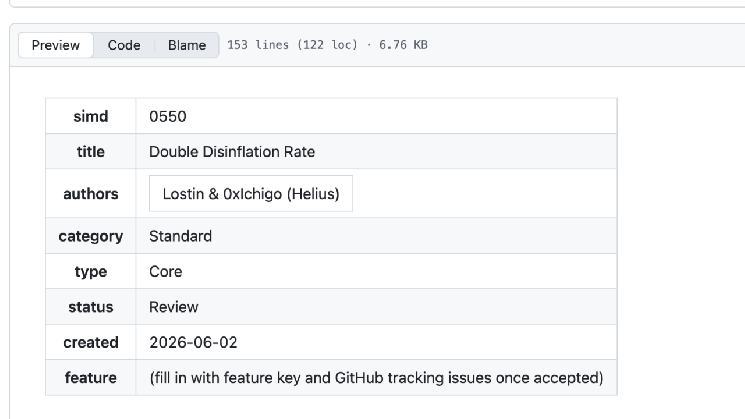
Solana is moving towards a stricter monetary model that could lead to a SOL deficit and significantly reduce staking rewards for holders. Two governance proposals drive these changes. SIMD-550, currently under vote, would double Solana's annual disinflation rate from 15% to 30%, accelerating the timeline to reach a final inflation rate of ~1.5% to the first half of 2029. The second, SIMD-553 (already approved), introduces additional token burning tied to computational units used on the network. Together, these measures could reduce SOL emission by an estimated $1.4-$1.5 billion over six years. The immediate impact would be lower staking yields, potentially falling from the current ~5.25% to approximately 4.34% in year one, 3% in year two, and 2.25% by year three. Analyst Matt Mena from 21Shares suggests inflation should be tied to economic metrics to help offset this decline. The changes also raise concerns for validator economics, with some potentially becoming unprofitable as inflation rewards decrease and voting costs may rise. However, the lower passive yield might push a significant portion of the 67.9% staked SOL into Solana's DeFi ecosystem for activities like lending and trading. This shift could boost network fee revenue to compensate for lower inflation rewards. The proposals aim to trade lower yield today for less dilution tomorrow, betting that network growth and usage will make this a worthwhile trade-off for SOL holders.

cryptonews.ru08/27 16:27

Solana Proposals Could Lead to Reduction in Staking Yields to 2.25% and Cut Emissions by $1.5 Billion

cryptonews.ru08/27 16:27

Japanese Rates Return to 1996 Levels, Can Bitcoin Withstand the September Rate Hike?

Japanese borrowing costs have hit their highest levels since 1996, with yields on 30-year bonds reaching 4.185%. This marks a significant shift for a country long reliant on negative rates. Concurrently, Bitcoin surged 22% past $80,000, seemingly decoupled from the bond market turmoil. Historically, the massive yen carry trade has fueled global risk assets, predicated on near-zero Japanese rates. This assumption is now challenged. A potential rate hike by the Bank of Japan in September could strengthen the yen, forcing carry trade unwinds and potentially triggering a global deleveraging event, as seen in August 2024 when Bitcoin fell sharply. Conversely, if the yen weakens further, Bitcoin could attract Japanese investors as a hedge against currency depreciation and the country's massive debt burden. Institutional adoption in Japan is growing, with regulatory changes paving the way for potential crypto ETFs by 2027. The key variable is the BoJ's September policy signal. If it hints at a rapid tightening cycle to combat inflation and support the yen, risk assets like Bitcoin may face selling pressure from carry trade liquidation. However, if debt sustainability concerns limit its hawkishness, leading to a weaker yen, Bitcoin could benefit. Currently, the market is betting on a slow-motion debt crisis, not a sudden collapse. While Bitcoin shows resilience, its fate remains tied to the direction of the yen and the scale of any carry trade unwind.

marsbit08/27 12:23

Japanese Rates Return to 1996 Levels, Can Bitcoin Withstand the September Rate Hike?

marsbit08/27 12:23

活动图片