Artículos Relacionados con SOTA

El Centro de Noticias de HTX ofrece los artículos más recientes y un análisis profundo sobre "SOTA", cubriendo tendencias del mercado, actualizaciones de proyectos, desarrollos tecnológicos y políticas regulatorias en la industria de cripto.

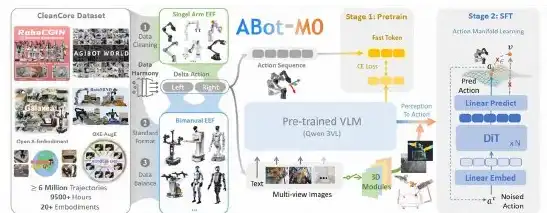
Embodied Intelligence Breakthrough: Amap Fully Open-Sources Universal Robot Base Model ABot-M0

Embodied Intelligence Breakthrough: AutoNavi Open-Sources Universal Robot Base Model ABot-M0 AutoNavi has announced the full open-source release of ABot-M0, the world's first unified architecture-based embodied manipulation base model. This model is designed to enable "one general brain to adapt to multiple forms of robots," aiming to break down barriers between heterogeneous hardware and accelerate the adoption of embodied intelligence in industrial and household settings. ABot-M0 demonstrated exceptional performance in industry tests, achieving a task success rate of 80.5% on the Libero-Plus benchmark—a nearly 30% improvement over the previous benchmark, Pi0. It also set new state-of-the-art records on benchmarks like Libero and RoboCasa. The open-source release addresses long-standing challenges in the field, such as data isolation and deployment difficulties, by providing resources across three key dimensions: - **Data:** The UniACT dataset, the largest of its kind, with over 6 million real operation trajectories and full data pipeline tools. - **Algorithm:** The model architecture and training framework, featuring innovative components like Action Manifold Learning (AML) and a dual-stream perception architecture. - **Model:** End-to-end pre-trained models and a complete toolchain for out-of-the-box deployment, significantly lowering the barrier to adaptation. According to AutoNavi's ABot-M0 technical lead, this open-source initiative aims to build a bridge between academic research and industrial application, enabling robots of various forms to possess a smart, reliable, and universal "brain."

marsbit04/01 08:19

Embodied Intelligence Breakthrough: Amap Fully Open-Sources Universal Robot Base Model ABot-M0

marsbit04/01 08:19

Just 6 Days After Launching ChatGPT Health, OpenAI Is Surpassed on Its Own Medical Benchmark

In a significant development in the AI healthcare sector, Baichuan Intelligence has surpassed OpenAI's GPT-5.2 High on the HealthBench benchmark—a medical evaluation dataset created by OpenAI with input from 260+ doctors across 60 countries—just six days after OpenAI launched ChatGPT Health. Baichuan's new model, Baichuan-M3, achieved a top score of 65.1 and also led in the more challenging HealthBench Hard subset, while demonstrating the lowest hallucination rate (3.5%) without relying on external tools. Key to M3’s performance is its Fact Aware RL technique, which improves diagnostic accuracy by balancing factual precision with proactive questioning. The model avoids both over-confident errors and overly vague responses. Additionally, Baichuan introduced SCAN-bench, a new evaluation framework designed to simulate real doctor-patient interactions. In tests, M3 outperformed human specialists in areas like safety stratification, clarity, and diagnostic questioning, partly due to its ability to integrate knowledge across medical disciplines. Baichuan is now rolling out the model via its consumer product Baixiaoying (百小应), offering tailored interfaces for both doctors and patients. The company emphasizes a focus on "serious medicine," prioritizing complex areas like oncology over general wellness, aiming to augment—not just assist—medical professionals. According to CEO Wang Xiaochuan, enhancing AI’s capability in high-stakes medical scenarios is crucial for building user trust and advancing toward AGI through deeper biological understanding.

marsbit01/14 02:31

Just 6 Days After Launching ChatGPT Health, OpenAI Is Surpassed on Its Own Medical Benchmark

marsbit01/14 02:31

Lighthouses Guide the Way, Torches Claim Sovereignty: A Hidden War Over AI Allocation Rights

The article "Lighthouse Guides Direction, Torch Fights for Sovereignty: A Hidden War Over AI Allocation" by Zhixiong Pan examines the underlying power struggle in AI development, moving beyond superficial metrics like model size and performance rankings. It identifies two coexisting paradigms: the "Lighthouse," representing state-of-the-art (SOTA), centralized AI systems controlled by tech giants like OpenAI and Google, which push cognitive boundaries but are resource-intensive and create dependency risks; and the "Torch," symbolizing open-source, locally deployable models (e.g., DeepSeek, Mistral) that democratize access, ensure data sovereignty, and enable private, customizable AI assets. The Lighthouse drives innovation and sets technical directions but poses risks in accessibility, control, and single-point failures. The Torch, while shifting security and responsibility to users, offers resilience, cost stability, and compliance for critical applications in sectors like healthcare and finance. The interplay between these models forms a symbiotic relationship: Lighthouses expand capabilities, while Torches disseminate and stabilize these advances, collectively elevating AI’s baseline. Ultimately, the conflict is over AI allocation rights—defining default intelligence, managing externalities, and determining individual control. A dual strategy—using Lighthouses for frontier tasks and Torches for private, reliable deployment—is proposed as the pragmatic path forward, balancing extreme capability with broad, sovereign access. The true measure of the AI era lies not in raw power but in whether individuals possess "a light they don’t have to borrow from anyone."

marsbit12/22 11:13
Lighthouses Guide the Way, Torches Claim Sovereignty: A Hidden War Over AI Allocation Rights

marsbit12/22 11:13

活动图片