Artículos Relacionados con Risk Assessment

El Centro de Noticias de HTX ofrece los artículos más recientes y un análisis profundo sobre "Risk Assessment", cubriendo tendencias del mercado, actualizaciones de proyectos, desarrollos tecnológicos y políticas regulatorias en la industria de cripto.

Anthropic Creates an AI Jailbreak 'Penal Code': Your Requests, Four Ways to Die

Anthropic has publicly detailed its security measures and a new "Cyber Jailbreak Severity" (CJS) framework following the controversial takedown of its Fable 5 model. The incident, triggered by simple user requests like counting letters or stating a profession, highlighted overzealous safety filters. Anthropic classifies cybersecurity-related prompts into four tiers: malicious activities (blocked), high-risk dual-use (like pentesting, with strict limits), low-risk dual-use (often blocked by "safety margin" errors), and harmless tasks (theoretically allowed but still frequently flagged). The company admits its classifiers are tuned for high sensitivity, leading to many false positives. The newly proposed CJS framework aims to objectively score the severity of AI "jailbreaks" (prompts that bypass safety rules) on a 0-10 scale across four dimensions: Capability Gain (does it grant new attack abilities?), Breadth (does it work across multiple attack types?), Weaponization Ease (how hard is it to turn into a real attack?), and Discoverability (how easy is it to find?). The score determines the response, from no action (CJS-0) to a potential model takedown (CJS-4). The score is context-dependent; for example, discovering a major unknown vulnerability today scores high, while asking about a well-known one scores low. The article raises concerns about Anthropic's dual role: it is both creating powerful models (like the restricted Mythos 5) and defining the rules (CJS) for judging their misuse, potentially giving it disproportionate influence. This is set against the backdrop of U.S. export controls, which for the first time directly restricted API access to a model (Fable 5), creating a "tiered" system where public models are heavily filtered and advanced ones are limited to vetted partners. The CJS framework is portrayed as potentially providing regulators with a metric to justify future API shutdowns. For users, the advice is to carefully phrase prompts, watch for signs of being downgraded to a weaker model, and wait indefinitely for promised filter improvements.

marsbit07/06 00:24

Anthropic Creates an AI Jailbreak 'Penal Code': Your Requests, Four Ways to Die

marsbit07/06 00:24

If It's Not a Clear Yes, It's a No: A Nine-Year Retrospective by a VC Who Survived Four Cycles

**"Invest Only When Certain": A Nine-Year Retrospective from a VC Across Four Cycles** IOSG founder Jocy shares hard-earned lessons from nine years and over a hundred investments in Web3. The core challenge isn't identifying successful founders, but understanding why talented founders with solid ideas still fail. Through building a "failed founder database," IOSG identified six recurring failure patterns. **Founder Trait Red Flags:** 1. **Emotionally Unstable:** Founders who react defensively to criticism or publicly lash out under pressure (e.g., 80% drawdowns) often fail. Resilience is key. 2. **Lacking Hunger / Having a Fallback:** Founders with significant safety nets (family wealth, cushy fallback jobs) may lack the "do-or-die" commitment needed to survive crypto's brutal cycles. 3. **Unchecked Ego:** Includes "polished execution machines" who excel in known frameworks but struggle when paradigms shift, and "professor-types" who are technically brilliant but resistant to commercial feedback or coaching. **Project Structure Red Flags:** 4. **Token-First, Not Product-First:** Treating the token solely as a fundraising tool with no real utility or connection to product value is a major warning sign. The project should have value even if the token goes to zero. 5. **No Day-1 Exit Thesis:** Founders must have a clear, staged capital strategy from the start, understanding what each funding round needs to prove to unlock the next. "Exit before entry" is crucial. 6. **No Full-Cycle Experience:** Founders who haven't lived through a complete crypto bull/bear cycle (e.g., 2018, 2022) often underestimate their vulnerability. IOSG limits initial checks for such teams to $250k, sizing for risk. **The Positive Flipside: Desirable Founder Traits** The ideal candidate exhibits: obsessive problem-depth, being a second-time founder with a non-consensus vision, strong communication skills with *controlled* ego, relentless perseverance, and a global perspective with agency and taste (increasingly vital in the AI era). **Three Survival Tips for Founders:** 1. **Cash Flow Over Narrative:** Real revenue is what sustains projects, not vanity metrics. 2. **Tokens Are a Liability:** Avoid issuing a token unless absolutely necessary. The hidden costs (market making, liquidity, compliance) are immense, often a multi-million-dollar burden. 3. **Respect Liquidity:** Sell during peaks to build treasury, buy back to support the protocol during troughs. Be realistic about valuations and your ability to deliver for the next round. The final principle is simple yet paramount: **"If it's a borderline 'yes' or 'no,' don't invest."** In an industry that reinvents itself every few years, the discipline to consistently say "no" is the ultimate secret to longevity.

Foresight News06/24 07:46

If It's Not a Clear Yes, It's a No: A Nine-Year Retrospective by a VC Who Survived Four Cycles

Foresight News06/24 07:46

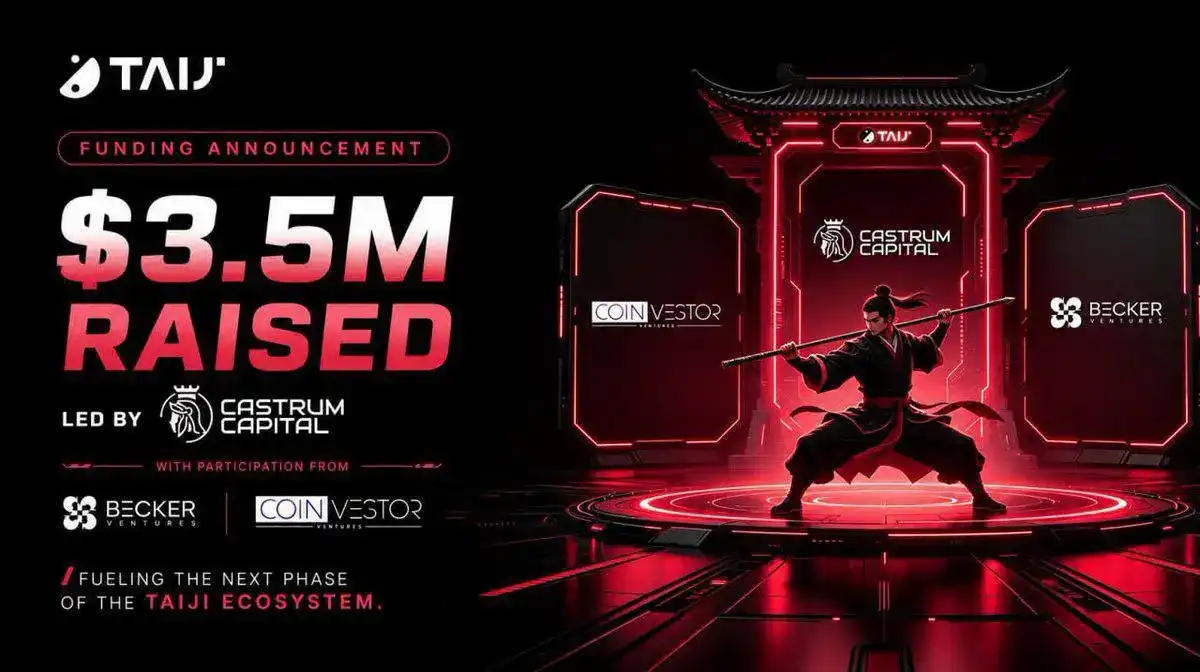
TaiJi Completes $3.5 Million Strategic Financing with Participation from Castrum Capital, Becker Ventures, and Coinvestor Ventures

TaiJi, an AI-driven market intelligence platform for Web3, has completed a $3.5 million strategic funding round. The investment was led by Castrum Capital, Becker Ventures, and Coinvestor Ventures. The funds will be allocated to product R&D, upgrading its AI inference engine, building a multi-agent analysis system, improving market data infrastructure, expanding its global community, and advancing ecosystem partnerships, particularly within the BSC ecosystem. TaiJi aims to transform how users understand the Web3 market by moving beyond simple data display. It integrates market data, on-chain signals, liquidity changes, social sentiment, and news events into a unified AI system. This system generates structured event inferences, impact pathways, risk assessments, and follow-up indicators. The platform's core approach involves a multi-agent framework where specialized agents (Market, On-chain, Sentiment, Risk, Event) collaboratively analyze disparate signals to produce coherent market intelligence. Its initial product will feature modules including Market Intelligence, a Scenario Engine for AI-powered event analysis, an Impact Map, Risk Signals, and a personalized user dashboard called "My TaiJi." TaiJi emphasizes that it does not custody user assets, execute trades, provide investment advice, or promise returns. Following this funding round, the company plans to accelerate product development and testing, gradually rolling out its core features to the broader Web3 market.

marsbit06/02 09:47

TaiJi Completes $3.5 Million Strategic Financing with Participation from Castrum Capital, Becker Ventures, and Coinvestor Ventures

marsbit06/02 09:47

At What Oil Price Would Systemic Market Risk Be Triggered?

Based on a UBS analysis, the key threshold for systemic risk in global markets is identified as $150 per barrel of oil. The report warns that breaching this level would trigger a dangerous negative feedback loop: soaring oil prices → resurgent inflation → tighter monetary policy → deteriorating financial conditions → collapsing demand → market panic. The impact of an oil shock is not linear but highly dependent on the initial economic vulnerability. In the current environment of high interest rates and weak growth, the damage from rising oil prices is significantly amplified. For instance, with a 40% baseline US recession probability, oil at $150 per barrel could cause an economic downturn nearly five times more severe than under milder conditions. UBS outlines two scenarios: in an ideal steady state, the US economy might withstand oil prices up to $200 per barrel. However, in a realistic risk scenario where financial markets react negatively, the critical threshold drops sharply to $150. At this level, three systemic pressures emerge: macroeconomic stagflation risks as central banks halt or reverse rate cuts; market-wide sell-offs due to compressed valuations and wider credit spreads; and a simultaneous slump in corporate profits and household consumption. The report cautions that markets are currently underestimating this nonlinear, cliff-like risk. While prices between $100-$130 may cause sector-specific stress, $150 represents a breaking point where localized damage transforms into a full-blown systemic crisis, accelerated by vanishing policy flexibility and collapsing market confidence.

marsbit04/03 07:32

At What Oil Price Would Systemic Market Risk Be Triggered?

marsbit04/03 07:32

Is Polymarket's Pricing Wrong? 200 AI Agent Simulation of Crisis Yields Unexpected Answer

An experiment used MiroFish, an open-source multi-agent simulation platform, to model the geopolitical crisis in the Strait of Hormuz and compare the results with Polymarket's prediction market. The system generated 200 AI agents—including government officials, media, energy firms, financial traders, and civilians—and simulated 7 days of social media interaction (Twitter-like environment) based on a 5,800-character background brief. Key findings: - Organic, free-form discussions among agents produced an average probability of 47.9% for the strait reopening by April 2026, significantly higher than Polymarket's market-derived probability of 31%. - When agents were individually questioned in a formal "interview" setting, they converged to overly optimistic responses (60–75% across categories), reflecting a cooperation bias. - The most accurate predictions came from a minority of pessimistic agents (e.g., Iranian officials, financial analysts, academics) who organically expressed probabilities near 22%—aligning closely with market pricing. - The simulation revealed a structural divide: public/official statements tend toward optimism, while genuine risk assessments emerge from unstructured, adversarial discourse. The study suggests that natural interaction among specialized agents can generate valuable signals, but LLM bias and limited context remain constraints. Future work will expand data scope, use stronger models, and increase agent diversity.

marsbit03/18 06:16

Is Polymarket's Pricing Wrong? 200 AI Agent Simulation of Crisis Yields Unexpected Answer

marsbit03/18 06:16

活动图片