Artículos Relacionados con Prompt

El Centro de Noticias de HTX ofrece los artículos más recientes y un análisis profundo sobre "Prompt", cubriendo tendencias del mercado, actualizaciones de proyectos, desarrollos tecnológicos y políticas regulatorias en la industria de cripto.

Three Frameworks for Ordinary People to Achieve AI Capability Leap: Say Goodbye to the Dilemma of 'Repeating Inputs Every Day'

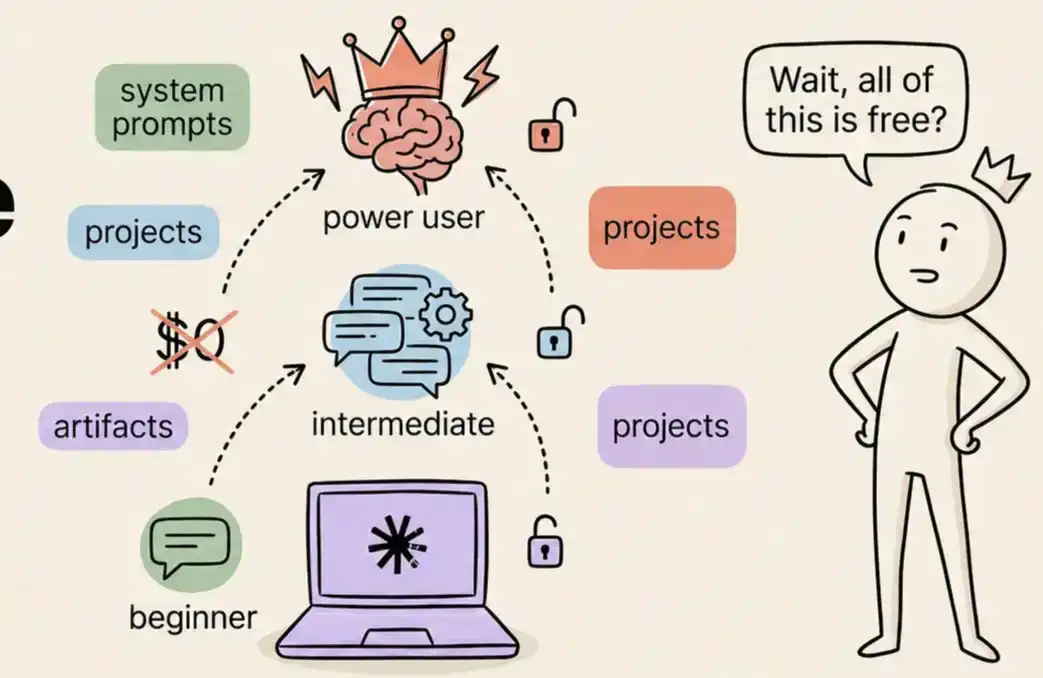
Summary: This article outlines three frameworks for maximizing AI efficiency, moving beyond basic prompt usage. 1. **Three-Layer Evolution**: Users progress from (1) **Prompt** (one-off instructions, reset each session), to (2) **Project** (context-aware within a specific project), to (3) **Skill** (permanent, auto-applied knowledge). Most users stagnate at the first layer, repeating the same instructions daily with no cumulative improvement. Skills transform the AI from a chat tool into a personalized work system. 2. **Transaction vs. Compound Interest Mindset**: Using prompts is a linear transaction—effort and output are 1:1, and stopping resets progress. Investing time in building Skills is compound interest; a small initial time investment pays continuous dividends, as each Skill permanently elevates the AI's baseline performance. 3. **Thin Harness, Fat Skills**: The system architecture should prioritize thick, well-defined Skills (90% of the value—containing processes, standards, and domain knowledge) and a thin "harness" (the minimal technical environment). Avoid over-engineering the toolchain while neglecting the AI's actual knowledge. Skills are permanent assets that automatically improve with model updates. The key takeaway: Identify tasks you repeat, encode them into Skills (using tools like Claude's Skill Creator), and shift focus from daily prompting to building a compounding, self-improving AI system.

marsbit04/22 06:43

Three Frameworks for Ordinary People to Achieve AI Capability Leap: Say Goodbye to the Dilemma of 'Repeating Inputs Every Day'

marsbit04/22 06:43

Agents Have Entered the Harness-Driven Era

The article discusses the significance of the leaked Claude Code from Anthropic, highlighting its revelation of advanced Agent engineering practices centered on "Harness" design. Rather than relying solely on model capabilities, modern AI systems now depend on a structured engineering framework—the Harness—to maximize performance. This framework includes six core components: multi-layered System Prompts, Tool Schema, Tool Call Loop (with Plan and Execute modes), Context Manager, Sub-Agent coordination, and Verification Hooks. The Harness enables tighter integration between training and inference, supports long-chain tool execution, and improves reliability through objective verification. It also drives six key training directions: behavior alignment via System Prompt, end-to-end tool-use training, integrated plan-execute training, memory compression, sub-agent orchestration, and multi-objective reinforcement learning. The shift to Harness-driven development reduces the emphasis on pure prompt engineering, favoring instead multidisciplinary talent with skills in AI, backend engineering, and infrastructure. The market is evolving toward more secure, private, and vertically integrated Agent deployments, with "model shell" companies needing either strong infrastructure or deep domain expertise to compete. Claude Code’s leak underscores that future AI advancements will be shaped by engineering architecture as much as by algorithmic innovation.

marsbit04/15 10:11

Agents Have Entered the Harness-Driven Era

marsbit04/15 10:11

AI Jargon Dictionary (March 2026 Edition), Recommended to Bookmark

The "AI Jargon Dictionary (March 2026 Edition)" is a practical guide for those new to the AI field, especially crypto enthusiasts looking to stay relevant. It covers essential and advanced AI terms to help readers understand key concepts and avoid confusion in industry discussions. The dictionary is divided into two parts: **Basic Vocabulary (12 terms):** - Core concepts like LLM (Large Language Model), AI Agent (intelligent systems that execute tasks), Multimodal (handling multiple data types), and Prompt (user instructions). - Key technical terms: Token (processing unit), Context Window (token capacity), Memory (retaining user data), Training vs. Inference (learning vs. execution), and Tool Use (calling external tools). - Generative AI (AIGC) and API (integration interface) are also explained. **Advanced Vocabulary (18 terms):** - Technical foundations: Transformer architecture, Attention mechanism, and Parameters (model scale). - Emerging trends: Agentic Workflow (autonomous systems), Subagents, Skills (reusable modules), and Vibe Coding (AI-assisted programming). - Challenges: Hallucination (incorrect outputs), Latency (response time), Guardrails (safety controls). - Optimization techniques: Fine-tuning, Distillation (model compression), RAG (Retrieval-Augmented Generation), Grounding (fact-based responses), Embedding (vector encoding), and Benchmark (performance evaluation). The article emphasizes practicality, urging readers to learn these terms to navigate AI conversations confidently. It highlights terms like RAG and Grounding as critical for enterprise AI, while newer buzzwords like MCP (Model Context Protocol) and Vibe Coding reflect evolving trends. The goal is to provide a concise yet comprehensive reference for understanding AI jargon in 2026.

Odaily星球日报03/11 11:36

AI Jargon Dictionary (March 2026 Edition), Recommended to Bookmark

Odaily星球日报03/11 11:36

Lobster Key 11 Questions: The Most Easy-to-Understand Breakdown of OpenClaw Principles

"OpenClaw Demystified: A Beginner's Guide to AI Agent Principles" explains the popular OpenClaw AI assistant by breaking down its core functions into 11 key questions. The article first clarifies that the underlying large language model is merely a "text prediction engine" with no real understanding, memory, or senses. OpenClaw acts as a "shell" around this model, creating the illusion of memory by appending massive prompts containing its personality files (AGENTS.md, SOUL.md, USER.md) and the entire conversation history before each interaction. This mechanism is why it's "expensive"—each query processes thousands of tokens of context, not just the latest message. A core differentiator is tool use. The model itself only outputs text; OpenClaw parses this output for specific structured commands (e.g., `[Tool Call] Read("file.txt")`) and executes the corresponding action (reading the file) locally on the user's machine. This allows it to act, not just advise. For complex tasks, it can even write and run its own Python scripts, a powerful but dangerous capability. To manage limited context windows and complex tasks, OpenClaw uses sub-agents. A main agent can spawn sub-agent to handle a sub-task and return a summarized result, preventing the main context from being overloaded. Crucially, sub-agents cannot spawn their own to avoid infinite loops. Unlike standard chatbots, OpenClaw is proactive due to its heartbeat mechanism, which periodically prompts the model to check for tasks. It can also "sleep" via cron jobs to wait for long-running tasks, saving resources. The guide ends with critical security warnings. OpenClaw has extensive local access, making it a significant risk. It can malfunction (e.g., deleting emails uncontrollably) or fall victim to prompt injection attacks, where malicious input from the web is mistaken for a user's command. The strong recommendation is to run it on a dedicated, isolated "sacrificial" computer with minimal permissions and mandatory human confirmations for destructive actions.

Odaily星球日报03/11 09:53

Lobster Key 11 Questions: The Most Easy-to-Understand Breakdown of OpenClaw Principles

Odaily星球日报03/11 09:53

活动图片