Artículos Relacionados con Data Infrastructure

El Centro de Noticias de HTX ofrece los artículos más recientes y un análisis profundo sobre "Data Infrastructure", cubriendo tendencias del mercado, actualizaciones de proyectos, desarrollos tecnológicos y políticas regulatorias en la industria de cripto.

Qingyan Jingzhun Raises Hundreds of Millions in Funding, with Investment from National Equipment Manufacturing Giants

Qingyan Precision, a provider of physical AI infrastructure, has secured billions of RMB in Series B financing. The investment round, led by prominent automotive industry funds and notably featuring the state-owned China National Machinery Industry Corp. (Sinomach) fund, underscores a strategic shift in the capital market towards companies with proven industrial application capabilities. The company positions itself as the "engineering foundation for physical AI," specializing in enabling embodied intelligence (like humanoid robots) to operate in complex, real-world industrial environments. Its core offering is the "TsingLoop" multi-modal data engineering pipeline, which captures and standardizes data from physical workspaces (like visual, force, and process parameters) to create reusable data assets. This system supports a "Robot-in-the-Loop" testing framework that validates robotic performance in digital twin simulations and real-world conditions before deployment. Qingyan Precision leverages over eight years of experience and a network of 2000+ industrial sensor nodes across sectors like automotive and mining. This provides a crucial "training ground" for embodied AI models. The founding team combines academic pedigree from Tsinghua University and Stanford with deep industry experience from leading robotics firms. The company's vision is to build "one foundation, one brain, and hundreds of vertical applications," using its data platform and industrial world model to deploy scalable physical intelligence across various industrial tasks.

marsbit07/13 04:30

Qingyan Jingzhun Raises Hundreds of Millions in Funding, with Investment from National Equipment Manufacturing Giants

marsbit07/13 04:30

Nearly a Hundred Players Rush into Embodied Data: With 4.47 Billion Yuan in Financing in One Year, Who Can Really Make Money by 'Selling Data'?

The domestic embodied AI data industry has attracted nearly 100 players, with 70 focused on data collection and 27 on data infrastructure. In the past year, 15 independent embodied data service providers raised approximately 4.47 billion yuan. Despite this growth, the sector remains early-stage, fragmented, and faces significant challenges. Data collection methods are diverse, categorized into four main routes: teleoperation of real robots, human demonstration without a robot (using motion capture, exoskeletons, etc.), simulation synthesis, and distillation from internet videos. Most companies (43%) adopt hybrid approaches, combining multiple routes, as no single method can meet all training needs. Teleoperation alone is pursued by 31% of players, often by state-owned platforms and robot companies, while newer firms favor asset-light, no-hardware human demonstration. Independent data service providers now form the largest player group (40%), indicating the emergence of a distinct industry segment rather than just a subsidiary function for robot makers. Two-thirds of all players are "embodied-native" startups, while one-third are companies that pivoted from fields like AI data annotation, which are more prevalent in the data infrastructure layer. Current annual industry capacity is estimated at 1.6-1.8 million hours plus 70-80 million data points, with a short-term goal to increase this 15-20 fold within 1-3 years. Data collection factories are spread across 20 provinces in China, concentrated in the Yangtze River Delta, Beijing-Tianjin-Hebei, and Pearl River Delta regions. Financially, the 4.47 billion yuan raised in the past year pales compared to the 43.8 billion yuan raised by the broader embodied intelligence sector in just the first half of 2026, highlighting that data remains a less "sexy" bet for investors. The 15 funded independent providers show clear stratification: a top tier led by a unicorn (Lightwheel Intelligence, 3.1 billion yuan), a middle tier of 11 firms raising tens to hundreds of millions, and an early-stage tier of 3 companies. Sixty-nine investment institutions have participated, but none have made concentrated bets, reflecting uncertainty about viable business models. Over half of these funded companies are less than a year old, most are at pre-A or A rounds, and profitability remains largely unproven. In summary, the embodied data industry has become an independent track creating jobs and local economic activity. However, it is still nascent, with unformed consensus, unsolved problems, and unproven business models. The coming 1-2 years will be a critical validation window to see if companies can build sustainable, profitable businesses purely by "selling data."

marsbit07/12 02:30

Nearly a Hundred Players Rush into Embodied Data: With 4.47 Billion Yuan in Financing in One Year, Who Can Really Make Money by 'Selling Data'?

marsbit07/12 02:30

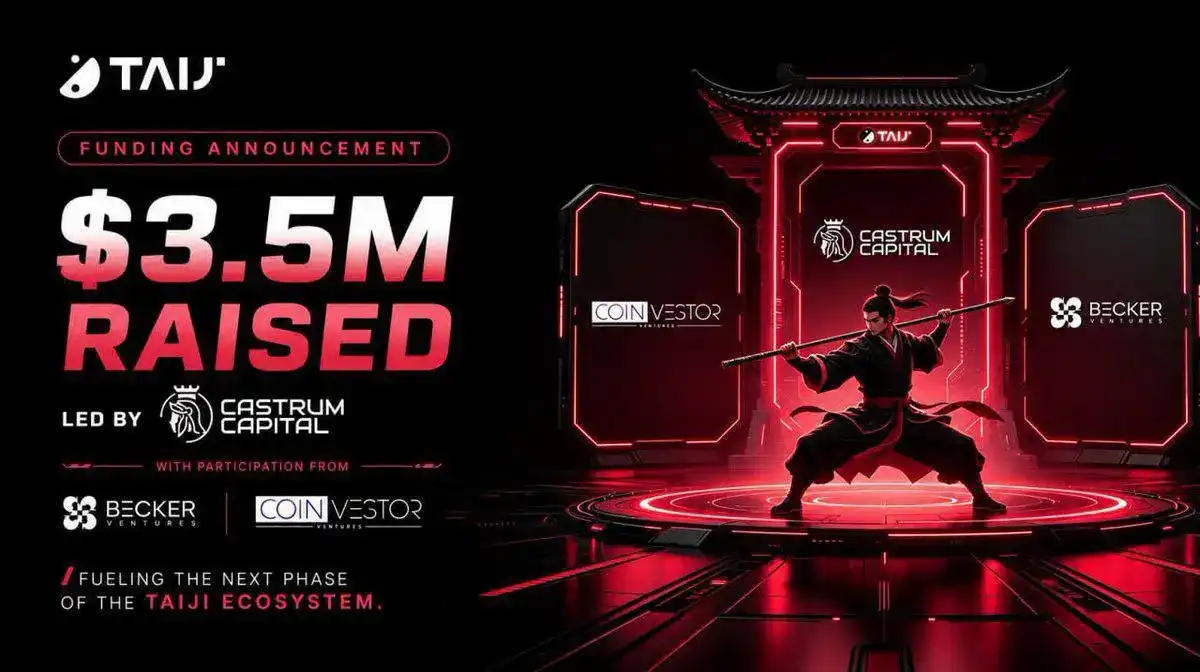
TaiJi Completes $3.5 Million Strategic Financing with Participation from Castrum Capital, Becker Ventures, and Coinvestor Ventures

TaiJi, an AI-driven market intelligence platform for Web3, has completed a $3.5 million strategic funding round. The investment was led by Castrum Capital, Becker Ventures, and Coinvestor Ventures. The funds will be allocated to product R&D, upgrading its AI inference engine, building a multi-agent analysis system, improving market data infrastructure, expanding its global community, and advancing ecosystem partnerships, particularly within the BSC ecosystem. TaiJi aims to transform how users understand the Web3 market by moving beyond simple data display. It integrates market data, on-chain signals, liquidity changes, social sentiment, and news events into a unified AI system. This system generates structured event inferences, impact pathways, risk assessments, and follow-up indicators. The platform's core approach involves a multi-agent framework where specialized agents (Market, On-chain, Sentiment, Risk, Event) collaboratively analyze disparate signals to produce coherent market intelligence. Its initial product will feature modules including Market Intelligence, a Scenario Engine for AI-powered event analysis, an Impact Map, Risk Signals, and a personalized user dashboard called "My TaiJi." TaiJi emphasizes that it does not custody user assets, execute trades, provide investment advice, or promise returns. Following this funding round, the company plans to accelerate product development and testing, gradually rolling out its core features to the broader Web3 market.

marsbit06/02 09:47

TaiJi Completes $3.5 Million Strategic Financing with Participation from Castrum Capital, Becker Ventures, and Coinvestor Ventures

marsbit06/02 09:47

活动图片