Artículos Relacionados con Copper

El Centro de Noticias de HTX ofrece los artículos más recientes y un análisis profundo sobre "Copper", cubriendo tendencias del mercado, actualizaciones de proyectos, desarrollos tecnológicos y políticas regulatorias en la industria de cripto.

In the Second Half of 2026, Commodities Enter an Era of 'High-Frequency Black Swans'

Heading into the second half of 2026, Citigroup warns that the commodities market is entering an era of "High-Frequency Black Swans," where extreme, paradigm-shifting events are becoming increasingly common. The report outlines major tail-risk scenarios beyond its baseline forecasts. The highest-impact scenario is a prolonged US-Iran conflict disrupting Gulf energy infrastructure and key shipping chokepoints, potentially causing a sustained 5-10 million barrel per day oil supply deficit and pushing crude prices above $200/barrel. Other geopolitical risks include stricter sanctions on Russian energy, which would hit gas markets harder than oil, particularly liquefied natural gas (LNG). A high-probability risk is a global scramble by governments to stockpile critical minerals. Large-scale strategic buying, particularly of copper, could drive prices above $20,000/ton. For gold, Citigroup sees near-term downside risk towards $3,800/ounce before a potential long-term rally to $6,000/ounce, supported by central bank demand and de-dollarization trends. An extreme El Niño weather pattern poses a medium-probability, high-impact threat to agriculture, potentially sending cocoa prices back to $10,000/ton and sugar above 20 cents/pound. The AI boom presents a dual-sided risk: a bust would hurt metals and power demand, while sustained growth would exacerbate structural deficits in copper and aluminum. Two other significant scenarios are the finalization of Russia's Power of Siberia 2 gas pipeline to China, which could depress Asian LNG prices to $5-6/MMBtu in the 2030s, and an extreme application of the Monroe Doctrine blocking Americas oil exports, which could create a price split with global benchmarks soaring above $100/barrel while regional benchmarks crash. The overarching conclusion is that traditional supply-demand analysis may fail in a market where such high-impact, interconnected shocks are becoming more frequent.

marsbit07/24 08:17

In the Second Half of 2026, Commodities Enter an Era of 'High-Frequency Black Swans'

marsbit07/24 08:17

From Corning to Ciena: The 10x Opportunity in the AI Optical Communication Chain

The transition from copper to optical communication in AI data centers is creating significant investment opportunities beyond just chipmakers. The entire photonics supply chain, from glass and fiber to connectors and test equipment, is critical. Corning, a key fiber supplier, has locked in multi-billion dollar, multi-year contracts with major cloud providers (Meta, Amazon, Google, Microsoft, OpenAI, NVIDIA), demonstrating pricing power and scale. Its profit growth is outpacing revenue growth. In the interconnect layer, Amphenol benefits from high growth in AI data centers, driven by strategic acquisitions and operational efficiency, while Credo Technology acts as a bridge between copper and optical solutions, though with high customer concentration risk. At the systems level, Ciena enables higher data capacity on existing fiber lines, with a strong backlog and cloud customer adoption. Further upstream, AXT is a bottleneck supplier of key indium phosphide wafers for lasers but faces geopolitical supply chain risks. VEO Solutions provides essential testing equipment for the entire photonics industry. A new pure-play photonics ETF (FOTO) offers a consolidated investment approach. The core thesis is that the physical limits of copper are driving an inevitable shift to optical technologies, with wealth flowing to essential, often overlooked, suppliers across the photonics value chain.

marsbit06/24 07:14

From Corning to Ciena: The 10x Opportunity in the AI Optical Communication Chain

marsbit06/24 07:14

Analysis of the Latest Portfolio Adjustment by the "Top Player" in the U.S. Stock Market: $9 Billion Short on NVIDIA, Shifting Focus to Power and Memory Sectors

AI investor Leopold Aschenbrenner has made a significant portfolio shift, taking a $9 billion nominal short position against top AI infrastructure stocks like NVIDIA, ASML, and Oracle. Simultaneously, he is redirecting capital towards what he sees as the next critical bottlenecks in the AI boom: power, memory, and data center networking, alongside private investments in AI model companies like Anthropic. This move is interpreted not as a call that the AI bubble has burst, but as a rotation within the infrastructure stack. The analysis highlights NVIDIA's recent $25 billion bond issuance as a potential signal, questioning why a cash-rich company would seek external debt despite high profits and increased dividends/buybacks. The core investment thesis is that the initial, crowded "picks and shovels" trade in semiconductors is maturing. The next wave of capital is expected to flow into the physical and logistical constraints of AI expansion: electricity supply, memory chip capacity, data center construction, and enabling technologies like optical networking (fiber) for high-bandwidth communication, where copper remains crucial for short distances. Aschenbrenner's substantial (approx. 20% of fund) private stake in Anthropic is noted as a key part of his strategy—investing directly in the "mine" (AI models) rather than just the "shovels." The discussion concludes that while certain segments may be overvalued, the overarching AI infrastructure demand driven by real product usage remains robust. The most promising long-term investments are seen in essential, non-sexy infrastructure—particularly energy and power companies—whose demand is viewed as a global constant irrespective of AI's cyclicality.

marsbit06/20 03:07

Analysis of the Latest Portfolio Adjustment by the "Top Player" in the U.S. Stock Market: $9 Billion Short on NVIDIA, Shifting Focus to Power and Memory Sectors

marsbit06/20 03:07

Copper, the Gold of 2026

Copper: The New Gold for 2026? Market focus has shifted from AI chips to underlying infrastructure, with copper emerging as a key narrative. Its role is evolving beyond "Dr. Copper"—a traditional indicator of economic cycles—due to structural demand growth from AI data centers (requiring massive electrical infrastructure), grid expansion, EVs, and re-industrialization. Estimates suggest data centers alone could require 300,000 tons of copper by 2050. The core bullish thesis is not just demand but a severe supply constraint. New copper mines take ~17 years to develop, while ore grades are declining and new discoveries are scarce, potentially leading to a 30% supply deficit by 2035. This supply rigidity, coupled with strategic importance, is giving copper a "gold-like" scarcity narrative. Major macro investors, including Stanley Druckenmiller, are allocating to copper as a hedge against dollar weakness and for its exposure to energy transition and geopolitics. Traders like Pierre Andurand have projected prices could reach $40,000/ton. Capital inflows are visible in surging futures trading volumes. Copper mining stocks act as leveraged plays on copper prices. Companies like Freeport-McMoRan (FCX) and Southern Copper (SCCO), as well as Chinese miners like CMOC, have seen significant volatility, offering high upside but also steep drawdowns, reflecting operational and geopolitical risks. While copper remains cyclical and won't fully replicate gold's monetary role, its long-term fundamentals have shifted. Its new scarcity premium, driven by a tightening supply structure and expanding electrical demand, suggests its "goldification" is just beginning.

marsbit06/16 03:09

Copper, the Gold of 2026

marsbit06/16 03:09

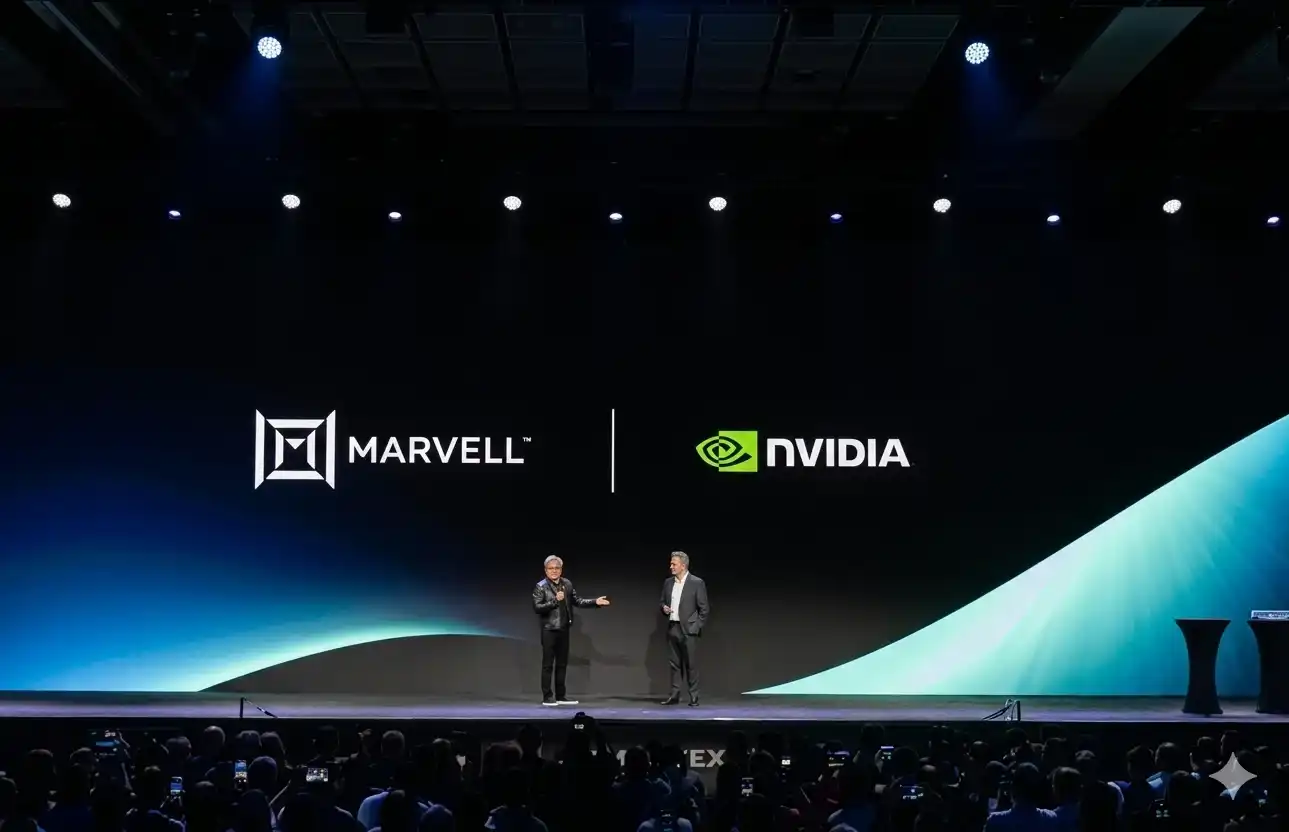
Huang Renxun and Marvell CEO Discuss on Stage: The Future of AI Competition is Not Computing Power but Connectivity, 'Use Copper Where You Can, Use Optics Only Where You Must'

Summary: At Computex 2024, NVIDIA CEO Jensen Huang joined Marvell CEO Matt Murphy on stage, highlighting the strategic partnership between their companies. The core theme was that the next decisive battleground for AI infrastructure is not compute or memory, but connectivity. As AI models evolve into vast agent-based systems, the ability to connect millions of processors efficiently is becoming the critical bottleneck. Huang announced NVIDIA's strategic $20 billion investment in Marvell, reflecting the deep integration between their technologies for AI data centers. A key discussion point was the transition from copper to optical interconnects within racks. The guiding principle, articulated by Huang, is: "You use optics wherever you must, you use copper wherever you can." While copper remains cost-effective for short distances, its physical limits are being reached as bandwidth demands double. When moving to 400Gbps, copper can no longer fully connect an entire rack. This shift necessitates innovations like Co-Packaged Optics (CPO), which integrates optical engines directly into the chip package to solve density and power challenges. Marvell demonstrated its 51.2T CPO-based switch, eliminating copper traces on the PCB. The future vision is a "distance-free data center," where optical connectivity removes physical constraints. This allows for fully disaggregated, dynamic architectures where compute, memory, and storage pools can be combined on-demand based on workload requirements, rather than being limited by connection boundaries. Marvell, positioned as a neutral "Switzerland" in the ecosystem with a comprehensive portfolio across all connectivity distances, is central to enabling this next era of AI infrastructure.

marsbit06/02 09:41

Huang Renxun and Marvell CEO Discuss on Stage: The Future of AI Competition is Not Computing Power but Connectivity, 'Use Copper Where You Can, Use Optics Only Where You Must'

marsbit06/02 09:41

Stanley Druckenmiller: From Soros' Comrade-in-Arms to the Godfather of Macro Investing—System, Disciples, and Latest Thoughts

Stanley Druckenmiller is a pivotal figure in global macro investing, renowned for his partnership with George Soros, his legendary fund Duquesne Capital, and a decades-long track record of near-30% annualized returns without a single annual loss. His methodology uniquely blends value, growth, macro, and trend investing. A key early experience was as a bank stock analyst, grounding him in both company fundamentals and macro forces. His most famous trade, shorting the British Pound in 1992, exemplified his approach: identifying unsustainable structural contradictions and concentrating capital on high-probability, high-payoff opportunities. The "Duquesne System" is built on four pillars: macro-directional analysis, concentrated bets on best ideas, rapid error correction, and acute awareness of liquidity. His famous phrase "Invest, then investigate" reflects a dynamic approach of entering a position based on a strong initial thesis and then adjusting based on market feedback. This differs fundamentally from Warren Buffett's focus on long-term intrinsic business value; Druckenmiller focuses on marginal changes, cycles, and capital allocation at inflection points. His influence extends through protégés like Scott Bessent (market execution) and Kevin Warsh (policy insight), representing the dual market-and-institutional understanding he embodies. He closed his flagship fund in 2010 at its peak, prioritizing flexibility and performance over asset-gathering. Recent moves highlight his core logic: reducing AI exposure as expectations became crowded while investing in copper, recognizing the underlying infrastructure and resource demands of the AI boom. He remains concerned about long-term US dollar purchasing power due to fiscal deficits and monetary policy. His core skill is judging risk/reward payoff, not just prediction accuracy. For ordinary investors, key lessons are to focus on marginal changes, align position size with conviction and risk, and seek second-order opportunities beneath surface-level narratives. Ultimately, Druckenmiller is a strategist who combines macro insight with price discipline, decisive action with rigorous risk management, succeeding by identifying major market mispricings, acting before full consensus, and exiting swiftly when proven wrong.

marsbit05/20 02:08

Stanley Druckenmiller: From Soros' Comrade-in-Arms to the Godfather of Macro Investing—System, Disciples, and Latest Thoughts

marsbit05/20 02:08

Bernstein's 97-Page Report Decoded: The Battle for AI Data Center Connectivity, Who Will Be the True Winner by 2026?

Bernstein's 97-page report analyzes the AI data center connectivity landscape. It argues that the bottleneck is shifting from raw compute (GPU) to the systems connecting GPUs, crucial for cluster efficiency. Copper and optical interconnects are not in a simple replacement cycle but will coexist long-term, with copper dominating short-distance "scale-up" connections and optics favored for longer "scale-out" scenarios. While Co-Packaged Optics (CPO) is the long-term direction for power and cost savings, its widespread adoption faces manufacturing and reliability hurdles, with mass deployment unlikely before 2028. Transitional technologies like Linear Pluggable Optics (LPO) and Near-Packaged Optics (NPO) are seen as near-term leaders. A key insight is that CPO will fundamentally reshape the value chain, shifting profits from traditional optical module suppliers towards chip designers (e.g., NVIDIA, Broadcom), advanced packaging (e.g., TSMC), and system integrators. For 2026, the report highlights more immediate and certain investment opportunities in the essential "infrastructure" enabling this connectivity shift. This includes upgrades for PCBs, ABF substrates, and CCLa driven by new AI server/switch platforms, alongside demand for 1.6T optical modules, LPO/NPO, and the testing/validation equipment required for future CPO scale-up.

marsbit05/19 03:16

Bernstein's 97-Page Report Decoded: The Battle for AI Data Center Connectivity, Who Will Be the True Winner by 2026?

marsbit05/19 03:16

After Storage, Are Copper and Fiber Optic Cables Facing an AI "Great Famine"?

Following the storage sector, copper and fiber optics are emerging as potentially the next major markets to experience explosive growth due to AI. Demand for copper, described by Goldman Sachs as "the oil of the AI era," is surging. Prices are near record highs, with LME copper up 41% over the past 12 months. This is driven by AI's immense and unique requirements: copper is the essential material for the massive electrical distribution (e.g., a 1GW AI data center requires ~27,000 tons) and advanced liquid cooling systems needed for high-power AI clusters like NVIDIA's GB200. Meanwhile, new large-scale copper mine discoveries have been scarce for a decade, tightening supply. Concurrently, a "fiber famine" is unfolding. AI's need for ultra-high-speed, long-distance interconnects between thousands of GPUs is pushing data transmission beyond the physical limits of copper cables. Demand for fiber optics is experiencing a step-change, with a single AI data center requiring up to 36 times more fiber than a traditional CPU rack. This has caused prices for standard G.652D fiber in China to nearly double in just three months. Supply is critically constrained due to the long (18-24 month) lead times required to expand production of the core preform material. In summary, AI's infrastructure demands are cascading down from semiconductors to foundational materials. Copper faces a structural supply-demand imbalance, while fiber optics is entering a period of severe shortage, positioning both as critical and potentially strained components of the AI build-out.

marsbit05/14 09:25

After Storage, Are Copper and Fiber Optic Cables Facing an AI "Great Famine"?

marsbit05/14 09:25

AI is Revaluing the Real World: Why Gold, Silver, and Copper are Becoming Important Again

AI is reassessing the value of the real world: why gold, silver, and copper are regaining importance. For over a decade, financial innovation centered on digitalization, from internet platforms to RWA tokenization. However, AI's rapid development highlights a deeper dependency: the physical infrastructure underpinning the AI era, not just code. Contrary to being "dematerialized," AI strengthens reliance on the real world. Every model training and deployment requires vast resources—data centers, energy grids, cooling systems, and critical industrial materials like copper, silver, and gold, which provide irreplaceable conductivity and durability. This shift is redefining the asset layer structure. A new "Asset Stack" is emerging: - Physical Layer: Metals, energy, and raw materials. - Financial Layer: Government bonds, ETFs, structured products. - Digital Layer: Tokenization infrastructure and programmable assets. The digital layer relies on the financial layer, which ultimately depends on the physical layer. While markets previously rewarded upper-layer assets like stocks and digital platforms, AI is redirecting attention to foundational real-world resources. S&P Global forecasts data center copper demand will surge from 1.1 million tons in 2025 to 2.5 million tons by 2040, amid a growing global supply deficit. This signals a long-term structural shift where energy, metals, and infrastructure form a critical "Physical Layer" that could limit AI's expansion. Tokenization alone doesn't create value; it connects markets to already-trusted assets. Successful tokenization requires mature demand, deep liquidity, and institutional consensus. Thus, the logical progression begins with sovereign debt (highest liquidity and trust), followed by gold (centuries of global consensus), then silver (blending reserve and industrial utility). Future expansion may include industrially critical materials like copper. Within gold, a key divergence is appearing. Gold ETFs solved "investability" but keep gold within traditional financial systems. Gold tokens, like Matrixdock's XAUm, explore making gold a functional part of the digital financial system—enabling instant settlement, cross-border collateral, and programmable utility without intermediaries. Looking ahead, industrial metals are evolving from commodities to strategic "functional assets." Silver faces a structural supply deficit, driven by demand from solar, EVs, and AI infrastructure. While gold represents a "Store of Value," metals like silver and copper are becoming "Stores of Function." Tokenizing them, as with Matrixdock's XAGm for silver, focuses not just on reserve value but on bridging physical commodity systems with digital infrastructure for efficient circulation. Ultimately, the asset layer is evolving to be more grounded in the strategic, physical realities of the economy. The most valuable assets for tokenization may not be the easiest to digitize, but those most essential for long-term economic and technological foundations.

链捕手05/13 11:00

AI is Revaluing the Real World: Why Gold, Silver, and Copper are Becoming Important Again

链捕手05/13 11:00

活动图片