Artículos Relacionados con Consumption

El Centro de Noticias de HTX ofrece los artículos más recientes y un análisis profundo sobre "Consumption", cubriendo tendencias del mercado, actualizaciones de proyectos, desarrollos tecnológicos y políticas regulatorias en la industria de cripto.

Misjudged A-Shares: Resilience, Expectations, and Confidence

China's A-share market recently faced selling pressure, especially in tech sectors, initially triggered by a global tech sell-off that began in South Korea. However, the article argues this is a case of "mistaken injury" and highlights the market's underlying resilience. This resilience stems from three main pillars: **1) Tech Sector Fundamentals:** Unlike Korea's market dominated by a few memory chip stocks, China's tech sector is diversified across computing, communications, electronics, and semiconductors, supported by dual narratives of global AI supply chains and domestic substitution. Core areas like optical modules and fiber optics continue to show strong earnings growth. **2) "National Team" Support:** State-backed institutions and large corporations have made significant market purchases and announced buybacks, providing liquidity and signaling confidence. This is seen as a stabilizing policy signal, often associated with market bottoms. **3) Broader Market Pillars:** Other major sectors are showing endogenous recovery momentum. Consumer stocks benefit from stabilizing CPI and signs of sector recovery (e.g., liquor price hikes). Cyclical sectors like aluminum have high earnings, potential price increases due to tight supply, and low valuations. The financial sector offers stable dividends and low valuations. The conclusion is that the sell-off was driven by external contagion, not a collapse in fundamentals. With strong policy support and recovering momentum across key sectors, the A-share market possesses the toughness to regain stability.

marsbit07/22 02:26

Misjudged A-Shares: Resilience, Expectations, and Confidence

marsbit07/22 02:26

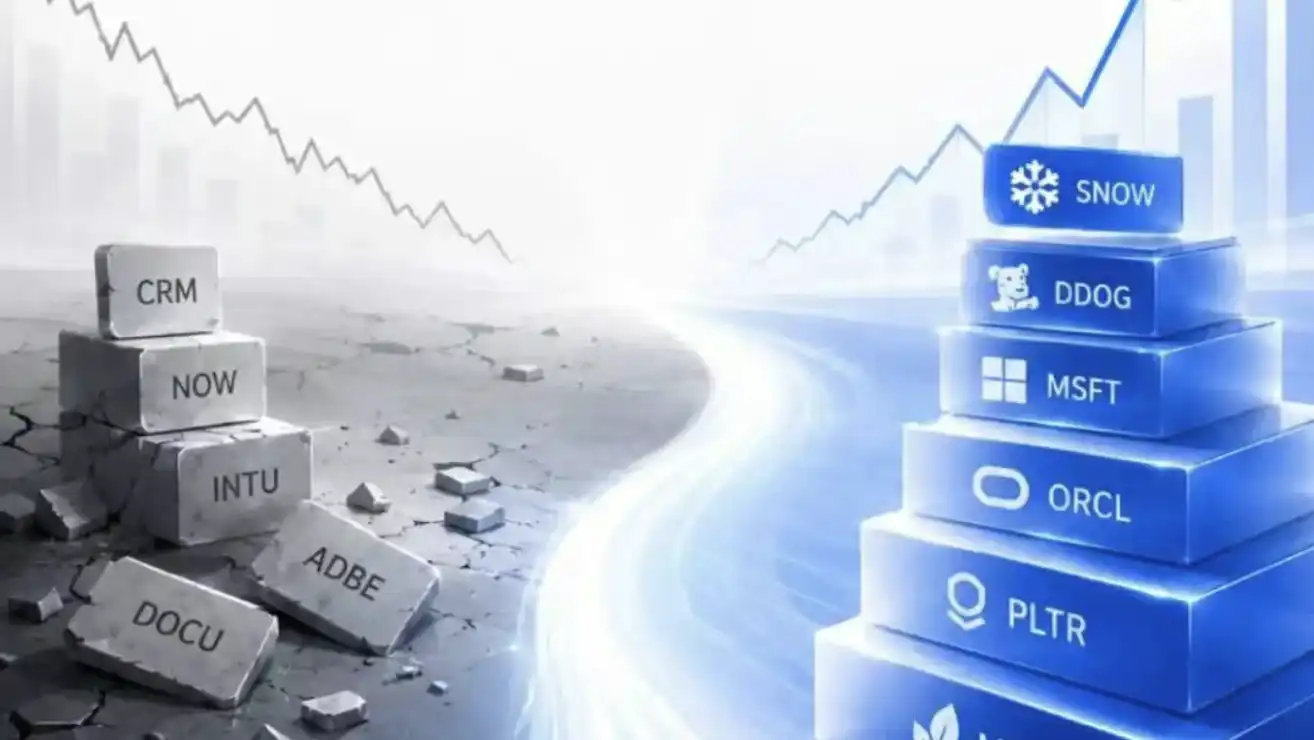
SaaS Battle Royale: The Survivors Who Win All Share One Common Trait

**Summary** The AI revolution has triggered a "SaaS apocalypse," forcing a brutal market shakeout. The key dividing line is the pricing model. Companies like Snowflake and Datadog, which charge based on consumption (e.g., data processed or compute used), are thriving. AI workloads actively *generate* more demand for their services, fueling growth. Datadog's accelerating revenue is a prime example. Microsoft and Palantir, as platform/ecosystem players, also benefit by acting as essential channels for AI deployment. In contrast, traditional SaaS firms built on per-seat or per-task licensing (e.g., Intuit, Adobe) face direct pressure, as AI threatens to automate the very human tasks their software supports. Companies like Salesforce, a per-seat giant, are caught in the middle. While showing strong AI monetization (e.g., its Agentforce platform) and experimenting with consumption-based "Flex Credits," its stock remains under pressure, illustrating that the market rewards *completed* transitions, not just the intent. The recent Microsoft Build conference underscored key trends: AI is evolving from an assistant to an autonomous "agent," and platform providers like Microsoft are consolidating their control. The market's recovery is highly selective, focused on identifying which companies are "fed by AI" versus "eaten by AI." Future focus will be on the diffusion of this recovery to transforming companies and the real-world adoption data of AI agents like Microsoft Copilot.

marsbit06/03 02:02

SaaS Battle Royale: The Survivors Who Win All Share One Common Trait

marsbit06/03 02:02

The Time of Machines: When Agents Consume Stablecoins

"The Age of Machines: When Agents Consume Stablecoins" explores the convergence of AI and cryptocurrency, focusing on the emerging narrative of AI agents as economic actors. The author argues that while AI is rapidly advancing into production and consumption, crypto, particularly stablecoins, is struggling to find its role beyond financialization. The piece begins by reflecting on how AI-powered bots are evolving from nuisances to become autonomous economic entities, potentially even developing a "dislike" for humans. This shift creates a sense of desperation in the crypto community, which is now trying to prove its value to AI by promoting stablecoins as the preferred medium of exchange for agents. A core tension is highlighted: AI is mastering both production and the new "relations of production" by replacing human labor, while crypto remains confined to a narrow financial role. Previous attempts by crypto to capture AI use cases—through decentralized storage, compute, or GPU lending—have largely failed. The author warns that compliant, bank-issued stablecoins on networks like Canton could ultimately prevail over native crypto stablecoins. The emergence of payment protocols for machines, like Stripe's MPP, is noted, but these efforts are seen as integrating machines into the existing traditional financial system rather than creating a new crypto-native one. The crypto industry's strategy of selling stablecoins to AI based on technical merits like cheapness and speed is portrayed as a weak, last-resort effort. The article then pivots to a more promising path for crypto: leveraging volatility. The true potential lies in AI agent economy's ability to generate massive, 24/7 consumption that far surpasses human limits. This creates a new battlefield for crypto—not by providing utility to AI, but by creating speculative assets (Crypto Tokens) that capture the value and FOMO generated by the AI boom (AI Tokens). The ultimate goal should be converting the immense economic activity of AI agents into liquidity for crypto assets. The conclusion states that while Circle's vision of agents using stablecoins offers a story of infinite users to the market, crypto's real strength is its position as a financial laboratory on the frontier, thriving on ambiguity and speculation. The future of the convergence depends on crypto creating volatility and wealth effects from the stable foundation of agent-driven consumption, ultimately completing the cycle from AI Token back to Crypto Token.

marsbit03/30 07:38

The Time of Machines: When Agents Consume Stablecoins

marsbit03/30 07:38

活动图片