Suspending IPO but Accelerating Expansion: Kraken's 'Strategic Retreat for Advancement'

比推Publicado a 2026-03-19Actualizado a 2026-03-19

Resumen

Kraken has paused its IPO plans, initially filed confidentially with the SEC in November 2025, citing unfavorable market conditions. The decision comes amid a significant crypto market downturn, with Bitcoin falling over 52% from its October 2025 high and total market capitalization dropping 42.5%. Other recently listed crypto firms like Gemini and Bullish also saw steep stock declines. Despite the IPO delay, Kraken continues to expand its services. Recent initiatives include a partnership with Nasdaq to develop tokenized stocks, approval for a Federal Reserve master account enabling direct access to Fedwire, and the launch of new products like crypto-backed loans and regulated tokenized stock perpetual futures. Financially, Kraken’s parent company Payward reported strong 2025 results with a 33% increase in adjusted revenue and 26% growth in adjusted EBITDA. However, regulatory developments and ongoing market volatility have created uncertainty, leading Kraken to adopt a wait-and-see approach. The move reflects broader industry challenges as crypto firms navigate shifting regulations and investor sentiment while expanding beyond pure trading into diversified financial services.

Author: Nicky, Foresight News

Original Title: Kraken Suspends IPO Plans, Can Exchanges Not Navigate Bull and Bear Markets?


On March 18, according to CoinDesk, cryptocurrency exchange Kraken has temporarily shelved its IPO plans after confidentially submitting an application to the U.S. Securities and Exchange Commission in November 2025. Sources indicated that the company may reconsider when market conditions improve. This decision follows the surge in crypto company listings in 2025—firms like Circle, Bullish, and Gemini collectively raised $146 billion last year, making Kraken's pause particularly notable.

Kraken's suspension of its IPO is closely tied to the current downturn in the crypto market. According to Bitget data, Bitcoin's price has been declining since hitting an all-time high of $126,200 on October 6, 2025, dropping to around $60,000 by February 6, 2026, a maximum decline of over 52%. As of March 19, it is still hovering near $70,000. During the same period, the total market capitalization of cryptocurrencies shrank from $4.23 trillion to $2.43 trillion, a decrease of 42.5%.

Coinbase, a bellwether for crypto in the U.S. stock market, also experienced significant volatility. After reaching a historic high of $444.6 on July 18, 2025, its stock price fell to a near one-year low of $139.36 on February 12, 2026, a maximum drop of 68.65%. It closed at $202.29 on March 18, with a market cap of $53.42 billion, but market confidence has not fully recovered.

Other recently listed crypto companies are also facing severe challenges. Since its listing on September 12, 2025, Gemini's stock price has fallen from its first-day close of $32 to a low of $5.57 on February 23, 2026, a decline of nearly 82.6%. It closed at $5.96 on March 18, with a market cap of approximately $701 million.

Bullish, after listing on August 13, 2025, saw its stock price drop from $68 to a historic low of $24.79 on February 5, 2026, a decline of 63.5%. It closed at $38.28 on March 18, with a market cap of $5.754 billion.
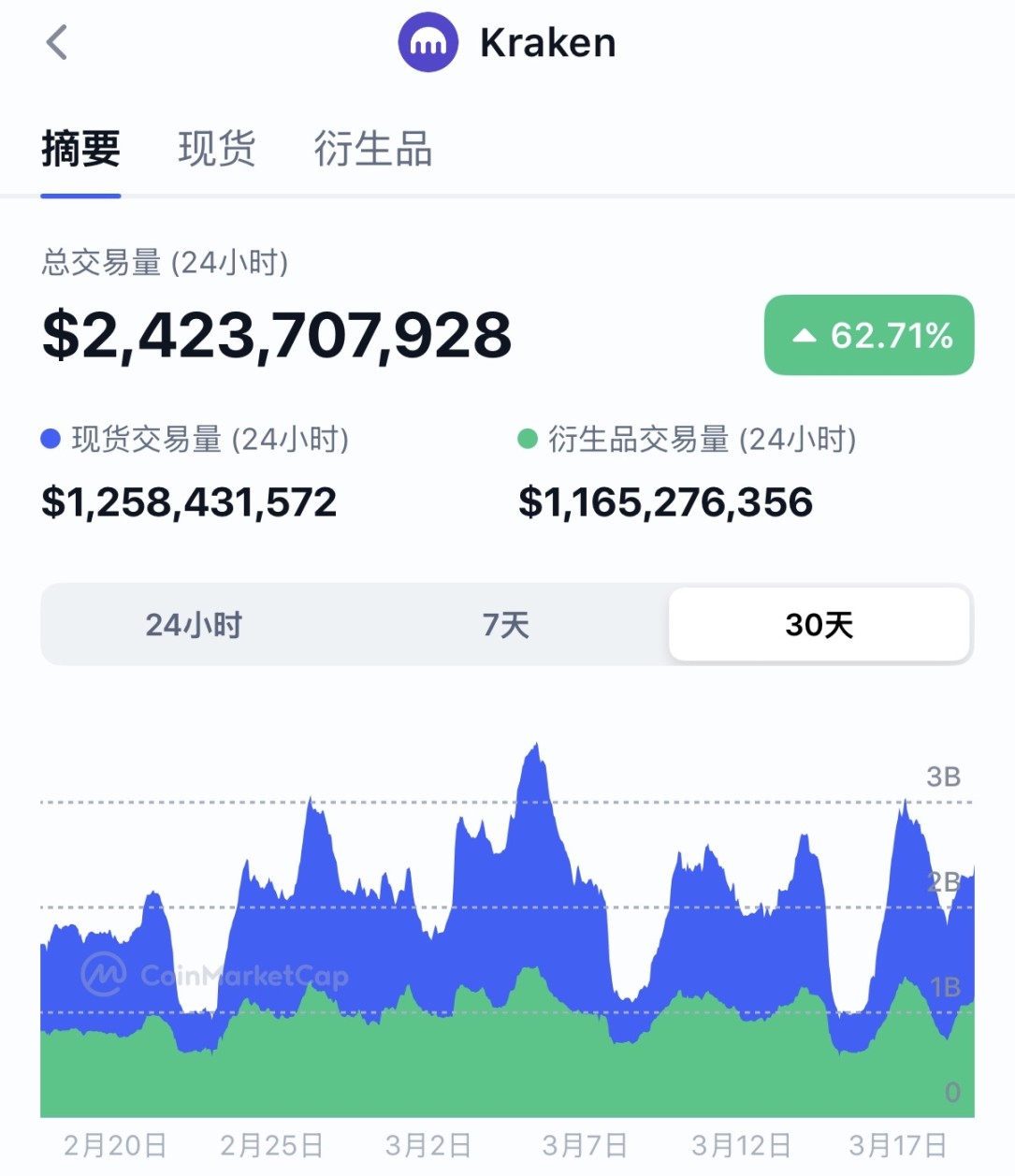
In terms of business scale, Kraken ranks in the middle globally among exchanges. According to CoinMarketCap data, Kraken's spot trading volume in the last 24 hours is approximately $1.2 billion, ranking 14th globally; its derivatives trading volume is about $1.1 billion, ranking 10th. In comparison, Coinbase's spot trading volume in the last 24 hours is around $1.86 billion, ranking second globally, while Binance leads with over $10 billion in spot trading volume and $65.18 billion in derivatives trading volume.

Financially, Kraken's parent company Payward reported 2025 results with adjusted revenue of $2.2 billion, a 33% year-over-year increase; adjusted EBITDA grew 26% to $531 million. Trading business revenue accounted for 47% of total revenue, with the remainder coming from non-trading businesses such as custody, payments, and financing. Total annual trading volume increased 34% to $2 trillion, platform assets grew 12% to $48.5 billion, and the number of customer accounts rose 50% to 5.7 million.

Despite the IPO plans being shelved, Kraken has been active in business expansion and regulatory compliance in recent months. On March 9, 2026, Nasdaq announced a partnership with Kraken to develop tokenized stocks and exchange-traded products, expected to launch in early 2027, focusing on using blockchain technology to streamline corporate governance processes.

On March 4, Kraken received approval for a Federal Reserve master account, becoming the first cryptocurrency company to access the Fed's core payment system, allowing direct use of the Fedwire interbank payment network. On February 25, the company launched its crypto asset staking loan service Flexline, enabling professional traders to access liquidity without selling their holdings. On February 24, Kraken announced the launch of regulated tokenized stock perpetual futures contracts, available to qualified non-U.S. users in over 110 countries, with initial products covering tokenized versions of major indices like the S&P 500 and Nasdaq 100.

Changes in the regulatory environment have added uncertainty to Kraken's path to listing. On March 18, the U.S. Securities and Exchange Commission and the Commodity Futures Trading Commission jointly issued interpretive guidance clarifying the classification standards for crypto assets, ending over a decade of regulatory ambiguity. This document provides clearer compliance guidance for the market but also means companies need to reassess how their business structures align with regulatory requirements. Meanwhile, cryptocurrency market structure legislation advancing in Congress is expected to pass in 2026, further clarifying the regulatory归属 of digital assets.

Kraken's decision to pause its IPO reflects the structural challenges crypto companies face in capital markets. On one hand, the industry is expanding from pure cryptocurrency trading to broader financial services, including stock trading, tokenized assets, and payment infrastructure; on the other hand, market volatility and regulatory uncertainty make investors cautious about valuing such assets.

For the entire cryptocurrency industry, Kraken's delayed listing may signal a turning point. Laura Katherine Mann, a partner at international law firm White & Case, previously noted that 2025 was a test year for crypto company IPOs, and 2026 would be the key node to test the long-term sustainability of digital asset IPOs. The market is judging whether crypto IPOs are a sustainable asset class or a cyclical trade that only during bullish markets. In the current market environment, Kraken's choice to wait for a more opportune moment may be a more prudent strategy.

It is worth noting that other leading players in the crypto industry are also actively adjusting their strategies to adapt to market changes. On March 19, Kris Marszalek, CEO of crypto trading platform Crypto.com, announced that the company is全面推进 its AI transformation, integrating AI tools and talent to enhance operational scale and precision. As part of this strategic adjustment, the company has targeted a reduction of about 12% of positions不适应 the new landscape.


Twitter:https://twitter.com/BitpushNewsCN

Bitpush TG Discussion Group:https://t.me/BitPushCommunity

Bitpush TG Subscription: https://t.me/bitpush

Original Link:https://www.bitpush.news/articles/7621233

Preguntas relacionadas

QWhy did Kraken decide to pause its IPO plans according to the article?

AKraken paused its IPO plans due to the current downturn in the cryptocurrency market and unfavorable market conditions, with the possibility of reconsidering when conditions improve.

QWhat significant partnership did Kraken announce in March 2026 regarding tokenized assets?

AIn March 2026, Kraken announced a partnership with Nasdaq to develop tokenized stocks and exchange-traded products, leveraging blockchain technology to simplify corporate governance processes.

QHow did the performance of other recently listed crypto companies like Gemini and Bullish compare in the market?

AGemini's stock price fell nearly 82.6% from its first-day close, while Bullish experienced a 63.5% decline from its IPO price, both reflecting severe market challenges.

QWhat regulatory development in the U.S. was highlighted as adding uncertainty to crypto asset classification?

AThe SEC and CFTC jointly issued interpretive guidance clarifying the classification standards for crypto assets, ending over a decade of regulatory ambiguity and requiring companies to reassess their compliance.

QHow does Kraken's business diversification strategy extend beyond cryptocurrency trading?

AKraken has expanded into services such as custody, payments, financing, crypto-asset staking loans, and regulated tokenized stock perpetual futures, aiming to become a broader financial services provider.

Lecturas Relacionadas

How to Do Research Well: Deliberately Practice the Real Skills That Matter

No one truly teaches you how to do research. You're often given a desk, a pre-selected problem, and vague instructions to "create something new." Consequently, many people reverse-engineer the job based on visible outputs—papers, posts, announcements—learning only how to *appear* like a researcher rather than how to *become* one. True research capability is built from stacking small, trainable skills, nearly all of which can be developed through deliberate practice. **Pick Your Own Problem:** Most researchers absorb problems from advisors or trends, lacking the underlying reasoning. Choosing a problem you genuinely care about, as John Schulman advises, leads to original work. Develop "taste" like a muscle: predict experiment outcomes, guess paper results from methods, and track which findings remain important over time. **Upgrade Your Inputs:** Relying on shared reading lists (arXiv hot lists, filtered group chats) leads to unoriginal conclusions. Undervalued old literature often holds crucial insights (e.g., MoE, LSTM, backpropagation). Richard Sutton's "The Bitter Lesson" or Claude Shannon's 1952 talk on creative thinking are more predictive than lengthy modern surveys. Breadth matters as much as depth: draw from neuroscience, mechanism design, hardware knowledge, and honest statistics. Read papers directly, especially appendices and limitations sections. **Write Everything Down:** As Paul Graham noted, writing exposes flaws in seemingly mature ideas. Writing is the cheapest defense against self-deception. Following Feynman's principle, Darwin programmatically wrote down facts contradicting his theory to combat memory bias. Maintain a detailed log of hypotheses, setups, predictions, results, and updated understandings. Reviewing past logs fosters essential humility.

marsbitHace 1 hora(s)

How to Do Research Well: Deliberately Practice the Real Skills That Matter

marsbitHace 1 hora(s)

Following US Ban on Fable 5, Zhipu AI's Stock Soars 47%

On June 15th, shares of Zhipu AI surged dramatically on the Hong Kong stock market, peaking at a 47.6% gain before closing 32.82% higher. This sharp increase was directly triggered by two recent industry events. On June 12th, Anthropic announced it was suspending global access to its latest flagship models, Claude Fable 5 and Claude Mythos 5, to comply with a U.S. government export control order. The next day, Zhipu AI announced it would open access to its latest open-source flagship model, GLM-5.2, under the permissive MIT license. The Anthropic incident highlighted a critical issue beyond raw model capability: the risk of sudden, unpredictable loss of access to advanced AI models, especially for developers and enterprises deeply integrated with them. This has shifted industry and market focus toward factors like stability, sustainable access, and controllability. Zhipu's move, promoting "frontier intelligence for all," positions its openly available model as a reliable and accessible alternative. The GLM-5.2 model emphasizes "Long Horizon Task" capabilities with a 1M context window, targeting complex, multi-step coding and engineering workflows where maintaining context is crucial. Analysts note this event exposes the risk of dependency on closed-source models subject to single jurisdictional controls, potentially accelerating a shift toward domestic base models and localized deployments. The market's reaction signals a new valuation dimension in AI: providers who can offer stable, long-term, and sustainably accessible AI capabilities are gaining strategic importance.

marsbitHace 1 hora(s)

Following US Ban on Fable 5, Zhipu AI's Stock Soars 47%

marsbitHace 1 hora(s)

Fully Entering the AI Era: Alipay Bets on Conversation, WeChat Holds Fast to Social

In May 2026, Alipay announced over 300 million AI payment transactions. Shortly after, WeChat opened its mini-programs for AI integration, sparking controversy by requiring developer source code access. This highlights their diverging approaches to AI integration. Alipay is testing "Project Treasure," an optional AI-native interface replacing traditional app grids with a conversational window. Users can command complex tasks (e.g., "book a ride and order coffee") handled end-to-end by AI. This shift follows an abandoned standalone AI app, focusing instead on enhancing its existing user base. For unmodified mini-programs, Alipay's AI uses "screen-reading" to simulate user interactions, bypassing the need for developer overhaul. It also introduced "Token Pay" for micro-transactions and "AI Wallets" for autonomous agent spending. WeChat, prioritizing its core social function, is taking an embedded approach. Its AI agent will operate within existing contexts like group chats and official accounts, assisting without a separate interface. To enable this, WeChat offers developers two paths: granting source code access for direct AI control ("Automatic Mode") or manually encapsulating services into standardized "Skills." Both place significant burden on developers. Key differences emerge in handling legacy services: WeChat demands developer cooperation (code or labor), while Alipay's screen-reading offers immediate, if potentially less stable, compatibility. Alipay's 3 billion AI transactions demonstrate user acceptance of AI-driven commercial actions. The divergent strategies may reshape mini-program ecosystems—Alipay passively "AI-fying" services, WeChat potentially favoring resource-rich developers—and set competing technical standards. Ultimately, the competition centers on where users entrust the command to "help me get things done."

marsbitHace 1 hora(s)

Fully Entering the AI Era: Alipay Bets on Conversation, WeChat Holds Fast to Social

marsbitHace 1 hora(s)

Trading

Spot
Futuros
活动图片





