Survey Shows Institutions Want Solana Over XRP And Dogecoin, Here Are The Figures

bitcoinistPublicado a 2026-03-27Actualizado a 2026-03-27

Resumen

A recent survey by Coinbase and EY-Parthenon reveals that institutional investors are more heavily allocated to Solana (SOL) than to XRP and Dogecoin (DOGE). As of January 2026, 36% of surveyed institutions held SOL, with 38% planning to increase their allocation. In contrast, only 18% held XRP and a mere 2% held DOGE. This preference for Solana places it just behind Bitcoin and Ethereum in institutional portfolios. However, this trend contrasts with the current ETF market data, which shows XRP ETFs leading in net assets at $949.15 million, compared to $849.65 million for Solana ETFs and $9.12 million for Dogecoin ETFs. The survey also indicates a growing institutional preference for gaining crypto exposure through ETFs rather than holding spot crypto directly, with 66% using ETFs as of January 2026, up from 64% a year earlier.

A recent survey by Coinbase and EY-Parthenon shows that institutional investors are more allocated to Solana over XRP and Dogecoin. This contrasts with the current trend in spot crypto ETFs, where XRP ETFs boast more net assets than SOL and DOGE ETFs.

Institutions Are More Invested In Solana Than XRP And Dogecoin

The survey shows that more institutions are investing in Solana than XRP and Dogecoin. 36% of these participants had allocations to SOL as of January 2026, while 38% plan to add to their allocations. Meanwhile, 18% allocated to XRP as of January, while 25% plans to add the token to their allocations this year.

Dogecoin is far behind Solana and XRP, with 2% of these institutions investing in DOGE as of January 2026, while 2% plan to add the meme coin to their allocations. It is worth noting that SOL is only behind Bitcoin and Ethereum and is well ahead of Chainlink, Binance Coin, Cardano, Tron, and Bitcoin Cash.
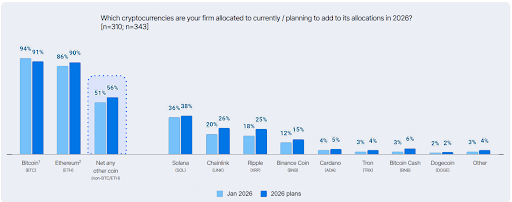
Source: Chart from Cftassets

This survey contrasts with the current trend among crypto ETFs, showing that investors allocate more to XRP ETFs than to Solana and Dogecoin ETFs. SoSoValue data shows that the XRP ETFs currently boast net assets of $949.15 million, representing 1.14% of the XRP’s market cap. Meanwhile, the Solana and Dogecoin ETFs boast net assets of $849.65 million and $9.12 million, respectively.

Furthermore, the XRP ETFs have seen more inflows since they launched than the Solana and Dogecoin ETFs. The XRP ETFs currently boast total net inflows of $1.21 billion, while the SOL and DOGE ETFs have seen inflows of $993.38 million and $7.64 million, respectively.

Institutions Holding Spot ETFs Over Spot Crypto

The survey also showed that most of these institutions are gaining crypto exposure through the crypto ETFs rather than holding spot crypto. As of January 2025, 64% of these institutions held spot crypto ETFs to gain exposure to Solana, XRP, Dogecoin, and other digital assets. This figure has climbed to 66% as of January 2026, signaling that more institutions are investing in crypto amid regulatory clarity.

Furthermore, 39% of these institutions held spot crypto as of January 2025. However, this figure has decreased to 36% as of January 2026, suggesting that institutions prefer to gain crypto exposure through an ETF wrapper rather than holding crypto directly. These institutions have also been seeking crypto exposure through the digital asset treasury companies (DATs). As of January 2025, 51% of these institutions invested in these DATs, and that figure increased to 53% as of January 2026.

At the time of writing, the XRP price is trading at around $1.36, down over 2% in the last 24 hours, according to data from CoinMarketCap.

SOL trading at $85 on the 1D chart | Source: SOLUSDT on Tradingview.com

Criptos en tendencia

Lecturas Relacionadas

Will MicroStrategy Fall into a Death Spiral? What Will the Macro Trend Be in the Second Half of the Year?

The podcast features investor Didier discussing the recent Bitcoin downturn and the evolving strategy of MicroStrategy (MSTR). He argues the core pressure is not macro factors or ETF outflows, but the market pricing in an expectation that MSTR will engage in continuous, small-scale Bitcoin sales to fund its increasing preferred stock and debt obligations under its "bitcoin-per-share neutrality" principle. This creates a structural headwind. However, he is cautiously optimistic a "death spiral" is avoidable without new major shocks, as market support is likely to emerge at a certain price point. Didier then posits that the AI-driven bull market in US stocks (semiconductors, data centers) is fundamentally driven by AI agents and tokens becoming the "new labor force," displacing human roles and boosting corporate margins. This shift toward a machine economy is still in its early stages. He comments on crypto exchanges adding US stock trading, viewing it as a natural move toward valuable real-world assets as truly valuable crypto-native assets remain scarce. For crypto-native traders, he suggests existing strategies (e.g., meme-chasing or value investing) can translate to similar assets in US markets. The discussion notes the severe liquidity damage from the "1011 event" (likely referring to a major market crash) has essentially ended the altcoin cycle, with speculative momentum shifting to the more liquid US stock market. Regarding the macroeconomic outlook for H2 2024, Didier expresses increased caution due to potential market pressure from upcoming mega-IPOs (e.g., SpaceX) and US midterm election risks. Long-term, he remains bullish on AI's productivity gains and its convergence with blockchain/Web3, which he sees maturing into a more institutional, real-asset-focused phase.

链捕手Hace 4 min(s)

Will MicroStrategy Fall into a Death Spiral? What Will the Macro Trend Be in the Second Half of the Year?

链捕手Hace 4 min(s)

Dylan Patel: Founder of SemiAnalysis, Praised by Jensen Huang, is a 'Beekeeper' and 'Forum Enthusiast'

Dylan Patel, founder of the independent research firm SemiAnalysis, has an unconventional background. A former beekeeper from rural Georgia, he entered the semiconductor world as a self-taught "forum warrior," discussing chip technology anonymously online from a young age. He launched the SemiAnalysis blog in May 2020, which later transitioned to a paid subscription model. The firm has grown from a one-person operation to a global team of around 60, with a dedicated teardown lab. Its detailed, technically-focused analysis on semiconductor supply chains, AI infrastructure, and products has earned significant industry recognition. Notably, NVIDIA founder Jensen Huang has publicly cited their reports. In a landmark case, a critical 2024 report on AMD's MI300X GPU software stack led to a 90-minute call with AMD CEO Lisa Su, who thanked him for the constructive feedback. SemiAnalysis later acknowledged AMD's improvements. The firm's influence on markets was seen when a report on NVIDIA's Rubin memory configuration was partially shared, affecting memory stock prices. Dylan Patel emphasized the importance of context, contrasting the shared excerpt with the report's actual title. SemiAnalysis, now a multi-faceted consultancy with revenue projected to reach $100 million, is known for its deep technical insights that influence major industry players and investment decisions.

marsbitHace 55 min(s)

Dylan Patel: Founder of SemiAnalysis, Praised by Jensen Huang, is a 'Beekeeper' and 'Forum Enthusiast'

marsbitHace 55 min(s)

Dylan Patel: SemiAnalysis, Praised by Jensen Huang, is Founded by a 'Beekeeper and Forum Warrior'

Dylan Patel, founder of the independent research firm SemiAnalysis, has an unconventional background. Growing up in rural Georgia, he later worked as a beekeeper in Minnesota. His entry into semiconductors began as a self-taught "forum warrior," engaging anonymously in online tech communities from a young age. In May 2020, he started the SemiAnalysis blog on WordPress, later moving it to Substack as a paid subscription service. The firm has since evolved from a one-person operation into a global company with around 60 employees, featuring a dedicated chip teardown lab. Its revenue, reaching $20 million last year, is projected to surpass $100 million this year. SemiAnalysis is highly regarded in the AI and semiconductor industry for its deep technical analysis. NVIDIA founder Jensen Huang has publicly praised its reports. In a notable instance, a critical report on AMD's MI300X GPU software shortcomings prompted a 90-minute call with CEO Lisa Su, who thanked Patel for the "constructive feedback." A later report acknowledged AMD's subsequent improvements. The firm's analyses have significant market impact. For example, a June report discussing potential memory configuration changes in NVIDIA's next-generation servers was cited as a factor in pressure on memory-related stocks. Patel plans to establish a venture capital firm, having already made personal investments in about 20 startups. SemiAnalysis combines roles as a consultancy, model platform, and tech lab, focusing on the practical bottlenecks in AI infrastructure.

Odaily星球日报Hace 59 min(s)

Dylan Patel: SemiAnalysis, Praised by Jensen Huang, is Founded by a 'Beekeeper and Forum Warrior'

Odaily星球日报Hace 59 min(s)

Ethereum Q1 Report: On-chain Activity Hits Record High, Tokenized Assets Lead the Industry

Ethereum Q1 2026 Report: On-chain activity hits record high, tokenized assets lead the industry. In Q1 2026, Ethereum's network experienced a unique divergence: on-chain activity soared while USD-denominated metrics declined. Monthly active users reached 13.2 million, transactions hit 200.4 million, and TPS averaged 25.78, all setting new highs. However, total value locked (TVL) fell 11.0% to $316.2B, DEX volume dropped 24.0% to $134.5B, and ETH's fully diluted market cap fell 30.3% to $290B. A key driver was the Blob Parameter Fork (BPO#2) in January, which increased data capacity and caused a sharp 47.9% drop in layer-1 transaction fees despite higher usage. Etherean's tokenized asset market cap reached $203.4B, up 42.9% year-over-year. While stablecoins ($178.9B) saw a slight dip, tokenized funds ($19.4B, +73.1% YoY), commodities ($4.7B, +325.9% YoY), and stocks ($365.1M) grew strongly. Ethereum dominates cross-chain comparisons, holding 71% of TVL, 79.2% of active loans, 61.8% of stablecoins, and 73% of tokenized funds among top chains. The report highlights a "Jevons Paradox" scenario: network expansion reduces per-transaction costs but unleashes latent demand, driving long-term growth. Ethereum's strategy mirrors Amazon's early focus on scale over profit. Its open, neutral foundation is seen as critical for institutional adoption, as evidenced by growing activity from firms like BlackRock and JPMorgan. The roadmap targets further scalability, aiming for thousands of TPS by 2029 to solidify its role as a global financial settlement layer.

marsbitHace 1 hora(s)

Ethereum Q1 Report: On-chain Activity Hits Record High, Tokenized Assets Lead the Industry

marsbitHace 1 hora(s)

Trading

Spot
Futuros

Artículos destacados

Qué es XRP 2.0

XRP 2.0: Una Nueva Frontera en el Panorama de las Criptomonedas Introducción a XRP 2.0 En el siempre cambiante ámbito de las criptomonedas, nuevos proyectos surgen continuamente, compitiendo por atención y adopción. Una de estas iniciativas prometedoras es XRP 2.0, un nuevo proyecto de criptomoneda diseñado para aprovechar la tecnología blockchain avanzada y metodologías de encriptación robustas. Aunque el nombre establece paralelismos con el XRP de Ripple, es crucial señalar que XRP 2.0 opera de manera independiente, enfocándose en mejorar la seguridad de las transacciones, la privacidad y la escalabilidad. A medida que el panorama financiero digital abraza cada vez más soluciones descentralizadas, XRP 2.0 busca contribuir de manera significativa a web3 y a la expansión general de los proyectos de criptomonedas. ¿Qué es XRP 2.0? En esencia, XRP 2.0 es un proyecto de criptomoneda que busca crear un ecosistema de moneda digital seguro y descentralizado. Su tecnología fundamental integra principios avanzados de blockchain con técnicas de encriptación de vanguardia. El objetivo principal de XRP 2.0 es establecerse como una plataforma confiable y eficiente que permita la ejecución rápida de transacciones mientras prioriza la protección de la privacidad de sus usuarios. El proyecto se promociona como una solución a muchas limitaciones enfrentadas por las criptomonedas existentes, proponiendo un sistema que puede manejar un mayor volumen de transacciones con mejor velocidad y privacidad. Esta versatilidad posiciona a XRP 2.0 como un competidor significativo en un mercado plagado de diversas monedas digitales. ¿Quién es el Creador de XRP 2.0? La identidad del creador detrás de XRP 2.0 ha sido señalada como 'Wilbur.' Sin embargo, los detalles completos sobre Wilbur o su entidad asociada siguen siendo elusivos. La anonimidad de muchos creadores de criptomonedas no es un fenómeno poco común en la industria, a menudo diseñado para mantener un grado de privacidad y seguridad. ¿Quiénes son los Inversores de XRP 2.0? Hasta ahora, la información específica relacionada con las fundaciones o organizaciones de inversión que apoyan a XRP 2.0 no está disponible públicamente. En el sector de las criptomonedas, el respaldo de inversores respetables puede influir significativamente en la credibilidad y el éxito de un proyecto, sin embargo, la transparencia sobre los patrocinadores financieros de XRP 2.0 no se ha establecido. ¿Cómo Funciona XRP 2.0? XRP 2.0 se destaca al emplear una combinación de tecnología blockchain y algoritmos de encriptación avanzados que aseguran transacciones seguras y descentralizadas. Su estructura innovadora incluye características únicas diseñadas para fomentar el compromiso del usuario y ampliar las funcionalidades más allá de las transacciones convencionales de criptomonedas. Entre estas características, XRP 2.0 incorpora capacidades impulsadas por IA, como funcionalidades de texto a imagen y de texto a voz. Estas adiciones están diseñadas para mejorar la experiencia interactiva de los usuarios, promoviendo una mayor aplicabilidad en diversos sectores. Al unir avances tecnológicos con un diseño centrado en el usuario, XRP 2.0 busca captar la atención de una amplia gama de individuos y empresas que buscan integrar soluciones de criptomonedas en sus marcos operativos. Cronología de XRP 2.0 Entender XRP 2.0 requiere examinar los hitos que han definido su viaje hasta ahora: 23 de julio de 2023: Se presenta XRP 2.0 como un nuevo proyecto de criptomonedas, con el objetivo de revolucionar las capacidades de transacciones seguras y descentralizadas en el ámbito de blockchain. 8 de septiembre de 2023: Se lanza otro proyecto, XRP20, marcando la aparición de un token ERC-20 en la blockchain de Ethereum que no guarda relación con XRP 2.0. 13 de noviembre de 2023: El Libro Mayor de XRP experimenta una actualización significativa con el lanzamiento de la versión 2.0.0 del software del servidor rippled. Es esencial señalar que este desarrollo está desconectado del proyecto de criptomonedas XRP 2.0. Puntos Clave sobre XRP 2.0 Para destilar la esencia de XRP 2.0, surgen varios factores críticos: Características Únicas: La inclusión de características como texto a imagen y texto a voz impulsadas por IA diversifica aún más las aplicaciones potenciales de XRP 2.0. Tecnología Blockchain: El marco utiliza mecanismos avanzados de blockchain y protocolos de encriptación, asegurando un entorno seguro y descentralizado para las transacciones. Escalabilidad y Privacidad: XRP 2.0 prioriza la protección mejorada de la privacidad en los procesos de transacción y la escalabilidad necesaria para acomodar una base de usuarios creciente. No Afiliación con Ripple: Es importante destacar que, a pesar de su nombre, XRP 2.0 no tiene ninguna lealtad ni colaboración con el XRP de Ripple, diferenciando su marco operativo y objetivos dentro del ecosistema de criptomonedas. Conclusión XRP 2.0 representa una ambiciosa aventura en la esfera de las criptomonedas, buscando ofrecer una combinación de seguridad, privacidad y eficiencia en las transacciones digitales. Al integrar tecnologías sofisticadas y características amigables para el usuario, el proyecto se propone ampliar los horizontes de lo que la criptomoneda puede lograr en la economía digital de hoy. Si bien la anonimidad de su creador y la falta de inversores revelados pueden generar cuestionamientos para algunos, el enfoque de XRP 2.0 en funcionalidades avanzadas y descentralización realza su atractivo en un mercado de criptomonedas cada vez más abarrotado. A medida que el paisaje de las criptomonedas sigue evolucionando, XRP 2.0 podría emerger como un jugador crucial en la expansión de soluciones blockchain seguras y escalables.

182 Vistas totalesPublicado en 2024.04.05Actualizado en 2024.12.03

Qué es XRP 2.0

Cómo comprar XRP

¡Bienvenido a HTX.com! Hemos hecho que comprar XRP (XRP) sea simple y conveniente. Sigue nuestra guía paso a paso para iniciar tu viaje de criptos.Paso 1: crea tu cuenta HTXUtiliza tu correo electrónico o número de teléfono para registrarte y obtener una cuenta gratuita en HTX. Experimenta un proceso de registro sin complicaciones y desbloquea todas las funciones.Obtener mi cuentaPaso 2: ve a Comprar cripto y elige tu método de pagoTarjeta de crédito/débito: usa tu Visa o Mastercard para comprar XRP (XRP) al instante.Saldo: utiliza fondos del saldo de tu cuenta HTX para tradear sin problemas.Terceros: hemos agregado métodos de pago populares como Google Pay y Apple Pay para mejorar la comodidad.P2P: tradear directamente con otros usuarios en HTX.Over-the-Counter (OTC): ofrecemos servicios personalizados y tipos de cambio competitivos para los traders.Paso 3: guarda tu XRP (XRP)Después de comprar tu XRP (XRP), guárdalo en tu cuenta HTX. Alternativamente, puedes enviarlo a otro lugar mediante transferencia blockchain o utilizarlo para tradear otras criptomonedas.Paso 4: tradear XRP (XRP)Tradear fácilmente con XRP (XRP) en HTX's mercado spot. Simplemente accede a tu cuenta, selecciona tu par de trading, ejecuta tus trades y monitorea en tiempo real. Ofrecemos una experiencia fácil de usar tanto para principiantes como para traders experimentados.

1.4k Vistas totalesPublicado en 2024.12.10Actualizado en 2026.06.02

Cómo comprar XRP

Discusiones

Bienvenido a la comunidad de HTX. Aquí puedes mantenerte informado sobre los últimos desarrollos de la plataforma y acceder a análisis profesionales del mercado. A continuación se presentan las opiniones de los usuarios sobre el precio de XRP (XRP).

活动图片