Strategy Watch #5

insights.glassnodePublicado a 2026-06-26Actualizado a 2026-06-26

Resumen

Strategy Watch #5 analyzes institutional digital asset trends in May, highlighting diverging flows. While corporate treasuries continued accumulating Bitcoin (BTC) and Ethereum (ETH), spot ETF investors reduced exposure. Market-neutral strategies benefited as CME basis yields turned positive, reviving cash-and-carry trades. A deep dive into DeFi notes that while outflows slowed, total value locked (TVL) continued declining. The report also covers fund performance, on-chain vault yields, manager positioning as cash balances rise, and new institutional expansion initiatives.

The full report is freely available in PDF format.

Download PDF version

Welcome to Strategy Watch #4

Strategy Watch was built to address a clear demand for high-signal, impartial analysis of fund-level performance and allocation trends in digital assets.

Our objective is straightforward — to make Strategy Watch a must-read monthly publication for the digital asset investment community.

This publication is strengthened by direct input from market participants. Funds and allocators that contribute data and insights help shape a more complete and valuable view of the landscape. If you have insights, data, or allocation updates worth sharing, we welcome your contribution.

Present your latest initiatives and updates to a curated audience of institutional allocators.

Share updates ↗

Inside the Latest Strategy Watch

The report is structured across six core sections, each focused on a distinct dimension of institutional activity in digital assets:

01 Institutional Flow Monitor | Institutional demand split by vehicle in May. ETF allocators reduced exposure while digital asset treasuries kept accumulating. What does this divergence signal for allocator positioning?

02 Fund and SMA Performance | Market-neutral strategies kept compounding gains, while the strongest directional returns came from stock selection rather than market beta.

03 Strategy Deep Dive: DeFi/Yield | A CIO's perspective on why fundamentals matter more than ever, and where the next wave of crypto value creation will accrue.

04 On-chain Vault Performance | On-chain credit continues to stabilize, but can vault yields compete with Treasury rates and native ETH staking?

05 Manager Monitor | Find out how managers are positioning as cash balances rise and fundraising conditions remain subdued.

06 Allocation Updates | Institutional expansion continued through new investment firms, dedicated crypto divisions, and quant fund launches.

in partnership with

The Premier Digital Assets Allocator Platform. Learn more


Institutional Flow Monitor

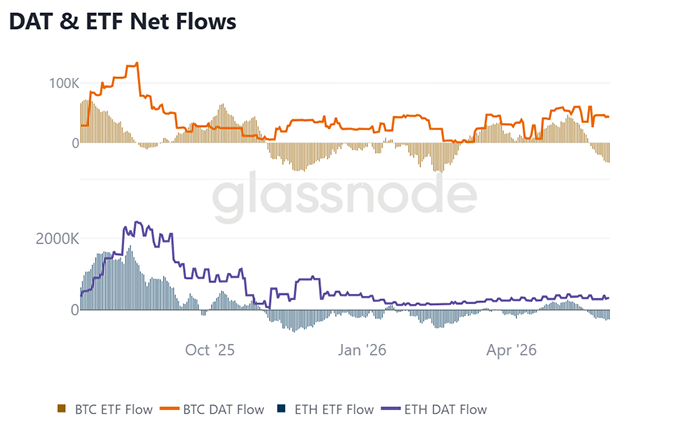
  • Bitcoin flows hovered near neutral while Ethereum outflows deepened and stablecoin inflows reversed sharply into month-end.

April's tentative stabilization carried into May for Bitcoin alone. BTC flows held close to neutral, spiking to +$2.9B on May 07 before drifting back to -$0.3B at the close. Ethereum again diverged, deepening from -$1.7B to a -$2.4B trough late in the month before ending at -$2.1B. The sharper signal came from stablecoins, which reversed from a +$6.1B peak early in May to -$2.5B by month-end, a decisive swing into net outflow. That rotation out of dollar liquidity points to allocators trimming risk into June rather than redeploying into spot.
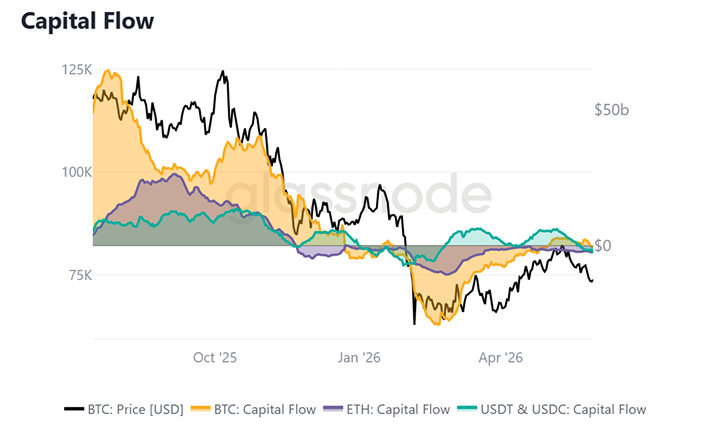
ETF & DAT Net Flows

  • Spot ETF flows for both Bitcoin and Ethereum swung from early-month highs into outflows while treasury vehicles kept accumulating.

Institutional demand split by vehicle in May. Spot ETF flows peaked early, with Bitcoin at +46.8k BTC and Ethereum at +283.4k ETH on May 05, before both rolled over into net redemptions, closing at -33.1k BTC and -261.5k ETH as ETF outflows reached a monthly record. Digital asset treasuries told the opposite story and stayed positive throughout. BTC DAT flows held between +26.1k and +60.4k BTC, ending at +42.9k, while ETH DAT flows ran from +302.4k to +439.2k ETH before settling at +330.8k. The divergence suggests balance-sheet buyers kept accumulating into weakness even as ETF allocators de-risked.
DeFi TVL & Stablecoin Cap

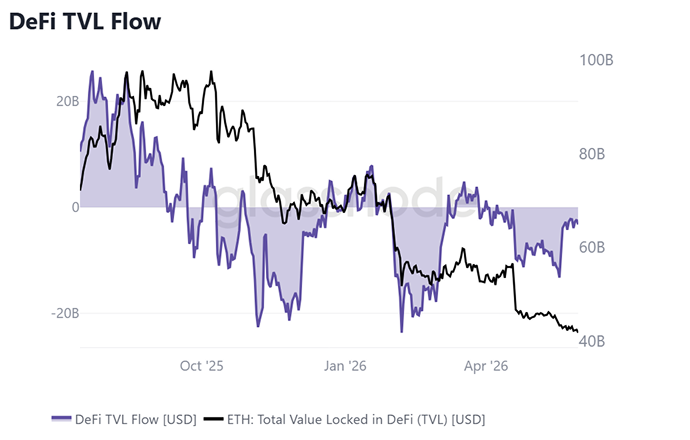
  • Ethereum DeFi TVL ground to new monthly lows even as the pace of net outflows eased through the second half of May.

The contraction that followed April's lending exploit persisted through May, though its intensity faded. Ethereum TVL slipped from $45.1B to $41.7B, closing at the monthly low after peaking at $46.1B on May 11. The flow picture was more constructive than the level implied. Thirty-day net flows stayed negative throughout but recovered from a -$13.3B trough on May 18 to -$3.2B by month-end, the shallowest outflow pace since the exploit. The combination of a falling TVL base alongside decelerating outflows suggests the forced deleveraging phase is largely complete, though fresh inflows remain absent.
CME Basis Yield

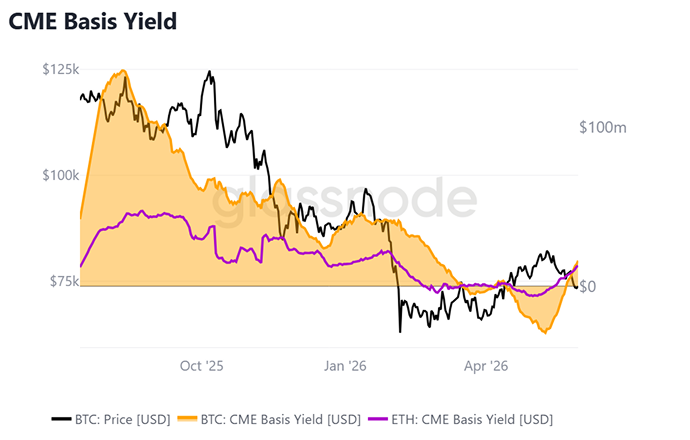
  • CME basis yields for both Bitcoin and Ethereum climbed back into positive territory through May, reviving the cash-and-carry trade.

Here we measure the return available to institutions running cash-and-carry trades. After April left both curves in backwardation, May delivered a clean reversal. BTC basis yield bottomed at -$29.3M on May 09 before rising steadily to +$16.0M, the monthly high reached at the close. ETH followed the same path, recovering from -$6.2M at the open to +$12.8M by month-end. Both series finished May at their peaks, with futures reclaiming a premium to spot for the first time since March. The rebuild restores a positive carry to market-neutral strategies, and a continuation into June would mark the firmest premium environment in several months.


Disclaimer: This report does not provide any investment advice. All data is provided for information and educational purposes only. No investment decision shall be based on the information provided here and you are solely responsible for your own investment decisions.
Exchange balances presented are derived from Glassnode’s comprehensive database of address labels, which are amassed through both officially published exchange information and proprietary clustering algorithms. While we strive to ensure the utmost accuracy in representing exchange balances, it is important to note that these figures might not always encapsulate the entirety of an exchange’s reserves, particularly when exchanges refrain from disclosing their official addresses. We urge users to exercise caution and discretion when utilizing these metrics. Glassnode shall not be held responsible for any discrepancies or potential inaccuracies. Please read our Transparency Notice when using exchange data.

Preguntas relacionadas

QWhat is the primary objective of the Strategy Watch publication, and how does it seek to strengthen its content?

AThe primary objective of Strategy Watch is to become a must-read monthly publication for the digital asset investment community by providing high-signal, impartial analysis of fund-level performance and allocation trends. It is strengthened by direct input and contributions of insights and data from funds and allocators.

QAccording to the report, how did the demand for Bitcoin and Ethereum ETFs versus Digital Asset Treasuries (DATs) diverge in May?

AIn May, demand diverged significantly. ETF flows for both Bitcoin and Ethereum peaked early before rolling over into net outflows. Conversely, Digital Asset Treasuries (DATs) kept accumulating throughout the month, with BTC and ETH DAT flows staying positive. This suggests balance-sheet buyers accumulated assets while ETF allocators were de-risking.

QWhat trend was observed in the CME basis yields for Bitcoin and Ethereum in May, and what is its significance?

AIn May, CME basis yields for both Bitcoin and Ethereum climbed from negative territory back into positive territory, reviving the cash-and-carry trade. This reversal restores a positive carry to market-neutral strategies, marking the firmest premium environment in several months.

QWhat is the current state of Ethereum DeFi Total Value Locked (TVL) based on the May data, and how did the outflow trends change?

AEthereum DeFi TVL continued to decline in May, grinding to new monthly lows, slipping from $45.1B to $41.7B. However, the pace of net outflows decelerated through the second half of the month, recovering from a -$13.3B trough to -$3.2B by month-end, suggesting the forced deleveraging phase is largely complete.

QWhat sharp signal from stablecoin flows did the report highlight as a key indicator of allocator behavior in late May?

AThe report highlighted that stablecoin inflows reversed sharply into month-end, swinging from a +$6.1B peak early in May to a -$2.5B net outflow by month-end. This decisive swing into net outflow points to allocators trimming risk into June rather than redeploying capital into spot markets.

Lecturas Relacionadas

Xing Bo Strikes Again: Last Time 'Critiquing' World Models, This Time It's Agents' Turn

Xing Bo, President of MBZUAI and professor at Carnegie Mellon University, along with co-authors Mingkai Deng and Jinyu Hou, has released a new paper, "Critique of Agent Model," critiquing the current state of artificial intelligence agents. The paper draws a crucial distinction between "agentic" systems, which rely on external toolchains, prompts, and workflows, and truly "agentive" systems capable of genuine autonomy driven by internal decision-making structures. To illustrate this, it references a real-world incident where an AI programming assistant, following an external prompt but lacking internalized judgment, caused a catastrophic data deletion. The authors propose a detailed analysis and a new framework, "Goal-Identity-Configurator" (GIC), for building truly autonomous agents. This framework systematically addresses five key dimensions where current "Agent" designs fall short: 1. **Goal:** Moving from step-by-step human instruction to a system capable of autonomously decomposing a single long-term goal and adapting sub-goals based on new information. 2. **Identity:** Evolving self-assessment updated by experience, rather than a static description in a system prompt. 3. **Decision Making:** Replacing textual Chain-of-Thought reasoning with "simulative reasoning" that uses a dedicated world model to predict real-world consequences before selecting actions. 4. **Cognitive Control:** Introducing a separate "System III" metacognitive module that dynamically decides when to deliberate, stick to a plan, or act quickly. 5. **Learning:** Enabling "continual autonomous learning," where the agent itself decides when to act, practice in simulation, or update its world model and self-perception. The GIC architecture integrates six components—a belief encoder, goal decomposer, identity evolver, configurator (System III), simulation-based planner (System II), and executor (System I)—to embody these principles. The paper argues that a growth path akin to pilot training (ground theory, simulator practice, real deployment) should be underpinned by a unified cognitive architecture, not separate workflows. On safety, the authors contend that the GIC framework's modular, explicit design enhances inspectability, allowing problematic behavior to be traced to specific components (e.g., flawed goal or poorly trained module) rather than emerging opaquely. However, they acknowledge that ultimate safety depends on correctly training these modules in the first place. In conclusion, the paper challenges the loose application of the term "Agent," asserting that task completion alone does not equal true autonomy. True autonomy requires goals, identity, and judgment to be genuinely internalized within the agent's architecture, not merely enforced by external scripts.

marsbitHace 12 min(s)

Xing Bo Strikes Again: Last Time 'Critiquing' World Models, This Time It's Agents' Turn

marsbitHace 12 min(s)

How Collector Crypt Uses 'Recirculating Buybacks' to Create an Illusion of Growth

Title: How Collector Crypt Creates a Growth Illusion with "Buyback Loops" Key Findings: Collector Crypt's (CC) net take rate has halved from 11.2% in Q3 2025 to 5.6% in Q2 2026, while GMV grew 4.7x. This growth is driven by higher-tier card packs ($250, $1,000, $2,500) which have lower platform dollar retention rates. The newly launched $2,500 Mythic tier captured 36.7% of June GMV within 13 days. Growth is fueled by a small cohort of high-spending, high-frequency wallets rather than broad user base expansion. The economic model faces pressure from three key areas: 1) **Shifting GMV Mix**: Pushing users towards larger, lower-retention card packs increases GMV but reduces overall profitability. 2) **Physical Redemptions**: Card redemptions for physical items remove reusable inventory from the system, creating costly replenishment needs. In May, redemptions consumed 41.6% of pre-redemption net income. Only 75 wallets drove redemptions in June. 3) **B2B/API Strategy**: Partner revenue remains negligible (cumulatively $1.83M) and dependent on CC for inventory, vaulting, and buyback services, failing to create a scalable, asset-light recurring revenue stream. The core product is a repetitive pack-buyback loop with limited secondary market activity and token value accrual. Sensitive modeling shows CC's economics turn negative when any two of the following pressures coincide: replenishment costs near market price, redemption rates exceeding 9%, or high-tier buyback rates around 93%. While CC operates in a large and growing collectibles market, its current growth levers—bigger packs, high buyback rates, and capital recycling by a few wallets—create a volume illusion without demonstrating sustainable collector engagement, deep secondary markets, or a viable path to improved margins. Future proof points include broadening collector participation, deepening secondary trading, and developing true asset-light B2B revenue channels.

Foresight NewsHace 34 min(s)

How Collector Crypt Uses 'Recirculating Buybacks' to Create an Illusion of Growth

Foresight NewsHace 34 min(s)

Grayscale's Latest Research: What is Solana's Next Growth Engine?

Grayscale's latest report, "Solana: Crypto's Financial Bazaar," signals a shift in how the market views Solana, moving beyond its high-performance and meme-centric reputation. The report frames Solana as an evolving application platform for large-scale economic activity, akin to a bustling digital marketplace. The analysis highlights that public chain competition has moved past raw throughput (TPS) to focus on genuine economic activity—daily users, transaction volume, and real revenue. Solana's metrics, such as over 1,000 dApps, 100M+ daily transactions, and ~4.3M daily active users, showcase this shift toward application-layer prosperity. The report identifies three key growth drivers: 1. **Jupiter**: Evolving from a DEX aggregator to a core liquidity hub and comprehensive financial platform for Solana's DeFi. 2. **Pump.fun**: Demonstrates Solana's capacity for consumer-scale applications, attracting millions of users and generating significant, sustainable revenue, validating network stability under high load. 3. **Helium & DePIN**: Represents expansion into real-world infrastructure, connecting blockchain to physical resources like wireless networks and positioning services, opening new long-term use cases. Solana Foundation's recent focus aligns with this broader vision, emphasizing AI Agents (for machine-to-machine transactions), payments, stablecoins, and Real-World Assets (RWA) to build a sustainable growth model beyond cyclical trends. While challenges remain—such as value capture for SOL and maintaining ecosystem sustainability beyond hot trends—institutional interest is growing due to Solana's maturing application business models, expanding payment/stablecoin ecosystem, and persistent developer activity. The competition is no longer about speed alone, but about which network can foster the most vibrant and valuable digital economy.

marsbitHace 55 min(s)

Grayscale's Latest Research: What is Solana's Next Growth Engine?

marsbitHace 55 min(s)

Trading

Spot
活动图片