Polygon burns hit 107M POL this year – So why is its price tanking?

ambcryptoPublicado a 2026-07-01Actualizado a 2026-07-01

Resumen

Polygon (POL) has burned over 107 million tokens in 2026, becoming net deflationary this year. Its network activity remains strong, achieving the highest stablecoin transaction volume among payment networks in May at 198 million. Major staking activity and whale confidence also support its fundamentals. However, POL's price has declined, recently trading around $0.06948. This price drop is attributed to a prolonged technical downtrend since late 2024, with the asset now in a consolidation pattern and facing significant selling pressure, as indicated by exchange offloads and negative market indicators.

Polygon [POL] is among the widely used chains for payment, with its volume matching or even surpassing that of established networks like Solana [SOL].

In the past 24 hours, POL price has declined by more than 1% after breaking below a support level at $0.07161. The altcoin’s price is currently trading at around $0.06948. Despite the price action declining, its network activity and fundamentals are growing.

A look into Polygon’s strong network activity and fundamentals!

As per Sandeep Nailwal, the founder and CEO of Polygon, the network has burned over 107 million POL tokens in 2026 alone. He celebrated the moment on X by marking,

Officially net deflationary this year.

All this was happening despite Polygon minting over 105 million POL tokens. The burned tokens were coming from the base fees collected, which resulted in a slightly reduced circulating supply.

In contrast, Ethereum [ETH], Solana, and Sui Network [SUI] added hundreds of millions of dollars worth of new tokens to the market.

The high fees were coming from the spike in transactions as a payment protocol. In fact, Polygon had the highest stablecoin volume in May among all payment networks, recording 198 million.

At the same time, whale activity and staking were heightening.

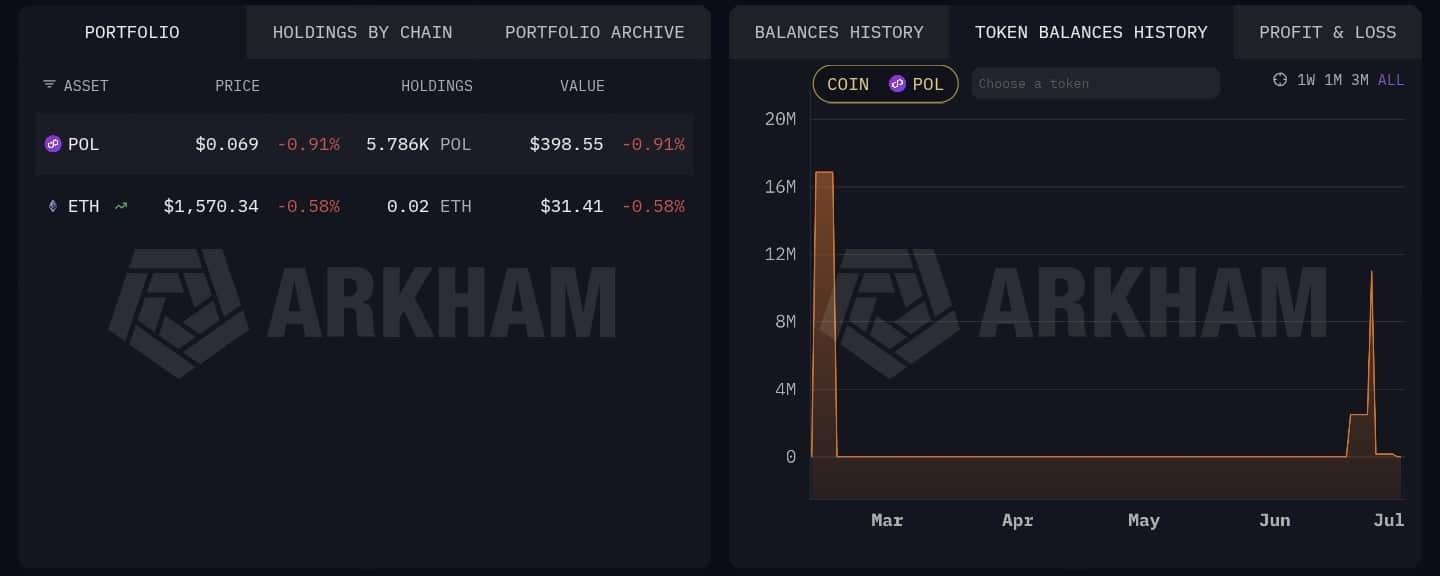
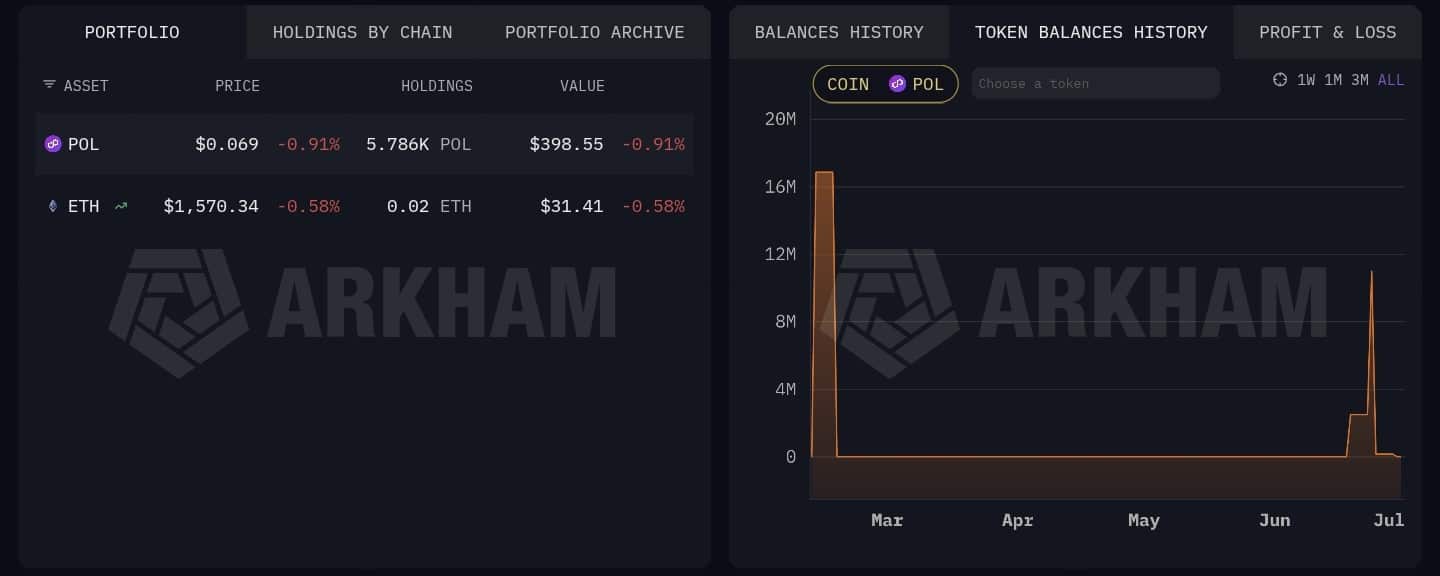
For instance, a whale migrated 17.512 million MATIC to 17.512 million POL worth $1.25 million. This indicated some whales were still confident with the Polygon project.

At the same time, a multisig wallet linked to Stader Labs and Polygon staked 11 million POL worth $839.41K. In total, the wallet has staked over 28 million POL tokens, which has helped reduce circulating supply in the market and improve network security.
Source: Arkham

While the Polygon chain has continued to display strong fundamentals and network activity, its price action is tanking.

But why is POL price stalling?

Since towards the end of 2024, Polygon has been in a consistent descent. A keen look at its price action shows the altcoin entered a consolidation phase in the form of a triangle pattern, which is nearing a break point.

The weekly chart shows sellers have been highly dominant starting October 2025 as the Bull Bear Power indicator is red. The Cumulative Volume Delta [CVD] too shows selling, indicating 670K POL have been offloaded into exchanges.
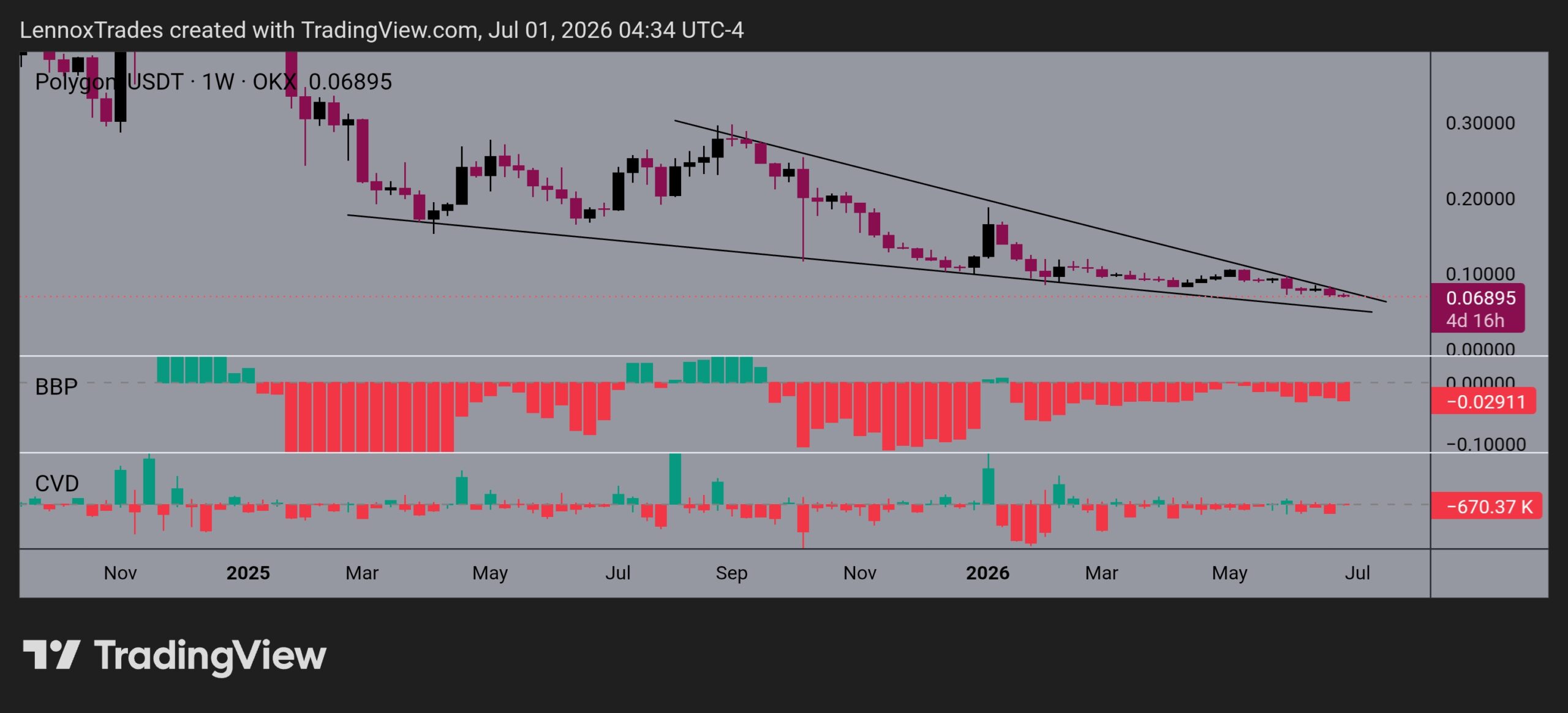
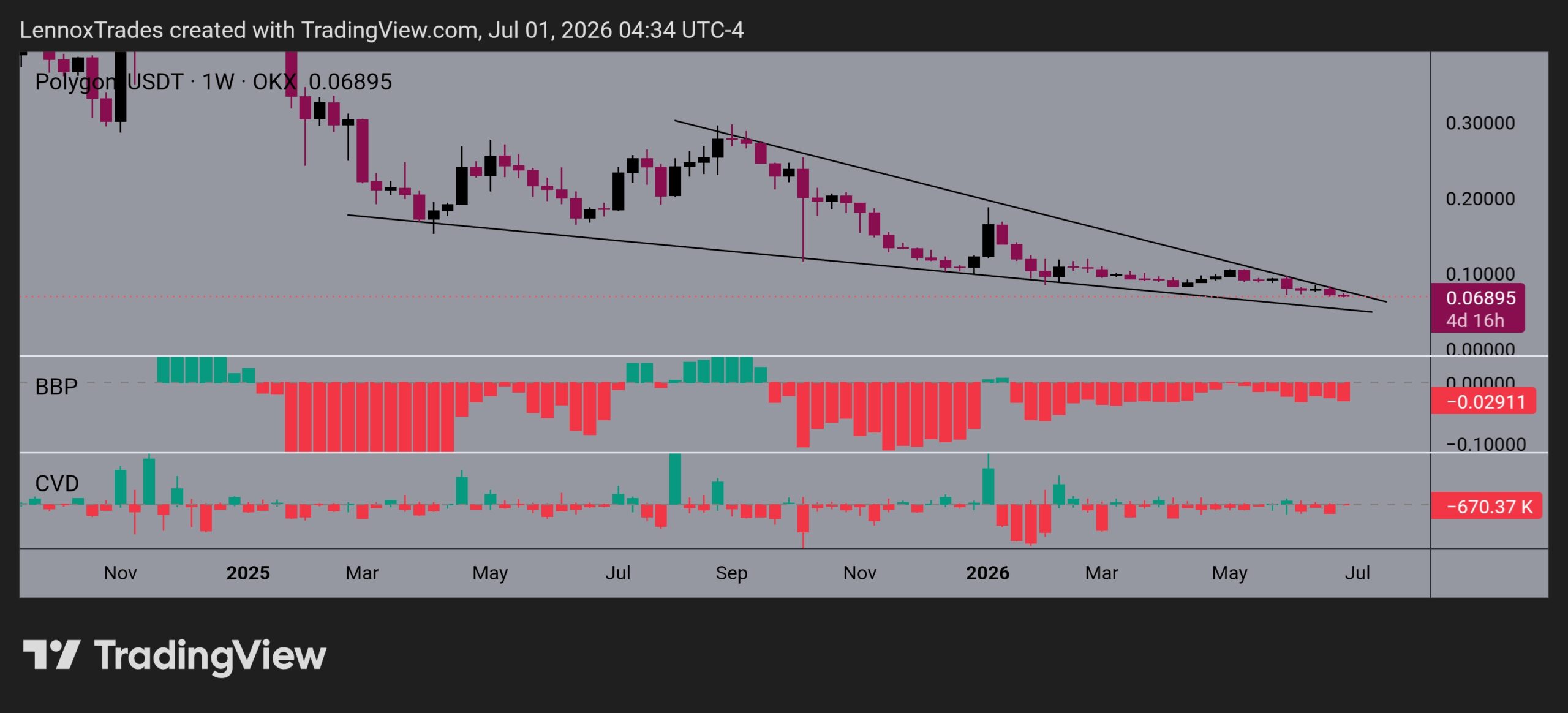
Source: POL/USDT on TradingView

Therefore, Polygon price is stalling because of the technical weakness even though its transaction count and burn rates were growing.


Final Summary

  • Polygon has burned over 107 million POL tokens in 2026 while its transaction volume reached 198 million in May.
  • POL price was trading in a triangle pattern as it has been falling since the end of 2024.

Criptos en tendencia

Preguntas relacionadas

QWhat key contradiction does the article highlight between Polygon's on-chain activity and its market performance?

AThe article highlights that despite Polygon exhibiting strong fundamentals in 2026—such as burning over 107 million POL tokens, recording a high stablecoin transaction volume of 198 million in May, and increased staking activity—its price has been declining, trading in a descending triangle pattern since late 2024.

QAccording to the article, why is Polygon considered 'officially net deflationary this year'?

APolygon is considered net deflationary because in 2026 alone, the network burned over 107 million POL tokens from base fees, which was more than the 105 million POL it minted, resulting in a net reduction in the circulating supply.

QWhat specific technical indicators suggest continued selling pressure on POL's price?

ATechnical indicators showing selling pressure include a red Bull Bear Power indicator starting October 2025 and a negative Cumulative Volume Delta (CVD), which indicates that approximately 670,000 POL tokens have been offloaded onto exchanges.

QHow did Polygon's stablecoin transaction volume in May compare to other payment networks, and what does it signify?

AIn May, Polygon had the highest stablecoin volume among all payment networks, recording 198 million transactions. This signifies its strong adoption and utility as a leading chain for payments, even surpassing established networks like Solana.

QWhat actions by whales and institutional stakers does the article mention as positive for Polygon's network?

AThe article mentions a whale converting 17.512 million MATIC to POL (worth $1.25 million), showing confidence, and a Stader Labs multisig wallet staking 11 million POL (worth ~$839k), bringing its total staked to over 28 million POL, which reduces circulating supply and improves network security.

Lecturas Relacionadas

$2 Trillion: Countdown to AI's Largest IPO in History

The countdown for the largest IPO in AI history, a potential $2 trillion listing for Anthropic, is underway for October. The staggering valuation, reportedly projected by several investors, contrasts with the company's own internal restraint on setting a public target. Founded five years ago by former OpenAI core members, Anthropic's growth has been meteoric. Annual recurring revenue (ARR) surged from ~$9B in late 2025 to $47B by May 2026, with Q2 2026 revenue of $11.5B marking a 14x year-over-year increase. Bank valuations are even based on internal 2028 revenue forecasts of $190-200B. A key growth driver is Claude Code, its AI coding assistant. Its ARR quintupled in five months to $2.5B by February 2026, now constituting nearly 20% of total revenue. Surveys indicate Anthropic commands roughly 40% of enterprise LLM spending, doubling OpenAI's share in programming-specific use. However, alongside this explosive growth, reports detail significant internal cultural strife. Critics describe a divisive "priesthood" of PhD executives, led by CEO Dario Amodei, who promote a "save humanity" narrative that some employees find cult-like and alienating. This has reportedly created a demoralized workforce and a covert "underground network" of dissent among engineers torn between lucrative pre-IPO equity and a toxic work environment. Anthropic now faces a pivotal paradox: pursuing its mission of "safe" AI requires immense capital for compute, yet that capital demands relentless commercial growth. As it approaches its historic IPO, the company must navigate intense regulatory scrutiny, soaring operational costs, and internal tensions—any of which could destabilize its post-listing trajectory, much like SpaceX's significant post-IPO stock drop. The stage is set for a defining moment in tech history.

marsbitHace 2 hora(s)

$2 Trillion: Countdown to AI's Largest IPO in History

marsbitHace 2 hora(s)

AI Boosting Efficiency and Cutting Costs Makes VC Increasingly Expensive

"AI for Cost Reduction Makes VC Funding More Expensive" Despite the "cost-reduction and efficiency" narrative of AI, venture capital (VC) investment in the AI sector is becoming increasingly costly. While AI tools lower the initial costs for many startups—with team sizes shrinking across funding stages—the market is polarizing. For top-tier AI teams, especially those from leading companies like Google and OpenAI, funding rounds are now larger and valuations are higher than ever at the seed and early stages. For example, new ventures by prominent researchers are securing billions in funding with valuations reaching tens of billions before having a mature product. This creates a "barbell" market: lightweight startups need less capital, while elite AI firms attract massive investments early on. This dynamic raises the cost for VCs to acquire and maintain meaningful ownership stakes. As valuations soar early, securing the same equity percentage requires significantly larger capital commitments. VCs must now invest more upfront and reserve substantial funds for follow-on rounds to avoid dilution, prompting large firms like Accel and a16z to raise massive new funds. Consequently, capital is concentrating intensely in a few perceived winners like OpenAI and Anthropic, widening the gap between large and small VC funds. While high valuations bake in future growth expectations, they also compress potential returns, demanding that portfolio companies achieve unprecedented scale. For major VCs, the core strategy is clear: secure early positions in potential winners and maintain the capital to keep investing as valuations rapidly escalate.

marsbitHace 3 hora(s)

AI Boosting Efficiency and Cutting Costs Makes VC Increasingly Expensive

marsbitHace 3 hora(s)

Trading

Spot

Artículos destacados

Cómo comprar POL

¡Bienvenido a HTX.com! Hemos hecho que comprar Polygon Ecosystem Token (POL) sea simple y conveniente. Sigue nuestra guía paso a paso para iniciar tu viaje de criptos.Paso 1: crea tu cuenta HTXUtiliza tu correo electrónico o número de teléfono para registrarte y obtener una cuenta gratuita en HTX. Experimenta un proceso de registro sin complicaciones y desbloquea todas las funciones.Obtener mi cuentaPaso 2: ve a Comprar cripto y elige tu método de pagoTarjeta de crédito/débito: usa tu Visa o Mastercard para comprar Polygon Ecosystem Token (POL) al instante.Saldo: utiliza fondos del saldo de tu cuenta HTX para tradear sin problemas.Terceros: hemos agregado métodos de pago populares como Google Pay y Apple Pay para mejorar la comodidad.P2P: tradear directamente con otros usuarios en HTX.Over-the-Counter (OTC): ofrecemos servicios personalizados y tipos de cambio competitivos para los traders.Paso 3: guarda tu Polygon Ecosystem Token (POL)Después de comprar tu Polygon Ecosystem Token (POL), guárdalo en tu cuenta HTX. Alternativamente, puedes enviarlo a otro lugar mediante transferencia blockchain o utilizarlo para tradear otras criptomonedas.Paso 4: tradear Polygon Ecosystem Token (POL)Tradear fácilmente con Polygon Ecosystem Token (POL) en HTX's mercado spot. Simplemente accede a tu cuenta, selecciona tu par de trading, ejecuta tus trades y monitorea en tiempo real. Ofrecemos una experiencia fácil de usar tanto para principiantes como para traders experimentados.

484 Vistas totalesPublicado en 2024.12.11Actualizado en 2026.06.02

Cómo comprar POL

Discusiones

Bienvenido a la comunidad de HTX. Aquí puedes mantenerte informado sobre los últimos desarrollos de la plataforma y acceder a análisis profesionales del mercado. A continuación se presentan las opiniones de los usuarios sobre el precio de POL (POL).

活动图片