Stock Price Surges Over 35%! Circle's Earnings Report Exceeds Expectations: USDC Circulation Soars 72%

marsbitPublicado a 2026-02-26Actualizado a 2026-02-26

Resumen

Circle (CRCL) reported strong Q4 and full-year 2025 financial results, with total revenue and reserve income reaching $770 million in Q4, up 77% year-over-year, exceeding expectations. This drove a 35% surge in its stock price. Key highlights include a 72% YoY increase in USDC circulation to $75.3 billion and a 247% rise in on-chain transaction volume to $11.9 trillion in Q4. Reserve income remained the core revenue driver at $733 million, while non-interest income reached $37 million. For the full year, total revenue grew 64% to $2.7 billion. Although the company reported a net loss of $70 million due to a one-time $424 million stock-based compensation expense from its IPO, adjusted EBITDA doubled to $582 million, indicating profitable core operations. Strategic developments include the stable testnet performance of its Arc blockchain, expansion of the Circle Payments Network with 55 financial institutions onboarded, and a key partnership with Polymarket to use native USDC. Regulatory progress includes conditional approval for a national trust bank. Looking ahead, Circle targets a 40% compound annual growth rate for USDC circulation. CEO Jeremy Allaire emphasized AI-driven payment demand, with 99% of agent-based payments currently using USDC. Despite challenges like declining yields and new competitors like USAT, Circle continues to execute its strategy as a growing internet financial infrastructure provider.

Author:Zhou, ChainCatcher

On February 25, stablecoin issuer Circle (NYSE code: CRCL) released its 2025 fiscal year fourth quarter and full-year financial report.

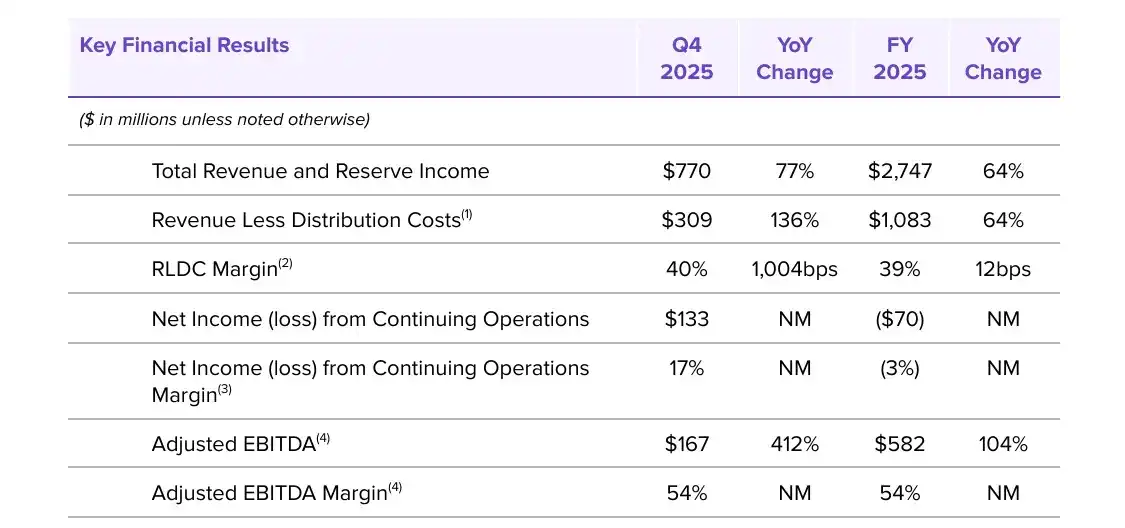
The report shows that the company's total revenue and reserve income for the fourth quarter reached $770 million, a year-on-year increase of 77%, exceeding market expectations.

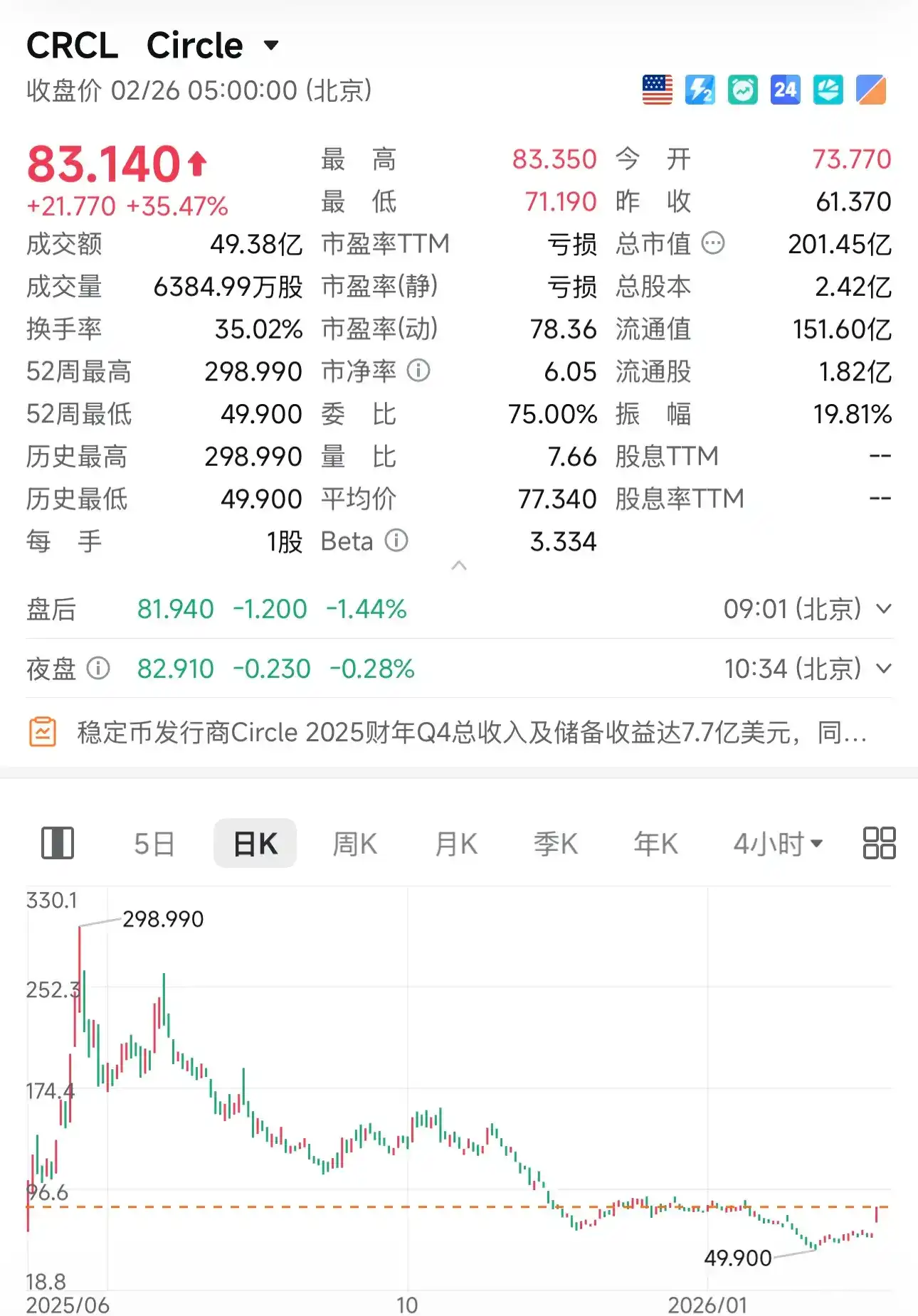
Driven by this, CRCL stock price rose over 35% at Wednesday's close.

Specifically, the growth of its stablecoin USDC was the core highlight of this earnings report. As of year-end, the circulation of USDC reached $75.3 billion, a year-on-year increase of 72%.

Meanwhile, network activity showed explosive growth, with on-chain transaction volume in the fourth quarter reaching $11.9 trillion, a year-on-year increase of 247%.


In terms of revenue composition, reserve income remains the company's main revenue pillar, contributing $733 million in Q4, a year-on-year increase of 69%.

Although market yields decreased by 68 basis points during the period, this pressure was offset by the significant expansion of USDC's average circulation scale.

At the same time, non-interest income reached $37 million, mainly due to the steady accumulation of subscription services and transaction fees.

Looking at the full-year performance, the company's total revenue and reserve income was $2.7 billion, a year-on-year increase of 64%.

Although continuing operations recorded a net loss of $70 million, this was mainly affected by the one-time inclusion of $424 million in stock-based compensation expenses during the IPO process.

As this expense is non-cash in nature, the company's core business is profitable after exclusion. Adjusted EBITDA reached $582 million, doubling year-on-year, showing that operating leverage is gradually emerging.
极

In terms of strategic layout, Circle is gradually transforming from a pure stablecoin issuer to an internet financial infrastructure provider, strengthening its underlying position in the real-time transaction field through various technological initiatives.

The report shows that the Arc public blockchain testnet is running stably, with transaction finality time shortened to about half a second, and total transactions have exceeded 166 million. The mainnet is expected to be officially launched within the year.

In terms of the payment network, the ecosystem of the Circle Payments Network continues to expand. Currently, 55 financial institutions have officially joined, with another 74 in the qualification review stage. The annualized transaction volume over the past 30 days has reached $5.7 billion.

It is worth mentioning that the strategic cooperation with Polymarket further highlights the value of USDC in emerging fields. As one of the world's largest prediction market platforms, Polymarket will gradually switch all betting and settlement to native USDC.

This cooperation not only eliminates bridging risks and improves capital efficiency but also directly converts the user growth of the prediction market into long-term increments in USDC circulation and transaction volume.

In addition, Circle is also gradually penetrating the traditional financial ecosystem. The company has not only achieved all-day settlement cooperation with Visa but also broadened application scenarios through platform integration with Intuit.

At the regulatory compliance level, the company received conditional approval from the U.S. Office of the Comptroller of the Currency to establish a national trust bank in December 2025, and further consolidated its first-mover advantage in compliance under the GENIUS Act framework.

The secondary market has given a relatively positive response. Technically, before the earnings release, the company's stock price had rebounded from its low and stabilized above the 7-day and 30-day moving averages.

On the institutional side, ARK Invest, under Cathie Wood, increased its holdings of Circle stock multiple times during market corrections. The latest holdings are about 4.14 million shares, worth approximately $261 million.

Mizuho Securities upgraded CRCL's rating from underweight to neutral at the end of January, setting a target price of $77. The institution believes that the growth of Polymarket will directly drive the expansion of USDC scale and revenue.

However, Circle still needs to deal with potential headwinds in the future.

On the one hand, the downward trend in interest rates may continue to put pressure on reserve income, which has been reflected in the decline in yield in the fourth quarter.

On the other hand, the stablecoin competitive landscape is changing. The USAT stablecoin, launched by Tether and issued by Anchorage Digital, is targeting the U.S. institutional market and is regarded as the first substantive compliant competitor for USDC domestically. This competition may lead to some diversion in the compliant institutional share.

In addition, overall cryptocurrency market volatility and macro cycles will still create uncertainty for circulation growth. According to Coinglass data, the current total stablecoin market capitalization is about $264 billion, with USDC accounting for about 28.5%. Although USDC leads the industry in growth rate, Tether still dominates.


Worthy of special attention from investors is Circle management's expectations and execution plans for the future. The company provided clear guidance for the 2026 fiscal year:

  • USDC circulation targets a compound annual growth rate of 40% over a multi-year cycle;
  • Other income (subscription, service, and transaction fees) is expected to be $150 to $170 million;
  • RLDC margin (revenue minus distribution and transaction cost margin) remains in the high range of 38% to 40%;
  • Adjusted operating expenses are expected to be $570 to $585 million.

These guidelines also reflect management's confidence in continued scale expansion, cost control, and accelerated growth in non-interest income.

Furthermore, Circle CEO Jeremy Allaire repeatedly mentioned AI agents and their payment needs during the earnings call.

He said, we are about to enter a world where there may be billions or even hundreds of billions of AI agents interacting on the internet and performing economic functions.

These AI agents need programmable digital dollars and open infrastructure to enable autonomous transactions, and Circle's products are built for this.

Specifically, Circle is heavily investing in agent-based payment infrastructure.

Currently, Circle Gateway has entered the test network phase, supporting AI agents to autonomously initiate cross-chain USDC transactions, with a single transaction cost as low as $0.00001 (extremely low fees, suitable for micro-payments and high-frequency machine-to-machine transactions).

It was also mentioned in the meeting that currently about 99% of agent-based payments use USDC, thanks to Circle's cross-chain deployment and participation in agent payment standards (such as the x402 standard, in cooperation with Google etc.).

Overall, this earnings report validates Circle's strategic execution capability in a complex regulatory environment, and the new story of AI+ payments has expanded the company's valuation imagination space. Despite facing yield fluctuations and emerging competitive challenges, Circle continues to exert efforts on the track of "financial infrastructure-ization" and "compliant expansion".


Preguntas relacionadas

QWhat was the percentage increase in Circle's total revenue and reserve income in Q4 2025, and what was the exact figure?

ACircle's total revenue and reserve income increased by 77% in Q4 2025, reaching $770 million.

QBy what percentage did the circulating supply of USDC grow year-over-year, and what was its total value at the end of the period?

AThe circulating supply of USDC grew by 72% year-over-year, reaching a total value of $75.3 billion.

QWhat was the main reason for Circle's net loss from continuing operations, and what was the adjusted EBITDA figure that showed core profitability?

AThe net loss was primarily due to a one-time, non-cash stock-based compensation expense of $424 million related to its public listing. The adjusted EBITDA, which excludes this, was $582 million, showing core profitability.

QName one new significant competitor for USDC in the U.S. institutional market mentioned in the article and which company is behind it.

AA new significant competitor is the USAT stablecoin, which is issued by Anchorage Digital and backed by Tether, targeting the U.S. institutional market.

QWhat future technology trend did CEO Jeremy Allaire highlight as a major growth driver for USDC, and what specific infrastructure is Circle building for it?

ACEO Jeremy Allaire highlighted AI agents and their payment needs as a major future growth driver. Circle is building 'agentic payment infrastructure,' including the Circle Gateway currently in testnet, to support autonomous, low-cost USDC transactions for AI.

Lecturas Relacionadas

In Conversation with Ray Dalio: We Are Currently in an AI Bubble, with 1% of My Portfolio in Bitcoin

Ray Dalio, founder of Bridgewater Associates, warns in an interview that the current AI boom shows classic bubble characteristics, which could lead to significant economic downturns as seen in past cycles like 1929 or 2000. He explains that speculative enthusiasm, fueled by debt and overvaluation, often precedes a crash when rising rates or taxation force asset sales, causing widespread losses and recession. Dalio also outlines his "Big Cycle" theory, describing an approximate 80-year pattern where widening wealth gaps, massive government deficits, and shifting geopolitical power (like China's rise) create internal conflict and global instability. He emphasizes that we are in a late-cycle, transitional phase where traditional powers like the US and UK face decline. For personal wealth protection, Dalio advises diversification beyond cash into assets like stocks, bonds, real estate, and particularly gold, which he prefers over Bitcoin. While he holds about 1% of his portfolio in Bitcoin as a non-printable hard asset, he views gold as more secure from technological or governmental threats. Regarding AI's impact, Dalio believes it will disproportionately benefit capital owners, worsening inequality by replacing both physical and cognitive labor. He suggests that human intuition and emotional intelligence, combined with AI, will be key for future workers. On taxation, Dalio argues that wealth taxes are impractical and risk triggering asset sell-offs, reducing productive investment. He points to the UK as a cautionary example of debt, low productivity, and political strife. Geopolitically, Dalio foresees a more regionalized world, with the US showing weakness in prolonged conflicts like with Iran, akin to past imperial declines. The ideal outcome, he suggests, is coexisting powerful blocs (e.g., Americas, China-Asia Pacific) without major war.

marsbitHace 1 hora(s)

In Conversation with Ray Dalio: We Are Currently in an AI Bubble, with 1% of My Portfolio in Bitcoin

marsbitHace 1 hora(s)

Daily 7.2 Trillion KRW: Foreign Capital's Record Net Buying on Friday! Wall Street Says Headwinds for Korean Stock Fund Flows Have Subsided

South Korean stock market sees a dramatic shift in fund flows. On July 31, foreign investors made a record net purchase of approximately KRW 7.2 trillion in KOSPI stocks, marking a fundamental reversal from the persistent large-scale net outflows seen in previous months. This contributed to a significant narrowing of foreign net selling in July to KRW 9.8 trillion, down sharply from KRW 48.4 trillion in June and KRW 44.5 trillion in May. Simultaneously, domestic institutional pressure eased. South Korean pension funds and asset managers turned to a net buying position in July, purchasing KRW 1.0 trillion worth of KOSPI shares, contrasting with net sales in May and June. Market volatility is expected to be dampened by new financial regulations. Effective July 31, the Financial Services Commission tightened access for retail investors to single-stock leveraged ETFs by raising the minimum cash deposit requirement. Trading volumes for these products subsequently dropped to about 50% of their monthly average. Citigroup Research maintains its year-end KOSPI target of 10,000 points. The firm cites several supportive factors: the substantial easing of headwinds from capital outflows, a robust fundamental outlook for the semiconductor sector, historically low market valuations, strong economic fundamentals, and the potential for policy support from financial authorities if needed.

marsbitHace 1 hora(s)

Daily 7.2 Trillion KRW: Foreign Capital's Record Net Buying on Friday! Wall Street Says Headwinds for Korean Stock Fund Flows Have Subsided

marsbitHace 1 hora(s)

Thanks to Dice Rolls, Bitcoin Keys Are Stored Offline, But Not Everyone Will Do It

The article discusses using dice rolls to generate secure Bitcoin wallet seeds, providing entropy independent of potentially flawed hardware random number generators. It explains that each fair dice roll offers about 2.585 bits of entropy, with around 50 rolls needed for a standard 12-word seed phrase and 99+ recommended for higher security. This method gained attention after a vulnerability was revealed in some Coldcard hardware wallets, where a faulty firmware RNG (dating back to 2021) compromised generated keys. The analysis notes that while a dice-generated main seed was safe from this specific flaw, other Coldcard functions (like creating paper wallets, backup keys, or passwords) could still be vulnerable if they used the defective RNG. The piece argues that while dice-based entropy is technically robust, the manual process is error-prone, tedious, and unrealistic for most new users, who might make mistakes in recording or inputting rolls. It concludes that while manual entropy generation should remain an option for advanced users, the long-term goal is to develop reliable, user-friendly hardware and software that securely generates randomness without requiring specialized knowledge. Coldcard users are advised to check their firmware version and replace any secondary secrets (like paper wallet keys) created with vulnerable devices, while also considering multi-signature setups with devices from different manufacturers for added security.

cryptonews.ruHace 6 hora(s)

Thanks to Dice Rolls, Bitcoin Keys Are Stored Offline, But Not Everyone Will Do It

cryptonews.ruHace 6 hora(s)

Trading

Spot
活动图片




