Standard Chartered, AirAsia parent to test ringgit stablecoin in Malaysia

cointelegraphPublicado a 2025-12-12Actualizado a 2025-12-12

Resumen

Standard Chartered Bank Malaysia and Capital A, the parent company of AirAsia, have signed a letter of intent to jointly explore a ringgit-pegged stablecoin. The initiative falls under Malaysia’s Digital Asset Innovation Hub, a regulatory framework introduced by the central bank. Standard Chartered will serve as the issuer, while Capital A and its ecosystem partners will develop and pilot wholesale use cases. This move aligns with Malaysia’s broader effort to modernize its financial system with digital assets, supported by recent regulatory developments including a central bank roadmap for asset tokenization and the formation of an industry working group.

Standard Chartered Bank Malaysia and Capital A, the parent company of AirAsia, plan to jointly explore a stablecoin pegged to Malaysia’s local currency, the ringgit.

In a statement Friday, the bank’s Malaysian arm and Capital A said they signed a letter of intent to explore a ringgit-pegged stablecoin under the country’s Digital Asset Innovation Hub, an initiative announced by Bank Negara Malaysia (BNM) in June.

This is Capital A’s first interaction with the regulated digital asset space. The initiative will rely on Standard Chartered’s infrastructure and financial expertise, as well as Capital A’s ecosystem, to pilot the stablecoin in a wholesale fashion, rather than focusing on the retail market.

Standard Chartered Malaysia will serve as the issuer of the stablecoin, while Capital A and companies within its ecosystem will be tasked with developing, testing, and piloting wholesale use cases.
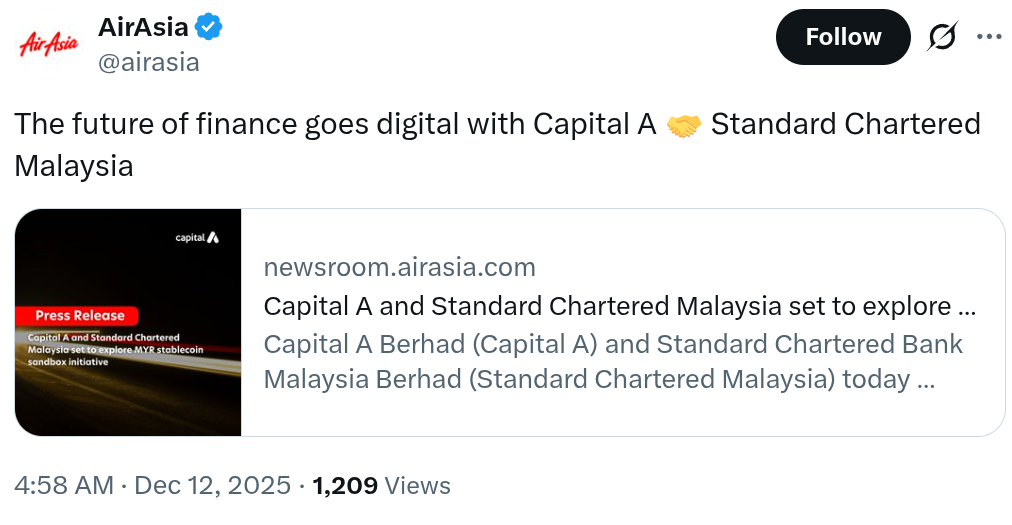
Source: Air Asia

Related: Malaysian regulator proposes easing crypto asset listing process

Malaysia is not getting left behind

Malaysia is moving to ensure it is not left behind as more countries weave crypto and stablecoins into mainstream finance. Capital A’s announcement said the effort “supports the aspirations of Malaysia,” positioning the stablecoin work as part of a broader national push to modernize payments and capital markets with digital asset technology.

That direction appears to have backing at the highest levels. The eldest son of Malaysia’s billionaire king recently launched a stablecoin pegged to the national currency. The Digital Asset Innovation Hub allows fintech and digital asset firms to test new technologies under BNM oversight.

Related: Illegal crypto mining surges in Malaysia amid unclear policies

Last month, BNM also unveiled a three-year roadmap to explore and test asset tokenization across the financial sector while building on the regulatory sandbox framework. The roadmap anticipates that the institution will launch proof-of-concept projects and conduct live pilots.

The central bank also decided to create an Asset Tokenization Industry Working Group to coordinate industry-wide exploration, share knowledge and identify regulatory and legal challenges in the country.

Malaysia has been considering a change in its approach to the digital asset industry since the beginning of 2025. In mid-January, the local government reportedly began exploring the possibility of establishing a cryptocurrency policy that could recognize the industry and modernize the nation’s financial system.


Lecturas Relacionadas

Franklin Templeton to Include Tokenized Assets BENJI in ETF and Mutual Fund Lineups

Franklin Templeton is preparing to incorporate tokenized assets into its traditional investment funds, marking a deeper integration of blockchain into mainstream asset management. According to reports, the firm plans to use its Franklin Onchain U.S. Government Money Fund (BENJI) as an asset or collateral within its exchange-traded funds (ETFs) and mutual funds, pending board approvals. The SEC has cleared this structure, permitting the use of this natively digital money market product for cash management and collateral purposes—a first-of-its-kind approval. This move goes beyond simply issuing blockchain versions of existing securities. Franklin already distributes tokenized funds via digital wallets but now aims to use these assets within conventional portfolios to enhance liquidity management and improve the efficiency of idle cash. The firm manages over 130 ETFs globally with around $82 billion in assets and approximately $790 billion in mutual fund assets. Its tokenized money market funds currently manage about $2.6 billion. This step occurs as tokenized real-world assets gain traction on Wall Street, with the total market value exceeding $38 billion. Other major firms like Blackrock and BNY are also expanding blockchain-based fund and settlement initiatives. Tokenization offers benefits like faster settlements, 24/7 transfers, and more efficient collateral use. Franklin's approach integrates these assets seamlessly into traditional fund operations, signaling an evolution where blockchain transitions from an external "wrapper" to a core operational mechanism. The company also plans to launch additional tokenized products for broader use across its fund lineup.

cryptonews.ruHace 1 min(s)

Franklin Templeton to Include Tokenized Assets BENJI in ETF and Mutual Fund Lineups

cryptonews.ruHace 1 min(s)

Liquidity Improvement Upgraded Again: Bonds, Gold, and Bitcoin Rise Simultaneously. Why Do Tech Stocks Continue to Fall?

On August 25th, US financial markets exhibited an unusual pattern: US Treasury bonds, gold, and Bitcoin rose simultaneously, the dollar remained strong, crude oil prices declined, and tech stocks continued to fall. The core drivers were two policy signals from US Treasury Secretary Scott Bessent. First, reports suggested the Treasury might use cash from its General Account (TGA) at the Fed to fund an expansion of long-term bond buybacks. Second, the US policy focus on Iran appeared to shift toward economic sanctions rather than further military escalation. These developments collectively lowered long-term Treasury yields and oil prices, while supporting gold and crypto assets. However, US equities did not broadly rally, with AI and semiconductor stocks continuing to weigh on the Nasdaq. The potential use of TGA cash, estimated at $80-$200 billion, was seen as a stronger tool to stabilize the long-end of the bond market by improving liquidity and altering the supply structure of tradable bonds. This led to a flatter yield curve. However, analysts from Goldman Sachs and others argue such buybacks may not address the fundamental pressures on long-term yields stemming from fiscal deficits, debt supply, sticky inflation, and term premiums. Regarding Iran, the US emphasis on "economic D-Day" sanctions against entities facilitating Iranian oil trade was interpreted as a de-escalation of immediate military risks, leading to a pullback in oil's geopolitical risk premium. However, risks remain for refined products due to transport bottlenecks and global refining capacity constraints. Despite the decline in interest rates, tech stocks, led by semiconductors and AI-related names like Nvidia, extended their losses. This suggests the AI trade is transitioning from a liquidity-driven phase to one focused on validating earnings, valuations, and returns on capital expenditure. Market volatility increased at the index level but decreased for individual stocks, indicating concerns are centered on systemic macro and sector risks rather than company-specific events. In summary, the day's moves reflected a complex mix of factors: improved bond market liquidity expectations, a temporary downgrade of Iran-related oil risks, and support for alternative assets from lower real rates. Tech stocks' divergence highlights a shift toward fundamental scrutiny amid ongoing macro policy uncertainty.

marsbitHace 8 min(s)

Liquidity Improvement Upgraded Again: Bonds, Gold, and Bitcoin Rise Simultaneously. Why Do Tech Stocks Continue to Fall?

marsbitHace 8 min(s)

Goldman Sachs Research Report Analysis: Cryptocurrency Trading Declines for Ten Consecutive Months, Turning Point May Be Approaching

Gold Sachs Research Note: Crypto Trading Declines for Ten Months, Inflection Point May Be Near Crypto trading volumes fell 30% in July and 21% in August, marking ten consecutive months of decline—a duration now exceeding the median of past five cycles. However, in a report dated August 24, Goldman Sachs expresses "cautious optimism" for the second half, suggesting a market recovery could provide significant upside potential. The current crypto trading volume downturn has seen a 75% drop from its peak over ten months. While a brief rebound in April-May failed to sustain, a recent 21% market cap increase, if maintained, could signal a volume inflection point. Goldman notes sector valuations are near the 30th percentile of the past five years, presenting a favorable risk-reward profile. Key catalysts include regulatory progress, such as the SEC's innovation exemption proposal and over 15 crypto firms receiving federal banking charters by 2026, which could bolster institutional adoption. Furthermore, crypto companies have cut costs by ~5% on average in 2026, improving operating margins and preserving cash flow. The report highlights four Buy-rated stocks: HOOD ($124 target), IBKR ($114 target, on Conviction List), FIGR ($43 target), and COIN ($196 target), each benefiting from distinct growth drivers like structural account growth, international expansion, or regulatory tailwinds. Overall, Goldman argues the sector has priced in significant pessimism, with a potential reversal supported by seasonal trends, election cycles, and a combination of market cap recovery, cost-cutting, and regulatory reforms.

marsbitHace 10 min(s)

Goldman Sachs Research Report Analysis: Cryptocurrency Trading Declines for Ten Consecutive Months, Turning Point May Be Approaching

marsbitHace 10 min(s)

Stanford Business School Internal Guide: Look Beyond the Reputation, How to Accurately Identify the 5% of Truly 'Top VCs'

"Stanford Business School Internal Guide: Beyond Reputation, How to Precisely Identify the Top 5% of 'Elite VCs'" Professor Ilya Strebulaev of Stanford Graduate School of Business, using data from 230,000 investments, reveals that the top 5% of venture capital firms generate approximately 90% of the industry's profits. For founders, choosing the wrong investor can mean a tenfold difference in returns. The article introduces the data-driven 2026 Strebulaev-Jackson VC Ranking, an alternative to lists like Forbes Midas. It scores nearly 13,000 investors across 30 years based on six factors: dilution-adjusted ownership, net profit (investment cost subtracted), value-add (e.g., lead investor/board role), and attribution of credit between firms and individual partners. Key findings from the top 100 firms: - Sequoia Capital leads with 10,158 points. - Performance follows a power law: the #1 firm scores ~41x more than #100. - Unicorn count is a poor performance proxy (e.g., SV Angel with 139 unicorns ranks #31). - 21 of the top 100 were founded in 2015 or later. - 23 firms have their top-scoring investment in frontier AI/AI infrastructure. - Geography remains concentrated: 62 in California, 19 in New York. The author cautions against using the rank order blindly. Founders must prioritize: 1. Strategic fit (stage, sector, involvement model) over raw rank. 2. Due diligence on the specific partner, not just the firm brand. 3. Recognizing that VC partnerships are long-term commitments akin to marriages. The ranking is a tool to identify the elite 5%, but the final choice requires deeper research into partner dynamics and how investors behave during a company's difficult times.

marsbitHace 11 min(s)

Stanford Business School Internal Guide: Look Beyond the Reputation, How to Accurately Identify the 5% of Truly 'Top VCs'

marsbitHace 11 min(s)

Trading

Spot
活动图片