Staking 'Net Outflow' Ends: Can Ethereum Achieve a Strong Breakthrough?

marsbitPublicado a 2025-12-30Actualizado a 2025-12-30

Resumen

By the end of 2025, the Ethereum network has reached a pivotal moment: the validator entry queue has surpassed the exit queue for the first time in months. This reversal indicates that more capital is seeking to stake ETH than to unstake, signaling a potential shift in market sentiment and underlying network strength. Currently, approximately 739,824 ETH are waiting to enter the staking queue, with an estimated wait time of nearly 13 days, while only 349,867 ETH are in the exit queue, requiring about 6 days to process. Total ETH staked stands at around 35.5 million, accounting for 29.27% of the total supply, with over 983,600 active validators. This change reflects reduced selling pressure and suggests growing confidence among institutional players. Key drivers include large staking moves by treasury firms like BitMine, which staked over 342,560 ETH in late December, and SharpLink, which has staked nearly all of its ETH. The Pectra upgrade—implemented in May 2025—also improved staking efficiency by raising the maximum validator balance and enabling reward compounding. Additionally, the deleveraging process in DeFi, which previously caused significant exit pressure, appears to be nearing its end. While challenges remain and the sustainability of this trend is yet to be confirmed, the shift toward net staking inflow marks a possible turning point for Ethereum’s security and capital accumulation cycle heading into 2026.

As 2025 draws to a close, the Ethereum network has reached a critical turning point: the validator "entry queue" has reversed and surpassed the "exit queue."

This means that, after months of market turbulence, the amount of capital attempting to stake Ethereum and become validators has far exceeded the amount seeking to unstake and exit.

This shift is more than just a numerical change—it is a barometer of market sentiment and network fundamentals. It signals that the sustained selling pressure of recent months is gradually easing and indicates that, driven by factors such as the return of institutional confidence, optimizations from the Pectra upgrade, and the clearing of DeFi leverage, the Ethereum network is entering a new cycle of enhanced security and capital accumulation.

Reversal of Ethereum Validator Queues

According to the latest data from Ethereum Validator Queue, approximately 739,824 ETH is currently queued to enter the network, with an estimated wait time of 12 days and 20 hours. The exit queue holds only 349,867 ETH, which would take about 6 days to clear.
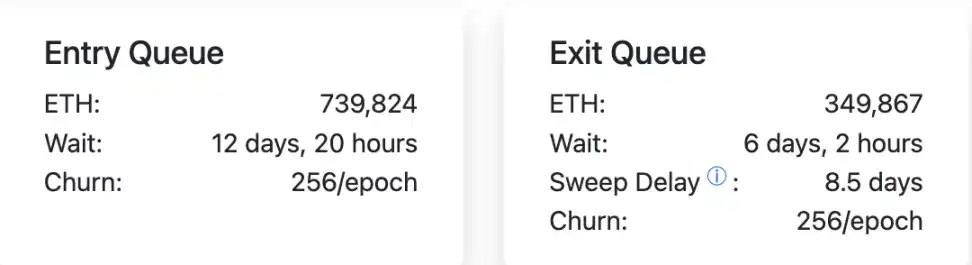
Additionally, the total amount of ETH staked is currently around 35.5 million, accounting for 29.27% of the total supply, with the number of active validators reaching 983,600.
What is the Validator Queue? Why is it Important?

Under Ethereum's Proof-of-Stake (PoS) mechanism, to ensure consensus stability, the protocol stipulates that nodes cannot join or leave at will. Instead, it regulates this through a "Churn Limit" mechanism.

Currently, the maximum number of validators that can be activated or exited per epoch (approximately 6 minutes and 24 seconds) is set at 256 ETH, equivalent to a daily processing capacity of about 57,600 ETH.

· Entry Queue: The queuing channel for staking 32 ETH to apply to become a validator. Growth in this queue indicates strong staking demand and long-term bullish sentiment.

· Exit Queue: The queuing channel for applying to withdraw funds. Growth in this queue typically signals selling pressure, liquidity needs, or deleveraging activities.

Therefore, the validator queue is not only an indicator of network health but also a barometer of market sentiment.

How Did the Validator Queue Change in 2025?

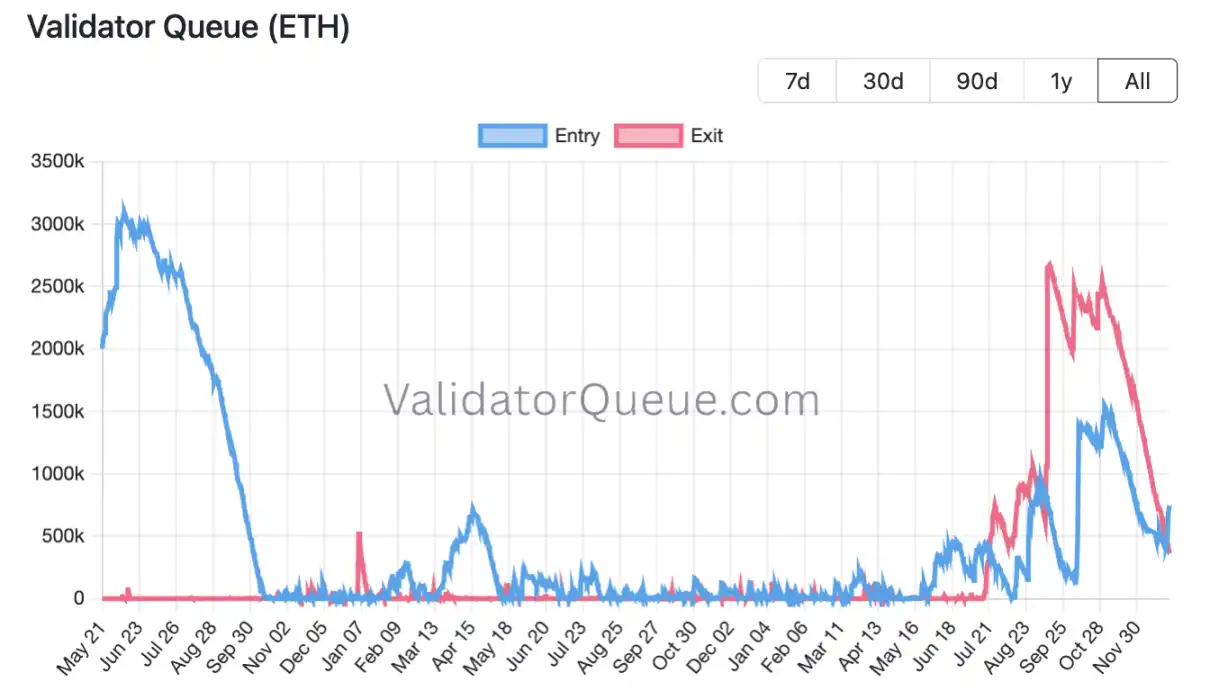
Throughout 2025, the Ethereum validator queue experienced significant fluctuations:

· First half to Autumn: The exit queue repeatedly reached record highs, primarily due to institutional rotation, profit-taking, DeFi deleveraging (e.g., soaring Aave lending rates triggering the unwinding of stETH looped borrowing positions), and isolated security incidents (such as Kiln exiting all its validator nodes in September).

· Mid-September: The exit queue peaked at 2.67 million ETH, with a waiting time of up to 46 days at that point.

· September-October: The "entry queue" briefly surpassed the exit queue but was later dominated by the "exit queue" again.

· November: The "entry queue" grew again to over 1.5 million ETH, but the "exit queue" once reached over 2.5 million ETH.

· End of December: The "entry queue" reversed the trend. Currently, approximately 739,824 ETH is queued to enter the network, while only 349,867 ETH is in the exit queue.

Four Core Drivers Behind the December Reversal

This reversal is not accidental but the result of the combined effect of capital, technology, and the macro environment:

Large-Scale Staking by Treasury Companies like BitMine

Just two days before the reversal occurred (December 25-27), BitMine staked a cumulative 342,560 ETH (approximately $1 billion), directly pushing the queue to reverse.

Furthermore, BitMine had previously stated its plan to launch dedicated staking infrastructure—the Made in America Validator Network (MAVAN)—in the first quarter of 2026, demonstrating its long-term commitment to the Ethereum staking ecosystem.

Simultaneously, another leading treasury company, SharpLink, has staked nearly 100% of its ETH holdings, further adding momentum to the capital inflow.

Although the crypto treasury sector currently faces severe challenges, with some institutions slowing their ETH accumulation pace or even seeing cases like ETHZilla reducing holdings for cash, the significant moves by key players like BitMine and SharpLink have largely stabilized the fundamental landscape of Ethereum staking.

Pectra Upgrade Optimizes Staking Experience

The Pectra upgrade implemented in May 2025 introduced key improvements via EIP-7251: increasing the maximum effective validator balance from 32 ETH to 2048 ETH and enabling reward compounding and validator consolidation. This reduces the operational costs for institutions managing thousands of validator nodes, providing technical convenience for large capital entry.

Kiln's Restaking Reopening

Kiln exited validators on a large scale following a security incident in September 2025. Although it's unclear exactly when Kiln resumed staking, according to Beaconcha.in data, Kiln currently holds a 1.68% share in the Ethereum staking ecosystem.

DeFi Deleveraging Nearing Completion

Previously, in June and July, rising lending rates on Aave forced the unwinding of stETH looped strategies, triggering阶段性 selling pressure. Recently, as the deleveraging process has largely cleared, related exit demand has gradually subsided, allowing market inflow demand to dominate.

Some Institutions Buying the Dip

The market has been adjusting for many days, and some institutions are bullish on ETH's long-term value. Trend Research is preparing to use $1 billion to continue accumulating ETH. On December 25th, Ai Yi confirmed with Jack Yi himself that the actual cost basis for the 645,000 ETH accumulated by Jack Yi's Trend Research since November is around $3,150, meaning the current floating loss on the holding is approximately $143 million. After the subsequent $1 billion investment, the expected average cost of ETH is projected to be controlled at around $3,050.

Summary

The reversal of the Ethereum validator "entry queue" surpassing the "exit queue" marks the initial formation of a net staking inflow-dominated格局 for the first time since July. This change is far more than a mere numerical crossover; it is a crucial signal of rebuilding market confidence. Of course, whether this leading trend can be sustained and solidified remains to be tested by time.

Although Ethereum spot ETFs have not yet shown significant net inflows, the improvement in on-chain fundamentals is evident. As SharpLink Gaming Co-CEO Joseph Chalom stated this month, the surge in stablecoins, tokenized RWA, and growing interest from sovereign wealth funds could potentially drive Ethereum's TVL to grow 10-fold in 2026.

Standing at the tail end of 2025, is Ethereum ready to gather momentum for a breakthrough in 2026? The answer will be revealed in time.

Criptos en tendencia

Preguntas relacionadas

QWhat does the reversal of the validator queues on the Ethereum network signify?

AThe reversal, where the entry queue surpasses the exit queue, signifies a key shift in market sentiment and network fundamentals. It indicates that the selling pressure from the past few months is easing and that the network is entering a new cycle of enhanced security and capital accumulation, driven by factors like returning institutional confidence, the Pectra upgrade, and the clearing of DeFi leverage.

QWhat are the 'Entry Queue' and 'Exit Queue' in Ethereum's Proof-of-Stake mechanism?

AThe 'Entry Queue' is the waiting channel for staking 32 ETH to apply to become a validator. Its growth indicates strong staking and long-term confidence. The 'Exit Queue' is the channel for validators to apply to withdraw their funds. Its growth typically signals selling pressure, liquidity needs, or deleveraging activity. Both are managed by a 'Churn Limit' to ensure consensus stability.

QWhat was a major driver behind the validator queue reversal in December?

AA major driver was the large-scale staking by treasury companies, particularly BitMine's accumulation of 342,560 ETH (approx. $1 billion) on December 25-27, which directly pushed the entry queue to overtake the exit queue. This was part of their long-term strategy, including plans to launch a dedicated staking infrastructure network (MAVAN) in Q1 2026.

QHow did the Pectra upgrade contribute to the change in Ethereum's staking dynamics?

AThe Pectra upgrade, implemented in May 2025, introduced EIP-7251, which increased the maximum effective validator balance from 32 ETH to 2048 ETH and enabled reward compounding and validator consolidation. This significantly reduced the operational costs for large institutions managing thousands of validator nodes, making it easier for substantial capital to enter the staking ecosystem.

QWhat does the current state of the validator queues suggest about the future of Ethereum's Total Value Locked (TVL)?

AThe shift to net staking inflows, as indicated by the queue reversal, suggests an improvement in on-chain fundamentals. While spot ETF inflows are not yet significant, industry leaders like Joseph Chalom of SharpLink speculate that the surge in stablecoins, tokenized RWA, and growing interest from sovereign wealth funds could potentially drive Ethereum's TVL to grow 10x in 2026.

Lecturas Relacionadas

The Verdict in Choi Tae-won's Divorce Case: Revealing the Inheritance Undercurrent Behind SK Hynix's Trillion-Won Empire

SK Group Chairman Chey Tae-won's high-profile divorce case, involving a record 1.38 trillion won settlement, has drawn attention to the succession plans for Korea's second-largest conglomerate, especially its crown jewel, SK hynix. Unlike traditional chaebol scripts centered on the eldest son, Chey's three children from his marriage to former President Roh Tae-woo's daughter, Roh Soh-yeong, are carving distinct, non-traditional paths. Eldest daughter Chey Yun-jung (b. 1989) is seen as the most evident successor. With a scientific and consulting background, she holds executive roles at SK bioscience and SK Inc.'s growth support department, focusing on future strategy and biopharma. Her marriage is to an AI infrastructure entrepreneur, not a traditional business alliance. Second daughter Chey Min-jung (b. 1991) took a unique route, voluntarily serving as a South Korean naval officer, including an anti-piracy deployment. She later worked on policy and strategy for SK hynix in Washington D.C. before co-founding an AI-driven healthcare startup. She married a former U.S. Marine Corps officer, connecting her to U.S. defense and policy circles—networks crucial for a global semiconductor giant. The only son, Chey In-geun (b. 1995), who studied physics like his father, worked briefly at SK E&S before joining McKinsey. Despite fitting the traditional "heir" profile as the eldest son, he remains silent and holds no public position or shares in SK, suggesting the old succession playbook is obsolete. As SK hynix's valuation soars, becoming a geopolitical asset in the AI era, the heirs' legitimacy is no longer automatic. They must prove themselves in fields like AI biotech, global policy, and strategic consulting. Their marriages also reflect new elite networks in tech and defense, not old political alliances. Their inheritance is the complex challenge of navigating a globalized, tech-driven world, not just a corporate throne.

marsbitAyer 09:06

The Verdict in Choi Tae-won's Divorce Case: Revealing the Inheritance Undercurrent Behind SK Hynix's Trillion-Won Empire

marsbitAyer 09:06

From OpenSea to OpenRouter: Is Alex Atallah Repeating His 'Exit at the Peak' Playbook?

From OpenSea to OpenRouter: Is Alex Atallah Repeating His "Exit at the Peak" Playbook? According to the Wall Street Journal, payments giant Stripe is in talks to acquire the AI model aggregation platform OpenRouter in a potential deal valuing the company near $100 billion. This would mark founder Alex Atallah's second creation of a company reaching a $100 billion valuation, following his co-founding of NFT marketplace OpenSea. OpenRouter, founded just over three years ago, has grown rapidly by acting as a unified gateway for developers to access over 400 AI models. It currently has about 10 million users and processes over 200 trillion tokens monthly. While the platform's annualized revenue is around $50 million, its valuation has skyrocketed from $1.3 billion in March 2026. The potential acquisition by Stripe, a company OpenRouter's founder once likened it to, represents a major expansion into AI infrastructure for the payments leader. This move echoes Atallah's previous timing with OpenSea, where he departed before the NFT market's significant downturn. For OpenRouter, selling now may be strategic. Despite its scale, its business model—charging a 5-5.5% fee on AI inference calls—faces pressure from competition, open-source models, and potential price wars among model providers, limiting its profitability narrative for an IPO. A key asset for potential acquirers like Stripe is OpenRouter's vast repository of real-world AI usage data, which offers unique insights into model performance and developer preferences that are difficult to replicate. Whether this potential deal signifies a new valuation benchmark for AI infrastructure or another market peak signal remains to be seen.

链捕手Ayer 08:42

From OpenSea to OpenRouter: Is Alex Atallah Repeating His 'Exit at the Peak' Playbook?

链捕手Ayer 08:42

Trading

Spot

Artículos destacados

Cómo comprar O

¡Bienvenido a HTX.com! Hemos hecho que comprar O1 exchange (O) sea simple y conveniente. Sigue nuestra guía paso a paso para iniciar tu viaje de criptos.Paso 1: crea tu cuenta HTXUtiliza tu correo electrónico o número de teléfono para registrarte y obtener una cuenta gratuita en HTX. Experimenta un proceso de registro sin complicaciones y desbloquea todas las funciones.Obtener mi cuentaPaso 2: ve a Comprar cripto y elige tu método de pagoTarjeta de crédito/débito: usa tu Visa o Mastercard para comprar O1 exchange (O) al instante.Saldo: utiliza fondos del saldo de tu cuenta HTX para tradear sin problemas.Terceros: hemos agregado métodos de pago populares como Google Pay y Apple Pay para mejorar la comodidad.P2P: tradear directamente con otros usuarios en HTX.Over-the-Counter (OTC): ofrecemos servicios personalizados y tipos de cambio competitivos para los traders.Paso 3: guarda tu O1 exchange (O)Después de comprar tu O1 exchange (O), guárdalo en tu cuenta HTX. Alternativamente, puedes enviarlo a otro lugar mediante transferencia blockchain o utilizarlo para tradear otras criptomonedas.Paso 4: tradear O1 exchange (O)Tradear fácilmente con O1 exchange (O) en HTX's mercado spot. Simplemente accede a tu cuenta, selecciona tu par de trading, ejecuta tus trades y monitorea en tiempo real. Ofrecemos una experiencia fácil de usar tanto para principiantes como para traders experimentados.

146 Vistas totalesPublicado en 2026.06.19Actualizado en 2026.06.29

Cómo comprar O

Cómo comprar PROS

¡Bienvenido a HTX.com! Hemos hecho que comprar Pharos (PROS) sea simple y conveniente. Sigue nuestra guía paso a paso para iniciar tu viaje de criptos.Paso 1: crea tu cuenta HTXUtiliza tu correo electrónico o número de teléfono para registrarte y obtener una cuenta gratuita en HTX. Experimenta un proceso de registro sin complicaciones y desbloquea todas las funciones.Obtener mi cuentaPaso 2: ve a Comprar cripto y elige tu método de pagoTarjeta de crédito/débito: usa tu Visa o Mastercard para comprar Pharos (PROS) al instante.Saldo: utiliza fondos del saldo de tu cuenta HTX para tradear sin problemas.Terceros: hemos agregado métodos de pago populares como Google Pay y Apple Pay para mejorar la comodidad.P2P: tradear directamente con otros usuarios en HTX.Over-the-Counter (OTC): ofrecemos servicios personalizados y tipos de cambio competitivos para los traders.Paso 3: guarda tu Pharos (PROS)Después de comprar tu Pharos (PROS), guárdalo en tu cuenta HTX. Alternativamente, puedes enviarlo a otro lugar mediante transferencia blockchain o utilizarlo para tradear otras criptomonedas.Paso 4: tradear Pharos (PROS)Tradear fácilmente con Pharos (PROS) en HTX's mercado spot. Simplemente accede a tu cuenta, selecciona tu par de trading, ejecuta tus trades y monitorea en tiempo real. Ofrecemos una experiencia fácil de usar tanto para principiantes como para traders experimentados.

162 Vistas totalesPublicado en 2026.06.22Actualizado en 2026.06.29

Cómo comprar PROS

Qué es VERONA

I. Introducción al Proyecto VERONA es una blockchain construida para todos, en todas partes a través de la abstracción de cadenas. Utilizando su capa de Abstracción Generalizada, VERONA se distingue por integrar funcionalidades complejas de blockchain, como cuentas, firmas e interoperabilidad, directamente a nivel de protocolo. Este enfoque permite interactuar con aplicaciones de blockchain sin necesidad de entender las tecnologías subyacentes.1) Información Básica Nombre: VERONA (VERONA)III. Enlaces Relacionados Enlace al sitio web oficial: https://xion.burnt.com/ Libro Blanco: https://xion.burnt.com/whitepaper.pdf Exploradores: https://explorer.burnt.com/ Redes Sociales: https://x.com/burnt_xion Nota: La introducción del proyecto proviene de los materiales publicados o proporcionados por el equipo oficial del proyecto, que es solo para referencia y no constituye asesoramiento de inversión. HTX no se hace responsable de ninguna pérdida directa o indirecta resultante.

191 Vistas totalesPublicado en 2026.06.22Actualizado en 2026.06.22

Qué es VERONA

Discusiones

Bienvenido a la comunidad de HTX. Aquí puedes mantenerte informado sobre los últimos desarrollos de la plataforma y acceder a análisis profesionales del mercado. A continuación se presentan las opiniones de los usuarios sobre el precio de A (A).

活动图片