Stablecoins could reach $1.5 quadrillion by 2035 – Here’s how

ambcryptoPublicado a 2026-04-09Actualizado a 2026-04-09

Resumen

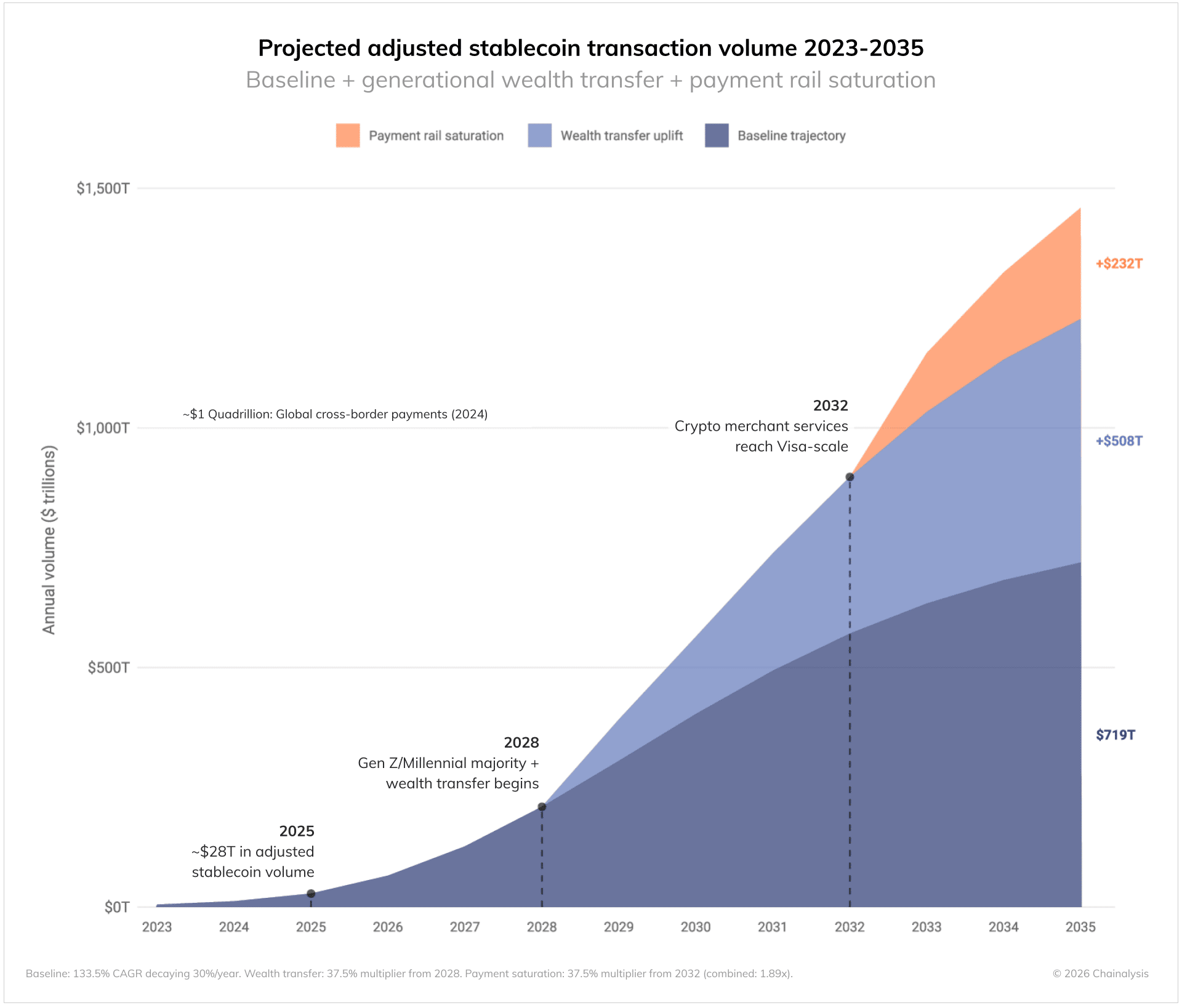
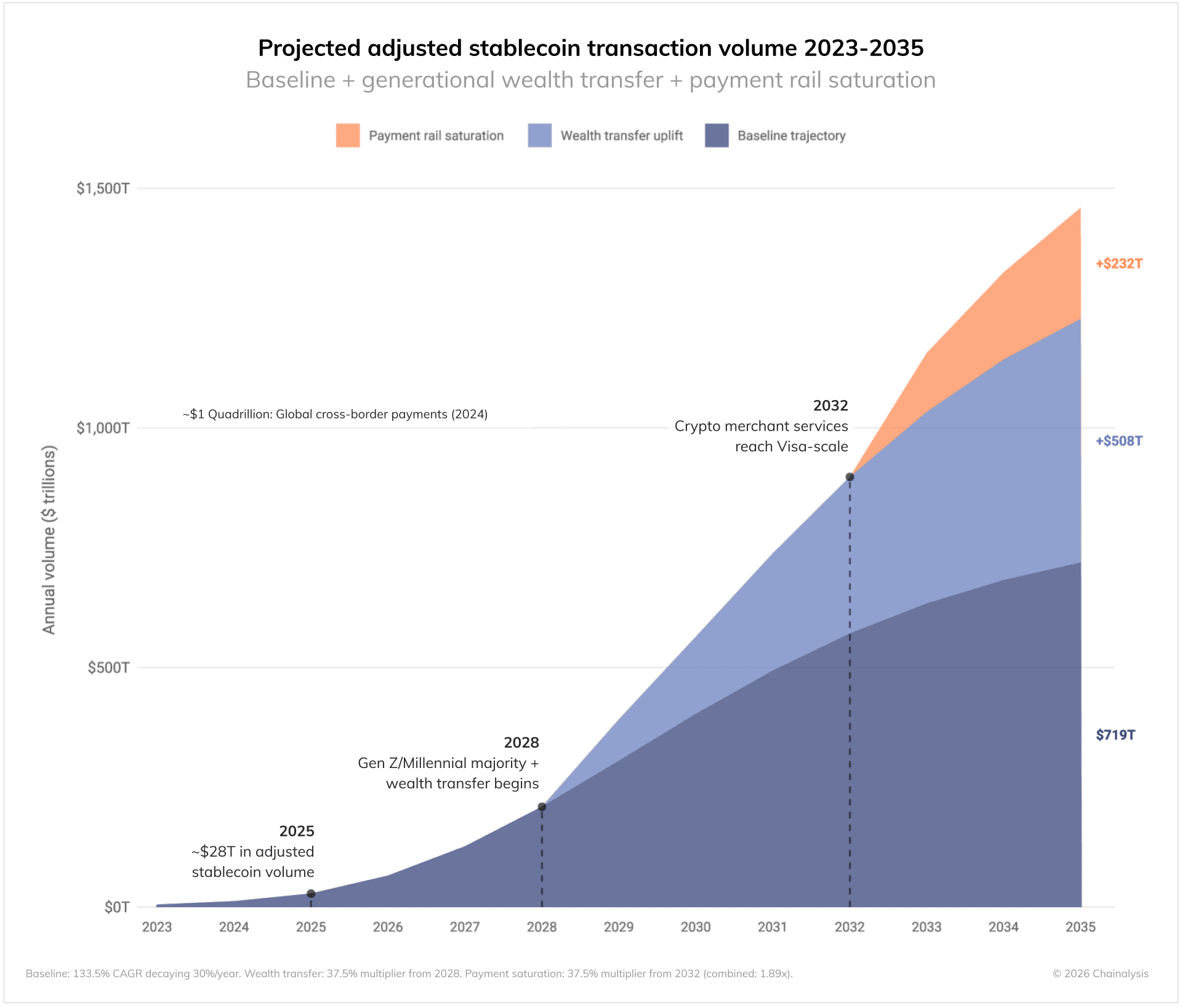
Stablecoin usage has surged over the past decade, with significant growth accelerated by the passage of the GENIUS Act in 2025, pushing the stablecoin value to $319 billion. According to Chainalysis, adjusted volume rose 133% from 2023 to reach $28 trillion in 2025, with monthly volume hitting a record $7.2 trillion—surpassing major traditional payment channels like U.S. ACH and Visa. Transaction volume exceeded 8.1 trillion through March 2026, and active addresses grew to 51.6 million. Chainalysis projects that, if current growth continues, stablecoin volume could exceed $1.5 quadrillion by 2035, driven by generational wealth transfers ($80–100 trillion moving to crypto-friendly younger generations) and point-of-sale adoption. This would surpass the estimated $1 quadrillion in global cross-border payments. Further adoption, including real-world asset tokenization and supportive legislation like the Clarity Act, could accelerate this trajectory.

Stablecoin usage has surged over the past decade with rising adoption and mainstream acceptance. The passage of the GENIUS Act by the U.S. Congress in 2025 accelerated this growth, pushing stablecoin value to $319 billion.

This global financial shift is driving the integration of traditional and decentralized finance, with stablecoins at the center of market transformation and projected to outpace traditional finance.

Stablecoin monthly volume hits $7.2T

According to the Chainalysis report, Stablecoin Adjusted Volume rose 133% from 2023 to hit $28 trillion in 2025. This showed extensive growth in the economic value of stablecoins.
Source: Chainalysis

At press time, monthly volume reached a historical high of $7.2 trillion, surpassing major traditional payment channels such as U.S. ACH and Visa.

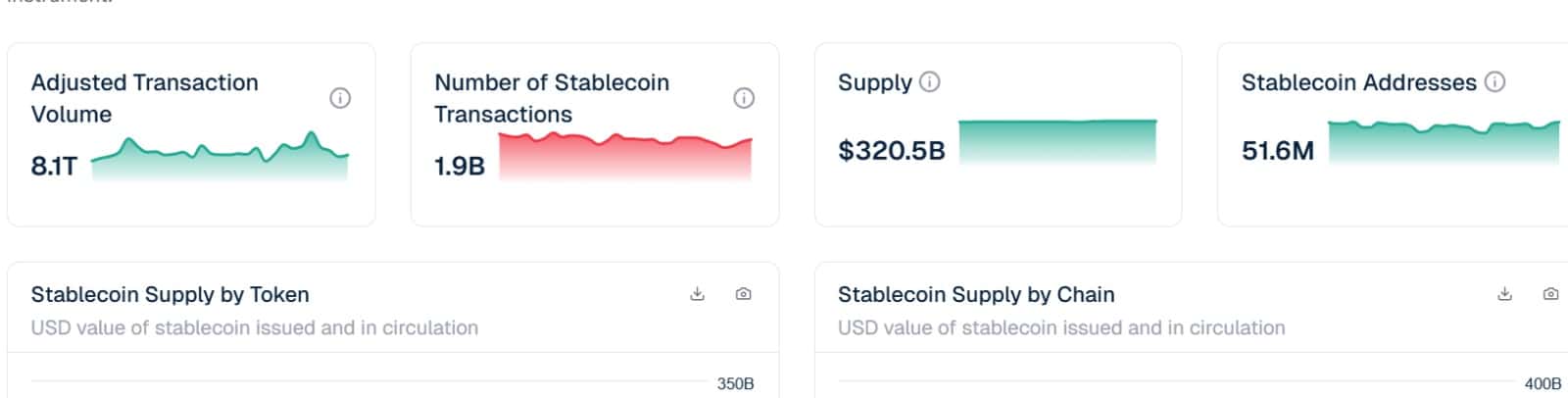
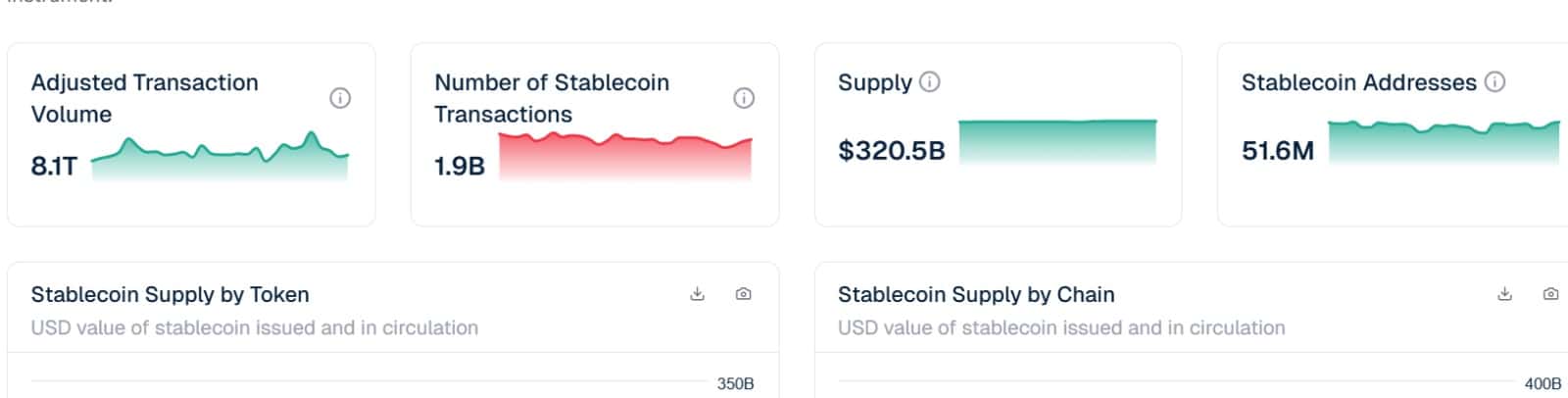
The growth has indicated the extensive usage of stablecoin in everyday life across all walks of life. In fact, Artemis data showed that both transactions and addresses have also risen significantly.
Source: Artemis

Adjusted Transaction Volume exceeded 8.1 trillion through March 2026, with the number of transactions nearing 2 trillion. At the same time, Stablecoin Addresses have surged to 51.6 million over the last 30 days, reflecting this sustained usage.

Usage to surpass $1.5 quadrillion by 2035

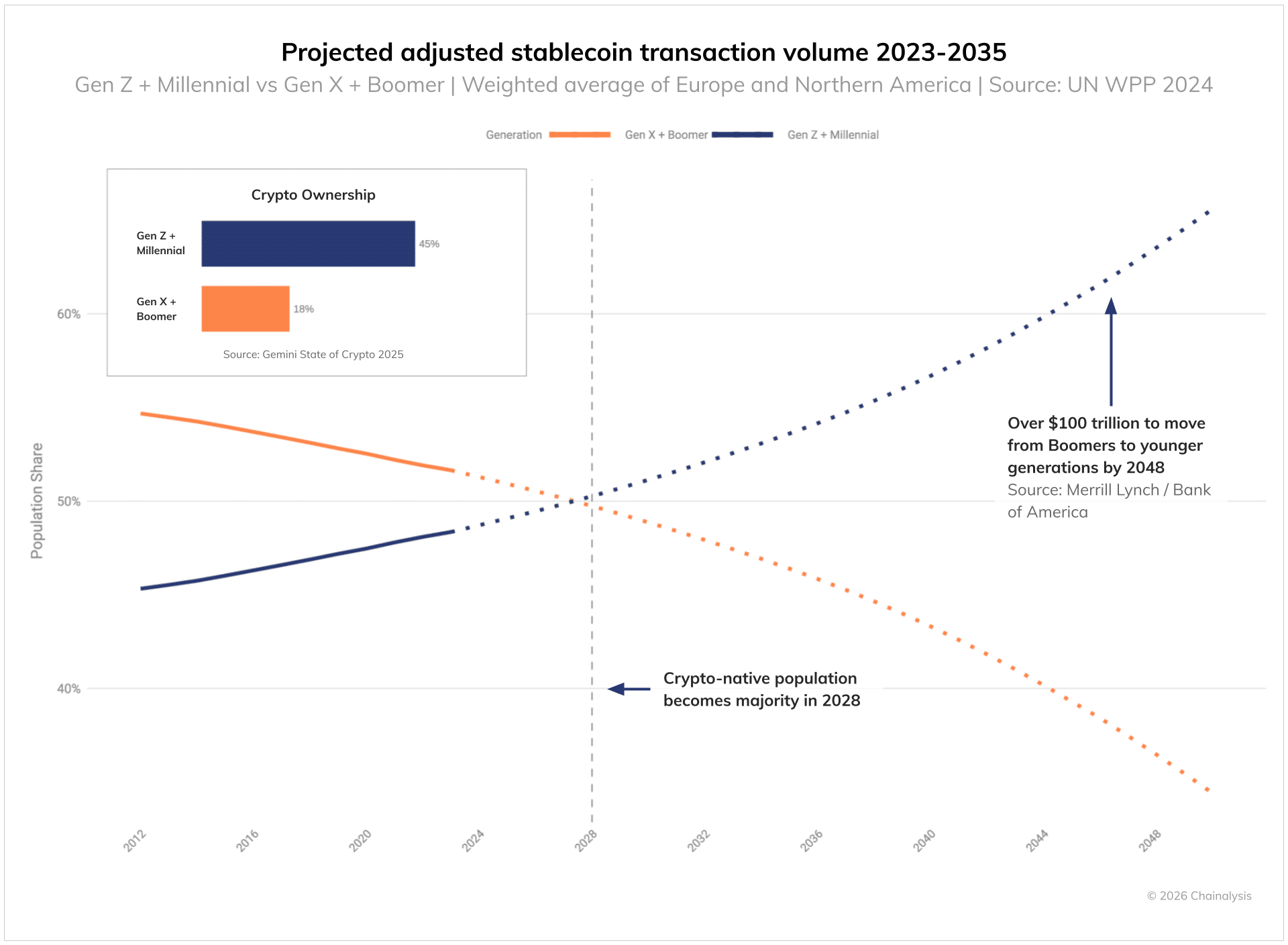
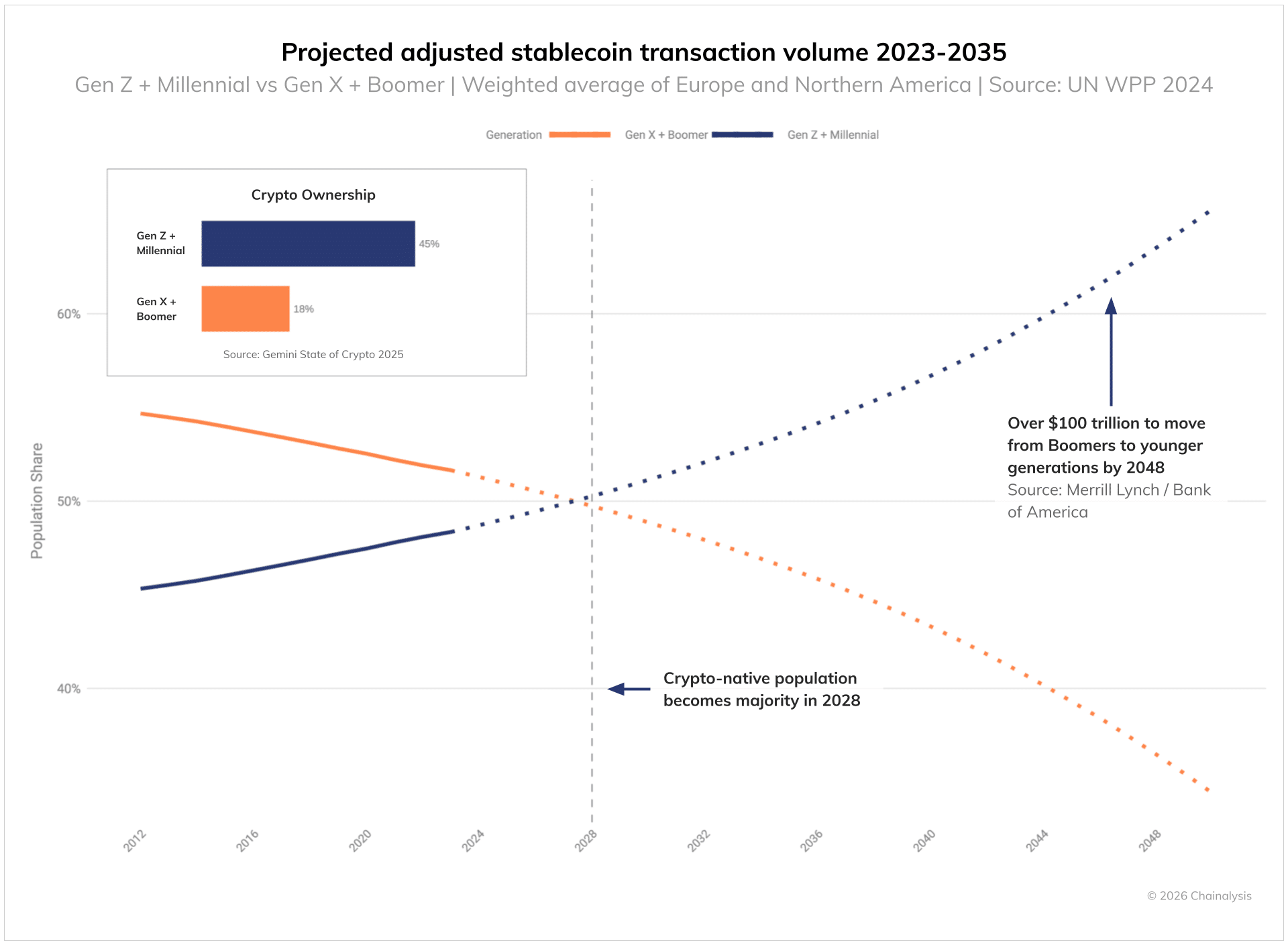
Chainalysis projects that if current growth continues, stablecoin volume could exceed $719 trillion by 2035. Notably, two key drivers are generational wealth transfers and point‐of‐sale adoption. Between $80 and $100 trillion in wealth is expected to move from boomers to millennials and Gen Z, nearly half of whom already hold crypto.

This transition alone could add more than $508 trillion in stablecoin transaction volume. At the same time, stablecoins may become default payment systems, further accelerating growth. Together, these forces could push stablecoin volume to $1.5 quadrillion by 2035, surpassing the estimated $1 quadrillion in global cross‐border payments.
Source: Chainalysis

Even more importantly, intergenerational wealth transfers and shifts in payment infrastructure could accelerate adoption. This will see a surge in real-world asset tokenization, prediction markets, and other TradFi-to-crypto products.

Institutions and other players in TradFi will be left at a crossroads: either fully embrace crypto or see assets migrate. As many users continue to adopt stablecoin, the growth is barely starting.

Finally, if the Clarity Act, currently stalled in the U.S. Senate, is passed, stablecoins will gain a clearer growth path.


Final Summary

  • Stablecoin Adjusted Volume rose 133% from 2023 to hit $28 trillion in 2025, with a monthly volume of $7.2 trillion.
  • Stablecoin volume is projected to hit $1.5 quadrillion by 2035, surpassing the estimated $1 quadrillion in global cross-payments


Preguntas relacionadas

QWhat was the percentage increase in Stablecoin Adjusted Volume from 2023 to 2025, and what was the total value reached in 2025?

AStablecoin Adjusted Volume rose 133% from 2023 to hit $28 trillion in 2025.

QWhat is the projected total stablecoin transaction volume by 2035, and how does it compare to the estimated value of global cross-border payments?

AStablecoin volume is projected to reach $1.5 quadrillion by 2035, surpassing the estimated $1 quadrillion in global cross-border payments.

QWhat are the two key drivers identified by Chainalysis that could push stablecoin volume to $1.5 quadrillion by 2035?

AThe two key drivers are generational wealth transfers (from boomers to millennials and Gen Z) and the adoption of stablecoins as a default payment system at the point-of-sale.

QWhat recent U.S. legislation is credited with accelerating the growth of stablecoins, and what is the name of the act currently stalled in the Senate that could provide further clarity?

AThe GENIUS Act, passed by the U.S. Congress in 2025, accelerated stablecoin growth. The Clarity Act is currently stalled in the U.S. Senate and could provide a clearer growth path if passed.

QWhat does the article state about the current monthly stablecoin volume compared to traditional payment channels like U.S. ACH and Visa?

AAt press time, the monthly stablecoin volume reached a historical high of $7.2 trillion, surpassing major traditional payment channels such as U.S. ACH and Visa.

Lecturas Relacionadas

From MSTR to STRC+: Where Is the Limit of the Strategy Universe?

From MSTR to STRC+: The Evolution and Limits of the Strategy Universe This article examines the transformation of Strategy (formerly MicroStrategy) from a simple "Bitcoin treasury" company into a complex financial engineering firm building a BTC-backed credit system. **Core Thesis:** Strategy's true significance lies not just in its massive BTC holdings (~844k BTC), but in its attempt to transform this static reserve into a multi-layered credit curve within traditional capital markets and, subsequently, into on-chain yield infrastructure. **The MSTR Flywheel:** The initial model was a reflexive loop: BTC price rises → MSTR stock rises → company raises capital (debt/equity) at a premium → buys more BTC → increases per-share BTC exposure → MSTR premium grows. This "amplified Bitcoin" equity (MSTR) thrives on bullish momentum but is vulnerable to tightening premiums and rising funding costs. **Building the Credit Curve:** Strategy's innovation is slicing its single BTC balance sheet into different risk/return profiles via specialized securities: * **MSTR:** High-volatility equity layer absorbing full BTC upside/downside. * **STRC:** Key product. A perpetual preferred stock designed as "short duration high yield credit," offering ~11.5% floating monthly dividends. It attracts fixed-income investors seeking yield without direct BTC exposure, funding Strategy's operations. * **STRD/STRK/STRF:** Other preferred/share classes with varying durations, conversion rights, and fixed dividends. **Risks of the STRC Model:** STRC's high yield is not risk-free. Its stability depends on: 1) Sufficient BTC asset coverage, 2) Strategy's continued ability to pay dividends, and 3) Market faith in the MSTR/STRC funding flywheel. Stress points include deep BTC price declines eroding the asset buffer, rising dividend costs if STRC trades below par, and a broken flywheel if MSTR's premium (mNAV) falls persistently. **On-Chain Expansion: STRC+:** Projects like **Saturn** and **Apyx** aim to package STRC's (and other DAT preferred stock) cash flows into on-chain stablecoin yield (e.g., sUSDat, apyUSD). They offer DeFi a new yield source distinct from trading fees or incentives—cash dividends from traditional securities. However, this introduces compounded risks: off-chain custody, issuer credit risk, BTC volatility, and protocol execution risk. **Conclusion: The Ultimate Boundary** Strategy's endgame is not infinite BTC accumulation. It is the market's long-term acceptance of a new credit system where BTC serves as collateral for tradable securities whose cash flows can power on-chain financial applications. Its "universe" expands if this BTC-native credit curve gains legitimacy, but contracts if these instruments are repriced purely as high-risk, yield-bearing credit assets without stablecoin mythology.

marsbitHace 5 min(s)

From MSTR to STRC+: Where Is the Limit of the Strategy Universe?

marsbitHace 5 min(s)

Founder of Baixing.com: My Fourteen Claude Code Usage Experiences

Founder of Baixing.com Shares 14 Personal Tips for Using Claude Code The author outlines his personal, non-universal strategies for maximizing Claude Code. Key points include: focusing deeply on one primary tool (Claude Code) rather than constant comparison; mastering essential shortcuts for the editor and command line; utilizing voice input like HoldSpeak; starting projects with a structured PROJECT.md file; defaulting to Claude agents for most tasks; and leveraging integrations with GitHub and Cloudflare for build, deployment, and infrastructure. He emphasizes a clear separation between human and machine work: manually maintain a core CLAUDE.md file, and understand AI-generated content by asking the AI, not reading its raw code. Efficient communication involves dragging files (screenshots, audio, documents) directly into the interface. For knowledge management, he recommends a centralized, Git-synced memory system based on ~/.claude/CLAUDE.md to ensure permanence and avoid scattered project memories. Other practices include writing and continuously refining "Skills," using the expensive but reliable ultracode for complex dynamic workflows, and employing Git documentation as handoff points between agents. The overarching philosophy is to treat Claude Code like a horse (or a person) with its own pathfinding abilities—setting goals and boundaries rather than micromanaging every turn.

链捕手Hace 13 min(s)

Founder of Baixing.com: My Fourteen Claude Code Usage Experiences

链捕手Hace 13 min(s)

Gary Yang: Agent Economy and AI Submicroeconomics

**Title:** Agent Economy and AI Sub-Microeconomics - Gary Yang **Summary:** Following the AI singularity, the pace of evolution has accelerated rapidly, creating new generational disparities in technological advancement globally. While many regions are still grappling with single-agent bottlenecks, Silicon Valley has moved ahead into the next dimension: the Agent Economy and A2A ecosystems. The article outlines six key areas of this emerging paradigm: 1. **AI Payment Competition & H2A Bottlenecks:** A fierce battle for AI Agent payment protocol standards is underway (e.g., MPP, x402). However, most current efforts remain Human-to-Agent (H2A), essentially grafting AI onto traditional human-centric commerce, which creates a non-AI-native bottleneck. The true potential lies in Agent-to-Agent (A2A) autonomous economies. 2. **Agent Economy & the Inevitable A2A Trend:** The Agent Economy is defined by autonomous AI Agents creating, exchanging, and capitalizing value as independent economic actors. The A2A ecosystem describes their interactions. This represents the next major investment frontier, akin to the early days of e-commerce or DeFi, but with faster iteration and an AI-native, efficiency-first perspective that often diverges from human needs. 3. **AI Protocol vs. Crypto Protocol:** AI Protocols are the foundational rules for Agent interaction in an open network (communication, discovery, collaboration), akin to the governance and economic laws of the AI world. Currently, they focus on communication and weak boundaries, unlike Crypto Protocols which emphasize asset rights and clear ownership. While they appear different due to political-economic factors and legacy system constraints, their eventual convergence into a unified Digital Protocol system is seen as inevitable, driven by first principles. 4. **AI Agent Sub-Microeconomics & Biological Analogy:** AI Agent economics differ fundamentally from human economics: higher frequency/lower value transactions, energy/value direct correlation, efficiency-driven (not emotional) decisions, task-oriented (not consumption-oriented) behavior, and near-zero organizational/communication costs. A powerful analogy frames the Agent economy as a biological system: the LLM is the nucleus, the Agent harness is the cytoplasm, the Agent itself is a cell, its communication protocol is the cell membrane, and external tools (Skills, Prompts) are the extracellular environment. 5. **The Inevitability of AIFi & FinChip:** AIFi (AI Finance) represents the financial system where AI-native value within the Agent economy is tokenized and exchanged. Unlike TradFi/DeFi where value resides *in* finance, in AIFi, value originates *in* AI, and finance becomes its form. This shift is enabled by Agents taking over value discovery. FinChip (Financial Chip) is introduced as a key infrastructure—a fusion of AI autonomy and crypto smart contracts—forming intelligent financial assets to power the future A2A economy. 6. **AI-Native as a Paradigm Shift:** Adopting AI is not akin to "Internet+". It requires AI-Native thinking—designing systems based on first principles, the shortest energy-value path, and maximum efficiency. This abstract, counter-intuitive logic poses a significant, ongoing challenge for all practitioners, as effective, generalized upgrade methodologies will be slow to emerge in this rapidly evolving landscape.

链捕手Hace 54 min(s)

Gary Yang: Agent Economy and AI Submicroeconomics

链捕手Hace 54 min(s)

From 'The Big Short' to San Francisco: The Revelry and Dizziness Within the AI Bubble

From "The Big Short" to San Francisco: The Frenzy and Dizziness in the AI Bubble The article captures the intense, frenetic atmosphere in San Francisco, the epicenter of the current AI boom. Drawing a parallel to the "smell of money" from *The Big Short*, the author observes a city gripped by a singular status game centered entirely on AI and technology. This manifests in a palpable, caffeine-fueled anxiety ("people are shaking"), rampant comparison using vanity metrics like funding rounds, and pervasive "Big Bubble Behavior." The piece explores the city's stark contrasts: its dystopian streets versus beautiful vistas, and the disconnect between the doomsday concerns of some AI researchers and the optimistic, growth-focused "GTM" teams. It critiques the obsession with "math genius" founders as the new ticket to outsized returns, akin to scouting sports prodigies. Referencing economic historian Carlota Perez's "frenzy phase" and Karl Polanyi's "double movement," the author frames the boom as a period where financial speculation detaches from fundamentals, with society potentially becoming subordinate to a new economic force driven by "geniuses in data centers." Ultimately, while acknowledging the unprecedented wealth creation and party-like energy, the article concludes with cautionary advice: when the music is playing, you should dance, but don't get drunk. The core reminder is to stay grounded, avoid distorted judgment, and maintain perspective amidst the euphoria.

marsbitHace 55 min(s)

From 'The Big Short' to San Francisco: The Revelry and Dizziness Within the AI Bubble

marsbitHace 55 min(s)

Trading

Spot
Futuros
活动图片




