Stablecoin payments below $200 can go tax-free: If Congress agrees

ambcryptoPublicado a 2025-12-21Actualizado a 2025-12-21

Resumen

In a renewed bipartisan effort, U.S. lawmakers Max Miller and Steven Horsford have proposed a tax exemption for stablecoin transactions valued at $200 or below, aiming to provide clarity and consumer protection. This follows a previous failed attempt by Senator Cynthia Lummis in 2025 to introduce a similar exemption. Currently, the IRS treats cryptocurrency as property, subjecting it to capital gains tax. Meanwhile, banking lobbyists oppose the high yields offered by crypto exchanges on stablecoin deposits, arguing it threatens traditional banks. Industry leaders, including Gemini's co-founder, are defending the GENIUS Act against what they call anti-competitive overreach by banks. The outcome of both the tax proposal and the stablecoin yield debate remains uncertain.

The U.S. Congress is making another attempt at tax relief for low stablecoin transfers and crypto staking.

In a recent House proposal, lawmakers Max Miller (Ohio) and Steven Horsford (Nevada) sought tax exemptions for stablecoins valued at $200 or below.

Part of the draft read,

“The provision is intended to establish a per-transaction de minimis threshold of $200, consistent with the foreign currency transaction exception under section 988.”

In a statement, Rep. Miller said that the legislation was a “bipartisan effort” to ensure consumer protection.

“This bill would protect consumers making everyday purchases, ensure the rules are clear for innovators and investors, and strengthen compliance so everyone plays by the same rules.”

However, this was not the first time Congress had tried to push for U.S. crypto tax clarity.

Senator Lummis’ failed crypto tax plan

In July 2025, pro-Bitcoin Senator Cynthia Lummis floated a similar tax proposal that included a $300 exemption for small transactions.

She also advocated for tax deferral for staking and mining rewards during the amendment process of President Donald Trump’s Big Beautiful Bill. The exemption was to have an annual cap of $5,000 on crypto gains to avoid abuse.

However, the provisions didn’t make it to the final version of the bill after failing to reach the voting threshold. Some Democrats also opposed the proposal, arguing that it would result in a loss of government revenue.

Currently, the U.S. Internal Revenue Service (IRS) treats cryptocurrency as property, which can attract capital gains tax rates ranging from 10% to 37%.

For long-term investors, the tax rates are relatively favorable, ranging from 0% to 20%.

It remains to be seen whether the latest tax proposals will be included in the crypto market structure bill.

Stablecoin yield fight

Even so, the stablecoin yield paid out by crypto exchanges like Gemini and Coinbase, among others, continues to be opposed by the banking lobby.

According to them, it threatens community banks. They argued that deposit capital will shift to stablecoins in search of the 3%-4% rewards, rather than banks’ less than 1% yield on average checking accounts.

However, Gemini co-founder Tyler Winklevoss and other industry players are also pushing back against the banksters’ anti-competitive ‘overreach.’

Reacting to a collective industry letter to Congress to defend the stablecoin law GENIUS Act, Winklevoss stated,

“We are not going to let them (banks) get away with this. That’s why we signed onto this letter with 125+ other companies to defend the GENIUS Act as it is written.”


Final Thoughts

  • Congress has revived the crypto tax exemptions for low stablecoin transfers.
  • However, the fight against stablecoin rewards issued by exchanges continues.

Preguntas relacionadas

QWhat is the proposed de minimis threshold for tax exemptions on stablecoin transfers in the recent House proposal?

AThe proposed de minimis threshold is $200 or below for stablecoin transfers.

QWhich two lawmakers are behind the recent proposal for tax exemptions on small stablecoin transactions?

AThe lawmakers are Max Miller from Ohio and Steven Horsford from Nevada.

QWhat was the outcome of Senator Cynthia Lummis's similar crypto tax proposal in July 2025?

ASenator Lummis's proposal, which included a $300 exemption for small transactions and tax deferral for staking and mining rewards, failed to reach the voting threshold and was not included in the final version of the bill.

QWhy are banking lobbies opposing the stablecoin yields offered by exchanges like Gemini and Coinbase?

ABanking lobbies argue that stablecoin yields threaten community banks because deposit capital may shift to stablecoins seeking 3%-4% rewards, compared to banks' average checking account yields of less than 1%.

QHow does the U.S. Internal Revenue Service (IRS) currently treat cryptocurrency for tax purposes?

AThe IRS treats cryptocurrency as property, which can attract capital gains tax rates ranging from 10% to 37% for short-term gains and 0% to 20% for long-term gains.

Lecturas Relacionadas

Bitcoin's ECX Hard Fork to Introduce Three New Versions Throughout October

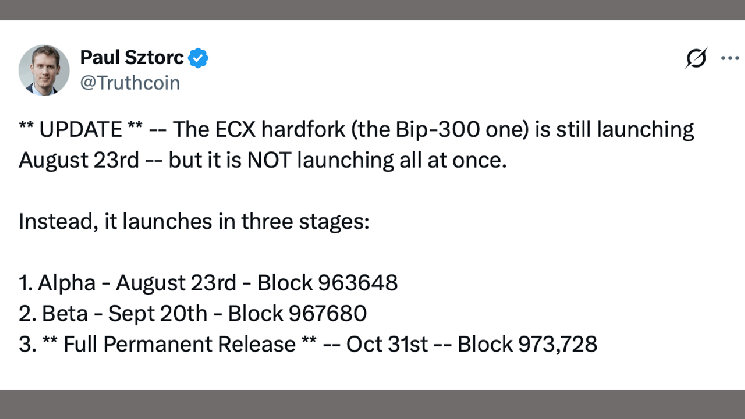
Bitcoin developer Paul Stortz, behind the Drivechain and BIP 300 proposals, has announced a hardfork for a new blockchain called ECX. Scheduled for October 31st (the 18th anniversary of the Bitcoin whitepaper), ECX will copy Bitcoin's full transaction history at a specific block height, crediting nearly all Bitcoin holders with an equal amount of ECX coins without altering the Bitcoin network itself. The launch will be executed in three phases. An "alpha" version is set for August 23rd (block 963,648), followed by a "beta" version on September 20th (block 967,680). The final mainnet launch is planned for October 31st (block 973,728). Coins accumulated during the alpha and beta phases can later be burned or swapped for real ECX. Stortz cites several reasons for the phased rollout: to address potential software bugs (including those possibly found by AI), allow an early market price to form for ECX before mining difficulty stabilizes, and let traders test and speculate. He described it as a "safety net" to manage any major issues and to demonstrate the chain's functionality. A key detail is that replay protection—a mechanism to prevent a transaction from being valid on both the Bitcoin and ECX chains—will remain optional, not automatic. The official ECX wallet software will apply this protection and warn users; Stortz warned that transactions ignoring this warning will be replayed on ECX, effectively tracking a user's spent bitcoins to their new owner unless a deliberate split is made. Stortz has given holders and exchanges 12 weeks from the alpha launch to prepare, during which they must decide on practical matters like running the wallet software to split their BTC and ECX holdings and how exchanges will credit the new asset to clients. The announcement comes as Bitcoin also faces another potential fork related to BIP-110.

cryptonews.ruHace 3 hora(s)

Bitcoin's ECX Hard Fork to Introduce Three New Versions Throughout October

cryptonews.ruHace 3 hora(s)

Trading

Spot
活动图片