France Advances Bill on Exchanging Cryptocurrency Taxation Data with 48 Countries

cryptonews.ruPublicado a 2026-08-08Actualizado a 2026-08-08

Resumen

France is tightening oversight of cryptocurrency users by advancing legislation to join an international tax data-sharing framework. On July 17, Minister Jean-Noël Barrot presented bill No. 921 to the Senate, aiming to implement the OECD's Crypto-Asset Reporting Framework (CARF). This law would integrate CARF into French legislation, enabling the automatic exchange of detailed cryptocurrency transaction information with 48 other countries that signed the agreement in November 2024. The data shared would include user names, addresses, taxpayer IDs, residence details, and aggregate transaction amounts. This move extends France's international data exchange efforts, aligning with the upcoming EU DAC-8 directive set for 2027. The push for greater transparency comes amid rising security concerns in France, including a reported increase in violent "wrench attacks" targeting crypto holders. A recent Chainalysis report noted 30 such incidents by 2026, potentially linked to a tax official allegedly selling data on wealthy French crypto owners. These developments have alarmed the crypto community. Earlier this year, France repealed a rule requiring self-custody crypto holders to declare assets to tax authorities, as lawmakers deemed verification of such reports impossible.

France is tightening supervision over cryptocurrency users, aiming to gain greater control and transparency over cryptocurrency transactions.

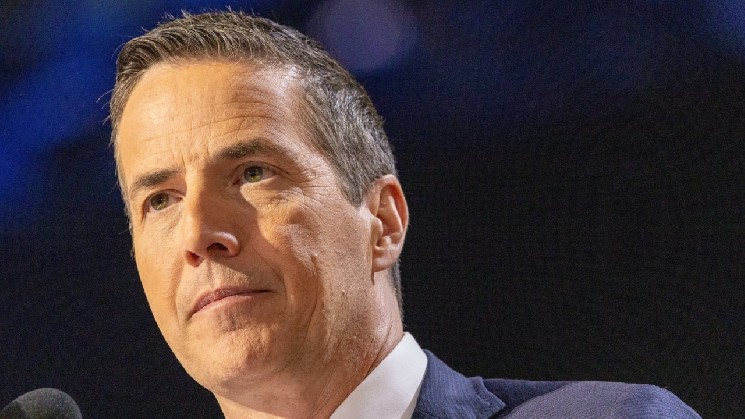
On July 17, Jean-Noël Barrot, France's Minister for European and Foreign Affairs, presented Bill No. 921 in the Senate. The bill aims to implement a multilateral agreement ensuring the automatic exchange of information under the Crypto-Asset Reporting Framework (CARF) developed by the Organisation for Economic Co-operation and Development (OECD).

The bill seeks to anchor the CARF framework into French law, enabling the exchange of specific cryptocurrency information with 48 countries that have also joined the agreement signed in Paraguay in November 2024.

The data exchange will include information on specific transactions, user names, addresses, taxpayer identification numbers, places of residence, as well as the aggregate value of operations carried out during the reporting period.

The bill will allow France to expand the automatic exchange of cryptocurrency information internationally, especially as EU countries are already preparing to exchange this data in accordance with the DAC-8 directive, which comes into force on September 30, 2027.

If the bill is approved, the French government's data collection activities will accelerate at a time when the majority of so-called 'wrench attacks,' involving violence related to cryptocurrency thefts, occur precisely in France.

According to the latest report by Chainalysis, as of 2026, French authorities recorded 30 publicly known incidents, though the organization acknowledges the actual number may be higher. The report explains that the surge in such incidents is linked to a French tax official from Paris and surrounding areas allegedly selling data on wealthy French cryptocurrency holders.

The rise in these incidents and increasingly aggressive data collection methods have alarmed French cryptocurrency holders, who are now becoming targets for kidnappings and home invasion robberies.

Earlier this year, a directive obliging cryptocurrency users to report their self-custodied assets to tax authorities was repealed. Lawmakers opposed the measure as verifying the authenticity of such reports would have been impossible.

end-content
Criptos en tendencia

Preguntas relacionadas

QWhat is the main objective of France's proposed Bill No 921 regarding cryptocurrency?

AThe main objective of Bill No 921 is to embed the OECD's Crypto-Asset Reporting Framework (CARF) into French law to enable automatic exchange of specific cryptocurrency transaction information with 48 other countries that signed the agreement.

QWhat specific information will France share with other countries under the CARF agreement?

AThe shared information will include details of specific transactions, user names, addresses, taxpayer identification numbers, place of residence, and the aggregate sum of operations carried out during the reporting period.

QHow does France's plan relate to the European Union's DAC-8 directive?

AFrance's plan expands automatic cryptocurrency data exchange internationally, while EU countries are already preparing for a similar exchange under the DAC-8 directive, which takes effect on September 30, 2027.

QWhat issue in France, according to the article, is prompting the government to accelerate data collection efforts?

AThe acceleration of data collection is partly a response to the high number of 'wrench attacks'—violent robberies related to cryptocurrency theft—which reportedly occur most frequently in France.

QWhy was a previous French directive requiring self-custody crypto users to declare their assets repealed?

AThe directive was repealed because lawmakers opposed it, arguing that verifying the accuracy of self-reported assets held in self-custody wallets would be impossible.

Lecturas Relacionadas

Bitcoin's ECX Hard Fork to Introduce Three New Versions Throughout October

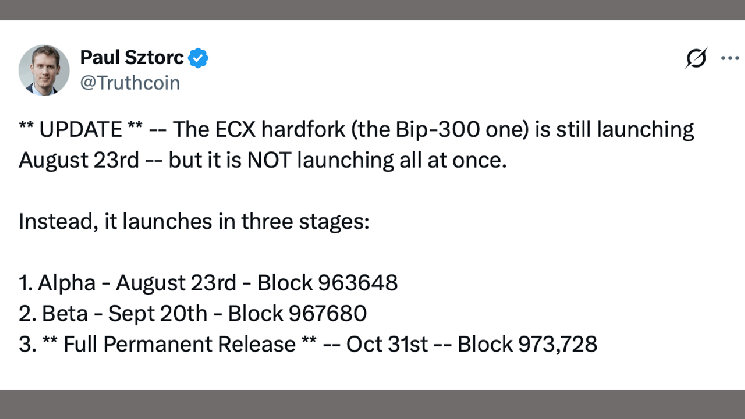
Bitcoin developer Paul Stortz, behind the Drivechain and BIP 300 proposals, has announced a hardfork for a new blockchain called ECX. Scheduled for October 31st (the 18th anniversary of the Bitcoin whitepaper), ECX will copy Bitcoin's full transaction history at a specific block height, crediting nearly all Bitcoin holders with an equal amount of ECX coins without altering the Bitcoin network itself. The launch will be executed in three phases. An "alpha" version is set for August 23rd (block 963,648), followed by a "beta" version on September 20th (block 967,680). The final mainnet launch is planned for October 31st (block 973,728). Coins accumulated during the alpha and beta phases can later be burned or swapped for real ECX. Stortz cites several reasons for the phased rollout: to address potential software bugs (including those possibly found by AI), allow an early market price to form for ECX before mining difficulty stabilizes, and let traders test and speculate. He described it as a "safety net" to manage any major issues and to demonstrate the chain's functionality. A key detail is that replay protection—a mechanism to prevent a transaction from being valid on both the Bitcoin and ECX chains—will remain optional, not automatic. The official ECX wallet software will apply this protection and warn users; Stortz warned that transactions ignoring this warning will be replayed on ECX, effectively tracking a user's spent bitcoins to their new owner unless a deliberate split is made. Stortz has given holders and exchanges 12 weeks from the alpha launch to prepare, during which they must decide on practical matters like running the wallet software to split their BTC and ECX holdings and how exchanges will credit the new asset to clients. The announcement comes as Bitcoin also faces another potential fork related to BIP-110.

cryptonews.ruHace 1 hora(s)

Bitcoin's ECX Hard Fork to Introduce Three New Versions Throughout October

cryptonews.ruHace 1 hora(s)

Trading

Spot

Artículos destacados

Cómo comprar DATA

¡Bienvenido a HTX.com! Hemos hecho que comprar DATA Network (DATA) sea simple y conveniente. Sigue nuestra guía paso a paso para iniciar tu viaje de criptos.Paso 1: crea tu cuenta HTXUtiliza tu correo electrónico o número de teléfono para registrarte y obtener una cuenta gratuita en HTX. Experimenta un proceso de registro sin complicaciones y desbloquea todas las funciones.Obtener mi cuentaPaso 2: ve a Comprar cripto y elige tu método de pagoTarjeta de crédito/débito: usa tu Visa o Mastercard para comprar DATA Network (DATA) al instante.Saldo: utiliza fondos del saldo de tu cuenta HTX para tradear sin problemas.Terceros: hemos agregado métodos de pago populares como Google Pay y Apple Pay para mejorar la comodidad.P2P: tradear directamente con otros usuarios en HTX.Over-the-Counter (OTC): ofrecemos servicios personalizados y tipos de cambio competitivos para los traders.Paso 3: guarda tu DATA Network (DATA)Después de comprar tu DATA Network (DATA), guárdalo en tu cuenta HTX. Alternativamente, puedes enviarlo a otro lugar mediante transferencia blockchain o utilizarlo para tradear otras criptomonedas.Paso 4: tradear DATA Network (DATA)Tradear fácilmente con DATA Network (DATA) en HTX's mercado spot. Simplemente accede a tu cuenta, selecciona tu par de trading, ejecuta tus trades y monitorea en tiempo real. Ofrecemos una experiencia fácil de usar tanto para principiantes como para traders experimentados.

420 Vistas totalesPublicado en 2026.07.01Actualizado en 2026.07.01

Cómo comprar DATA

Discusiones

Bienvenido a la comunidad de HTX. Aquí puedes mantenerte informado sobre los últimos desarrollos de la plataforma y acceder a análisis profesionales del mercado. A continuación se presentan las opiniones de los usuarios sobre el precio de DATA (DATA).

活动图片