SpaceX Faces Heavy Selling After IPO Followed by Massive Bond Issue 'Angers' the Market

marsbitPublicado a 2026-06-28Actualizado a 2026-06-28

Resumen

Following a record-breaking IPO, SpaceX's massive $25 billion bond issuance faced fierce selling pressure in the secondary market. The aggressive financing pace of the long-unprofitable rocket and AI company quickly backfired, eroding investor confidence and causing its bond spreads to widen sharply, nearing speculative-grade ("junk") levels. Within 48 hours of pricing, SpaceX's bonds plummeted. The 10-year bond yield rose to nearly 6%, with its spread over US Treasuries widening to over 160 basis points (bps). Longer-dated bonds saw spreads surge to 193 bps and 201 bps, significantly worse than the average spread for BB-rated junk bonds at 167 bps. This rapid deterioration shocked fixed-income traders. Initial strong demand, with nearly $90 billion in orders, was driven largely by short-term speculative "fast money" rather than traditional buy-and-hold investors. When these funds sought quick profits, heavy selling ensued. Analysts describe a "perfect storm" caused by SpaceX's post-IPO market cap decline, technical selling pressure from the enlarged deal size, and investor uncertainty in pricing its unique risk profile. The core concern for bond investors is SpaceX's fundamentals: while it reported $18.7 billion in 2025 revenue, it posted a net loss of $4.9 billion. Creditors focus on actual cash flow for debt repayment, not future growth expectations tied to AI. Heavy reliance on CEO Elon Musk's leadership and weak corporate governance were also cited as key credit weakn...

Written by: Bao Yilong

Following a record-breaking IPO, SpaceX's massive $25 billion bond issue encountered heavy selling in the secondary market. The aggressive financing pace of this long-unprofitable rocket and artificial intelligence company quickly backfired on investor confidence, causing its bond spreads to widen sharply, directly approaching speculative-grade (i.e., "junk") levels.

By Friday, SpaceX corporate bonds had turned from "hot demand" on the book to a full-blown sell-off within just 48 hours of pricing.
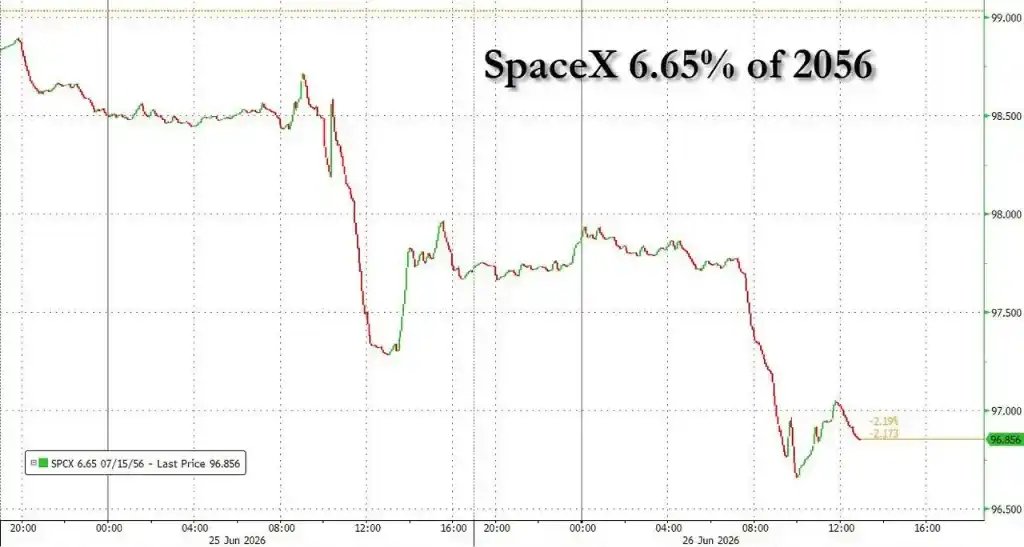
Selling pressure across SpaceX's various maturities led to cumulative book losses of approximately $400 million compared to U.S. Treasuries, completely erasing the spread tightening achieved by underwriters during the book-building stage with the declines in the long-end bonds.

According to MarketAxess data, SpaceX's 10-year bond yield rose to nearly 6%, with the spread over U.S. Treasuries widening to more than 1.6 percentage points. The spreads on its long-end bonds maturing in 2046 and 2056 surged to 1.93 and 2.01 percentage points, respectively.

According to Ice Data Services, the current market's average spread pricing for BB-rated "junk bonds" is 1.67 percentage points, meaning that with its Baa1/BBB investment-grade rating, SpaceX's actual trading price is significantly worse than that of some junk-grade issuers.

The magnitude and speed of the plunge shocked fixed-income market traders. Market participants noted that among recent mega bond issues, it's almost impossible to find a precedent where spreads widened so rapidly to such an extent.

"Perfect Storm" Hits Secondary Market

The initial book data for SpaceX's bond issue once masked the underlying risks.

According to Bloomberg, the deal initially garnered nearly $90 billion in subscription orders, nearly 4 times oversubscribed, and the issuance size was subsequently increased from $20 billion to $25 billion.

However, traders revealed that this frenzy was mainly driven by fast money seeking short-term arbitrage, not traditional buy-and-hold investors. When these funds tried to take quick profits in the secondary market, selling pressure surged.

Tony Trzcinka, portfolio manager at Impax Asset Management, said the market had anticipated a widening of SpaceX's spreads, but the current magnitude constitutes a "perfect storm."

He pointed out that this stems from the company's significant market cap decline since the IPO, the technical selling pressure brought by the increased issuance size, and investors still grappling with how to price its unique risk profile.

In contrast, Nvidia, which recently completed a $25 billion bond issue, saw its long-end bond spreads widen by only 11 to 12 basis points, while Alphabet's long-end spreads even narrowed.
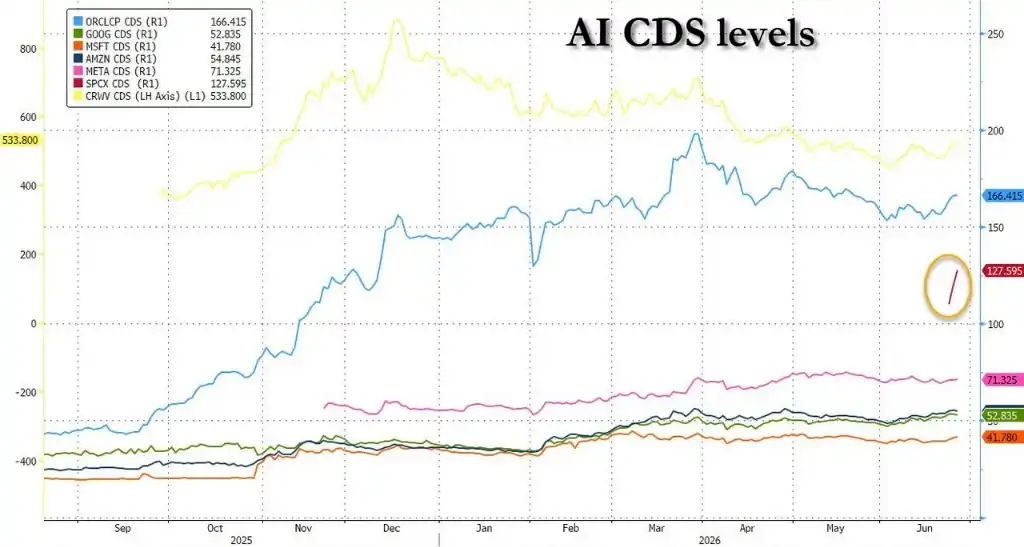
Additionally, SpaceX's credit default swaps (CDS) widened significantly after trading began, further confirming the market's defensive stance towards its credit.

Cash Flow and Governance Risks Spark Direct Concerns

Stock and bond investors have fundamentally different logics for evaluating SpaceX.

The company raised $86 billion through its IPO earlier this month, with its valuation once reaching nearly $3 trillion before falling back to $2 trillion. This valuation is largely built on expectations that its AI revenue will surge in the future.

However, for creditors, the core fact is that while SpaceX achieved $18.7 billion in revenue in 2025, it recorded a net loss of $4.9 billion. PGIM portfolio manager Michael Campion stated:

In the investment-grade bond market, we focus on whether a company can repay its debt. We are accustomed to lending based on actual cash flows, not expectations.

Allianz Chief Investment Officer Ludovic Subran also remarked bluntly:

Bond investors are different from equity investors. Equity investors might go to Mars with you, but bond investors will just ask, 'Where's my coupon?'

Furthermore, the extreme reliance on Musk's personal leadership has become a core concern for rating agencies and investors. Fitch Ratings sees this as a "key rating constraint."

Professor James Dow of the London Business School pointed out that SpaceX is currently highly reliant on Musk, lacks a succession plan, and has exceptionally weak corporate governance, which significantly reduces the appeal of its long-term debt.

Tech Giant Bond-Issuance Wave Nears "Bubble" Territory

The cold reception faced by SpaceX is not an isolated incident but exposes systemic vulnerabilities in the current tech giant debt expansion.

As tech companies race to raise huge sums to fund AI projects, investors are facing a massive supply shock of bonds.

According to Morgan Stanley data, AI-related debt issuance this year has reached $236 billion, a 357% year-over-year increase, and is projected to double to $570 billion by year-end.

The borrowing frenzy is rapidly pushing up industry leverage ratios. Data shows that the total leverage ratio of mega-tech companies has doubled in just over two quarters, skyrocketing from 0.9x to 1.8x, already exceeding the total leverage ratio of the entire energy sector.

This massive supply is overwhelming the market structure. Bloomberg calculations show that as of Wednesday, U.S. investment-grade bond supply for June has reached $180 billion, a record high.

The supply glut has begun to weigh on broader credit spreads. Morgan Stanley notes that spreads for mega-size issuers are widening overall, a trend confirmed by the performance of bonds from Oracle and Meta.

In a report, Mark Dowding, Chief Investment Officer of Fixed Income at RBC BlueBay Asset Management, wrote, bondholders have clearly concluded that future debt issuance could be significant as this unprofitable company finances its path to future profitability.

Analysis suggests that if this pace of debt expansion continues, credit spreads could ultimately break out further, thereby imposing material constraints on tech companies' capital expenditure cycles.


Preguntas relacionadas

QWhy did SpaceX's bonds experience a sharp sell-off in the secondary market shortly after issuance?

ASpaceX's bonds experienced a sharp sell-off due to a combination of factors: aggressive fundraising following its IPO, investor concerns over its persistent losses and high valuation based on future AI expectations, a large supply of bonds driven by short-term speculative 'fast money' seeking quick profits, and significant selling pressure as those investors exited their positions. Additionally, market confusion over how to price the company's unique risk profile and its high dependence on Elon Musk contributed to the sell-off, causing spreads to widen dramatically.

QHow do bond investors' concerns about SpaceX differ from equity investors' perspectives?

ABond investors focus on a company's ability to generate cash flow to service and repay debt, prioritizing current financial reality over future growth potential. They are concerned with SpaceX's significant net losses ($4.9 billion in 2025 despite $18.7 billion revenue). Equity investors, in contrast, are more willing to fund long-term growth based on future expectations, such as a surge in AI revenue, which supported SpaceX's high IPO valuation. Bondholders prioritize coupon payments, while equity investors may tolerate losses for future capital appreciation.

QWhat specific governance risk is highlighted as a key concern for SpaceX by rating agencies and analysts?

AA key governance risk highlighted is the company's extreme reliance on Elon Musk's personal leadership and the lack of a formal succession plan. Fitch Ratings cited this as a 'key rating constraint,' and analysts note that the weak corporate governance structure significantly reduces the attractiveness of SpaceX's long-term debt to fixed-income investors.

QAccording to the article, what broader market trend is contributing to pressure on corporate bond spreads?

AA broader trend of massive debt issuance by technology giants to fund AI projects is creating a supply shock in the bond market. This surge in issuance is rapidly increasing the sector's leverage and overwhelming market capacity. The article notes that AI-related debt issuance has soared, and the sheer volume of new supply is putting upward pressure on credit spreads across the technology sector, as seen with other issuers like Oracle and Meta.

QWhat was the market's reaction in terms of credit default swaps (CDS) for SpaceX following the bond issuance?

AFollowing the bond issuance, SpaceX's credit default swaps (CDS) also widened significantly. This movement indicates that the cost of insuring against a default on SpaceX's debt increased, reflecting a defensive market stance and growing concerns about the company's creditworthiness among investors.

Lecturas Relacionadas

An Eight-Year Investment Takes a Sharp Turn: Why Did Ethereum Suddenly Abandon Poseidon?

On August 13, Ethereum researcher Justin Drake announced a significant shift in Ethereum's Layer-1 cryptographic roadmap: abandoning the SNARK-friendly hash function Poseidon in favor of traditional functions like SHA2 or BLAKE2. This decision ends eight years of research and investment, marking a major revision to the post-quantum security strategy. Poseidon, introduced in 2019, was highly efficient for zkRollups and zkVMs within SNARK circuits. However, its need for prolonged cryptanalysis and the pressing timeline for quantum resistance revealed limitations. Recent breakthroughs in SNARK design, specifically using binary fields, now enable traditional, battle-tested hash functions to perform as efficiently as Poseidon within SNARKs. Benchmarks show modern laptops can now verify over a million traditional hash calls per second. This change is partly driven by accelerated concerns over quantum computing threats. Reports warn that "Cryptographically Relevant Quantum Computers" could break current blockchain signatures like ECDSA by the early 2030s, risking trillions in assets. Ethereum's response focuses on hash-based post-quantum signature schemes, deemed more quantum-resistant than some lattice-based alternatives under pressure from AI cryptanalysis. Ethereum's updated post-quantum roadmap targets a production-ready "leanVM" for signature aggregation by 2027, with full deployment across consensus, execution, and data layers by 2028. The shift to mature hash functions like SHA2 reduces reliance on newer algorithms and aligns with the goal of using widely analyzed cryptographic primitives. Other major blockchains are also preparing. Solana's core teams have independently chosen the NIST-standardized Falcon signature scheme for its compact size. Starknet plans a phased migration, starting with replacing its Pedersen hash with BLAKE2. Ethereum's move signifies a strategic pivot towards proven security foundations for the quantum era.

marsbitHace 45 min(s)

An Eight-Year Investment Takes a Sharp Turn: Why Did Ethereum Suddenly Abandon Poseidon?

marsbitHace 45 min(s)

Programmers Worldwide Are Wasting Money on Anthropic! The Company Can't Stand It Anymore

Anthropic recently published guidelines to help developers using Claude Code reduce unnecessary token costs. The key recommendations include: 1) Clear (/clear) conversations after completing a task to avoid carrying irrelevant file reads and command outputs into the next task. 2) Set the model and reasoning effort level at the start of a session, as switching mid-session invalidates the prompt cache, requiring a full-price recalculation of the entire dialog history. 3) Attach files using @ references instead of typing paths manually to avoid extra tool calls and searches that bloat the context. 4) Add quiet flags to verbose commands (e.g., in CLAUDE.md) to minimize lengthy output in the dialog history. 5) Use /compact while the session cache is still warm (before breaks) to compress the dialog at one-tenth the cost. 6) Offload large-output tasks to a sub-agent, which runs in an isolated context and only returns conclusions, preventing intermediate outputs from polluting the main dialog. The article explains token pricing: input tokens (prefill) are processed in parallel, while output tokens (decode) are generated serially, making output tokens five times more expensive. Caching is crucial for savings—if a request's prefix (system prompt, CLAUDE.md, dialog history) matches the previous one byte-for-byte, reading it costs only 10% of the standard input price. However, cache invalidation occurs when changing models, effort levels, fast mode, compressing dialogs, after cache expiration, or when resuming old sessions. Dialog history also grows quadratically (O(n²)) as file contents and command outputs accumulate, increasing costs per round. Proactive context management—like isolating noisy tasks, using /rewind to trim unproductive turns, and task-based session clearing—is becoming an essential skill for cost-effective AI-assisted development.

marsbitHace 2 hora(s)

Programmers Worldwide Are Wasting Money on Anthropic! The Company Can't Stand It Anymore

marsbitHace 2 hora(s)

Pax Silica vs. WAICO: The US Wants to Prohibit Europe from Using Chinese Artificial Intelligence

The United States is preparing to demand that European and other partners abandon Chinese artificial intelligence initiatives, threatening exclusion from the American-led "Pax Silica" coalition, according to a leaked U.S. State Department document. This ultimatum forces signatories of the "AI Opportunity Statement" to choose between the Western technological ecosystem and alternative frameworks, with China not explicitly named but clearly targeted. Pax Silica is a U.S. strategy for AI and semiconductor hegemony, launched in late 2025. Its European presence expanded significantly in mid-2026. Concurrently, China, Russia, and 27 other nations established the World AI Cooperation Organization (WAICO) in July 2026 as an independent intergovernmental platform promoting AI governance based on UN principles. This situation creates a difficult choice, especially for European nations balancing strategic autonomy with dependence on U.S. tech and security. It also pressures Global South countries with pragmatic ties to both Washington and Beijing. The formation of competing blocks risks fragmenting the global tech landscape, forcing companies to split supply chains, increasing costs, and potentially leading to incompatible standards and protocols. The era of open globalization in AI may be ending, replaced by geopolitical confrontation where technological sovereignty trumps economic efficiency. The decisions made will shape the global digital economy for decades.

cryptonews.ruHace 4 hora(s)

Pax Silica vs. WAICO: The US Wants to Prohibit Europe from Using Chinese Artificial Intelligence

cryptonews.ruHace 4 hora(s)

Robert Kiyosaki Shares His Mentor's Predictions About the Emergence of Bitcoin and AI

American entrepreneur and author of "Rich Dad Poor Dad," Robert Kiyosaki, discussed the influence of futurist R. Buckminster Fuller on his worldview, linking Fuller's past technological predictions to the emergence of Bitcoin and the development of artificial intelligence. In an X post, Kiyosaki also reflected on personal purpose, sharing his journey from the music business—where he worked with bands like The Police and Iron Maiden—to creating the "Cashflow" board game and writing his famous book. He described feeling an inner emptiness despite his success, a turning point that came after meeting Fuller, whom he studied with for three summers. Kiyosaki described Fuller as a "friendly genius" who foresaw world-changing developments like Bitcoin and AI. However, the core of his post focused on Fuller's philosophical impact, particularly a quote about belonging to the universe and finding purpose by dedicating one's life to the maximum benefit of others. The entrepreneur remains a vocal advocate for cryptocurrencies. He regularly advises buying Bitcoin during market panics, viewing it and assets like Ethereum, gold, and silver as hedges against traditional financial system failures. Kiyosaki has predicted a major market crash by 2026, seeing it as an opportunity for prepared investors, with long-term price targets including $750,000 for Bitcoin and $95,000 for Ethereum.

cryptonews.ruHace 6 hora(s)

Robert Kiyosaki Shares His Mentor's Predictions About the Emergence of Bitcoin and AI

cryptonews.ruHace 6 hora(s)

Trading

Spot
活动图片