Written by: Jeff Park
Compiled by: Saoirse, Foresight News
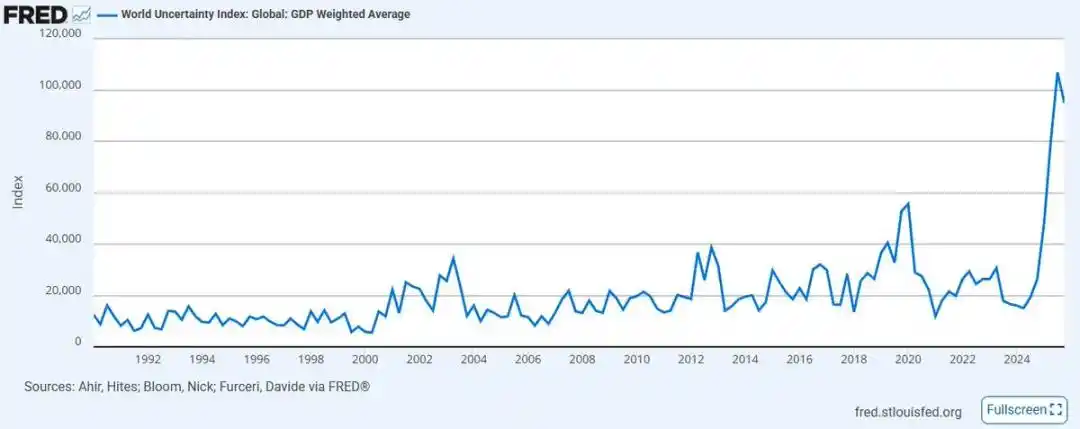
The Global Uncertainty Index (GUI) constructed by the International Monetary Fund (IMF) recently hit its highest level since its inception in 2008. The lack of clear direction and coordination in policy and trade has significantly worsened market sentiment since the previous historical high, and this trend is highly likely to intensify further — especially in the Middle East, where the already shaky old global alliances are being drawn into an unprecedented conflict.
At the same time, the accelerated adoption of exponential technologies like artificial intelligence is leaving experts and ordinary people increasingly perplexed: how can productivity-driven deflation be reconciled with a credit-driven inflationary monetary system? Compounding the problem, private credit is experiencing an epic collapse, precisely because it has supported this fragile capital supply chain by manipulating capital prices at the expense of liquidity.
Just in the past week, we witnessed a series of events:
- Iran designated Mojtaba Khamenei as the new Supreme Leader, while U.S. crude oil prices surged nearly 40%, marking the largest weekly gain since 1983;
- AI company Anthropic sued the U.S. Department of Defense citing "supply chain risks";
- BlackRock capped redemptions on its $25 billion direct lending fund at 5%, while investor redemption demand was nearly double that percentage.
No one can precisely predict the trajectory of these complex issues because they are all unprecedented (notably, these three events are not independent of each other, a point I will elaborate on later). In such moments, we need to step back and re-clarify the core: not obsessing over the unknown, but anchoring on the facts you are absolutely certain of and that are the direct causes of the aforementioned events.
As Sherlock Holmes said to Dr. Watson: "When you have eliminated the impossible, whatever remains, however improbable, must be the truth." Therefore, our task is not to chase elusive unknowns, but to root ourselves in those fundamental facts that already exist and are indisputable.
Following this line of thinking, in the uncertain decade ahead, I believe there are three certain truths — and their certainty is only becoming more pronounced at present. By "certain," I mean these are events with a 100% probability of occurring. The only real unknowns are the specific timing and, to some extent, the severity, but the catalyst for each event is destined to appear within our lifetimes. And when we anchor on these indisputable facts, we can transform the pervasive sense of powerlessness into a firm conviction about how to respond to the future.
Certain Truth One: The Global Population Pyramid is Inverting, and All Asset Classes Built Upon It Will Collapse
In 2019, a statement released by the World Economic Forum caused a huge shock to institutional consensus: "The number of people aged 65 and over has, for the first time, exceeded the number of children under five." Seven years on, after a devastating global pandemic, societies around the world have felt the heavy pressure and dire consequences of this trend, and this is just the beginning.
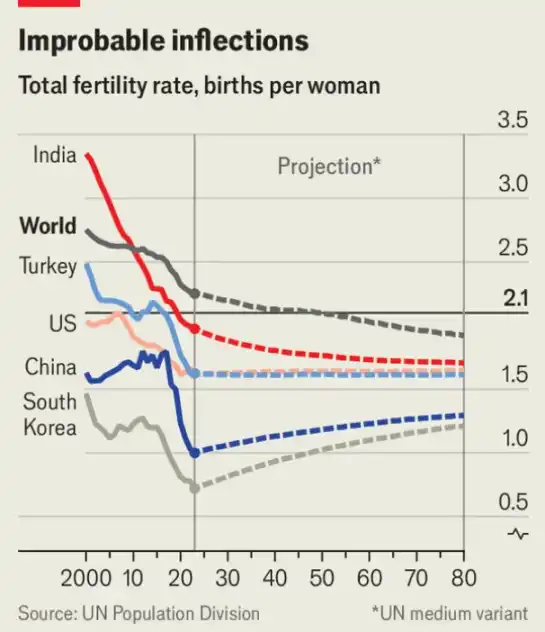
Global fertility rates are dangerously approaching below replacement level, a threshold long passed in developed markets. Declining birth rates combined with an aging population will create the highest dependency ratio in the history of human civilization. Worse still, the gerontocracy in developed nations will ultimately need to liquidate liquidity to fund their increasingly long lifespans. The result is a grand intergenerational wealth transfer: the financial assets accumulated by an entire aging generation must exit the market through massive liquidity events.
The scale of this capital is staggering: the U.S. stock market alone is worth approximately $69 trillion (with the baby boomer generation holding over $40 trillion of that), and U.S. residential real estate adds another $50 trillion (though baby boomers and the preceding generation comprise less than 20% of the population, they hold over $20-25 trillion in assets). In total, nearly $60-70 trillion in wealth needs to exit the capital asset system, just as the next generation of younger groups sees its income pricing power continually weaken and has little disposable wealth.
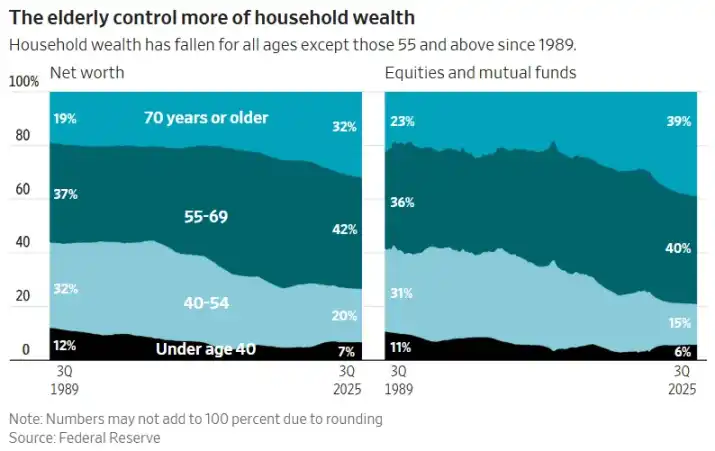
When this aging generation is finally forced to sell assets, it will almost inevitably trigger a prolonged asset deflation.
The underlying logic of the stock market is essentially a reflection of demographic trends: markets rise when the cohort of savers accumulating assets grows steadily and moves into retirement. The brutal collapse of "private credit" is the most直观的 example — another $2 trillion "time bomb" hidden in pensions, endowments, and life insurance companies, which, under the guise of liquidity transformation for the young, borders on fraud.
But once the younger generation realizes they are being set up as the "exit liquidity bagholders" for their parents' generation, they will choose not to enter the market. No one voluntarily buys an asset that is in a long-term decline. This is precisely why the Trump administration pushed for child investment accounts, why the U.S. is actively promoting stock tokenization (to make it easier for foreign capital to absorb U.S. stocks), and why Registered Investment Advisors (RIAs) are massively adopting automated model portfolios without asking the core question: "Why do this?"
These measures are all designed to delay the inevitable: when the baby boomers engage in inelastic price selling of assets, there will be no buyers unless the young, foreign capital, or machines are forced to step in. Just look at the design of the Trump child account itself: the account prohibits any form of diversification, explicitly banning bonds, international stocks, and alternative investments, allowing only allocation to U.S. stock indices. Upon turning 18, the account converts to an Individual Retirement Account (IRA) with high redemption penalties — a stark contrast to the standard Uniform Transfers to Minors Act (UTMA) account, which allows complete freedom of redemption upon adulthood. It's abundantly clear this is not a wealth-building tool for children, but a one-way, closed channel lasting over 40 years, intentionally or not, designed to turn an entire generation of young people into "passive bagholder liquidity" for the previous generation.
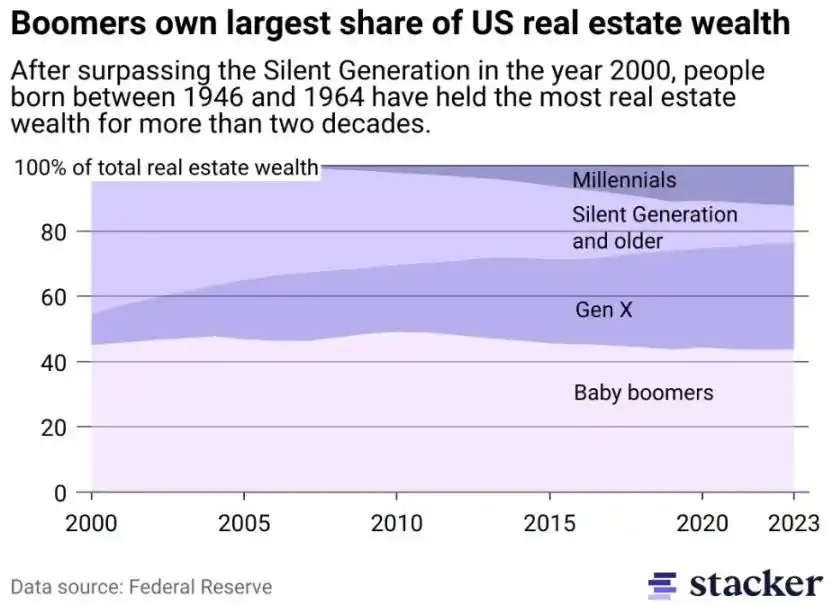
This phenomenon will be even more pronounced in real estate, which sits at the center of the largest asset bubble in history. One generation, through deliberate, decades-long hoarding of fixed-supply assets, has used duration effects to completely sever home prices from the underlying economic productivity of communities. For most residential and commercial real estate (excluding prime assets operating in a separate economic system), "affordability" has long been a myth. A generation of young people whose wages have never kept up with home prices will never buy at current prices. For the fortunate, many properties will eventually be passed down naturally to children; without heirs, they will ultimately be sold into a market with a shrinking number of homebuyers and structurally declining household formation. Once again, the math is brutal and inescapable: a significant deflation in real estate is not a possibility but an inevitable conclusion.
To accelerate this liquidity event, the transition of real estate from an investment asset to a consumption good will be viciously叠加ed by rising property taxes — prices will become increasingly linked to government expenditure inflation, including public schools, social services, municipal infrastructure, and the overall trend of service costs普遍高于商品成本. Fiscal pressure alone will force market-unsustainable selling behavior. New York City Mayor Mamdani's push to raise property taxes is not an isolated case, but a harbinger of the grand transaction of the era of "inert capital asset taxation," a trend that will be particularly pronounced in cities where wealth inequality has become so high that the status quo is politically untenable. This leads to my second certain truth.
Certain Truth Two: Wealth Inequality Will Reach a Tipping Point, and Wealth Taxes Will Become the Unforeseen Answer
The demographic challenge described above is essentially a vertical collapse: the population pyramid slowly inverts, the base shrinks, and the weight of the upper, older dependent cohort becomes unsustainable. In addition to this vertical demographic collapse, there is a more worrying horizontal fissure globally — income inequality.
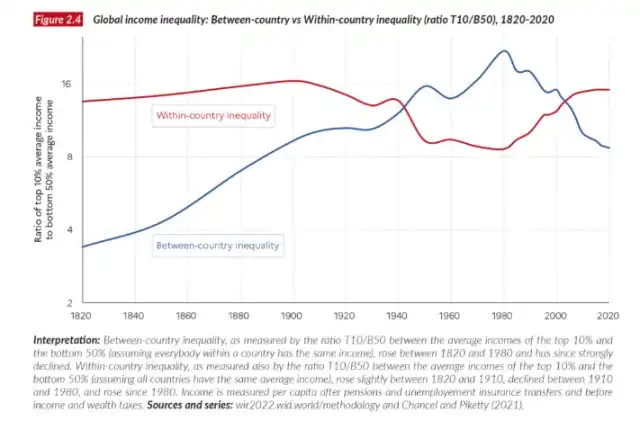
When seeing headlines like "The top 10% of the global population owns 76% of global wealth" (source: UN 2022 World Inequality Report), we need to understand a key distinction: this is not a story of some countries getting rich first while others lag behind, but something happening within every country globally: the gap between rich and poor is widening everywhere in the world, and accelerating across all measurable time dimensions.
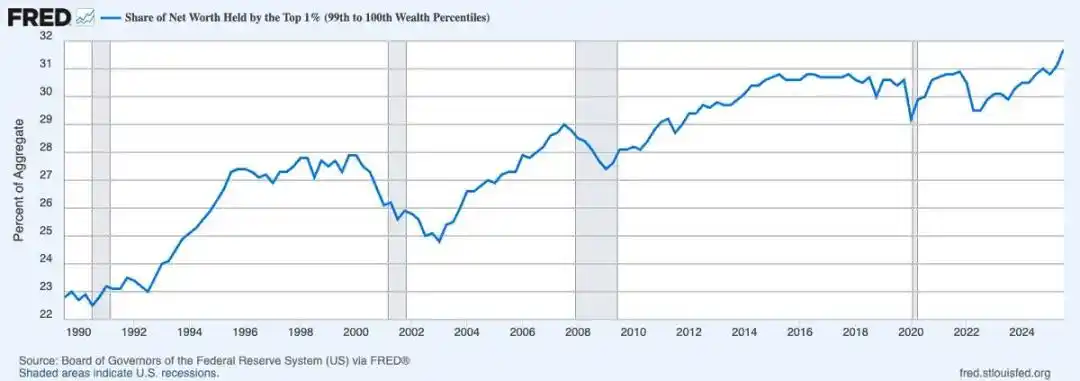
More precisely, the problem is not just income inequality, but wealth inequality. Never before in human history has such a high proportion of wealth been concentrated in the hands of the top 1%. In the United States, for example, the share of net worth held by the top 1% continues to climb and is now接近 one-third of the nation's total wealth.
The distinction between income and wealth is crucial. Income is a transactional concept, "money in motion," a market-priced measure of productivity; wealth is not. Non-capital wealth is "money at rest": it lacks intrinsic productivity and, in a credit-driven zero-sum game, drags down the velocity of money required for economic operation. When wealth is as highly concentrated as it is today, it stops moving, and the consumption velocity that sustains broad economic activity quietly suffocates.
In this context, in the absence of significant productivity growth to create new resources, despite the controversy, wealth taxes will ultimately become the inevitable result of fiscal nihilism. The reason is that the only feasible mechanism to rebalance this landscape is to tax wealth itself — no matter how crude its design or untenable its logic. A wealth tax can be seen as the mirror image of social security: the former extracts from the bottom to subsidize existence, the latter extracts from the top to sustain existence. Both are essentially levies on unrealized value, the only difference being the direction: the former is vertical (extracting from the young), the latter is horizontal (extracting from the rich).
The process of implementing wealth taxes has already begun. On February 12, 2026, the Dutch House of Representatives passed a landmark bill mandating a flat 36% tax on the annual appreciation of stocks, bonds, and cryptocurrencies, regardless of whether these assets have been sold. The bill now awaits approval by the Senate, and the parties supporting it already hold a majority, making approval almost certain. Whether this policy is morally justified, mathematically sound, or legally enforceable is irrelevant — those纠结ing over these questions completely miss the larger core. The真正关键的问题 is simple yet profound: what happens when the rest of the world follows suit?
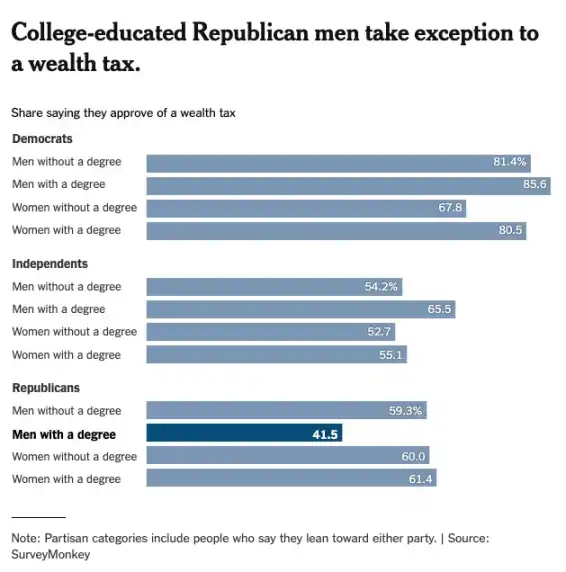
Look at the birthplace and last bastion of capitalism — the United States. Polling by The New York Times on public attitudes towards wealth taxes shows near-universal support across all demographic groups except for college-educated men (a demographic that is rapidly declining).
This is the core of understanding the "citizenship" of capital. It is a普遍 belief that free capital accounts are an inherent feature of the modern world, but the vulnerable know that capital can be restricted at any time when a nation chooses — China, Russia, and others have provided examples. The historical problem has been "defection": if any single country imposes a wealth tax, capital simply flows to other jurisdictions. But as the sense of global fiscal nihilism intensifies and political will across nations converges on the only option, collective bargaining arrangements will become inevitable, and those havens that have long benefited from the prisoner's dilemma will no longer be allowed to stay on the sidelines.
Following the Dutch decision, the EU is already actively coordinating tax frameworks aimed at preventing capital flight between member states. By the mid-21st century, the global passport for capital will be revoked, replaced by a "Schrödinger's visa" — simultaneously valid and invalid in the eyes of different regulators. Local restrictions on capital will only intensify the demand for "outside money" that can bypass compliance layers. Welcome to the renaissance of the price-specie economy backed by hard currency.
According to the framework proposed by David Hume in his 1752 essay "Of the Balance of Trade," modern investors have long默认ed "outside money" to be assets like gold, Bitcoin — assets without a country, without a jurisdiction, not subject to any sovereignty. But four hundred years later, a new class of "outside money" is emerging that will fundamentally redefine the concept of comparative advantage. It is time to write a new essay on international relations: "Of the Balance of Intelligence."
Just as Hume stated that trade surpluses and gold flows determined the relative strength of nations; today, the new determinant of comparative advantage will be the concentration of productive AI infrastructure — who controls compute, who controls data, who sets the model rules on which all other systems run. Capital will flow to intelligence hegemony just as it once flowed to manufacturing hegemony. The nations, institutions, and individuals who grasp this trend earliest will define the new hierarchy of wealth. This leads to my third certain truth.
Certain Truth Three: AI Will Destroy the Relative Value of Labor and Redefine Capital Value for an Intent-Driven Economy
Karl Marx, in "Das Kapital," described capital as "dead labour, that, vampire-like, only lives by sucking living labour, and lives the more, the more labour it sucks." This famous quote highlights the socialist view: capital, in the form of accumulated labour,增值s by consuming the living labour of workers.
However, Marx made a key error in his analysis: he believed that capital itself was inherently缺乏活力 and must continuously consume human labour to be profitable. But with the rise of credit, and now the explosion of AI, we are about to enter a new paradigm — the "vampire" is not only fully agentic but can even bypass human labour, requiring only the continuous consumption of kinetic energy to profit. As shown in the chart below, the trend of rising capital's share of income and falling labour's share has been brewing for over a decade, and AI will push this trend past an irreversible tipping point.
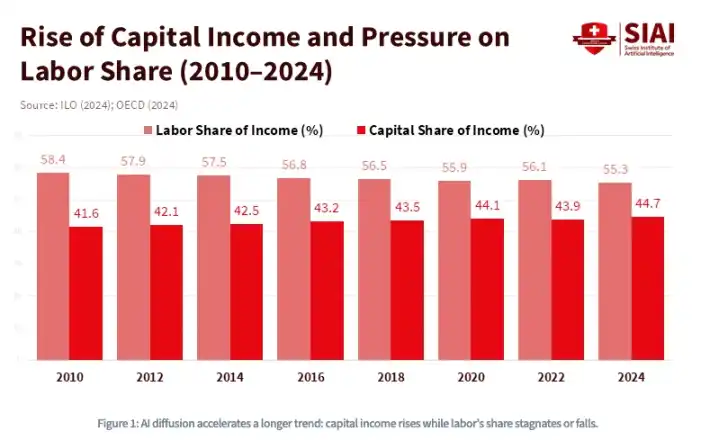
Since 1980, labour's share of U.S. GDP has fallen from about 65% to below 55%, and this was before the proliferation of large language models (LLMs). Goldman Sachs estimated in 2023 that generative AI could put 300 million full-time jobs at risk of automation.
In other words, AI is not only a capital-intensive technology but also a labour-destroying technology. The rise of AI will permanently alter the underlying economic principles on which society operates, reshaping the irreversible relationship between capital and labour. More specifically, when labour costs converge with compute costs, a new "capital war" will erupt globally, requiring unprecedented government subsidies, radical industrial policy, and fiscal policy. In this world, capital will reign supreme: asset ownership will become the only barrier between dignity and a permanent underclass. This is precisely what the IMF predicts: in an AI-dominated economy, the federal tax base will shift from labour income to corporate taxes and capital gains taxes.
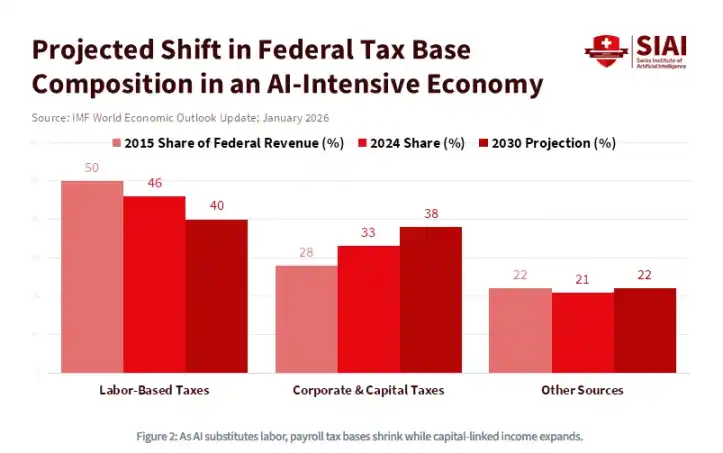
However, capital itself will also be redefined — because asset ownership is no longer limited to financial assets. The vast AI industry also relies on another factor, even more precious and irreplaceable than pure energy: data. Specifically, the data footprint you leave behind daily provides the context for model inference and learning. The world is moving towards a new paradigm: human thoughts, behaviors, instructions, preferences, and especially intent, will hold极高的价值. When intent itself becomes capital, an economic order with a completely different structure will emerge — asset ownership will take on a strange, "non-custodial" form, detached from the KYC/AML financial institutions we know. AI agent systems are already being equipped with crypto wallets, autonomously paying for compute, APIs, and data. For a world where value needs to flow seamlessly between intelligent agent systems, with preferences for explicit, transactional use, this is a tangible inevitability — within it, labour and capital will exist in a superimposed "Schrödinger state."
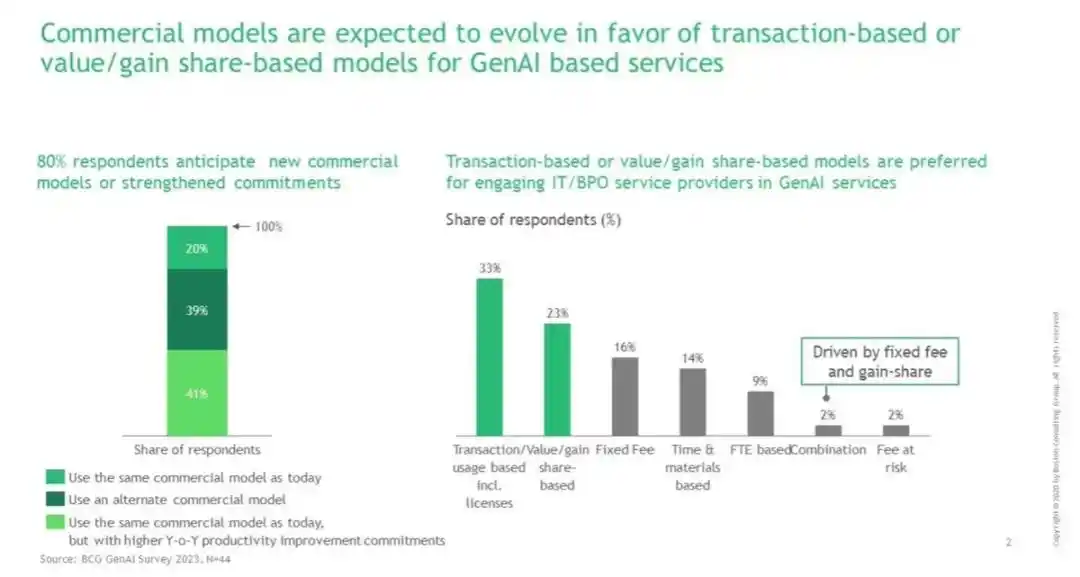
Historically, financial assets have always clearly resided within the regulatory boundaries drawn by financial regulators like the SEC, CFTC, FINRA, FASB. But as assets evolve into forms with "active attributes" — your data footprint becoming collateral, intent becoming a variable output (consumption-based pricing models will be realized through open, API-based products embedded with context) — AI systems will blur regulatory boundaries from all directions. The FCC has jurisdiction because your cognitive information is transmitted over spectrum; the FTC has jurisdiction because intent collection falls under consumer protection; the DoD has jurisdiction because data sovereignty is a national security issue.
In other words, this superposition effect exists not only at the asset level but also蔓延s upward through the entire regulatory system. When no single agency can draw a clear boundary around a "financial asset," the definition of money (who issues it, who protects it, who confiscates it) will become the most contentious geopolitical issue of the century.
Welcome to the era of intelligent money.
Three Certain Truths, Two Convergences, One Conclusion
If you've read this far, you might feel uneasy — perhaps finding yourself plunged back into great uncertainty. But remember: the entire purpose of this article is to find clear answers. Let's reiterate the core conclusion together: the three forces of demographic collapse, wealth inequality, and AI-driven labour substitution are all certain to happen. They are not independent risks that need to be weighed and hedged separately, but are logically converging simultaneously. The population pyramid is collapsing vertically, while the horizontal tear in wealth at the base is放大ed by a technological revolution that favors only capital.
Many investors try to cope with this uncertainty through partial solutions to partial problems: an asset rotation here, a hedge there, a thematic bet on AI infrastructure, or blind hope in cryptocurrency. The most tempting, and most likely to lull traditional investors into complacency, counter-argument is the techno-optimist's "escape pod": AI-driven productivity growth will rapidly expand the wealth pie enough to outweigh the demographic collapse. This argument sounds persuasive but is precisely a seemingly complex logic that misses the core.
Throughout human history, the speed and fairness of productivity gains have never been fast enough or sufficient enough to avoid the political and social fractures caused by inequality. The Industrial Revolution did not prevent labor uprisings; it triggered them — despite creating unprecedented total wealth. Crucially, AI is not a neutral productivity multiplier: by its very architecture, it is a capital concentrator. Every ounce of productivity it creates will first and most lastingly accrue to those who control the compute, the data, and the models. The optimist is not wrong that the wealth pie will grow larger, but wrong about who gets the slices — and that is the very core of the entire debate.
When you look at these truly irreversible phenomena macro enough, conviction in direction becomes surprisingly clear:
- Global population aging, shrinking, demographics will deteriorate, this is 100% certain;
- Wealth inequality will widen to trigger global capital restrictions — both cross-border and domestic, this is 100% certain;
- AI will structurally favor capital, birthing new forms of transitional capital the global economy has never seen, this is also 100% certain.
Most critically, the common core characteristic of these three points points to one word: global. Intergenerational demographics, asset allocation, cost of capital have never been as correlated as they are now in history, and this correlation is strengthening. Furthermore, this correlation exists not only across space but also across time — because the demographic evolution of wealth is one-way and irreversible. This means this convergence is not only global but also synchronous.
Together, this forms what I see as the core collective bargaining problem of the modern century: the Generational Exit Liquidity Prisoner's Dilemma. It poses the questions:
- Will the younger generation voluntarily participate in "ownership of American capitalism" when they too feel the government's directive is to "baghold for their parents' generation"?
- Will the top wealthy voluntarily shoulder high tax burdens when their wealthy peers are moving to "tax-efficient" planning?
- Will AI companies voluntarily slow down development when their profit-driven competitors ignore the cost of capital and keep expanding?
The Nash equilibrium will form: all participants will rationally choose defection as the dominant strategy — regardless of what others do, because the cost of inaction is too high. Therefore, when the critical juncture arrives, everyone will rationally seek exit liquidity simultaneously.
This Faustian bargain of liquidity must not be seen as a potential risk, or a tail risk to be modeled and hedged, but as the most predictable mass coordinated event in the history of human capital markets. Some will say that in a deflationary environment, you should hold nominal interest-bearing instruments like bonds, or ride the wave of AI stocks. Perhaps. But my core principle is simpler, more structural: you want to hold assets that do not make you the bagholder for someone else's exit liquidity. Under this framework, the assets you should hold least are, in order: real estate, bonds, U.S. stocks. These are duration manipulation tools that, whether by design or not, constitute the greatest intergenerational wealth grab in history.
Conversely, your ideal asset should simultaneously satisfy three inverse conditions:
- Currently has the lowest demographic ownership but is poised for the highest future ownership;
- Most likely to become the safe haven of no jurisdiction when capital liquidity is heavily taxed, restricted, or confiscated;
- Closest to the form of capital that an autonomous intelligent world will use seamlessly, replacing human labor for productive functions without intermediaries.
When the Ottoman Empire breached the walls of Constantinople in the 15th century, the Byzantine merchant class lost all assets denominated in imperial credit: land, titles, government bonds. None were spared. But the young, capable scholars and enterprising merchants who moved westward to Florence with portable wealth — manuscripts, gold, knowledge — ultimately ignited what would later be called the Renaissance.
Among them was a young Byzantine scholar named Johannes Bessarion. Born in 1403 in Trebizond on the Black Sea, he fled Constantinople carrying chests of irreplaceable Greek manuscripts containing almost the entire intellectual heritage of the ancient world. He was the single greatest provider of books and manuscripts to the West in the 15th century, and in doing so created one of the earliest "information technologies": the Biblioteca Marciana — the first open-source knowledge repository (i.e., public library) in Latin European history. This collection, housed in Venice, became the direct source material for Aldus Manutius. Using it, he printed the complete works of Aristotle and dozens of Greek classics, sparking the printing revolution, which in turn spawned the Reformation, the Scientific Revolution, and the Enlightenment. The portable, autonomous, jurisdiction-less capital that Bessarion carried with him, over five centuries, ultimately gave birth to Western civilization.
Capital that can move across space and time survives. That which cannot, perishes.
This leads to our final conclusion — and the only radical decision worth considering in the face of the trap of traditional choices:
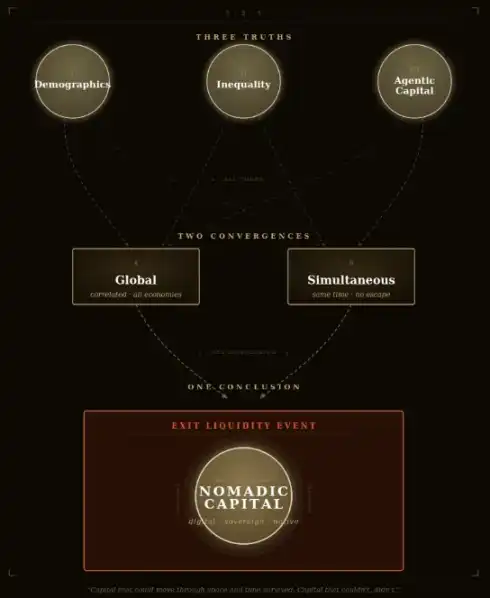
What you truly need to hold is Nomadic Capital. Capital that can migrate freely across intergenerational demographics, political borders, and AI-native ecosystems; that can bypass the "Strait of Hormuz" of money. In the 21st century, to be nomadic is to be digital. The specific investment vehicle is personal, and Radical Investment Theory provides a feasible framework: a 60% allocation to compliant assets and 40% to anti-fragile assets. But if you rigorously and prudently follow the three conditions above — hold what the young will ultimately need, hold what governments will struggle to reach, hold what is practically transactable in an autonomous economic system — the outcome is no longer a prediction, but an inevitability. Uncertainty crystallizes into certainty.
After all, there is only one disruptive asset in history that, from the very beginning of its code, simultaneously satisfied these three conditions. For those with high agency, this step is simple enough.
The rest is merely a matter of timing.