Author: Azuma, Odaily Planet Daily
Original Title: Solana's Two Lending Giants Clash, Foundation Steps In to Mediate
This past weekend, the two leading lending protocols on Solana, Jupiter Lend and Kamino, got into a public spat.
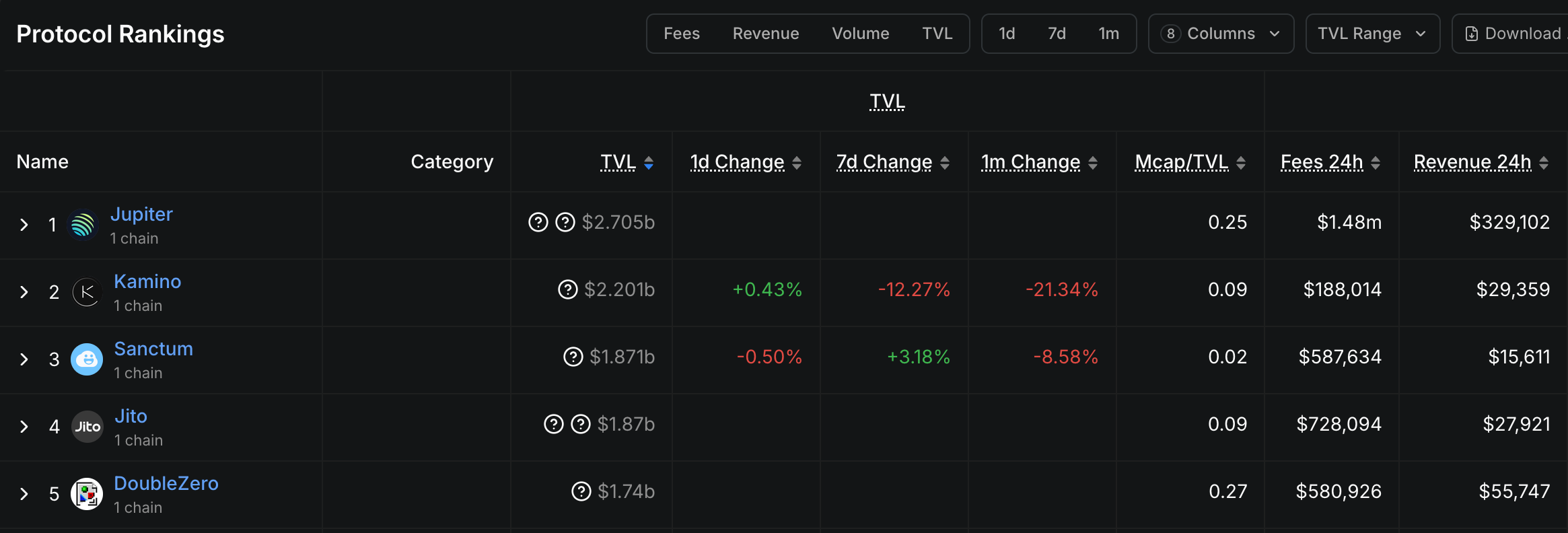
Odaily Note: Defillama data shows that Jupiter and Kamino are currently the two protocols with the highest TVL in the Solana ecosystem.
The Cause: A Quietly Deleted Tweet from Jupiter
The incident can be traced back to August of this year. During the pre-launch promotion of its lending product, Jupiter Lend, Jupiter's official account repeatedly emphasized the "risk isolation" feature of the product (the related posts have been deleted), meaning there would be no cross-contamination of risks between different lending pools.

However, the final design of Jupiter Lend did not align with the market's common understanding of a risk isolation model. In the general market perception, a DeFi lending pool that can be called risk-isolated is one that, through its design mechanism, separates the risks of different assets or markets from each other, preventing a single asset default or a market crash from affecting the entire protocol. The main characteristics of this structure include:
-
Pool Isolation: Different asset types (such as stablecoins, volatile assets, NFT collateral, etc.) are allocated to independent lending pools, each with its own liquidity, debt, and risk parameters.
-
Collateral Isolation: Users can only use assets within the same pool as collateral to borrow other assets, cutting off cross-pool risk transmission.
In fact, Jupiter Lend's design supports rehypothecation (reusing deposited collateral elsewhere within the protocol) to improve capital efficiency, meaning the collateral deposited into the vaults is not completely isolated from each other. Jupiter co-founder Samyak Jain's interpretation was that Jupiter Lend's lending pools are isolated "in a sense" because each pool has its own configuration, caps, liquidation thresholds, liquidation penalties, etc., and the rehypothecation mechanism is merely to better optimize capital utilization efficiency.
Although Jupiter's product documentation for Jupiter Lend provides more detailed explanations than the promotional content, objectively speaking, the "risk isolation" mentioned in its early promotions did have a certain deviation from the market's common understanding and was potentially misleading.
The Battle Erupts: Kamino Launches an Attack
On December 6th, Kamino co-founder Marius Ciubotariu seized this opportunity to publicly criticize Jupiter Lend and disabled Kamino's migration tool to Jupiter Lend.
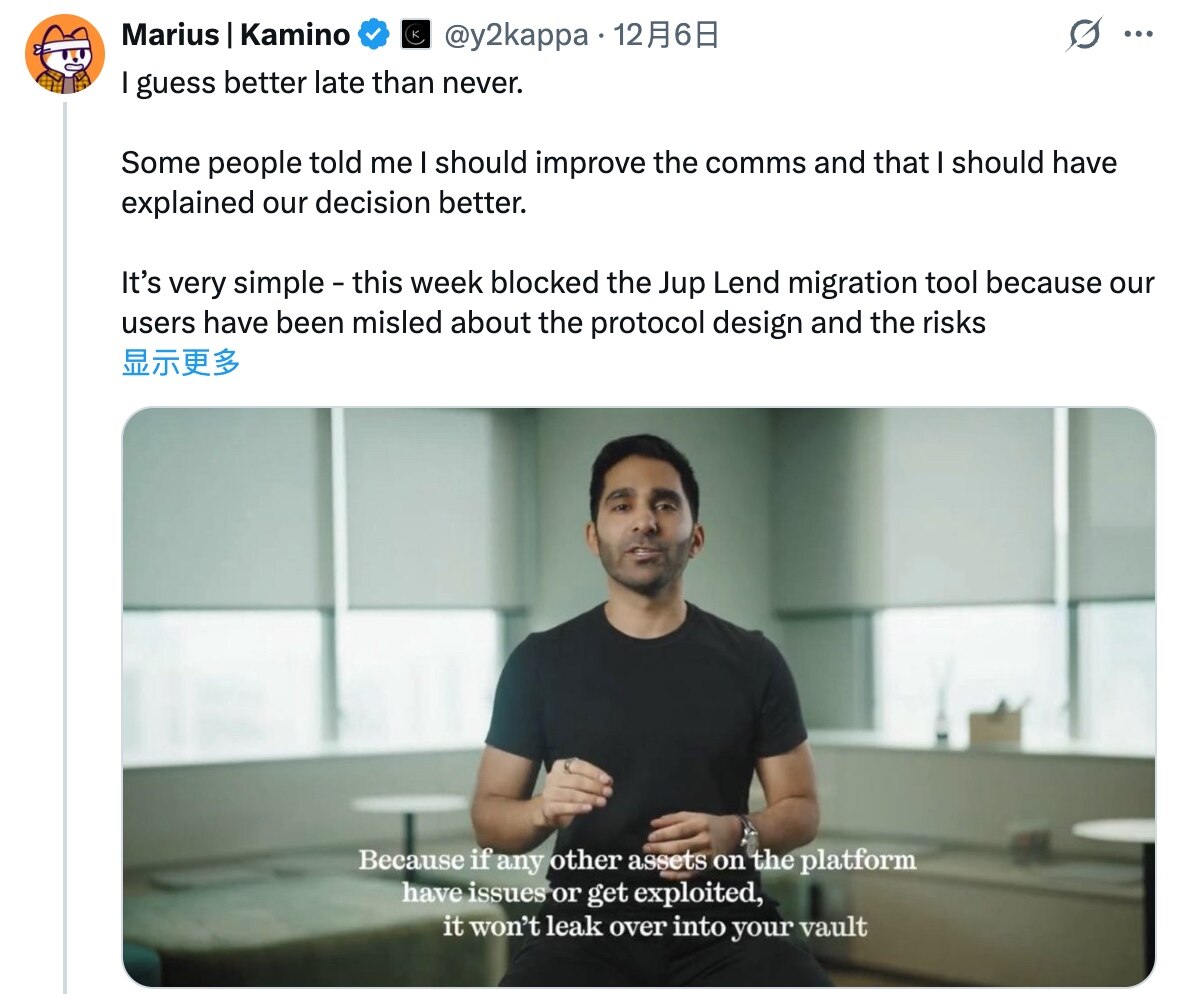
Marius stated: "Jupiter Lend repeatedly claims there is no cross-contamination between assets, which is complete nonsense. In reality, in Jupiter Lend, if you deposit SOL and borrow USDC, your SOL will be lent to other users engaging in recursive farming using JupSOL, INF... you bear all the risk of these recursive farms blowing up or assets collapsing. There is no isolation here, there is full cross-contamination, contrary to what was advertised and what people were told... In both TradFi and DeFi, information about whether collateral is rehypothecated, whether there is contagion risk, etc., is material information that must be clearly disclosed, and no one should be making fuzzy explanations about it."
After Kamino's offensive, discussions surrounding Jupiter Lend's product design quickly ignited the community. Some agreed that Jupiter was涉嫌 (suspected of) false advertising – for example, Penis Ventures CEO 8bitpenis.sol angrily accused Jupiter of blatantly lying from the start and deceiving users; others believed that Jupiter Lend's design model balanced safety and efficiency, and that Kamino's attack was merely for market competition with impure motives – for example, overseas KOL letsgetonchain stated: "Jupiter Lend's design achieves the capital efficiency of a pooled model while incorporating some of the risk management capabilities of modular lending protocols... Kamino can't stop people from migrating to better tech."
Under pressure, the Jupiter team quietly deleted the early posts, but this triggered even larger-scale FUD. Later, Jupiter's Chief Operating Officer Kash Dhanda also came forward to admit that the team's previous social media claims about Jupiter Lend having "zero contagion risk" were inaccurate and apologized, stating they should have issued a correction statement simultaneously with deleting the posts.
Core Contradiction: The Definition of "Risk Isolation"
Summarizing the current opposing attitudes within the community, the fundamental divergence seems to lie in the different definitions different groups have for the term "risk isolation."
From the perspective of Jupiter and its supporters, "risk isolation" is not a completely static concept; there can be some design space within it. Jupiter Lend, while not the commonly understood risk isolation model, is also not a completely open pooled model. Although it shares a common liquidity layer that allows rehypothecation, each lending pool can be configured with independent asset limits, liquidation thresholds, and liquidation penalties.
From the perspective of Kamino and its supporters, any allowance of rehypothecation is a complete negation of "risk isolation," and as a project, one should not use vague disclosures and false advertising to deceive users.
Upper Echelon Sentiment: Some Fuel the Fire, Some Mediate
Aside from the dispute between the two parties and the community, another noteworthy point in this turmoil is the attitude of various upper echelons within the Solana ecosystem.
First is the venture capital fund Multicoin, which holds significant sway within the Solana ecosystem (perhaps the most, arguably). As an investor in Kamino, Multicoin partner Tushar Jain directly questioned Jupiter, stating they were "either incompetent or malicious, and neither is excusable" – objectively speaking, his remarks significantly intensified the controversy.
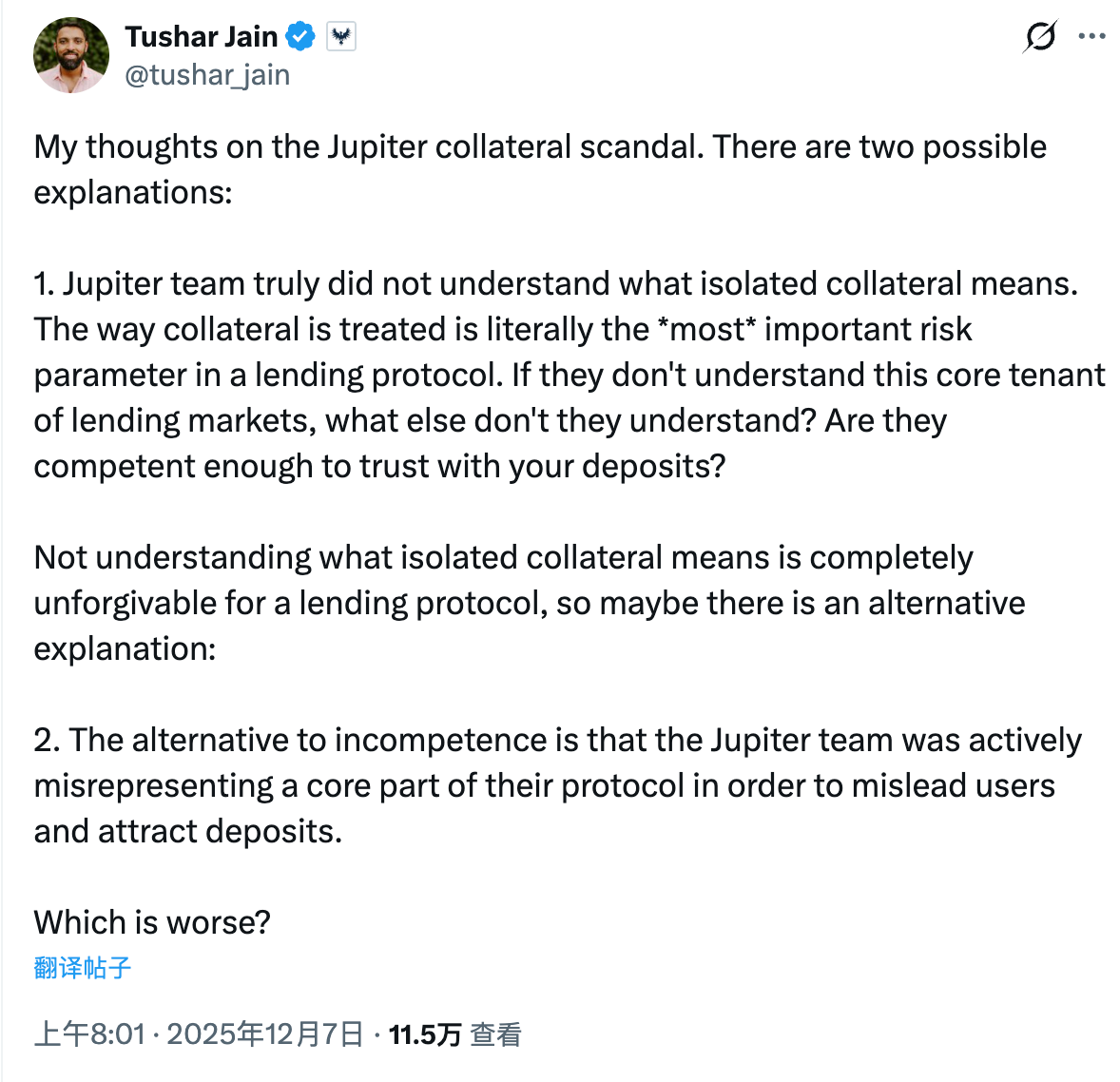
Tushar stated: "There are two possible explanations for the controversy around Jupiter Lend. One is that the Jupiter team genuinely does not understand what isolated collateral means. Collateral treatment is the most important risk parameter in a lending protocol. If they don't understand this core principle of lending markets, what else have they not figured out? Is their expertise sufficient to make people feel comfortable depositing funds? For a lending protocol, not understanding the meaning of isolated collateral is completely inexcusable. The other possibility is that the Jupiter team is not incompetent but is actively misrepresenting the core parts of its protocol to mislead users and attract deposits."
Clearly, Tushar's motivation was very clear: to seize this opportunity to help Kamino打击 (strike) its competitor.
Another important upper echelon voice came from the Solana Foundation. As the parent ecosystem, Solana obviously does not want to see its two leading contenders become overly antagonistic, leading to overall ecosystem infighting.

Yesterday afternoon, Solana Foundation President Lily Liu posted on X to address both projects and mediate, saying: "Love you both. Overall, our lending market size is currently around $5 billion, while the Ethereum ecosystem is about 10 times larger. As for the traditional finance collateral market, that's countless times larger than this number. We can choose to attack each other, but we can also choose to set our sights further—first work together to capture share from the entire crypto market, and then jointly advance into the vast world of traditional finance. Simply put — stop arguing, or Ethereum will benefit!
The Underlying Logic: The Battle for Solana's Lending Supremacy
Looking at the data development of Jupiter Lend and Kamino and the market environment, this controversy, while sudden, seems like an inevitable collision that was only a matter of time.
On one hand, Kamino (red in the chart below) long held the top spot as Solana's lending leader, but Jupiter Lend (blue in the chart below) has captured a significant market share since its launch, becoming the only entity currently capable of challenging the former within the Solana ecosystem.
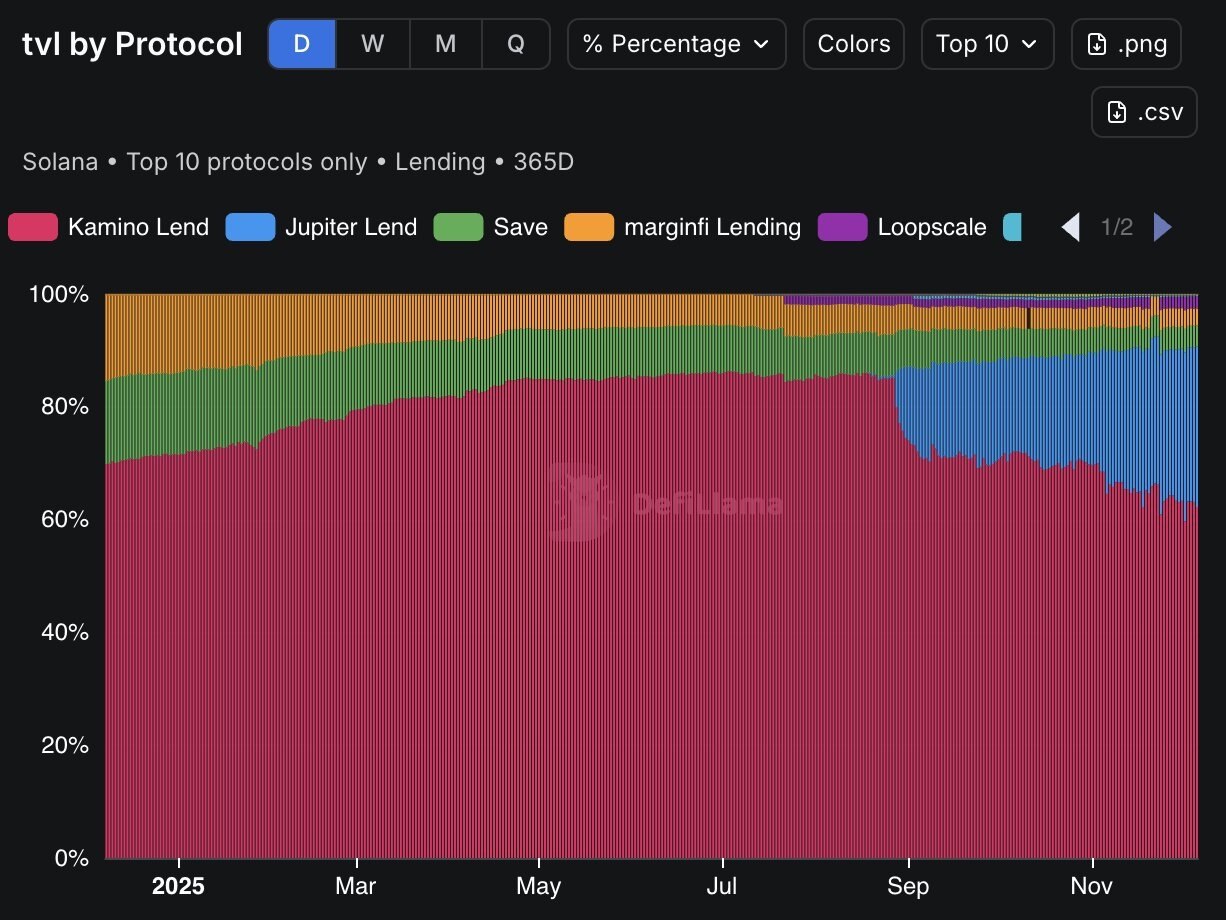
On the other hand, since the major bloodbath on October 11th, market liquidity has tightened significantly, and the overall TVL of the Solana ecosystem has continued to decline; coupled with multiple project failures leading to extreme sensitivity around "security" in the DeFi market.
When the market was better and incremental funds were abundant, Jupiter Lend and Kamino were relatively harmonious, as there was profit to be made, and it seemed like it would only increase... But when the market turned into a存量博弈 (stock game), the competitive relationship between the two became more tense, and security issues happened to be the most effective point of attack at the moment – even though Jupiter Lend has not had any security incidents historically, mere design suspicions were enough to trigger user alertness.
Perhaps from Kamino's perspective, now is the perfect opportunity to severely damage its opponent.
Twitter:https://twitter.com/BitpushNewsCN
BitPush TG Discussion Group:https://t.me/BitPushCommunity
BitPush TG Subscription: https://t.me/bitpush