Tether-backed Stable protocol has launched its USDT-powered blockchain, StableChain, alongside a new governance foundation and a native token.
According to the protocol, the new layer-1 network is designed for stablecoin transactions and relies on Tether’s (USDT) for gas fees payments, removing the need for volatile assets to process payments.
Alongside the mainnet debut, Stable introduced the Stable Foundation and the STABLE governance token on Monday, separating network security from payment flows settled in USDT.
The rollout follows a pre-deposit campaign that drew more than $2 billion from over 24,000 wallets. It also comes on the heels of a $28 million seed round backed by crypto exchange Bitfinex, Hack VC and other investors, including Tether CEO Paolo Ardoino, who is also listed as an adviser to the project.
The launch expands the stablecoin infrastructure footprint of Bitfinex and Tether, which share the iFinex parent company, and extends USDT’s utility as a core element of the network’s design.
Brian Mehler, CEO of Stable, told Cointelegraph that the company has “maintained frequent contact with governing bodies overseeing the implementation of stablecoin and payments guardrails worldwide.”
Related: Circle and Bybit deepen USDC partnership as stablecoin nears $80B
Stablecoins’ role in digital payments continues to expand
The rise of stablecoins — digital tokens designed to maintain a steady value, often pegged to the US dollar — has pushed banks, payment companies and remittance providers such as Western Union to explore new strategies.
However, most stablecoins still run on blockchains that were not built for fast, low-cost payments. For example, Ethereum, home of the majority of the stablecoin supply, can take around three minutes to finalize transactions.
These constraints have helped drive interest in blockchains engineered specifically for stablecoin settlement.
In February, stablecoin startup Plasma raised $24 million to build a new blockchain for USDT in a funding round led by Framework Ventures and backed by Bitfinex, Peter Thiel and Tether CEO Paolo Ardoino. Plasma’s mainnet beta went live on Sept. 25, launching alongside its native XPL token
In August, Circle announced plans to launch Arc, an EVM-compatible layer-1 blockchain designed for enterprise-grade stablecoin payments, FX and capital markets, later this year.
The following month, payment giant Stripe disclosed plans to launch a new layer-1 network called Tempo, after CEO Patrick Collison said that existing blockchains are “not optimized” to handle the growing stablecoin and crypto activity moving through Stripe’s platform.
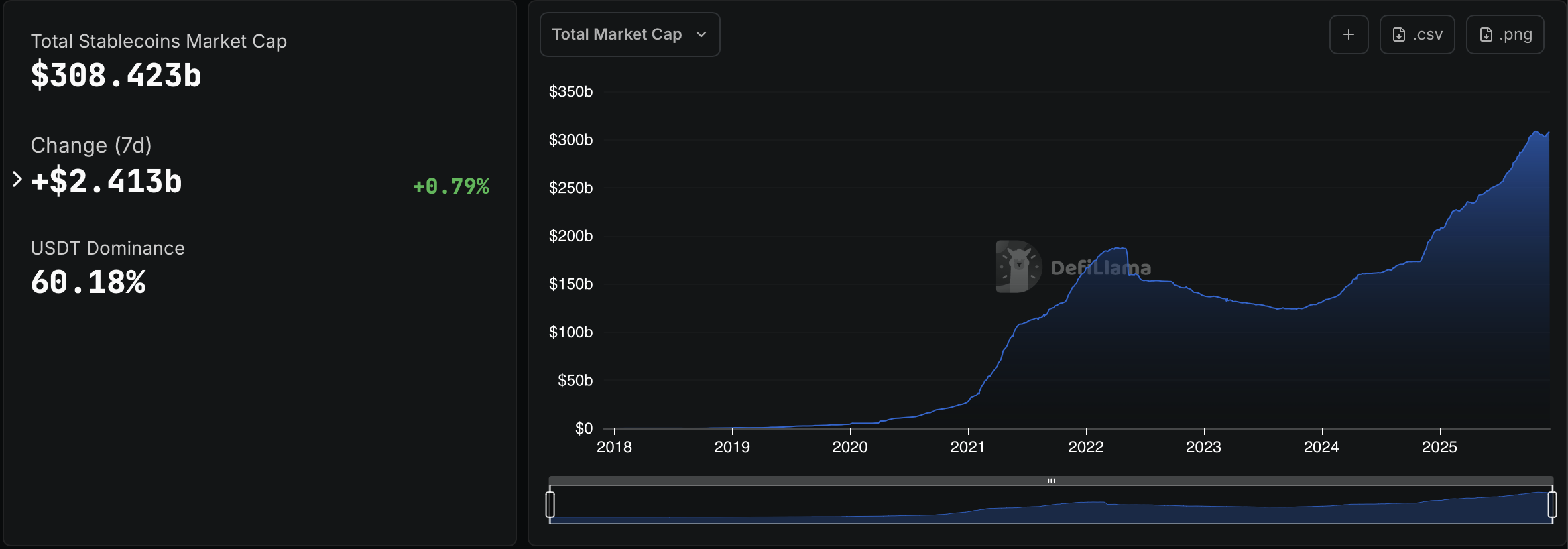
According to DefiLlama data, the stablecoin market capitalization has grown to about $308.45 billion from $198.76 billion a year ago, a roughly 55% increase over the period.
Magazine: 6 reasons Jack Dorsey is definitely Satoshi... and 5 reasons he’s not